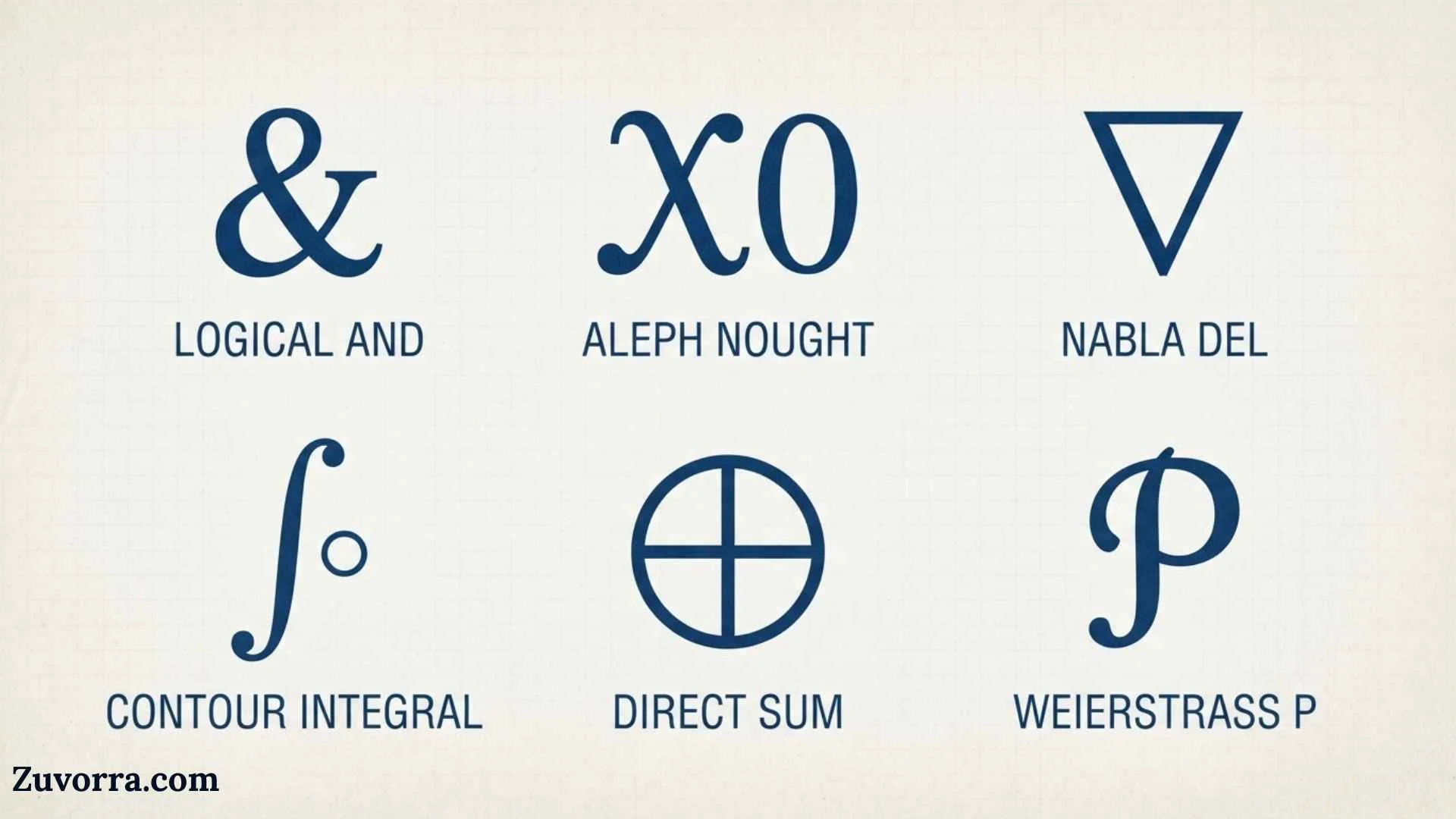
Weird math symbols are unfamiliar marks used to express mathematical ideas, relationships, operations, and logical statements in a compact form. Symbols such as ∀, ∃, ∈, ∅, ∑, ∂, ∇, and ≈ may look mysterious, but each acts like a precise instruction or shorthand sentence.
You may encounter these symbols in algebra textbooks, calculus formulas, statistics, computer science, physics, engineering, logic, or academic papers. Learning how to read them makes advanced-looking equations far less intimidating. This guide explains the most common unusual symbols, how they developed, and how their meanings change with context.
Quick Meaning
Weird math symbols are specialized notation marks that represent operations, sets, quantities, relationships, logic, or mathematical structures. They are not decorative signs. Each symbol communicates a specific instruction, such as “belongs to,” “approximately equals,” “there exists,” “take the sum,” or “find the rate of change.”
Weird Math Symbols Overview Table
| Symbol | Name | Primary Meaning | Main Field | Simple Example | Unicode |
| ∀ | For all | Applies to every member | Logic | ∀x, x + 0 = x | U+2200 |
| ∃ | There exists | At least one value exists | Logic | ∃x such that x² = 4 | U+2203 |
| ∈ | Element of | Belongs to a set | Set theory | 3 ∈ {1, 2, 3} | U+2208 |
| ∉ | Not an element of | Does not belong to a set | Set theory | 5 ∉ {1, 2, 3} | U+2209 |
| ∅ | Empty set | A set with no members | Set theory | A = ∅ | U+2205 |
| ⊂ | Subset of | Every member is inside another set | Set theory | {1, 2} ⊂ {1, 2, 3} | U+2282 |
| ∪ | Union | Combines members of sets | Set theory | A ∪ B | U+222A |
| ∩ | Intersection | Shared members of sets | Set theory | A ∩ B | U+2229 |
| ∑ | Summation | Add a sequence of values | Algebra, statistics | ∑x | U+2211 |
| ∏ | Product | Multiply a sequence of values | Algebra | ∏x | U+220F |
| ∞ | Infinity | No finite limit or bound | Calculus, geometry | x → ∞ | U+221E |
| √ | Square root | A value that squares to a number | Arithmetic | √25 = 5 | U+221A |
| ∂ | Partial derivative | Change in one variable | Calculus | ∂f/∂x | U+2202 |
| ∇ | Nabla or del | Vector differential operator | Calculus, physics | ∇f | U+2207 |
| ≈ | Approximately equal | Nearly, but not exactly, equal | General mathematics | π ≈ 3.14 | U+2248 |
| ≡ | Identical or equivalent | Equality under a stated system | Algebra, number theory | 7 ≡ 1 mod 3 | U+2261 |
| ≠ | Not equal | Values are different | General mathematics | 4 ≠ 7 | U+2260 |
| ∝ | Proportional to | Changes at a constant ratio | Science, algebra | y ∝ x | U+221D |
| ⊥ | Perpendicular | Forms a right angle | Geometry | AB ⊥ CD | U+22A5 |
| ∥ | Parallel | Lines remain equally spaced | Geometry | AB ∥ CD | U+2225 |
Unicode officially encodes many of these characters in its Mathematical Operators block so they can be stored, displayed, copied, and exchanged consistently across digital systems.
What Do Weird Math Symbols Mean?
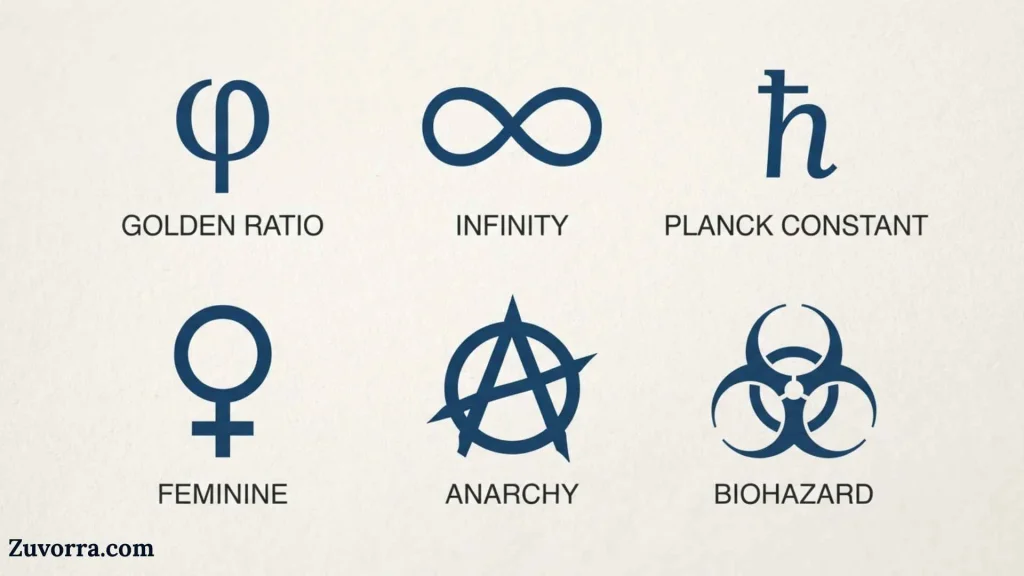
Weird-looking mathematical symbols form a visual language. They replace longer verbal statements with short, exact marks.
For example:
- x ∈ A means “x is an element of set A.”
- a ≠ b means “a is not equal to b.”
- y ∝ x means “y is proportional to x.”
- ∃x means “there exists at least one x.”
- ∑x means “add the listed values of x.”
A symbol does not always have one universal meaning. Its interpretation depends on the branch of mathematics, the surrounding expression, and definitions given by the author.
The vertical bar |, for instance, may mean:
- “Such that” in set-builder notation
- Absolute value when paired as |x|
- Divisibility in number theory
- Conditional probability in P(A | B)
- A determinant when placed around a matrix
This context-dependent behavior resembles ordinary language. The word “root” can describe part of a plant, the origin of a problem, or a solution to an equation. Mathematical notation works in a similar way, but its meaning is usually controlled more strictly.
History and Origin of Mathematical Symbols
Mathematical notation developed gradually because people needed faster and clearer ways to record calculations.
Early Number Marks
Ancient communities used tally marks, tokens, carved lines, and written numerals to represent quantities. A number is an abstract concept, while a numeral is the written symbol used to represent that concept. Modern positional notation later allowed a digit’s location to determine its value, making calculation far more efficient.
Egyptian, Babylonian, Roman, Indian, Chinese, and Greek mathematical traditions all developed systems for recording numbers and operations. These systems did not use one shared symbolic language.
Greek Letters in Mathematics
Greek letters became especially influential because Greek mathematicians wrote major works on geometry, astronomy, and number theory. Modern mathematics still uses Greek letters for quantities and concepts, including:
- π for the circle constant
- θ for an angle
- Σ for summation
- μ for a population mean
- σ for standard deviation
- Δ for change
- λ for wavelength or an eigenvalue
The ancient Greek numeral system also used alphabetic characters as number signs.
Growth of Modern Notation
Many symbols familiar today appeared between the Renaissance and the modern period. Printing, international scholarship, and the growth of algebra encouraged mathematicians to standardize concise marks.
The plus and minus signs became widely used in Europe during the early modern era. The equality sign was introduced in the 16th century. Later mathematicians such as René Descartes, Gottfried Wilhelm Leibniz, Leonhard Euler, and Giuseppe Peano helped establish notation for algebra, calculus, functions, logic, and sets.
Much of the notation now used in mathematics developed within roughly the last several centuries, although its conceptual roots reach much further back.
Digital Standardization
Computers created a new problem: the same symbol needed a consistent digital identity across devices, fonts, operating systems, and languages. Unicode addressed this by assigning code points to mathematical operators, arrows, geometric signs, letterlike symbols, and technical marks.
Unicode does not determine every mathematical meaning. It standardizes characters so people and software can represent them reliably.
Symbolism and Interpretation
Mathematical symbols primarily communicate technical meaning, but they also carry broader symbolic associations.
Precision and Order
A mathematical mark suggests that a statement follows a defined system. Symbols reduce ambiguity by showing exactly how quantities or ideas relate.
For example:
- = asserts equality.
- < establishes order.
- ∴ introduces a conclusion.
- ⇒ indicates implication.
- ∵ introduces a reason.
These marks represent a style of reasoning built on definitions, evidence, and logical relationships.
Infinity and the Unknown
The infinity sign ∞ has moved beyond mathematics into philosophy, art, jewelry, and popular culture. In mathematics, infinity does not usually behave like an ordinary number. It expresses unbounded growth, endless continuation, or the absence of a finite limit.
Outside mathematics, people may use it to symbolize eternity, limitless love, continuity, or spiritual permanence. Those emotional meanings are cultural interpretations rather than formal mathematical definitions.
Balance and Equality
The equals sign = technically states that two expressions have the same value. In public life, it has also become a symbol of fairness, equal treatment, and social equality.
The connection is understandable, but mathematical equality and social equality are different concepts. One compares formal quantities or expressions; the other concerns rights, opportunities, treatment, or status.
Positive and Negative Associations
A symbol’s shape does not make it inherently positive or negative. Meaning comes from use.
- + may suggest addition, benefit, or positivity.
- − may suggest subtraction, loss, or negativity.
- ∞ may suggest possibility or an overwhelming lack of limits.
- ∅ may suggest emptiness, but in set theory it simply identifies a set containing no elements.
Psychological reactions often come from cultural habits rather than mathematics itself.
Cultural Significance of Mathematical Notation
Mathematics is practiced worldwide, but its notation is not completely culture-free.
A Shared International Language
Many symbols now function across linguistic boundaries. A student in Brazil, Japan, Pakistan, France, or the United States may recognize symbols such as +, −, =, π, and √ even when spoken explanations differ.
This makes notation one of the closest things to an international written language. However, pronunciation, teaching methods, decimal separators, and local conventions may vary.
Regional Differences
Not every country formats mathematics in the same way.
Common differences include:
- A comma or period as the decimal separator
- A comma, space, or period as the thousands separator
- Different symbols for multiplication
- Different forms of the division sign
- Alternate meanings for interval notation
- Different conventions for natural numbers
For example, multiplication may appear as ×, ·, or simple adjacency, as in 3x. Division may appear as ÷, a fraction bar, a slash, or a colon in some educational traditions.
Letters from Different Writing Systems
Modern mathematics uses symbols borrowed from several scripts, especially Greek and Latin. Hebrew letters such as ℵ also appear in set theory, where aleph numbers describe sizes of infinite sets.
The symbols may come from particular languages, but their mathematical meanings are defined by disciplinary convention rather than everyday linguistic meaning.
Religious or Spiritual Meaning
Most weird math symbols are not religious signs. Their formal meanings come from mathematics, logic, science, or technology.
However, some shapes have gained spiritual interpretations outside the classroom.
The Infinity Symbol
The infinity sign frequently appears in jewelry, tattoos, meditation art, and spiritual imagery. It may represent eternity, rebirth, endless connection, or the continuity of existence.
These meanings should not be confused with its mathematical role. In calculus, ∞ may indicate unbounded behavior or a limiting direction, not a supernatural force.
Geometric Forms
Circles, triangles, spirals, and symmetrical patterns appear in both mathematics and sacred art. Their religious meanings depend on a tradition’s teachings, not on geometry alone.
A triangle can represent a three-sided polygon in mathematics while also carrying theological or ceremonial meaning in a specific cultural setting. Shared shape does not prove shared origin.
A Useful Interpretation Rule
When deciding whether a symbol is mathematical or spiritual, examine the context:
Is it inside an equation?
It probably has a technical meaning.
Is it used in jewelry, ritual art, or devotional imagery?
It may carry symbolic or spiritual meaning.
Does the source define it?
Use the source’s definition rather than assuming a universal interpretation.
Scientific and Technical Meanings
Many strange math symbols become essential in calculus, physics, statistics, engineering, and computing.
Logic Symbols
∀: For All
The universal quantifier ∀ means that a statement applies to every allowed value.
Example:
∀x ∈ ℝ, x² ≥ 0
Read it as: “For every real number x, x squared is greater than or equal to zero.”
∃: There Exists
The existential quantifier ∃ states that at least one value satisfies a condition.
Example:
∃x ∈ ℤ such that x² = 9
This means at least one integer has a square equal to 9.
Unicode identifies ∀ as the universal quantifier and ∃ as the existential quantifier.
⇒ and ⇔
- P ⇒ Q means P implies Q.
- P ⇔ Q means P and Q are logically equivalent.
The second symbol is often read as “if and only if.”
Set Theory Symbols
∈ and ∉
The symbol ∈ means “is an element of.”
4 ∈ {2, 4, 6}
The symbol ∉ means “is not an element of.”
5 ∉ {2, 4, 6}
∅
The empty-set symbol represents a set with no members.
It is not the number zero. Zero is a number and may itself be an element of a set:
- ∅ has no elements.
- {0} has one element: zero.
Unicode also notes that ∅ may be called the null set, while related fields such as linguistics can use the same shape differently.
∪ and ∩
The union A ∪ B includes elements in A, B, or both.
The intersection A ∩ B includes only elements shared by both sets.
Example:
A = {1, 2, 3}
B = {3, 4, 5}
Therefore:
- A ∪ B = {1, 2, 3, 4, 5}
- A ∩ B = {3}
Calculus Symbols
∂: Partial Derivative
The curly symbol ∂ is used when a function depends on several variables and you differentiate with respect to one of them.
For a function f(x, y):
∂f/∂x
means “the partial derivative of f with respect to x.”
∇: Nabla or Del
The inverted triangle ∇ is called nabla or del. It acts as a vector differential operator.
Depending on how it is used, it can create:
- A gradient: ∇f
- A divergence: ∇ · F
- A curl: ∇ × F
These operations appear in electromagnetism, fluid dynamics, heat transfer, and engineering.
∫: Integral
The elongated S symbol ∫ represents integration. Historically, its shape reflects the idea of a sum.
Example:
∫₀¹ x dx
This asks for the accumulated value represented by x over the interval from 0 to 1.
Summation and Product Symbols
∑: Summation
The capital Greek sigma ∑ tells the reader to add a sequence of terms.
Example:
∑ᵢ₌₁⁴ i = 1 + 2 + 3 + 4 = 10
OpenStax explains sigma notation as an instruction to add specified values, much as a plus sign gives an operation to perform.
∏: Product
The capital Greek pi ∏ tells the reader to multiply a sequence.
Example:
∏ᵢ₌₁⁴ i = 1 × 2 × 3 × 4 = 24
Do not confuse ∏ with the lowercase π used for the circle constant.
Comparison and Approximation Symbols
≈: Approximately Equal
Use ≈ when two values are close but not exactly equal.
π ≈ 3.14159
≡: Equivalent or Identical
The triple-bar symbol has several technical uses:
- Identity: true for every permitted value
- Congruence in modular arithmetic
- Logical equivalence
- A definition, under some conventions
Example:
15 ≡ 3 mod 6
Both numbers leave the same remainder when divided by 6.
∝: Proportional To
The symbol ∝ means two quantities vary proportionally.
C ∝ r
This does not automatically reveal the constant of proportionality. A full equation might be:
C = 2πr
Geometry Symbols
- ⊥ means perpendicular.
- ∥ means parallel.
- ∠ means angle.
- △ may identify a triangle.
- ≅ often means congruent.
- ∼ may mean similar in geometry.
The double vertical-bar form is also used for norms in higher mathematics, which shows why context matters.
Statistics and Probability Symbols
- μ commonly represents a population mean.
- σ commonly represents population standard deviation.
- x̄ commonly represents a sample mean.
- P(A) means the probability of event A.
- P(A | B) means the probability of A given B.
- E(X) represents expected value.
- Σ directs the reader to sum terms.
OpenStax distinguishes μ as a population mean and x̄ as a sample mean in statistical notation.
Where Weird Math Symbols Are Used
Textbooks and Classrooms
Students first meet unusual notation in algebra, geometry, statistics, precalculus, and calculus. Symbols save space, but instructors should define them before relying on them.
Scientific Research
Researchers use notation to state formulas, models, assumptions, proofs, and measurements. Physics papers may combine Greek letters, integrals, derivatives, vectors, and operators in a single expression.
Computer Science
Logic and set notation appear in algorithms, databases, programming-language theory, cybersecurity, and artificial intelligence research.
Examples include:
- Boolean logic
- Function mappings
- Set membership
- Complexity notation
- Probability models
- Formal proofs
Engineering
Electrical, mechanical, civil, and chemical engineers use symbols for vectors, rates of change, tolerances, angles, resistance, frequency, stress, and system behavior.
Digital Communication
Unicode allows mathematical symbols to appear in websites, documents, messaging apps, source code comments, and digital textbooks. Poor font support can still cause a symbol to display as an empty square or replacement character.
Art, Logos, Jewelry, and Tattoos
The most common mathematical signs used decoratively include:
- Infinity
- Pi
- Delta
- Sigma
- Plus and minus
- Geometric figures
- Coordinate diagrams
In decorative use, meanings may become personal rather than mathematical.
Common Variations and Similar Symbols
Several symbols look alike but should not be treated as interchangeable.
| Symbols | Difference | ||
| ∅ and Ø | ∅ is the empty set; Ø is a letter used in some languages | ||
| ∈ and ε | ∈ means “element of”; ε is the Greek letter epsilon | ||
| ∑ and E | ∑ is capital sigma; E is a Latin letter | ||
| ∏ and π | ∏ indicates a product; π commonly represents the circle constant | ||
| ≈ and = | ≈ means close in value; = means exactly equal | ||
| ⊂ and ⊆ | ⊂ may indicate a proper subset; ⊆ allows equality | ||
| x | and ‖x‖ | Single bars often mean absolute value; double bars often mean a norm | |
| ∆ and Δ | They may look similar, but fonts and mathematical conventions can affect usage | ||
| − and – | The mathematical minus sign differs typographically from a keyboard hyphen |
A Quick Decision Guide
Does the symbol compare two values?
Look for =, ≠, <, >, ≤, ≥, ≈, or ≡.
Does it describe set membership?
Look for ∈, ∉, ⊂, ⊆, ∪, or ∩.
Does it command a calculation?
Look for ∑, ∏, √, ∫, ∂, or ∇.
Does it express logic?
Look for ∀, ∃, ⇒, ⇔, ∧, ∨, or ¬.
Is its meaning still unclear?
Check the author’s definitions and the surrounding subject.
Common Misconceptions
“Every symbol has one fixed meaning.”
Many symbols have several meanings. The tilde ∼, for example, may express similarity, asymptotic behavior, equivalence relations, or probability distributions. Even major mathematical references must specify which meaning is intended.
“Infinity is the biggest number.”
Infinity is not normally treated as the largest ordinary number. In many contexts, it describes unboundedness rather than a final counting value.
“∅ and zero are the same.”
The empty set contains nothing. Zero is a number. The set {0} is not empty because it contains one element.
“≈ and = can be used interchangeably.”
They cannot. Writing π = 3.14 is technically false because 3.14 is only an approximation of π. The accurate statement is π ≈ 3.14.
“All mathematicians use exactly the same notation.”
Most common notation is widely shared, but conventions can differ between fields, countries, authors, and textbooks. A responsible writer defines any symbol that could be ambiguous.
“A strange symbol must represent something advanced.”
Some unfamiliar marks express simple ideas. The symbol ∈ merely means “belongs to,” while ∃ means “there exists.”
Interesting Facts About Weird Math Symbols
- The word “notation” refers to an organized system of marks. Mathematical notation is not a random collection of shapes. It follows rules for representing quantities, operations, and relationships.
- The empty-set symbol is not a slashed zero. Its design resembles Ø, but Unicode treats them as different characters with different purposes.
- Sigma can be both a letter and an operator. Lowercase σ often represents standard deviation, while uppercase ∑ instructs the reader to add terms.
- The same bars can perform several jobs. Vertical bars may indicate absolute value, determinants, divisibility, conditional probability, or set conditions.
- Spacing can change interpretation. In professional typesetting, spacing helps distinguish operators, relations, punctuation, and ordinary variables.
- Some symbols function like entire phrases. The expression ∀x can replace “for every possible value of x.”
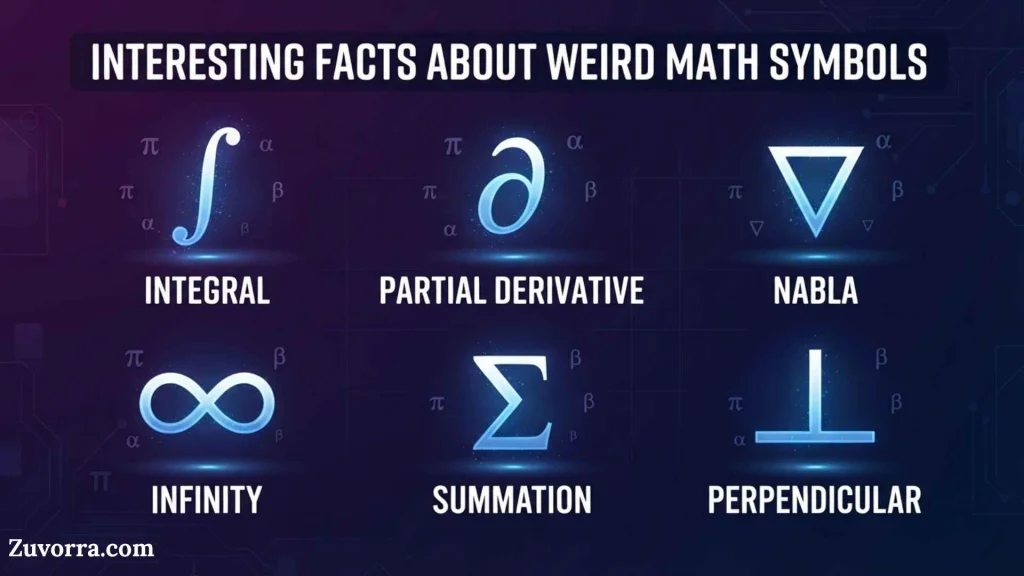
- The integral sign grew from the concept of summation. Its stretched shape reflects a historical connection with adding infinitely many small contributions.
- Greek letters are not automatically variables. Their meanings depend on convention. π may represent the circle constant in one formula and another defined quantity elsewhere.
- Mathematical notation continues to evolve. New branches of mathematics and computer science may introduce fresh symbols or reuse existing ones with precise definitions.
- Unicode encodes symbols, not complete equations. Software still needs layout systems to display fractions, superscripts, matrices, limits, and stacked operators correctly.
- A symbol’s spoken name can vary. ∇ may be called “nabla” or “del,” while ∼ may be called “tilde” or informally “twiddle.”
- Simple notation can prevent long explanations. A compact formula may preserve relationships more clearly than a paragraph, provided the reader knows the symbols.
Related Math Symbols
Therefore: ∴
The three-dot triangle means “therefore.” It introduces a conclusion based on previous statements.
Because: ∵
This reversed dot arrangement means “because.” It introduces a reason or supporting condition.
Logical AND: ∧
The symbol is true when both connected statements are true.
Logical OR: ∨
The symbol is true when at least one connected statement is true, depending on the logic system being used.
Not: ¬
The negation symbol reverses the truth value of a statement.
Maps To: ↦
This arrow shows how an input is assigned to an output.
Example:
x ↦ x²
Approaches: →
In calculus, an arrow may show that a variable approaches a value.
x → 0
In functions and logic, arrows can have other meanings.
Ceiling and Floor: ⌈x⌉ and ⌊x⌋
The ceiling rounds a value up to the nearest integer. The floor rounds it down.
The NIST Digital Library of Mathematical Functions lists ceiling, floor, set membership, universal quantification, intersection, union, and other notation in its common definitions.
Frequently Asked Questions
What are the weirdest math symbols?
Symbols often considered strange by beginners include ∀, ∃, ∈, ∅, ∂, ∇, ∑, ∏, ∫, and ≡. They appear unusual mainly because everyday arithmetic rarely uses them. Once connected to phrases such as “for all,” “belongs to,” or “take the sum,” they become much easier to read.
What does ∈ mean in math?
The symbol ∈ means “is an element of” or “belongs to.” For example, 2 ∈ {1, 2, 3} states that 2 belongs to the displayed set. The crossed version, ∉, means that an object is not a member of the stated set.
What does the backwards E symbol mean?
The backwards E symbol, ∃, means “there exists.” It states that at least one object satisfies a condition. For example, ∃x such that x + 2 = 5 means there is at least one value of x that makes the equation true.
What does the upside-down A mean?
The upside-down A, ∀, means “for all” or “for every.” It is called the universal quantifier. A statement beginning with ∀x claims that the following condition applies to every permitted value of x, not merely one example.
What does ∂ mean in calculus?
The symbol ∂ represents a partial derivative. It is used when a function depends on two or more variables and the calculation measures change with respect to one variable while treating the others as fixed for that operation.
What is the difference between ∑ and Σ?
They are visually related forms of the Greek capital letter sigma, but formatting and context matter. In a formula, ∑ usually acts as a summation operator. A plain Σ may serve as a Greek letter, a matrix name, a set, or another defined object.
Does ≡ mean the same thing as =?
Not always. The equals sign states equality. The triple bar may indicate an identity, congruence, logical equivalence, or a defined relationship. Because conventions vary, readers should check the subject and any definitions provided near the expression.
Why do mathematicians use so many Greek letters?
Greek letters expand the available symbol set and help distinguish different kinds of quantities. Historical influence also played a major role. Today, conventions associate letters such as θ with angles, μ with means, σ with standard deviations, and λ with wavelengths or eigenvalues.
How can I type unusual math symbols?
You can use a character map, equation editor, Unicode input method, LaTeX command, or copy-and-paste tool. Microsoft Word, Google Docs, and many scientific editors include symbol menus. For formal equations, LaTeX provides precise commands and professional mathematical layout.
How can I learn math symbols quickly?
Group symbols by purpose rather than memorizing a long mixed list. Learn comparison signs first, then set notation, logic, calculus, and statistics. Practice reading each expression aloud. Turning ∀ into “for every” or ∈ into “belongs to” makes notation feel like language instead of code.
Key Takeaways
- Weird math symbols are compact instructions, relationships, or logical statements.
- Their meaning depends on context, field, and author-defined conventions.
- ∀ means “for all,” while ∃ means “there exists.”
- ∈ shows membership, and ∅ represents a set with no elements.
- ∑ means summation, while ∏ means repeated multiplication.
- ∂ and ∇ are common in multivariable calculus, physics, and engineering.
- ≈ means approximately equal, not exactly equal.
- Similar-looking characters may have completely different meanings.
- Unicode gives mathematical symbols consistent digital code points.
- Reading symbols as spoken phrases is one of the fastest ways to understand them.
Conclusion
Weird math symbols become far less strange once you treat them as parts of a precise written language. A mark such as ∀ can replace “for every,” ∈ can replace “belongs to,” and ∑ can replace a long addition instruction.
The key is not to memorize every symbol at once. Identify its category, read the surrounding expression, and check how the author defines it. With practice, symbols that once looked confusing begin to reveal the structure and logic of mathematics clearly.
References
- Unicode Consortium. Mathematical Operators: Unicode Character Code Charts.
- National Institute of Standards and Technology. Digital Library of Mathematical Functions: Common Notations and Definitions.
- OpenStax. Introductory Business Statistics 2e: Sigma Notation and Mathematical Symbols.
- OpenStax. Contemporary Mathematics: Basic Set Concepts.
- OpenStax. Intermediate Algebra 2e: The Language of Algebra.
- Wolfram MathWorld. Notation, Double Bar, Tilde, Colon, and Related Mathematical References.

I’m Rupert Ashbourne, a British author interested in how symbols have shaped human communication throughout history. I examine signs, emblems, markings, and visual representations, explaining their meanings and cultural significance. My aim is to make symbolism approachable while helping readers understand how simple shapes and images can carry surprisingly powerful messages.
Books:
- The Meaning of Symbols
- A History of Signs and Emblems