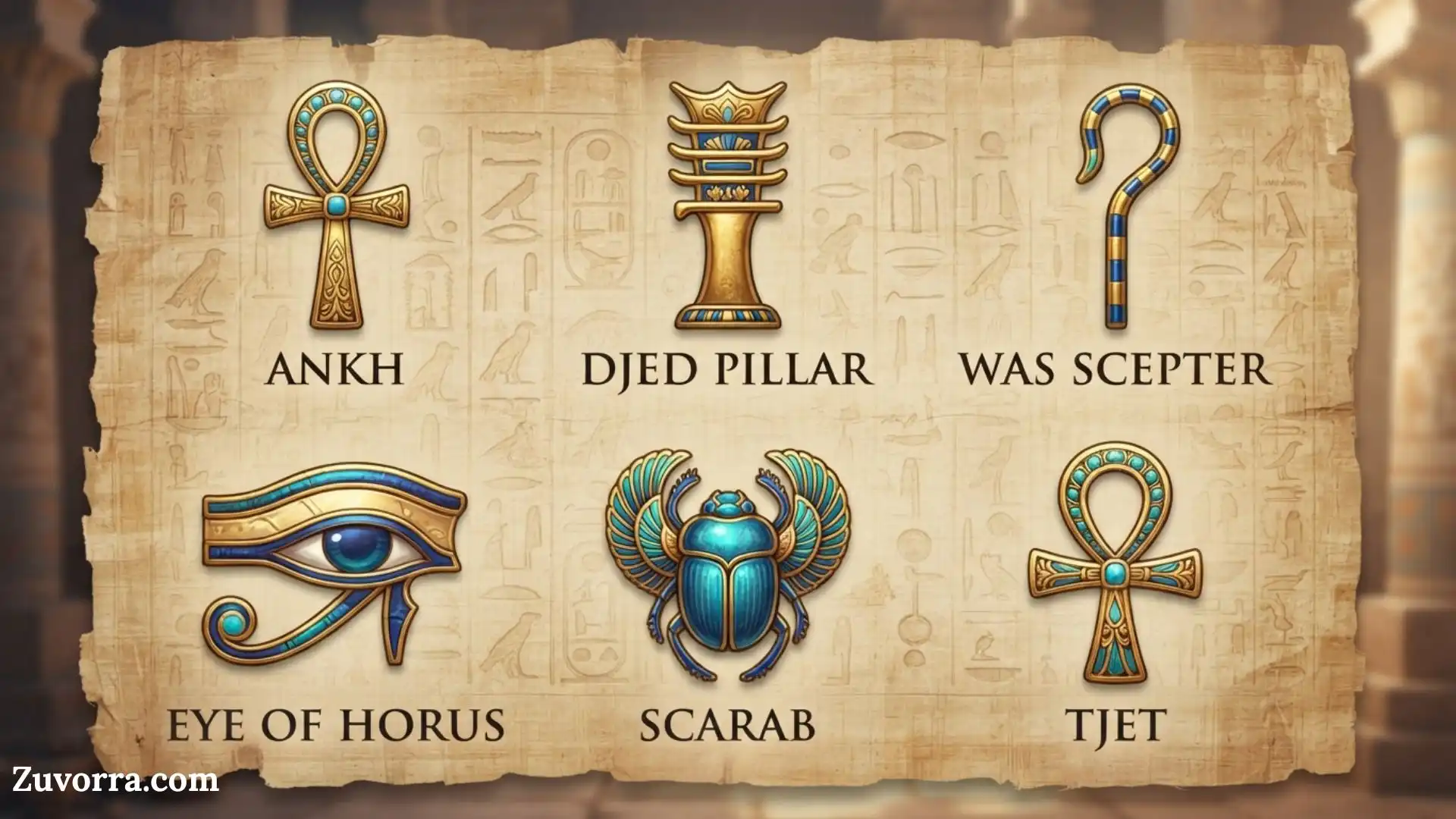
Egyptian symbols carried ideas about life, death, protection, divine power, kingship, nature, and the order of the universe. Ancient Egyptians placed these signs on temples, tombs, coffins, jewelry, statues, papyrus scrolls, and everyday objects because images were believed to communicate meaning and, in some settings, actively provide protection.
Understanding Egyptian symbols meaning requires more than matching each image with a one-word definition. A symbol could function as a written hieroglyph, a religious emblem, a royal title, an amulet, or several of these at once. Its meaning could also change according to its color, material, location, and connection to a particular deity.
Quick Meaning
Ancient Egyptian symbols represented central ideas such as life, rebirth, protection, stability, truth, royal authority, fertility, and the afterlife. Well-known examples include the ankh for life, the Eye of Horus for healing and protection, the djed pillar for stability, the scarab for renewal, and the feather of Ma’at for truth and cosmic order.
Egyptian Symbols Overview Table
| Egyptian Symbol | Primary Meaning | Associated Figure or Concept | Common Ancient Use | Modern Interpretation |
| Ankh | Life and continued existence | Gods, kings, eternal life | Temple scenes, amulets, tomb art | Life, spirituality, African heritage |
| Eye of Horus | Healing, protection, restoration | Horus | Amulets, coffins, jewelry | Protection and well-being |
| Eye of Ra | Royal and destructive power | Ra and solar goddesses | Temple art, crowns, protective imagery | Strength, vigilance, fierce protection |
| Djed pillar | Stability and endurance | Osiris | Amulets, funerary art, rituals | Strength and resilience |
| Scarab | Renewal and transformation | Khepri and the rising sun | Seals, jewelry, heart scarabs | Rebirth and personal growth |
| Was scepter | Power and dominion | Gods and rulers | Temple reliefs, divine imagery | Authority and control |
| Tyet knot | Protection and regeneration | Isis | Funerary amulets | Maternal protection |
| Shen ring | Eternity and protection | Kingship and divine guardianship | Royal art, temple decoration | Infinite protection |
| Cartouche | Royal identity and protection | Pharaohs | Inscriptions and monuments | Egyptian identity and prestige |
| Feather of Ma’at | Truth, justice, cosmic balance | Ma’at | Funerary texts and judgment scenes | Honesty and fairness |
| Lotus | Creation, rebirth, regeneration | Sun and creation myths | Art, columns, vessels, offerings | Renewal and enlightenment |
| Papyrus | Life, fertility, Lower Egypt | Nile marshes | Architecture, royal emblems | Growth and abundance |
| Uraeus cobra | Sovereignty and divine defense | Wadjet and the king | Crowns and royal headdresses | Leadership and protection |
| Crook and flail | Kingship and responsibility | Osiris and pharaohs | Royal statues and coffins | Leadership and authority |
| Ba bird | Individual personality and mobility | Human spiritual existence | Tomb paintings and funerary texts | Soul and personal identity |
What Do Egyptian Symbols Mean?
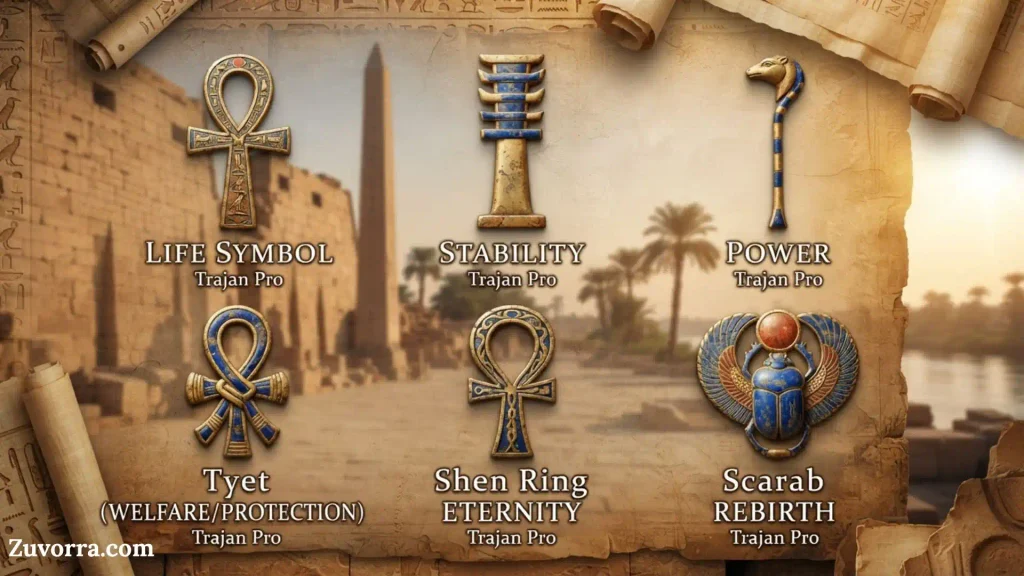
Egyptian symbols express the relationships between human beings, nature, the gods, kingship, death, and the ordered universe. They did not form one simple system in which every image always had the same meaning. Instead, their interpretation depended on context.
A lotus shown opening at sunrise could represent creation or rebirth. A lotus held near a person’s face might suggest fragrance, vitality, or rejuvenation. The same flower carved into a temple column could connect the building to the mythical landscape of creation.
Many symbols also operated on three levels:
- Written meaning: The image functioned as a hieroglyph representing a sound, word, or idea.
- Visual meaning: Its shape communicated a religious, political, or cultural concept.
- Protective meaning: When worn or placed in a tomb, it could serve as an amulet intended to produce a desired effect.
Ancient Egyptians did not always separate writing, art, and sacred symbolism as modern viewers do. A hieroglyph could be readable language, meaningful decoration, and a source of ritual power at the same time.
History and Origin of Egyptian Symbols
Egyptian symbolic traditions developed alongside the early Egyptian state and hieroglyphic writing during the late fourth millennium BCE. Some images came from the natural environment of the Nile Valley, including cattle, falcons, cobras, crocodiles, scarab beetles, lotus flowers, and papyrus plants.
Other forms grew from religious ideas and royal ceremonies. Crowns represented political territories and divine authority. Scepters signaled status. Images of gods combined human and animal features to express divine qualities rather than to suggest that Egyptians literally believed every deity had a fixed animal body.
Symbols changed across more than three thousand years of pharaonic history. The djed pillar, for example, may have begun as a stylized object or plant form, but it became closely associated with Osiris and the idea of stability. The Metropolitan Museum of Art notes that the precise original object represented by the djed remains uncertain, even though its later symbolic connection with stability is clear.
Foreign rule and cultural exchange also influenced Egyptian imagery. Nubian, Libyan, Persian, Greek, and Roman rulers adopted Egyptian symbols to present themselves as legitimate sovereigns. During the Ptolemaic and Roman periods, traditional signs continued to appear in temples while interacting with Greek and Roman religious imagery.
In modern times, Egyptian symbols entered archaeology, museum culture, architecture, jewelry, film, fashion, popular spirituality, and African diasporic identity. Modern uses may respect ancient meanings, simplify them, or assign interpretations that have little historical evidence.
Major Egyptian Symbols and Their Meanings
1. Ankh: Life and Continued Existence
The ankh is a cross-shaped sign with a loop at the top. Its basic hieroglyphic meaning is “life.” Gods are often shown holding ankhs or presenting them to kings, suggesting the divine gift and continuation of life.
In funerary contexts, the ankh could also relate to renewed existence after death. However, describing it only as “life after death” is too narrow because it represented life more generally, including vitality in the present world.
Today, the ankh appears in jewelry, tattoos, music, fashion, African-centered cultural movements, and modern spiritual practices. The Unicode character commonly used to display it is ☥, although the sign also exists within the Egyptian Hieroglyphs character set.
2. Eye of Horus: Healing and Restoration
The Eye of Horus, also called the wedjat eye, symbolizes wholeness, healing, protection, and regeneration. Its mythology is connected to the conflict between Horus and Seth, during which Horus’s eye was damaged and later restored.
Because the eye became whole again, it carried the idea that injury, disorder, or loss could be repaired. Wedjat-eye amulets were used by both the living and the dead. The Metropolitan Museum explains that the symbol embodied healing power and regeneration.
The markings around the eye combine features resembling a human eye and the facial pattern of a falcon, the bird associated with Horus.
3. Eye of Ra: Solar Power and Fierce Protection
The Eye of Ra represents the active, protective, and sometimes destructive force of the sun god Ra. It could be personified as a goddess, including Hathor, Sekhmet, Bastet, or Wadjet, depending on the myth and period.
Unlike the restorative emphasis of the Eye of Horus, the Eye of Ra frequently expresses royal power, heat, punishment, and defense against enemies. The distinction is useful but not absolute because Egyptian religious concepts often overlapped.
4. Djed Pillar: Stability and Endurance
The djed pillar means stability, endurance, and lasting order. It became especially associated with Osiris and was sometimes interpreted as his backbone.
The “raising of the djed” was an important ritual image. Raising the pillar symbolized the restoration of order, the renewed strength of Osiris, and the continuity of royal rule.
Djed amulets were placed with the dead to support regeneration and continued existence. In modern symbolism, the djed often represents inner strength, spiritual steadiness, and resilience.
5. Scarab Beetle: Rebirth and Transformation
The scarab symbol developed from Egyptians’ observations of dung beetles rolling balls across the ground. This behavior was connected symbolically with the movement of the sun.
The scarab was associated with Khepri, the deity of the rising sun and daily renewal. Its name was connected with the Egyptian verb meaning “to come into being” or “to become.”
Small scarabs served as seals, jewelry, amulets, and commemorative objects. Larger heart scarabs were placed in burials and were associated with the judgment of the dead. Scarabs frequently carried protective signs rather than continuous readable sentences. A Middle Kingdom example at the Metropolitan Museum combines wedjat eyes, an ankh, a nefer sign, and a djed pillar for positive and protective meaning.
6. Was Scepter: Power and Dominion
The was scepter is a long staff with a forked base and an animal-like head. Gods commonly hold it as a sign of power, dominion, authority, and control over chaotic forces.
It appears frequently beside the ankh and djed in temple imagery. Together, these signs could communicate life, stability, and power.
The exact animal represented by the head remains debated. It should not automatically be identified as a specific modern species.
7. Tyet Knot: Protection of Isis
The tyet, sometimes called the “knot of Isis” or “girdle of Isis,” resembles an ankh with arms that curve downward. It became closely associated with Isis, protection, blood, regeneration, and funerary care.
Tyet amulets were often made from red stone, glass, or faience. The color may have strengthened associations with blood, vitality, and the protective power of Isis. The British Museum describes a red jasper tyet amulet as an object intended to grant the goddess’s protection.
8. Shen Ring: Eternity and Encircling Protection
The shen is a loop of rope with its ends tied or resting along a base. It represents encirclement, eternity, completeness, and protection.
Deities or protective birds may hold shen rings above royal names or figures. The related cartouche is an elongated enclosure around a royal name.
Modern viewers sometimes equate the shen directly with the infinity sign. Both can suggest endlessness, but their forms and historical origins are different.
9. Cartouche: Royal Identity
A cartouche is an oval enclosure with a line at one end. It surrounds certain names of Egyptian kings and queens, especially the throne name and birth name.
The shape developed from the shen ring and communicated royal identity under divine protection. The word “cartouche” is modern and French in origin. French soldiers reportedly thought the oval resembled a cartridge case.
Not every oval Egyptian design is a cartouche. A true cartouche normally encloses hieroglyphs spelling a royal name.
10. Feather of Ma’at: Truth and Cosmic Order
The feather of Ma’at represents truth, justice, balance, proper order, and ethical conduct. Ma’at was both a goddess and a fundamental principle governing society, nature, kingship, and the cosmos.
In famous judgment scenes, the deceased person’s heart is weighed against the feather of Ma’at. The image expresses moral accountability rather than a simple contest based on the heart’s physical weight.
Ma’at did not mean passive harmony alone. It required rulers, officials, priests, and ordinary people to maintain justice and oppose disorder.
11. Lotus Flower: Creation and Rebirth
The lotus, more accurately represented in much Egyptian art by blue or white water lilies, symbolizes creation, renewal, fragrance, beauty, and rebirth.
Because the flower opens in daylight and closes at night, it became connected with the sun’s daily cycle. Creation traditions sometimes describe the young solar deity emerging from a primeval flower.
Lotus imagery appeared on vessels, jewelry, furniture, paintings, offerings, and architectural columns. Today, it commonly represents spiritual awakening, although that phrase often reflects broader modern symbolism rather than a single ancient Egyptian doctrine.
12. Papyrus Plant: Fertility and Lower Egypt
Papyrus grew in the wetlands of the Nile Delta. It symbolized fertility, freshness, growth, and Lower Egypt.
Bundles of papyrus often appear in architecture and decorative art. Papyrus-shaped columns helped transform temples into symbolic landscapes connected with the marshes of creation.
The plant also supplied material for writing sheets, ropes, baskets, sandals, and other objects. However, its symbolic meaning should not be reduced to “knowledge” simply because papyrus later became strongly associated with written texts.
13. Uraeus Cobra: Royal Sovereignty
The uraeus is an upright cobra placed on a royal crown or headdress. It represents sovereignty, divine legitimacy, and aggressive protection.
The cobra was associated especially with Wadjet, the protective goddess of Lower Egypt. In royal imagery, the uraeus threatened enemies with divine fire or venom.
A king could wear more than one protective emblem, including a cobra and vulture, to represent the guardianship of Lower and Upper Egypt.
14. Crook and Flail: Kingship and Duty
The crook and flail are crossed royal emblems associated with Osiris and Egyptian rulers. The crook resembles a shepherd’s staff, while the exact origin and original function of the flail-like object remain debated.
Together, they represent royal authority, care, control, and responsibility. Modern explanations sometimes state confidently that the flail symbolized punishment or agriculture. These interpretations are possible, but scholars do not agree on one proven original meaning.
15. Ba Bird: Individual Personality
The ba is commonly shown as a bird with a human head. It represented a person’s distinctive manifestation, mobility, or individual personality.
It was not an exact equivalent of the modern English word “soul.” Egyptian ideas of personhood included several elements, such as the ka, ba, name, body, shadow, and luminous transformed spirit known as the akh.
The ba could leave the tomb and move between different realms, but it remained connected to the deceased person and required reunion with the body.
Symbolism and Interpretation
Positive Symbolism
Most widely recognized Egyptian symbols carry constructive meanings:
- Life and vitality through the ankh
- Healing through the wedjat eye
- Stability through the djed
- Renewal through the scarab
- Truth through the feather of Ma’at
- Protection through the uraeus, tyet, and shen
- Fertility through papyrus and Nile imagery
These meanings reflect a society deeply concerned with continuity. Flood and drought, life and death, sunrise and sunset, and order and disorder were understood as recurring forces that had to remain balanced.
Negative or Dangerous Symbolism
Egyptian symbols did not always represent comfort. Some expressed danger, punishment, chaos, disease, or destruction.
The Eye of Ra could destroy enemies. The serpent Apophis represented a threat to the solar order. Seth could symbolize violence and disorder, although he was not simply an Egyptian version of an absolutely evil devil. He could also defend the sun god against Apophis.
A dangerous symbol was not necessarily worshipped as evil. Ritual images could depict harmful forces being restrained, pierced, bound, or defeated to neutralize their power.
Psychological Interpretation
Modern psychology may interpret Egyptian images as symbols of identity, death anxiety, renewal, authority, or the search for order. These readings can be meaningful, but they should be labeled as modern interpretation rather than ancient evidence.
For example, a modern tattoo wearer may see the scarab as personal transformation. An ancient wearer may have chosen it for solar regeneration, protection, social status, or a combination of religious and practical reasons.
Cultural Significance
Egyptian symbols belong first to the history and cultural heritage of Egypt and the Nile Valley. They also developed through interaction with Nubia, the Mediterranean world, the Levant, and other neighboring regions.
Nubian rulers of Egypt’s Twenty-Fifth Dynasty adopted traditional Egyptian royal imagery while maintaining connections to their own southern religious and political traditions. Later Greek-speaking Ptolemaic rulers presented themselves in Egyptian temples using established crowns, cartouches, and divine symbols.
Under Roman rule, images of Isis, Horus, and other Egyptian deities spread across the Mediterranean. Their forms were sometimes adapted to local artistic styles.
In recent centuries, Egyptian imagery has influenced:
- Egyptology and museum education
- Egyptian national identity and tourism
- African and African diasporic cultural movements
- Western esoteric traditions
- Art Deco design
- Gothic fashion and music
- Films, games, comics, and fantasy literature
- Jewelry and tattoo culture
These modern settings often blend historical meanings with newly created symbolism.
Religious and Spiritual Meaning
Ancient Egyptian religion treated sacred images as more than decorative illustrations. Temple and funerary rituals could activate, purify, protect, or sustain images and objects.
Amulets were chosen according to their shape, material, color, inscription, and placement. A wedjat-eye amulet might support healing and wholeness, while a djed amulet could provide stability. A tyet might call on the protection of Isis.
Symbols were also central to funerary belief. The dead hoped to regain movement, breath, identity, and social belonging in the next world. Images and texts supplied knowledge, protection, offerings, and ritual assistance.
Modern spiritual systems sometimes combine Egyptian symbols with astrology, energy healing, or universal “sacred geometry.” Such practices may be personally meaningful, but they should not automatically be presented as authentic ancient Egyptian teachings.
Scientific, Mathematical, and Digital Meaning
Egyptian hieroglyphs formed a sophisticated writing system that used signs in several ways. A sign might represent a sound, an entire word, or a semantic category known today as a determinative.
The Eye of Horus has often been linked with a series of fractional values used in Egyptian mathematics. Parts of the eye resemble signs associated with fractions such as 1/2, 1/4, and 1/8. However, popular claims that the complete eye was deliberately invented as a mathematical fraction diagram may oversimplify the evidence.
Egyptian hieroglyphs are now encoded digitally in Unicode. The primary Egyptian Hieroglyphs block occupies U+13000–U+1342F, with signs named largely through the classification system associated with Egyptologist Alan Gardiner. Unicode also includes an Extended-A block for additional signs, especially from later periods.
Digital encoding allows researchers, educators, publishers, and students to reproduce hieroglyphs more consistently. Fonts and devices may still vary in their support.
Where Egyptian Symbols Are Used
Egyptian symbols appear in many ancient and modern settings:
- Temples: to identify gods, record rituals, and establish sacred order
- Tombs: to protect the dead and support rebirth
- Coffins: to identify the deceased and display protective texts
- Jewelry: as personal adornment, status markers, and amulets
- Royal monuments: to communicate legitimacy and divine support
- Papyrus manuscripts: as writing, illustration, and ritual imagery
- Architecture: in columns, doorways, capitals, and decorative patterns
- Tattoos: to express life, protection, ancestry, or transformation
- Logos and branding: to suggest mystery, durability, luxury, or antiquity
- Films and games: to create Egyptian settings, magic systems, and fictional relics
Modern users should examine the historical meaning before selecting a symbol, especially for permanent tattoos or religious designs.
Common Variations and Similar Symbols
Egyptian signs can vary because artists worked across different periods, regions, materials, and levels of detail.
The Eye of Horus may face left or right. This does not always create a simple good-versus-evil distinction. The direction may depend on composition, orientation, deity, or writing layout.
Ankhs can appear narrow, rounded, painted, carved, or combined with arms holding fans or offerings. Djed pillars may include crowns, arms, eyes, or other divine features.
The Eye of Horus and Eye of Ra may look nearly identical in modern art. Their identities often depend more on mythological context than on a universal visual rule.
The shen ring and cartouche are related, but the cartouche is elongated and normally encloses a royal name. The tyet resembles the ankh, yet its downward-curving arms and association with Isis distinguish it.
Common Misconceptions
Every Egyptian symbol has one fixed meaning
Meanings changed according to context, period, color, material, deity, and location. A single-word definition is only a starting point.
The Eye of Horus and Eye of Ra are always visually different
Modern charts often assign one eye to the left and the other to the right. Ancient evidence is less uniform. Context provides the safest identification.
The ankh exclusively means life after death
The ankh means life broadly. Funerary use extended that idea to renewed or continued life after death.
The pyramids are hieroglyphic symbols
A pyramid is an architectural form with enormous religious significance, but it is not normally classified in the same way as ankh, djed, or was signs.
Egyptian deities were simply humans with animal heads
Composite forms communicated divine powers and relationships. A falcon head could express Horus’s celestial and royal qualities rather than describe a permanent biological body.
All modern tattoo meanings are ancient
Ideas such as “manifestation,” “vibrational energy,” or fixed personality traits may come from modern spiritual culture rather than documented Egyptian texts.
Interesting Facts About Egyptian Symbols
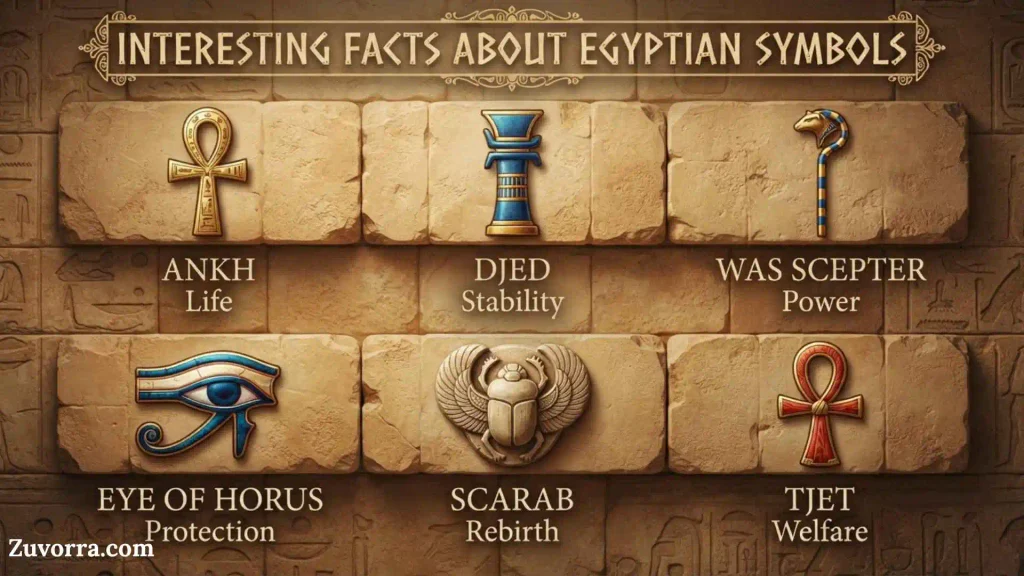
- Images could function as language and protection at the same time. A hieroglyph was not necessarily either writing or art. It could perform both roles.
- Damaged symbols could be ritually significant. Potentially dangerous animal signs were sometimes altered in funerary texts so that the creature could not harm the deceased.
- Color contributed to meaning. Green suggested vegetation and regeneration, while black could represent fertile Nile soil, rebirth, and the realm of Osiris rather than simple evil.
- Royal names received symbolic protection. Cartouches enclosed important royal names and connected them with the protective concept of the shen ring.
- The same sign could have several reading functions. A hieroglyph might represent a consonant, a word, or a category of meaning depending on its position.
- Scarabs were not only burial objects. People used them as seals, jewelry, gifts, administrative tools, and commemorative items during life.
- The djed’s original physical model remains uncertain. Its symbolic meaning of stability is well established, but scholars still debate what object its shape first represented.
- The “lotus” is often a water lily. Popular descriptions use the word lotus, although much Egyptian imagery depicts blue and white water lilies.
- Seth was not always purely evil. He represented disruptive power, but some traditions also showed him protecting Ra’s solar boat.
- Hieroglyphs could face either direction. Readers normally begin from the side toward which human and animal figures face.
- Egyptian signs now exist as digital characters. Unicode encoding allows thousands of hieroglyphs to appear in databases and electronic publications.
- Meaning came from placement as well as shape. An amulet placed over the heart could serve a different purpose from the same form carved above a temple doorway.
Related Egyptian Symbols
Ka Symbol
The ka sign looks like two raised arms. It represents a vital aspect of personhood that received offerings and continued after death.
Akhet
The akhet shows the sun rising between two mountains. It represents the horizon and the place of solar rebirth.
Sema-Tawy
This image shows plants representing Upper and Lower Egypt being bound together. It symbolizes the unification of the Two Lands.
Nefer
The nefer hieroglyph expresses goodness, beauty, completion, or perfection. Its exact visual origin remains debated.
Menat Necklace
The menat was connected with Hathor, music, fertility, well-being, and ritual performance. It could be worn or shaken ceremonially.
Sistrum
The sistrum was a sacred rattle associated especially with Hathor and temple ritual. Its sound helped create a pleasing and protective religious atmosphere.
Winged Sun Disk
The winged sun disk represents solar power, kingship, divine protection, and victory over enemies. It often appears above temple entrances.
Double Crown
The combined red and white crown represents the political union of Lower and Upper Egypt under one ruler.
Frequently Asked Questions
What is the most famous Egyptian symbol?
The ankh is probably the most internationally recognized Egyptian symbol. Its basic meaning is life, and Egyptian gods frequently hold it in temple and funerary scenes. The Eye of Horus, scarab, and pyramid are also widely recognized, although the pyramid is an architectural form rather than a hieroglyphic amulet symbol.
Which Egyptian symbol means protection?
Several Egyptian signs represent protection. The Eye of Horus symbolizes healing and restored wholeness, the uraeus cobra defends royal authority, the tyet invokes the protection of Isis, and the shen ring suggests encircling protection. The best choice depends on whether the intended emphasis is health, kingship, motherhood, eternity, or general safety.
What Egyptian symbol represents strength?
The djed pillar is the clearest symbol of stability, endurance, and lasting strength. The was scepter represents power and dominion, while the uraeus expresses forceful royal defense. For personal resilience, the djed usually offers the closest historically grounded meaning.
What Egyptian symbol means rebirth?
The scarab is strongly associated with rebirth, becoming, and the rising sun. The lotus or water lily also represents renewed creation because it opens with daylight. The djed and ankh can express regeneration and continued life, particularly in funerary contexts.
Is the Eye of Horus the same as the Eye of Ra?
No, although their imagery and meanings overlap. The Eye of Horus emphasizes restoration, healing, wholeness, and protection. The Eye of Ra represents the sun god’s active power and may act as a fierce goddess who protects divine and royal order. Visual appearance alone may not identify them reliably.
What does the Egyptian scarab mean in jewelry?
A scarab in ancient jewelry could represent solar renewal, protection, becoming, status, or good fortune. Some scarabs also served as seals. Modern jewelry usually presents the beetle as a sign of transformation and rebirth, but the exact meaning depends on the design and inscription.
Are Egyptian symbols considered religious?
Many were religious, but not all uses were exclusively religious. Hieroglyphs also recorded names, goods, titles, historical events, and administrative information. Even ordinary signs could gain sacred importance when placed in temples, tombs, or amulets.
Can Egyptian symbols be used respectfully in tattoos?
They can be used respectfully when the wearer studies the historical meaning, chooses an accurate design, and avoids false claims. It is wise to verify hieroglyphic spelling with a qualified Egyptologist rather than relying on automatic online translators, which may produce incorrect or meaningless text.
Do Egyptian hieroglyphs work like an alphabet?
Not exactly. Some hieroglyphs represent one consonant, but others represent two or three consonants, complete words, or categories of meaning. Egyptian writing normally omitted vowels, so converting a modern English name letter by letter does not reproduce the ancient language accurately.
Is there an Egyptian symbol for good luck?
Ancient Egyptians used many favorable and protective signs rather than one universal “good luck” symbol. Scarabs, wedjat eyes, ankhs, nefer signs, and protective deity amulets could promote life, health, protection, beauty, or successful renewal.
Key Takeaways
- Egyptian symbols communicated life, protection, rebirth, truth, power, kingship, and cosmic order.
- The ankh primarily means life, while the Eye of Horus represents healing and restoration.
- The djed pillar symbolizes stability, and the scarab expresses renewal and becoming.
- Meanings depend on historical period, location, material, color, and religious context.
- Hieroglyphs could function as written language, visual symbolism, and protective imagery.
- The Eye of Horus and Eye of Ra cannot always be distinguished by direction alone.
- Modern tattoo and spiritual meanings should not automatically be treated as ancient facts.
- Accurate interpretation requires attention to the complete object or scene, not just one isolated sign.
Conclusion
The study of Egyptian symbols meaning reveals a culture that saw writing, art, religion, nature, and political authority as closely connected. An ankh did more than label the idea of life. A scarab did more than represent a beetle. Each sign belonged to a wider system in which images helped explain creation, defend sacred order, identify rulers, protect the vulnerable, and preserve human existence beyond death.
These symbols still attract attention because they address lasting human concerns: Who are we? What protects us? How can order overcome chaos? What continues after death? By separating documented ancient meanings from later interpretation, readers can appreciate Egyptian imagery without reducing a complex civilization to decorative mystery.
References
- The Metropolitan Museum of Art. “Egyptian Amulets.” Discussion of amulet functions, the wedjat eye, regeneration, materials, and protective symbolism.
- The Metropolitan Museum of Art. The Art of Ancient Egypt: A Resource for Educators. Information on the djed, hieroglyphs, Egyptian art, and fractional signs.
- The Metropolitan Museum of Art. “Scarab Inscribed with Hieroglyphs.” Museum record explaining the protective combination of scarab, wedjat, ankh, nefer, and djed signs.
- British Museum. Life in Ancient Egypt: Visit Resource. Educational overview of the ankh, Eye of Horus, scarab, and djed.
- British Museum. “Red Jasper Tyet-Girdle Amulet.” Collection record describing the tyet’s connection with divine protection.
- University College London. Digital Egypt for Universities. Academic resources on Egyptian religion, artifacts, language, art, and archaeological periods.
- Unicode Consortium. “Egyptian Hieroglyphs” and “Unicode Egyptian Hieroglyph Database.” Official information on digital hieroglyphic character encoding.
I’m Jasper Huxley, a British writer fascinated by the symbols that communicate ideas without words. I explore their meanings, origins, cultural connections, and everyday uses. From ancient markings to contemporary signs, I enjoy uncovering the stories behind visual language and presenting symbolism in a clear, engaging way for curious readers worldwide.
Books:
- The Hidden Language of Symbols
- Symbols, Signs and Their Meanings