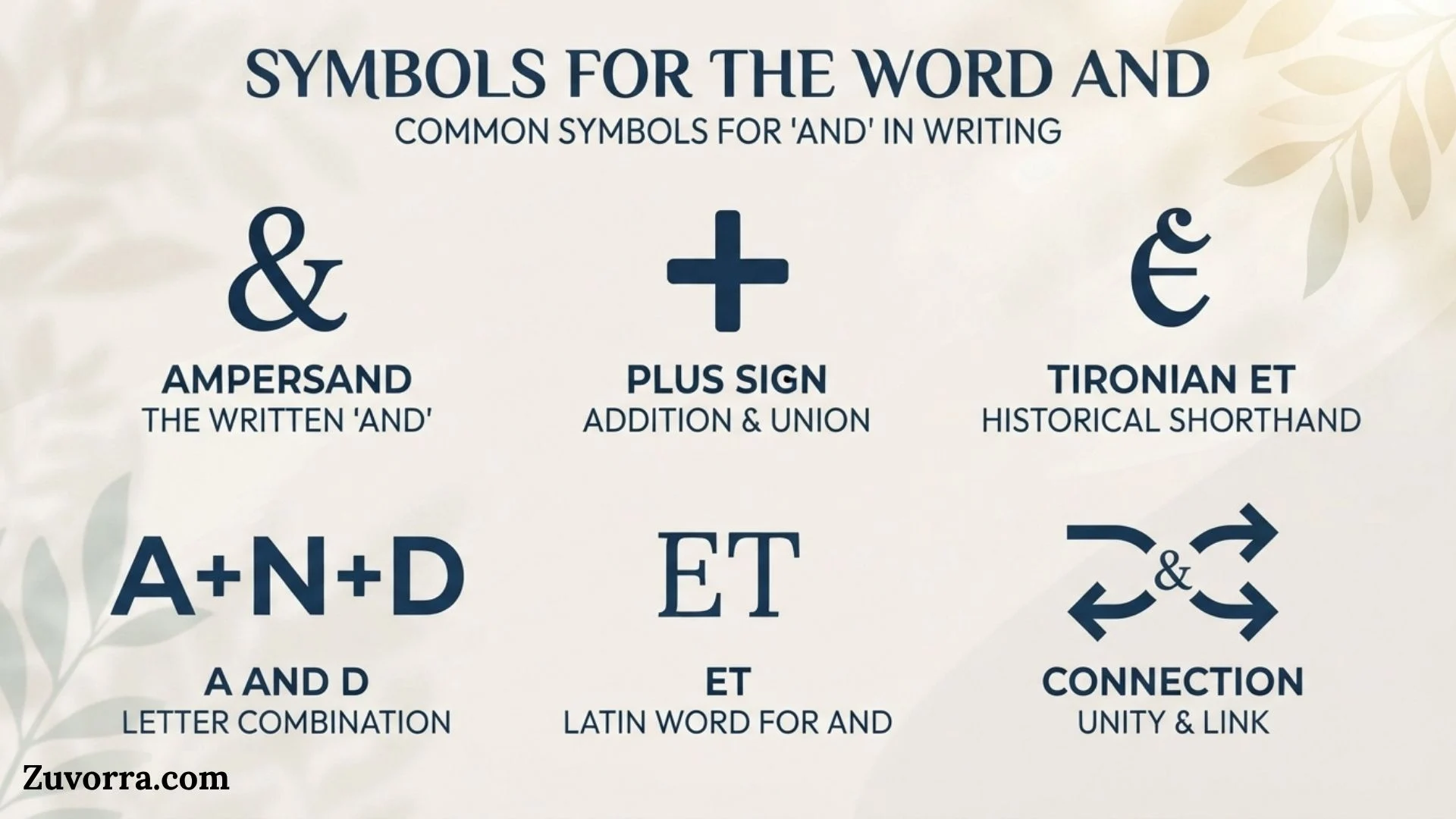
Symbols for the word and appear in everyday writing, mathematics, programming, business names, music, and historical manuscripts. The most familiar is the ampersand (&), but it is not the only mark that can connect two ideas.
Depending on the context, &, +, ∧, &&, ⁊, and even a slash may express some form of addition, connection, or combination. However, these symbols are not always interchangeable. Understanding their origins and correct uses helps you choose a mark that is clear, accurate, and appropriate.
Quick Meaning
The standard symbol for the word and is the ampersand, written &. It joins words, names, or related items, especially in company names, titles, labels, citations, and informal writing. Other symbols, including +, ∧, &&, and ⁊, mean “and” only in specific mathematical, digital, linguistic, or historical contexts.
Symbol Overview Table
| Field | Details |
| Primary symbol | & |
| Symbol name | Ampersand |
| Primary meaning | And; together with; combined with |
| Symbol category | Logogram, punctuation mark, typographic symbol |
| Linguistic origin | Latin word et, meaning “and” |
| Historical form | A ligature joining the letters e and t |
| First known development | Roman handwriting, traditionally traced to the early centuries CE |
| Common modern uses | Business names, titles, labels, citations, branding, informal notes |
| Unicode | U+0026 AMPERSAND |
| Keyboard entry | Shift + 7 on a standard US keyboard |
| Emoji equivalent | No exact emoji equivalent |
| Historical alternative | ⁊, the Tironian sign et |
| Mathematical alternative | ∧, logical conjunction |
| Programming alternative | &&, logical AND in many languages |
| Informal alternative | +, meaning “and” or “with” in limited contexts |
| Related symbols | +, ⁊, ∧, &&, /, ⅋ |
Unicode identifies & as U+0026 AMPERSAND and notes that it originally developed from a ligature of the letters e and t.
What Do Symbols for the Word And Mean?
A symbol for “and” communicates a relationship between two or more elements. Its broad message is connection, addition, inclusion, partnership, or combination.
In ordinary English, the ampersand performs the same basic job as the conjunction and:
- Salt & pepper
- Research & development
- Johnson & Johnson
- Rhythm & blues
The symbol tells the reader that the connected items belong together in some meaningful way. They may be partners, categories, ingredients, activities, names, or parts of a single concept.
However, context changes the exact meaning:
- Tea & coffee means tea and coffee.
- You + me suggests togetherness or partnership.
- A ∧ B means both statements must be true in formal logic.
- condition1 && condition2 tells a computer to check whether both conditions are true.
- ⁊ represents “and” in historical manuscripts and some Gaelic writing traditions.
The ampersand is therefore a general-language symbol, while the other marks usually belong to specialized systems.
History and Origin of the Ampersand
The ampersand began as a faster way to write the Latin word et, which means “and.” Roman scribes joined the handwritten letters e and t into a single flowing character. This type of combined character is called a ligature.
In early forms, readers could often see both letters clearly. Over centuries of handwriting and typography, the strokes became more curved and compact. The result gradually developed into the familiar & shape.
Merriam-Webster explains that the symbol was created by joining e and t from the Latin et.
How the Name “Ampersand” Developed
The word ampersand did not come from the symbol’s visual shape. It developed from the phrase:
and per se and
The Latin expression per se means “by itself.” When children once recited the alphabet, letters that could also function as words were identified with this phrase. For example, they might say “I, per se I” to make clear that the letter itself formed the word I.
Because & was sometimes listed after Z, students ended the alphabet with a phrase that sounded like:
X, Y, Z, and per se and
Repeated speech gradually blended and per se and into ampersand. The English word is recorded from the late 18th century, although the symbol itself is far older.
Was the Ampersand Once Part of the Alphabet?
The ampersand was commonly taught or recited after the 26 letters in some English-speaking schools. This has led to the popular statement that it was once the “27th letter.”
That description requires care. The ampersand appeared at the end of some alphabet recitations and educational materials, but it was not a normal alphabetic letter representing a speech sound. It functioned as a symbol or logogram for an entire word.
Calling it the “27th character sometimes taught with the alphabet” is more precise than calling it a true letter.
Symbolism and Interpretation
The ampersand has a practical grammatical function, but people also use it symbolically. Its central theme is connection.
Partnership and Cooperation
An ampersand placed between two names often suggests equal participation:
- Smith & Jones
- Arts & Sciences
- Design & Technology
Unlike a long sentence, the compact mark gives both sides similar visual weight. This makes it useful in partnerships, law firms, creative studios, and joint projects.
Unity and Belonging
The symbol can represent two separate people or ideas forming one relationship. For this reason, it appears in wedding stationery, jewelry, tattoos, home décor, and family designs.
A design reading you & me may symbolize companionship. Names joined by an ampersand may represent marriage, friendship, or family unity.
These emotional meanings are modern interpretations rather than ancient sacred meanings inherent in the character.
Addition and Inclusion
The word and adds one element without removing another. Symbolically, & can communicate inclusion:
- tradition & innovation
- work & life
- strength & compassion
- past & future
This makes the ampersand useful when a designer wants to show that two ideas can coexist.
Balance and Duality
An ampersand may connect apparent opposites:
- light & dark
- logic & emotion
- risk & reward
- body & mind
In such examples, the mark represents balance rather than simple addition. It acts as a bridge between concepts that differ but remain related.
Positive Symbolism
Common positive interpretations include:
- partnership
- unity
- cooperation
- continuity
- inclusion
- harmony
- shared identity
- mutual support
Possible Negative Interpretations
The symbol itself is neutral, but context can create less positive meanings. It might suggest:
- an unwanted connection
- dependence between two parties
- forced compromise
- a complicated relationship
- two problems occurring together
For example, “stress & exhaustion” connects two negative conditions. The ampersand does not change meaning; the surrounding words create the emotional tone.
Cultural Significance
The ampersand belongs primarily to the history of Latin-script writing. Its use spread through European manuscript culture, printing, commerce, and modern international typography.
English-Speaking Cultures
In English, & appears most naturally in:
- official business names
- artistic titles
- signs and labels
- abbreviations
- informal notes
- design-led text
Writers usually spell out and in formal prose unless an established name or style guide calls for the symbol.
French, Italian, and Other European Languages
Because the ampersand developed from Latin et, it has historical connections across Europe. Modern European languages may use it in logos, names, advertising, or graphic design even when their ordinary word for “and” is not and or et.
Its meaning is widely recognized, but frequency and style conventions vary by language and publication.
Irish and Gaelic Contexts
The Tironian sign ⁊ has a special relationship with Irish writing. It developed separately from the ampersand and represents Latin et, meaning “and.” Unicode notes its association with Irish Gaelic, Old English, and medieval materials.
In Irish contexts, ⁊ may be read as agus, the Irish word for “and.” It can appear on traditional signs, in manuscripts, and in typography designed to evoke Gaelic heritage.
Global Branding
International brands often use & because it is compact and widely recognizable. It can connect names without favoring one language’s full spelling of “and.”
Even so, readers should not assume that every culture interprets decorative ampersands identically. The general idea of connection travels easily, while historical and stylistic associations remain culturally specific.
Religious or Spiritual Meaning
The ampersand has no universal sacred meaning and does not belong to the central symbol system of a major religion. It began as a writing abbreviation, not as a religious emblem.
Still, religious communities may use it in ordinary titles and messages:
- faith & works
- grace & truth
- church & community
- prayer & reflection
In these phrases, the symbol connects theological ideas, but the religious meaning comes from the words rather than the ampersand itself.
Some people adopt the symbol as a personal reminder of unity, relationships, or the belief that life holds more than one truth at once. Such interpretations are modern and individual. They should not be presented as established ancient doctrine.
In Christian manuscript history, scribes used ligatures and abbreviations while copying Latin texts. The ampersand’s link to Latin writing means it may appear in religious documents, but this does not make it a specifically Christian symbol.
Scientific, Mathematical, and Technical Meanings
Different fields use specialized symbols that can be read as “and.” These marks often have stricter meanings than the ampersand.
Ampersand in Mathematics
The ordinary ampersand has no single universal mathematical operation. It may appear in labels, matrices, tables, or software syntax, but its role depends on the system.
It should not automatically replace:
- the plus sign for addition
- the multiplication sign
- the logical conjunction symbol
- a set-intersection symbol
Mathematical symbols must be interpreted according to their formal definitions.
Logical AND: ∧
In propositional logic, ∧ represents conjunction, commonly read as “and.”
For example:
P ∧ Q
means that P is true and Q is true.
The combined statement is true only when both parts are true.
| P | Q | P ∧ Q |
| True | True | True |
| True | False | False |
| False | True | False |
| False | False | False |
The wedge symbol expresses a logical condition, not merely a stylistic replacement for the English word.
Programming AND: &&
Many programming languages use a double ampersand:
&&
It commonly represents a logical AND operator. For example:
age >= 18 && hasID
This condition is true only when the person meets the age requirement and has identification.
Languages that use && include JavaScript, Java, C, C++, C#, and PHP. Exact behavior can differ, especially when languages use short-circuit evaluation.
A single ampersand may have another technical meaning, such as a bitwise AND operation, a reference marker, an address operator, or part of an entity code. Programmers should not treat & and && as interchangeable.
The Ampersand in HTML
In HTML, the ampersand begins a character reference or entity, such as:
- & for &
- < for <
- > for >
To display a literal ampersand safely in some HTML contexts, writers use &.
The Ampersand in URLs
A web address may use & to separate query parameters:
example.com/search?color=blue&size=large
Here, the ampersand does not mean ordinary grammatical “and.” It separates data fields sent to a website.
Spreadsheets
In several spreadsheet systems, including Microsoft Excel and Google Sheets, an ampersand can join text strings:
=”First”&” “&”Last”
The formula combines separate pieces into:
First Last
In this setting, the symbol functions as a text-concatenation operator.
The Plus Sign as “And”
The plus sign + sometimes means “and,” “with,” or “together” in informal visual communication:
- you + me
- coffee + cake
- design + strategy
This usage suggests addition or combination. It works well in posters, advertisements, menus, and social media graphics, but it is not a standard replacement for and in ordinary sentences.
Slash as a Limited Connector
A slash may join closely related terms:
- writer/editor
- input/output
- and/or
However, a slash can mean and, or, per, or a relationship between two roles. Because its meaning can be ambiguous, writers should use it carefully.
Where Symbols for “And” Are Used
Business and Organization Names
The ampersand appears frequently in official names:
- Barnes & Noble
- Procter & Gamble
- Johnson & Johnson
- AT&T
When an organization officially uses &, writers should preserve that styling.
Book, Film, and Music Titles
Creators may choose an ampersand for visual rhythm or identity. It is especially common when a title joins two names, places, themes, or characters.
Academic Citations
Some citation systems use an ampersand between author names inside parenthetical references. The exact rule depends on the required style guide.
Writers should follow the current edition of APA, Chicago, MLA, or the relevant institutional guide rather than applying one rule everywhere.
Menus and Product Labels
Compact labels often use ampersands:
- fish & chips
- soap & lotion
- bed & breakfast
- black & white
The mark saves space and creates a familiar paired expression.
Logos and Branding
Designers value the ampersand because its curved form can become a distinctive visual element. A custom ampersand may communicate elegance, heritage, creativity, or partnership.
Personal Designs
The symbol appears in:
- wedding invitations
- monograms
- necklaces
- wall art
- tattoos
- family signs
These uses often emphasize emotional connection rather than grammar.
Common Variations
Standard Ampersand: &
This is the ordinary digital and printed character. Unicode encodes it as U+0026.
Italic or Calligraphic Ampersand
Many italic typefaces make the original et structure easier to see. The character may resemble a looping lowercase e connected to a t.
These are usually font designs, not different Unicode characters.
Tironian Sign Et: ⁊
The Tironian sign ⁊ is an ancient shorthand mark for et. Unicode encodes it as U+204A and describes it as a punctuation mark meaning “and,” with historical use in Irish Gaelic, Old English, and medieval texts.
Turned Ampersand: ⅋
The turned ampersand ⅋ is Unicode U+214B. It is used in linear logic, where it has a specialized formal meaning. It is not a decorative substitute for & in normal writing.
Fullwidth Ampersand: &
The fullwidth ampersand is used in East Asian typography and computing environments where characters occupy a uniform full-width space. It has the same general textual value as an ampersand but a different typographic width.
Heavy and Decorative Ampersands
Unicode also includes ornamental ampersand-like characters. These are intended primarily for presentation and decoration. Standard text should normally use & unless a specialized symbol is required.
How to Choose the Correct Symbol
Use this simple decision guide:
Are you writing a normal formal sentence?
↓
Write the word and.
Are you reproducing an official company or title?
↓
Use & when it is part of the official name.
Are you creating a label, menu, heading, or compact design?
↓
Use & if it improves clarity and fits the style.
Are you showing informal combination or collaboration?
↓
Use + cautiously, especially in visual designs.
Are you writing formal logic?
↓
Use ∧.
Are you writing a logical condition in a programming language?
↓
Use && when that language requires it.
Are you transcribing Irish, Old English, or medieval material?
↓
Use ⁊ only when historically and linguistically appropriate.
Common Misconceptions
“Every Symbol Meaning ‘And’ Is Interchangeable”
This is incorrect. &, +, ∧, &&, and ⁊ belong to different systems. Replacing one with another can change the meaning or create an error.
“The Ampersand Is Always Informal”
The symbol can be informal, but it is required in official names that contain it. It may also appear under formal citation or publishing rules.
“The Ampersand Was Invented as the 27th Letter”
It developed from the Latin ligature et. Its later position after Z in some alphabet recitations did not cause its invention.
“The Plus Sign Is Another Standard Spelling of And”
A plus sign can suggest “and” in visual or informal contexts, but it normally represents addition or a positive value. It should not replace and throughout ordinary prose.
“The Tironian Sign Is Just an Old Font Style for &”
The Tironian ⁊ and the ampersand have different graphic histories. Both can represent et, but Unicode treats them as separate characters.
“Ampersands Should Never Appear in Sentences”
They may appear when an official name requires them, as in “Research was funded by Smith & Jones Foundation.” The surrounding sentence can remain formal even though the proper name contains an ampersand.
Interesting Facts About Symbols for “And”
- The ampersand hides a Latin word.
Its shape developed from the joined letters e and t in et, the Latin word for “and.” - Some typefaces reveal its origin better than others.
Italic and calligraphic ampersands often make the e and t more visible than simple sans-serif designs. - Its name came from a spoken phrase.
Ampersand evolved from “and per se and,” not from a person, place, or material. - It once followed Z in some lessons.
Children sometimes recited it at the end of the alphabet, which explains its popular “27th character” reputation. - The ampersand is both punctuation and a symbol.
Unicode includes it among common characters that may be treated as symbols as well as punctuation. - Computers give it several jobs.
Depending on the language, & can join text, mark a reference, begin an entity, separate URL parameters, or perform a bitwise operation. - A double ampersand can control program decisions.
In many programming languages, && requires two conditions to be true. - The Tironian sign survived for centuries.
The symbol ⁊ moved from ancient shorthand into medieval writing and remains associated with Irish-language typography. - Not every decorative ampersand is a new character.
Most visual variations are glyphs created by fonts rather than separately encoded symbols. - The symbol can influence perceived equality.
Placing an ampersand between two names often gives them balanced visual importance, which helps explain its popularity in partnership names. - A turned ampersand belongs to logic.
The character ⅋ has a formal role in linear logic and should not be read as an ordinary backward ampersand. - There is no exact ampersand emoji.
Decorative icons may communicate togetherness, but Unicode emoji does not provide a direct emoji equivalent for the standard word and.
Related Symbols
| Symbol | Name | Main Meaning | Difference from & |
| + | Plus sign | Addition, positive value, combination | Means “and” mainly in informal or visual contexts |
| ⁊ | Tironian sign et | Historical “and” | Separate shorthand character with medieval and Gaelic associations |
| ∧ | Logical conjunction | Both statements are true | Used in formal logic |
| && | Logical AND operator | Both conditions must hold | Used in many programming languages |
| / | Slash | Or, and, per, paired roles | More ambiguous than the ampersand |
| ∩ | Intersection | Elements shared by sets | Represents overlap, not grammatical “and” |
| ⅋ | Turned ampersand | Specialized logical operation | Used in linear logic |
| , | Comma | Separates list items | Does not replace the final conjunction in every style |
| × | Multiplication sign | Multiplication or dimensions | Indicates a mathematical relationship, not ordinary “and” |
Frequently Asked Questions
What is the main symbol for the word and?
The main symbol for the word and is the ampersand, &. It represents connection or inclusion between words, names, and ideas. It is common in official business names, titles, signs, menus, labels, citations, and informal notes. Formal sentences usually spell out and unless a specific style or proper name requires the symbol.
Is & a letter or punctuation mark?
The ampersand is generally classified as a symbol or punctuation character rather than a standard English letter. It represents an entire word instead of a single speech sound. Although it once appeared after Z in some alphabet recitations, that educational custom did not make it a true letter of the modern English alphabet.
Why does the ampersand mean and?
It means and because it developed from the Latin word et, which has that meaning. Scribes joined the letters e and t into a ligature for faster writing. Repeated handwriting and later type design gradually transformed that joined form into the modern & character.
Can I use & instead of and in formal writing?
Usually, formal prose should use the written word and. Use & when it forms part of an official name, appears under a required citation style, or is appropriate in a table, label, heading, or established abbreviation. Consistency and the rules of the relevant publication or organization should guide the choice.
Does the plus sign mean and?
The plus sign can suggest and, with, or together in informal designs such as “you + me” or “coffee + cake.” Its primary technical meaning is addition. Because readers may interpret it mathematically, it should not replace and freely in ordinary sentences, legal language, or precise professional writing.
What does && mean?
In many programming languages, && is the logical AND operator. It tests whether two conditions are both true. For example, isMember && hasTicket succeeds only when both conditions are satisfied. A single & may perform a different operation, so programmers must follow the syntax of the language they are using.
What is the difference between & and ⁊?
The ampersand & developed as a ligature of the Latin letters e and t. The Tironian sign ⁊ came from an ancient shorthand tradition. Both can represent “and,” but they are historically and digitally distinct characters. The Tironian sign is especially associated with medieval manuscripts and Irish-language typography.
What does ∧ mean in mathematics?
The symbol ∧ usually represents logical conjunction. The expression P ∧ Q means “P and Q,” with both statements required to be true. It is not normally used as a decorative replacement for and. Its meaning belongs to formal logic, Boolean reasoning, mathematics, and related technical fields.
Is there an emoji for and?
There is no exact emoji that serves as a universal replacement for the word and. People may use a handshake, link, heart, or plus sign to suggest connection, partnership, or togetherness, but those icons add emotional meanings that the neutral conjunction does not necessarily contain.
Should spaces appear around an ampersand?
In most English text, place spaces around an ampersand when it connects separate words, as in “research & development.” Official logos and stylized names may follow different spacing. In programming, URLs, and code, spacing depends on technical syntax rather than general writing rules.
Key Takeaways
- The standard symbol for the word and is the ampersand: &.
- The ampersand developed from the Latin word et, meaning “and.”
- Its name evolved from the spoken phrase “and per se and.”
- It symbolizes connection, partnership, inclusion, and combination.
- Formal prose usually spells out and unless an official name or style rule requires &.
- + can suggest “and” in informal visual designs but normally means addition.
- ∧ represents logical conjunction in mathematics and formal logic.
- && is a logical AND operator in many programming languages.
- ⁊ is the historical Tironian sign et, used in medieval and Gaelic contexts.
- Similar-looking symbols should not be treated as interchangeable.
Conclusion
Symbols for the word and show how one simple idea can take different forms across language, history, mathematics, design, and technology. The ampersand & remains the standard and most widely recognized choice, carrying a history that reaches back to the Latin word et.
Other marks serve narrower purposes. The plus sign suggests combination, the logical wedge joins true statements, the double ampersand controls digital conditions, and the Tironian sign preserves an older writing tradition. Choosing the right symbol depends not only on what it looks like, but also on where it appears and what relationship it must communicate.
