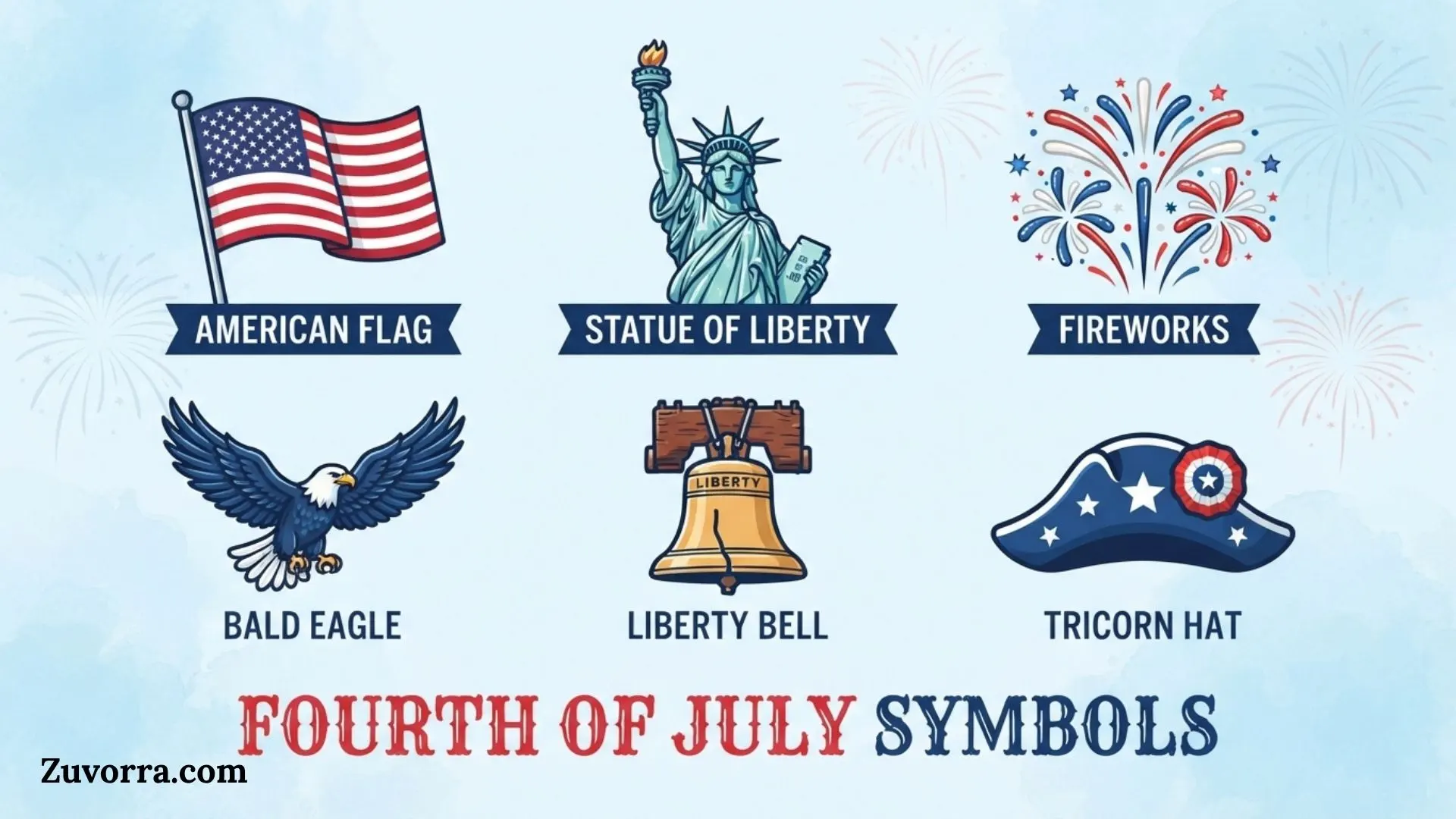
Fourth of July symbols represent American independence, liberty, national identity, remembrance, and celebration. The most familiar examples include the American flag, bald eagle, Liberty Bell, fireworks, Statue of Liberty, Uncle Sam, and the colors red, white, and blue.
You may see these symbols on parade floats, clothing, decorations, greeting cards, public buildings, military ceremonies, advertisements, and social media posts. Some come directly from the American Revolution, while others became patriotic icons many years later. Understanding their history reveals that Independence Day is not only a festive holiday. It is also a yearly reflection on the nation’s founding principles, unfinished promises, and changing identity.
Quick Meaning
Fourth of July symbols express the ideals and traditions connected with American independence. They commonly represent liberty, courage, unity, sacrifice, self-government, and national pride. Fireworks recall early public celebrations, the flag represents the United States, and historical objects such as the Liberty Bell and Declaration of Independence connect the holiday to the events of 1776.
Fourth of July Symbols Overview
| Symbol | Primary Meaning | Historical Connection | Common Modern Use |
| American flag | National unity, identity, and patriotism | The Continental Congress adopted an official flag resolution in 1777 | Homes, parades, ceremonies, clothing, and decorations |
| Fireworks | Celebration, triumph, and public joy | Used during the first anniversary celebrations in 1777 | Community displays, festivals, and televised events |
| Bald eagle | Strength, independence, and national sovereignty | Appears on the Great Seal of the United States | Government seals, currency, logos, and patriotic art |
| Liberty Bell | Freedom, equality, and the continuing call for liberty | Became a major liberty symbol through later reform movements | Museums, posters, educational materials, and decorations |
| Declaration of Independence | Independence, natural rights, and government by consent | Adopted by Congress on July 4, 1776 | Readings, reenactments, exhibits, and classroom lessons |
| Statue of Liberty | Freedom, welcome, democracy, and hope | Dedicated in 1886 as a gift from France | Art, tourism, political imagery, and patriotic designs |
| Red, white, and blue | Patriotism and national identity | Colors of the United States flag | Clothing, food, banners, balloons, and lighting |
| Stars and stripes | States, national union, and the American republic | Core design elements of the national flag | Flags, bunting, logos, crafts, and apparel |
| Uncle Sam | Personification of the United States government or nation | Developed during the 1800s and became iconic in wartime posters | Cartoons, recruiting imagery, costumes, and advertising |
| Independence Hall | Founding, debate, and representative government | Site associated with the Declaration and Constitution | Historical tours, illustrations, coins, and educational media |
| Torch | Enlightenment, liberty, and guidance | Strongly associated with the Statue of Liberty | Logos, jewelry, memorials, and civic art |
| Thirteen stars or stripes | The original thirteen colonies | Reflect the states that declared independence from Britain | Historical flags, seals, clothing, and commemorative designs |
What Do Fourth of July Symbols Mean?
Fourth of July symbols collectively represent the birth of the United States as an independent nation and the values expressed in the Declaration of Independence. These include liberty, equality, natural rights, representative government, and the belief that political authority should come from the consent of the governed.
However, the symbols do not all carry the same message.
The flag emphasizes national identity and union. Fireworks create a sense of celebration and dramatic public recognition. The Liberty Bell suggests that freedom must be proclaimed and protected. The Declaration of Independence represents the political ideas behind the holiday. The bald eagle communicates strength and sovereignty, while the Statue of Liberty expands the meaning of freedom to include hope, opportunity, and welcome.
These symbols can also invite reflection. The Declaration states an ideal of equality, but American history shows a long struggle over who could fully enjoy that ideal. For this reason, Independence Day symbolism may communicate both pride in the nation’s founding principles and a call to apply those principles more completely.
History and Origin of Fourth of July Symbols
The Declaration of Independence Created the Holiday’s Central Meaning
The central event behind Independence Day was the Continental Congress’s adoption of the Declaration of Independence on July 4, 1776. Congress had voted for independence on July 2, then approved the Declaration’s wording two days later. The document announced that the thirteen colonies regarded themselves as free and independent states.
The date on the adopted document became the date Americans commemorated. Public readings, bells, artillery, music, toasts, and later parades helped transform July 4 into a national ritual.
Contrary to a common belief, most delegates did not sign the parchment copy on July 4. The formal engrossed version was prepared later, and delegates began signing it on August 2, 1776.
Early Celebrations Established Lasting Traditions
The first anniversary celebrations in 1777 included public festivities in cities such as Philadelphia. Fireworks, cannon fire, military displays, bells, music, and illuminated buildings created a language of celebration that continues today.
Early military commemorations also used thirteen cannon shots to represent the thirteen original states. Soldiers sometimes repeated ceremonial gunfire in coordinated displays, linking noise, military power, and national independence.
Fireworks in the eighteenth century were far less colorful than modern displays. Early Fourth of July fireworks generally produced orange-yellow light rather than today’s carefully designed red, white, blue, gold, and multicolored effects.
National Symbols Accumulated Over Time
Not every familiar Independence Day image dates from 1776. Several developed later:
- The Stars and Stripes became an official national flag design in 1777.
- The bald eagle appeared on the Great Seal adopted in 1782.
- The State House Bell became widely known as the Liberty Bell after abolitionists adopted that name in the 1830s.
- Uncle Sam developed during the nineteenth century and gained his most famous visual form in the twentieth century.
- The Statue of Liberty was dedicated in 1886.
- Modern patriotic advertising expanded greatly during the nineteenth and twentieth centuries.
This gradual development matters because Fourth of July symbolism is not a frozen collection. Each generation has added images, customs, and interpretations to the holiday.
Symbolism and Interpretation
American Flag
The American flag is the most widely recognized Fourth of July symbol. Its stars represent the current states, while its thirteen stripes honor the original colonies. The flag symbolizes the United States as one political union, even though the country contains many regions, communities, and viewpoints.
During Independence Day celebrations, people display the flag on homes, government buildings, vehicles, parade routes, uniforms, and stages. In official settings, it also represents civic duty, military service, national sacrifice, and loyalty to constitutional government.
The flag may inspire pride, remembrance, protest, or debate. Because it represents the nation as a whole, people sometimes use it to praise the country and sometimes to demand that the country live up to its stated principles.
Fireworks
Fireworks symbolize joy, victory, freedom, and dramatic public celebration. Their bright flashes make independence visible, while their sound recalls the cannons and ceremonial gunfire used during early national celebrations.
Modern fireworks also create a shared experience. People gather in parks, streets, waterfront areas, and town centers to watch the same display. This temporary community is part of their symbolism: many separate viewers focus on one national event.
Fireworks can also carry negative associations. Their explosive sound may disturb veterans, people with sensory sensitivities, pets, wildlife, and young children. They can cause fires and injuries when used carelessly. As a result, public fireworks symbolize celebration but also require responsibility.
Bald Eagle
The bald eagle represents strength, freedom, authority, and national sovereignty. Its native North American identity helped make it an appropriate emblem for the new republic.
On the Great Seal, the eagle holds an olive branch and arrows. Together, these objects suggest the power to pursue peace while remaining prepared for defense. The eagle therefore symbolizes more than physical strength. It represents the authority and responsibilities of an independent government.
Liberty Bell
The Liberty Bell represents freedom, but its symbolic history developed gradually. In the eighteenth century, it was known as the State House Bell. There is no reliable evidence that it rang on July 4 or July 8, 1776, to announce independence, despite the popularity of that story.
Abolitionists began calling it the Liberty Bell in the 1830s. Its inscription, drawn from Leviticus, reads, “Proclaim Liberty Throughout All the Land Unto All the Inhabitants thereof.” The bell later inspired abolitionists, women’s suffrage advocates, civil rights activists, and other reformers.
Its crack has also gained symbolic meaning. Many people interpret it as a reminder that American liberty is valuable but imperfect and must continually be repaired, defended, and expanded.
Declaration of Independence
The Declaration is both a historical document and a symbol of political ideals. It explains the colonies’ reasons for separating from Britain and states principles that became central to American political identity.
Its language concerning equality, unalienable rights, liberty, and the consent of the governed has influenced reform movements in the United States and abroad. The National Archives describes the Declaration as a statement of principles underlying American government and identity, even though the document itself is not a legally binding constitution.
On July 4, public readings of the Declaration reconnect the holiday with ideas rather than decorations alone.
Statue of Liberty and the Torch
The Statue of Liberty represents freedom, democracy, enlightenment, and welcome. Its raised torch suggests light overcoming darkness, while the broken chain near its feet symbolizes release from oppression.
Although the statue was not created specifically for Independence Day, its imagery fits the holiday’s themes. It connects national independence with a broader human desire for freedom. Its association with immigrants also adds the ideas of hope, new beginnings, and belonging.
Uncle Sam
Uncle Sam personifies the United States, especially the federal government. He is commonly shown as an older man wearing a star-spangled top hat and red, white, and blue clothing.
The name is traditionally associated with Samuel Wilson, a meat supplier during the War of 1812. Later illustrators shaped the character, and James Montgomery Flagg’s famous recruiting image helped establish the appearance most people recognize today.
Unlike the Statue of Liberty, which often represents ideals, Uncle Sam frequently represents government authority, military recruitment, taxation, policy, or the nation speaking directly to citizens.
Red, White, and Blue
Red, white, and blue function as a quick visual code for the United States. On Independence Day, these colors appear in clothing, table settings, desserts, banners, lights, flowers, face paint, and digital graphics.
People often assign red the meaning of courage or sacrifice, white the meaning of purity or peace, and blue the meaning of loyalty or justice. These interpretations are widely used in patriotic explanations, but they should not be treated as the official reason the colors were originally selected for the first national flag.
Stars and Stripes
Stars commonly represent the states, heavenly guidance, unity, and national aspiration. Stripes represent the thirteen original colonies and the historical foundation of the republic.
When designers use a field of stars without reproducing the full flag, the pattern still communicates American identity. Stripes alone may suggest continuity, order, history, or movement. Together, stars and stripes form one of the strongest visual shortcuts for the Fourth of July.
Positive and Negative Interpretations
| Positive Interpretation | Possible Concern or Negative Interpretation |
| Freedom and self-government | Freedom was historically denied to many groups |
| National unity | Patriotism can become exclusionary when narrowly defined |
| Courage and sacrifice | Military imagery may overshadow civilian civic values |
| Community celebration | Large events can create noise, waste, and safety risks |
| Pride in national ideals | Symbols may be used without examining historical contradictions |
| Respect for public service | Political groups may claim symbols as belonging only to them |
| Hope and progress | Decorative use may reduce complex history to simple slogans |
The most balanced interpretation recognizes that patriotic symbols can express genuine pride while also encouraging honest reflection. A symbol does not need to represent a perfect history to remain meaningful. It can represent an ideal toward which a society continues to work.
Cultural Significance
Fourth of July symbols are primarily connected with United States history, but their meanings vary among communities.
For many Americans, the holiday centers on family gatherings, military service, local traditions, citizenship, and gratitude for political freedoms. Immigrant and naturalized citizens may view the flag or Statue of Liberty as symbols of opportunity and belonging.
Native American communities may interpret the celebration differently because the expansion of the United States brought land loss, broken treaties, forced removal, and cultural suppression. Black Americans have also long examined the gap between the Declaration’s language of equality and the historical realities of slavery and discrimination.
Frederick Douglass expressed this tension in his 1852 speech commonly known as “What to the Slave Is the Fourth of July?” His address challenged Americans to extend the promise of liberty to those who remained excluded from it. The Smithsonian presents this history as part of the holiday’s continuing conversation about freedom, equality, and the work of forming a more perfect union.
Outside the United States, familiar symbols such as the flag, eagle, and Statue of Liberty may represent American culture, political influence, democracy, immigration, or military power. Interpretation depends on historical experience and political context.
Religious and Spiritual Meaning
Independence Day is a civic holiday rather than a religious holy day. However, religious language and ceremonies have often appeared in its observance.
Churches may hold patriotic services, offer prayers for leaders, honor military members, or discuss freedom of religion. Some communities connect national liberty with divine providence. Others warn against confusing religious faith with unquestioning loyalty to a government.
The Liberty Bell has a direct biblical connection through its inscription from Leviticus 25:10. In its original biblical setting, the passage refers to proclaiming liberty during the Jubilee. American reform movements later applied the wording to abolition, voting rights, and broader campaigns for justice.
Spiritually, Fourth of July symbols may encourage gratitude, hope, responsibility, moral courage, and service. A careful interpretation distinguishes love of country from worship of country. Civic symbols represent a nation and its ideals; they are not sacred objects in the same sense as religious symbols.
Scientific and Technical Meaning
How Fireworks Produce Color
Fireworks create visual effects through chemistry and controlled combustion. Different chemical compounds release characteristic colors when heated:
- Strontium compounds commonly produce red.
- Copper compounds help create blue.
- Sodium compounds produce yellow.
- Barium compounds can create green.
- Calcium compounds may produce orange.
- Aluminum, magnesium, or titanium can produce bright white or silver effects.
The shape of an aerial firework depends partly on how small explosive pellets, called stars, are arranged inside the shell. When the shell bursts, their placement helps form circles, rings, hearts, willows, or other patterns.
This technical development explains why modern fireworks differ so greatly from the limited orange-yellow displays of the eighteenth century.
Digital Symbols and Emoji
There is no single official Fourth of July Unicode symbol. Instead, digital messages commonly combine several emoji:
- 🇺🇸 United States flag
- 🎆 Fireworks
- 🎇 Sparkler
- 🗽 Statue of Liberty
- 🦅 Eagle
- 🔔 Bell
- ⭐ Star
- 🗽🎆🇺🇸 as a common patriotic sequence
Emoji can communicate celebration quickly, but they simplify complex historical meanings. A flag emoji may express pride, identify nationality, mark an event, or support a political statement depending on context.
Where Fourth of July Symbols Are Used
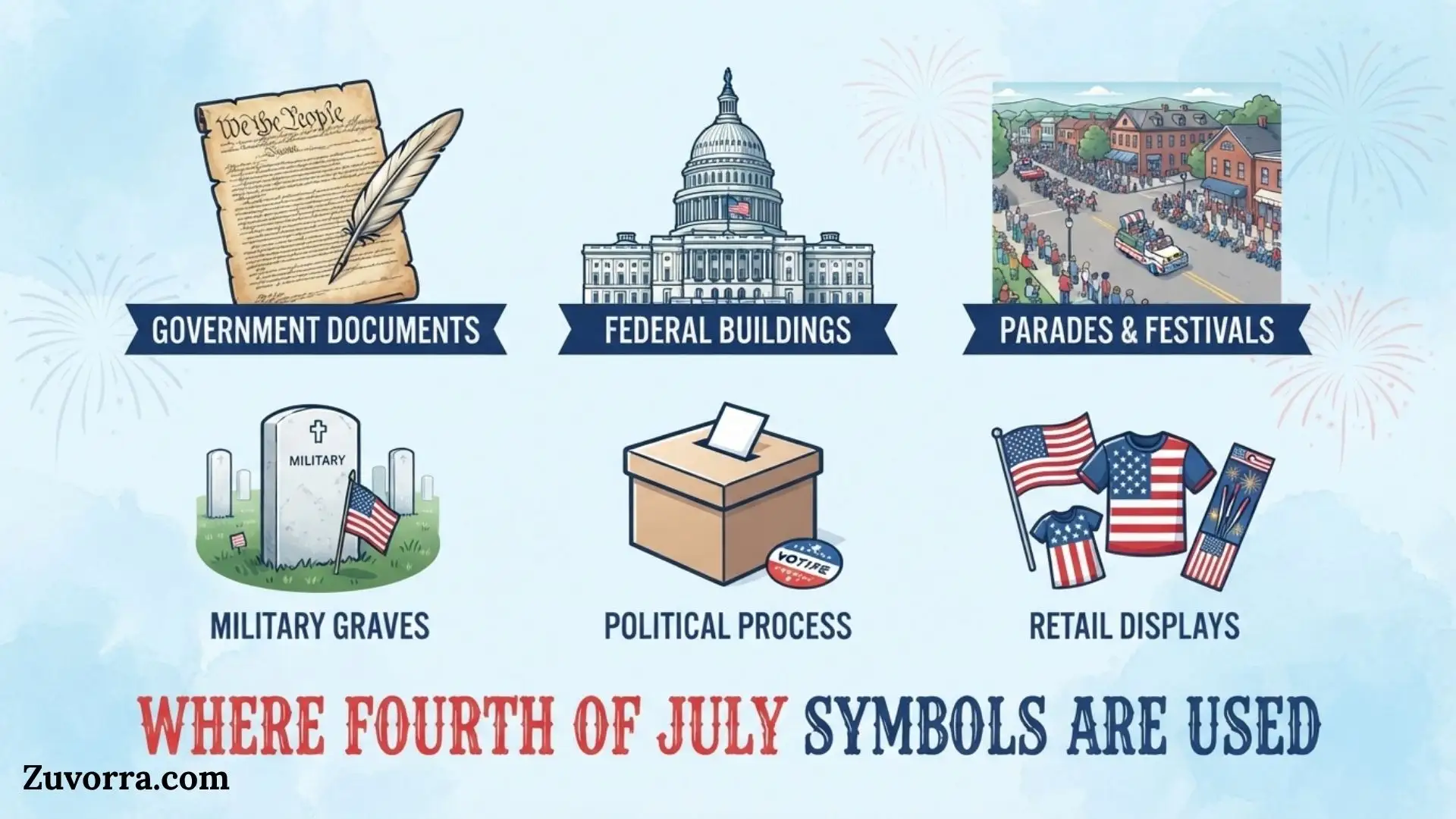
Public Celebrations
Cities and towns display flags, bunting, stars, banners, eagles, and historical images along parade routes and festival grounds. Fireworks usually serve as the final visual event of the day.
Government and Civic Ceremonies
Official programs may include military color guards, flag raising, citizenship ceremonies, speeches, readings of the Declaration, patriotic music, and wreath-laying ceremonies.
The National Archives has held annual Fourth of July programs featuring historical reenactors and a public reading of the Declaration. In 2026, the event marked the document’s 250th anniversary.
Homes and Parties
People use patriotic tablecloths, paper stars, flags, ribbons, balloons, wreaths, lights, and themed food. These domestic decorations turn national symbols into expressions of family tradition and community participation.
Art and Literature
Artists use eagles, flags, fireworks, bells, torches, and historical documents to explore freedom, protest, war, citizenship, and national identity. Writers may use fireworks as a metaphor for brief brilliance, emotional release, or explosive change.
Clothing and Jewelry
Flag patterns, star earrings, eagle pins, Liberty Bell charms, and red-white-and-blue clothing are common. Respectful designs usually avoid placing actual flags where they will be stepped on, discarded carelessly, or treated as disposable material.
Tattoos
Patriotic tattoos may include flags, eagles, the year 1776, military emblems, the Statue of Liberty, the Liberty Bell, or phrases from the Declaration. Their meanings can include family heritage, military service, civic pride, independence, or remembrance.
Logos and Advertising
Businesses use patriotic colors and imagery during holiday promotions. Such designs may create a sense of celebration, but excessive commercial use can separate symbols from their historical meaning.
Common Variations
Historical American Flags
The number and arrangement of stars changed as new states entered the Union. Historical designs, including thirteen-star arrangements, often appear during Independence Day events to emphasize the Revolutionary era.
Thirteen-Star Circles
A circle of thirteen stars is often called a Betsy Ross flag design. It has become strongly associated with the Revolution, although historians cannot prove the popular story that Betsy Ross created the first American flag.
Rustic and Vintage Designs
Weathered wood, faded colors, colonial lettering, parchment textures, and distressed flags suggest age, heritage, and historical memory. These designs are common in signs and home decorations.
Military Variations
Some designs combine the flag with soldiers, memorial silhouettes, dog tags, aircraft, or military unit emblems. These emphasize sacrifice and national defense rather than the political philosophy of independence.
Inclusive Modern Adaptations
Contemporary artists may combine patriotic symbols with images representing different races, religions, professions, disabilities, immigrant backgrounds, or family structures. These designs present American identity as diverse and evolving.
Minimalist Digital Designs
A single star, stripe pattern, torch, “1776,” or red-white-and-blue color palette may represent the holiday without showing a complete national symbol.
Simple Symbol Selection Guide
What message do you want to communicate?
↓
National unity and identity
Choose the American flag, stars, or red-white-and-blue colors.
↓
Freedom and civil rights
Choose the Liberty Bell, Statue of Liberty, torch, or Declaration of Independence.
↓
Celebration and excitement
Choose fireworks, sparklers, confetti, or illuminated stars.
↓
Strength and sovereignty
Choose the bald eagle or Great Seal imagery.
↓
Founding history
Choose Independence Hall, thirteen stars, colonial designs, or the date 1776.
↓
Government or public duty
Choose Uncle Sam, a flag, or civic architecture.
This approach helps decorations and educational materials communicate a clear idea instead of combining unrelated patriotic images.
Common Misconceptions
The Declaration Was Signed by Everyone on July 4
Congress adopted the Declaration’s text on July 4, 1776, but most delegates signed the engrossed parchment later. August 2 is the main signing date recorded in the congressional journal.
Independence Was Approved on July 4
Congress voted for independence on July 2. It approved the final wording of the Declaration on July 4, which became the commemorative date.
The Liberty Bell Rang When Independence Was Declared
There is no dependable evidence that the bell rang on July 4 or July 8 to announce the Declaration. The famous story became popular through later tradition and literature.
The Liberty Bell Always Had That Name
People in the Revolutionary era called it the State House Bell. Abolitionists helped popularize the name Liberty Bell decades later.
Betsy Ross Definitely Designed the First Flag
Betsy Ross may have made flags, but historians lack firm contemporary evidence proving that she designed the first official American flag. The famous account emerged through family tradition many years later.
Fireworks Were Invented in America
Fireworks originated in China centuries before the founding of the United States. Americans adapted an older pyrotechnic tradition for Independence Day celebrations.
The Bald Eagle Represents Only Military Power
The eagle represents sovereignty and strength, but the Great Seal balances arrows with an olive branch. The design joins defense with the desire for peace.
Every Patriotic Image Is an Official National Symbol
Some images are official, while others are traditional or commercial. The national flag and Great Seal have legal status. Fireworks, stars, barbecues, and red-white-and-blue desserts are cultural symbols rather than official emblems.
10 Interesting Facts About Fourth of July Symbols
1. Early Fireworks Lacked Today’s Color Range
The first anniversary displays were mainly orange-yellow. Advances in chemistry later made modern red, green, blue, silver, and purple effects possible.
2. Thirteen Was a Powerful Visual Number
Early celebrations used thirteen cannon shots, and historical designs still use thirteen stars or stripes to represent the original states.
3. The Liberty Bell Became More Famous After the Revolution
Its strongest symbolic identity developed when nineteenth-century abolitionists used it as an emblem of emancipation. The meaning was therefore shaped as much by reform movements as by the founding generation.
4. The Bell’s Crack Is Not Its Original Symbolic Feature
The inscription made the bell attractive to liberty movements. The visible crack later added themes of endurance, imperfection, and historical survival.
5. Uncle Sam Is Younger Than the United States
The character developed after the founding era and became especially influential through political cartoons and military recruitment posters.
6. The Declaration Is Symbolically Powerful but Not a Constitution
It states principles and explains separation from Britain. The Constitution, adopted later, created the national government’s operating framework.
7. Fireworks Combine Art and Engineering
A display requires chemistry, timing, shell design, launch calculations, safety planning, and musical coordination. Modern shows are both artistic performances and technical projects.
8. Independence Day Symbols Can Support Criticism
Activists have repeatedly used the flag, Liberty Bell, Declaration, and Statue of Liberty to argue for abolition, voting rights, civil rights, labor rights, and immigration reform. Patriotic symbolism can therefore challenge the nation as well as praise it.
9. The Library of Congress Groups Six Major National Symbols
Its educational collection highlights the Liberty Bell, U.S. flag, bald eagle, national anthem, Uncle Sam, and Statue of Liberty. This grouping shows how objects, characters, music, and monuments can all function as national symbols.
10. July 4 Became Important Because of the Document’s Date
John Adams expected July 2, the day Congress voted for independence, to become the major anniversary. July 4 prevailed because it appeared on the approved Declaration and later printed copies.
Related American Symbols
National Anthem
“The Star-Spangled Banner” symbolizes endurance, national identity, and the survival of the American flag during wartime. Unlike fireworks, it is an official national symbol used in formal ceremonies.
Great Seal of the United States
The Great Seal represents federal authority. It includes the bald eagle, olive branch, arrows, shield, motto, stars, and other elements with governmental meaning.
Independence Hall
Independence Hall represents debate, political founding, and constitutional government. It is closely linked to both the Declaration of Independence and the U.S. Constitution.
The Number 1776
The year 1776 symbolizes the founding of the United States. It appears on clothing, tattoos, monuments, coins, and political materials. It refers to the Declaration rather than the completion of the Revolutionary War.
Minuteman
The Minuteman represents citizen soldiers, readiness, local defense, and Revolutionary resistance. It has a stronger military meaning than the Statue of Liberty or Declaration.
Colonial Drum
The drum recalls military communication, marching troops, public ceremony, and Revolutionary-era imagery. It often appears in parades and historical reenactments.
Oak Leaves
Oak leaves represent strength, endurance, honor, and civic achievement. They are less specific to Independence Day but often appear in military and government designs.
Thirteen Colonies Map
A map of the original colonies emphasizes geography and the political union that declared independence. It is especially useful in classrooms and historical exhibits.
Frequently Asked Questions
What is the main symbol of the Fourth of July?
The American flag is the main Fourth of July symbol because it directly represents the United States and its national union. Fireworks are the holiday’s best-known celebration symbol, while the Declaration of Independence provides its historical and political foundation. Together, these three images express country, celebration, and founding ideals.
Why are fireworks a symbol of Independence Day?
Fireworks became associated with Independence Day during the earliest anniversary celebrations. Their light, sound, and dramatic scale expressed triumph and public joy. They also echoed the cannon salutes used in eighteenth-century ceremonies. Modern displays continue the tradition, although their advanced colors and patterns differ greatly from early fireworks.
What do red, white, and blue mean on July 4?
The colors primarily identify the United States because they appear on the national flag. Popular interpretations connect red with courage or sacrifice, white with purity or peace, and blue with loyalty or justice. These meanings are useful symbolically, but they were not recorded as the official original explanation for choosing the flag’s colors.
Why is the bald eagle used for the Fourth of July?
The bald eagle is used because it is a national emblem of the United States. It communicates independence, strength, authority, and sovereignty. Its appearance on the Great Seal also connects it with the federal government. On patriotic decorations, the eagle usually creates a more formal or powerful tone than fireworks or stars.
Did the Liberty Bell ring on July 4, 1776?
There is no reliable evidence that the bell rang on July 4 or July 8 to announce independence. The story became a popular national legend. The bell’s true importance comes from its long history and its later adoption by abolitionists and other reformers as a symbol of liberty.
What does the Statue of Liberty represent on Independence Day?
The Statue of Liberty represents freedom, enlightenment, democracy, and hope. Its torch suggests guidance and the spread of liberty, while the broken chain near its feet represents release from oppression. On Independence Day, it broadens the holiday’s meaning from national independence to the universal human desire for freedom.
Is Uncle Sam an official Fourth of July symbol?
Uncle Sam is a recognized national personification rather than the central official emblem of Independence Day. He represents the United States or federal government and often appears in posters, advertisements, cartoons, and costumes. His image works well when the message concerns public duty, recruitment, taxation, government, or citizenship.
What does the number 1776 symbolize?
The number 1776 represents the year the Declaration of Independence was adopted. It symbolizes the political founding of the United States, resistance to colonial rule, and the beginning of an independent republic. It does not mark the end of the Revolutionary War, which continued until the peace settlement of 1783.
Are Fourth of July symbols religious?
Most are civic and national rather than religious. The Liberty Bell carries a biblical inscription, and some celebrations include prayers or worship services. However, the flag, eagle, fireworks, Declaration, and Statue of Liberty belong primarily to American political history and public culture, not to one particular religion.
How can Fourth of July symbols be used respectfully?
Use them with attention to their meaning and context. Display the flag properly, avoid placing it where it will be stepped on or discarded carelessly, follow fireworks laws, and explain historical symbols accurately. In educational settings, connect decorations with ideas such as liberty, equality, citizenship, responsibility, and the continuing work of democracy.
Key Takeaways
- Fourth of July symbols represent American independence, liberty, unity, sacrifice, celebration, and national identity.
- The American flag, fireworks, bald eagle, Liberty Bell, Declaration of Independence, and Statue of Liberty are the most recognizable examples.
- Congress voted for independence on July 2, 1776, and adopted the Declaration’s text on July 4.
- Most delegates did not sign the parchment Declaration on July 4.
- Fireworks have been part of Independence Day traditions since the first anniversary celebrations in 1777.
- The Liberty Bell did not receive its famous name until abolitionists popularized it decades after the Revolution.
- Patriotic symbols can express pride while also encouraging reflection on equality, civil rights, and national responsibility.
- Not every popular holiday image is an official national emblem.
- The best symbol depends on the intended message: celebration, history, unity, freedom, strength, or public duty.
- Responsible use includes historical accuracy, respectful flag display, and safe fireworks practices.
Conclusion
Fourth of July symbols turn the history and ideals of American independence into images people can immediately recognize. Fireworks express celebration, the flag represents national unity, the bald eagle conveys sovereignty, and the Declaration of Independence preserves the political principles behind the holiday.
Other symbols add important layers. The Liberty Bell reminds Americans that freedom must be proclaimed and expanded. The Statue of Liberty connects independence with hope and human dignity. Independence Hall and the number 1776 point back to the founding era, while modern adaptations show that national identity continues to change.
Understanding these Fourth of July symbols makes the holiday more meaningful. They are not merely seasonal decorations. They are visual reminders of a national story built around liberty, debate, sacrifice, contradiction, progress, and the continuing responsibility to make founding ideals real for everyone.

I’m Jasper Huxley, a British writer fascinated by the symbols that communicate ideas without words. I explore their meanings, origins, cultural connections, and everyday uses. From ancient markings to contemporary signs, I enjoy uncovering the stories behind visual language and presenting symbolism in a clear, engaging way for curious readers worldwide.
Books:
- The Hidden Language of Symbols
- Symbols, Signs and Their Meanings