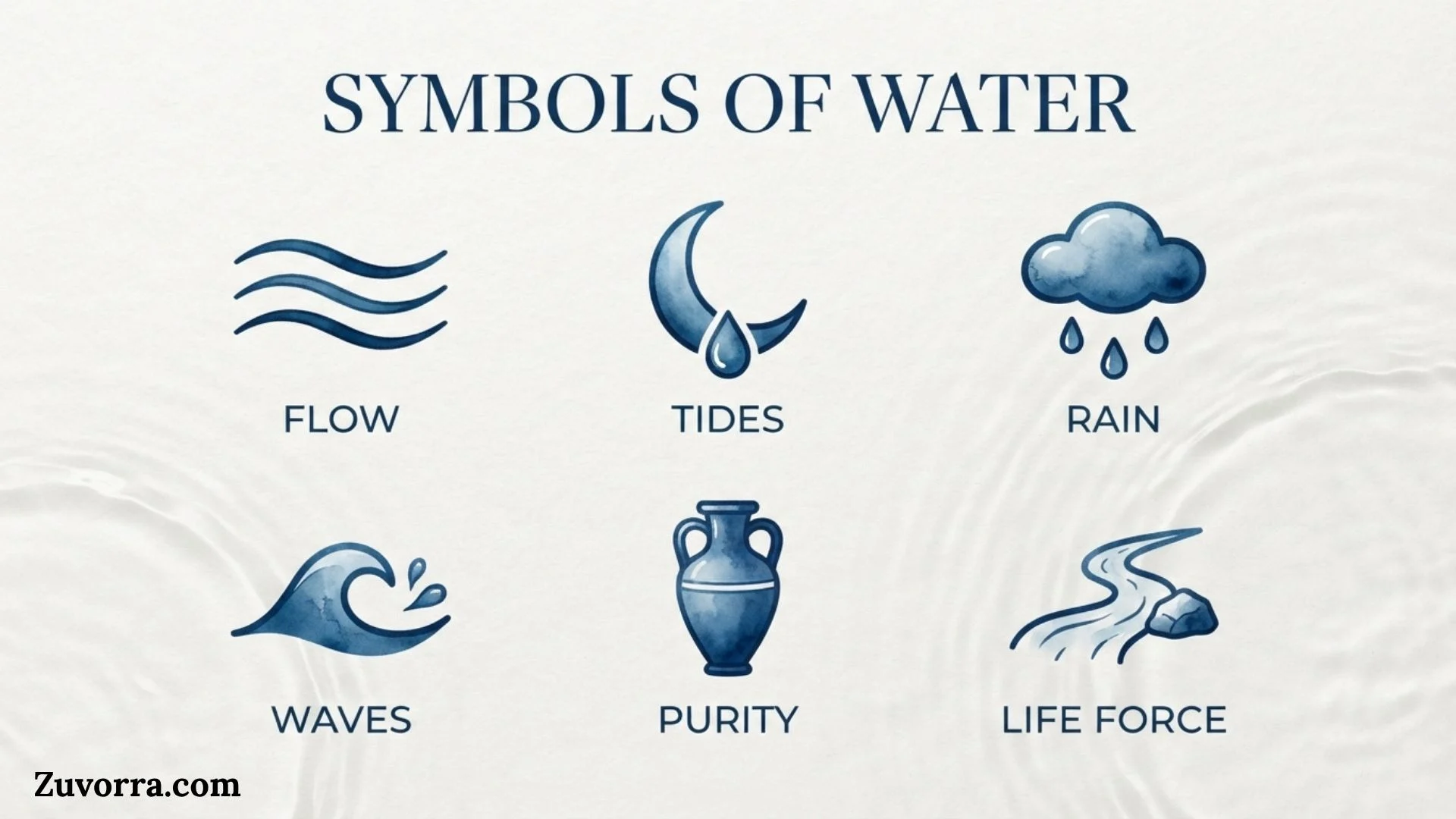
Water is the essential substance of life, shaping the geography of our planet, fueling our biology, and anchoring human consciousness. From the raging ocean currents of ancient mythology to the quiet ripple of a sacred spring, symbols of water have served as humankind’s primary vehicle for expressing purity, transformation, creation, and emotional depth. Across millennia, civilizations have looked to fluid elements to make sense of mortality, divine grace, and the constant flux of existence. Understanding these motifs opens a window into how global cultures conceptualize renewal, sacred boundaries, and the very origin of life.
Quick Meaning
Water symbols universally represent life, purification, fertility, and emotional depth. They embody continuous change, adaptability, and spiritual rebirth, serving as vital emblems across world religions, art, and philosophy to signify both the destructive power of chaos and the sustaining grace of creation.
Symbol Overview Table
| Field | Detail |
| Symbol Name | Symbols of Water (Waves, Rivers, Triple Zigzags, Chalices, Rain Clouds) |
| Primary Meaning | Life, purification, renewal, subconscious emotion, and cyclical transformation |
| Category | Universal Archetype, Elemental Symbol, Religious Iconography |
| Origin | Prehistoric rock art and Neolithic pottery motifs |
| Civilization or Culture | Ancient Mesopotamia, Ancient Egypt, Greco-Roman, Vedic, and Indigenous traditions |
| First Known Use | Circa 5th millennium BCE (Neolithic water bands and wave patterns) |
| Common Usage | Religious rituals, baptismal fonts, weather forecasting icons, art, jewelry, and architecture |
| Modern Meaning | Environmental awareness, emotional fluidity, cleanliness, calmness, and global connectivity |
| Unicode | U+1F30A (Water Wave), U+1F4A7 (Droplet) |
| Emoji Equivalent | |
| Related Symbols | The Crescent Moon, The Chalice, The Fish, The Lotus, The Anchor |
What Does the Symbol Mean?
At its core, a symbol of water communicates the duality of existence: sustenance and destruction, stillness and motion. Because all living things depend on moisture to survive, water iconography instantly triggers psychological associations with nourishment, birth, and physical vitality. Philosophically, water represents the formless state of potential out of which all ordered reality emerges.
When humans depict water—whether as a stylized wave, parallel wavy lines, a sacred vessel, or falling raindrops—they tap into deep-seated intuitions about time and change. Water takes the shape of any container, teaching lessons of resilience, flexibility, and harmony. It also serves as a mirror for the human psyche, where calm surfaces denote mental clarity and turbulent depths symbolize repressed emotions, the unconscious mind, and existential chaos.
History and Origin
The earliest symbols of water emerged in agrarian societies where human survival depended entirely on predictable rainfall and river irrigation. In prehistoric rock art and painted pottery from the Neolithic period, artists depicted water using parallel wavy lines, zigzag patterns, and concentric circles representing ripples.
In ancient Mesopotamia, the god Enki (Ea) was associated with the subterranean fresh waters of Abzu, often depicted with streams of water and fish flowing from his shoulders. Similarly, Ancient Egyptians revered the Nile River through the flood god Hapi, using the Nif and wave glyphs to signify inundation, fertility, and rebirth. As writing systems evolved, Egyptian hieroglyphs utilized a triple-zigzag sign representing flowing water, which later influenced the Phoenician letter Mem, meaning water, and eventually gave rise to the modern alphabetical letter ‘M’.
Symbolism and Interpretation
Traditional Meanings
Traditionally, water signifies divine grace, ritual cleansing, and boundaries between worlds. Many ancient cultures believed that physical bodies of water served as portals to the underworld or the realm of spirits.
Modern Meanings
In contemporary culture, water motifs represent ecological preservation, calm, mental wellness, and global unity. Graphic designers frequently use minimalist wave vectors to denote purity, speed, or fluid digital connectivity.
Positive Symbolism
- Purification: Washing away sin, guilt, or negative energy.
- Renewal: Rebirth, baptism, and fresh starts.
- Adaptability: The ability to navigate life’s obstacles with grace and flexibility.
Negative Symbolism
- Chaos and Destruction: Tsunamis, floods, and deep-sea abysses representing annihilation.
- Uncertainty: Quicksand, drowning, and the treacherous unknown.
Cultural Significance
Different civilizations interpret water symbols through the lens of their unique geographic realities. In arid regions like the Middle East and North Africa, water symbols denote precious life, divine mercy, and paradise (often envisioned as cool, flowing gardens). In contrast, maritime societies such as the ancient Norse and Polynesians viewed water as a vast, untamable realm of adventure, monsters, and ancestral pathways.
In East Asian traditions, particularly Daoism, water is viewed as the ultimate manifestation of the Tao. The Tao Te Ching famously notes that water is the softest substance yet overcomes the hardest rock, epitomizing the power of yielding strength (wu-wei).
Religious or Spiritual Meaning
Water holds a central place in the rituals and cosmologies of nearly every major religion:
- Christianity: Water symbolizes spiritual cleansing, baptism, and eternal life. Holy water is used to bless believers and ward off malevolent forces.
- Hinduism: Rivers, particularly the Ganges, are revered as living goddesses. Bathing in sacred rivers washes away bad karma and purifies the soul.
- Islam: Water is viewed as the source of all life. Ritual ablutions (wudu) purify the body before prayer, reflecting internal spiritual readiness.
- Judaism: The Mikveh is a ritual bath used for spiritual purification, representing a return to a state of primordial potential and rebirth.
- Buddhism: Water bowls offered on shrines symbolize purity, clarity, and the tranquil mind.
Where the Symbol Is Used
- Books: Found in epic poetry and religious texts describing creation myths and floods.
- Maps: Blue contour lines, jagged blue ribbons, and anchor icons denote lakes, rivers, and oceans.
- Road Signs: Blue triangular or rectangular panels signal bridges, flood zones, harbors, and rest stops.
- Technology: Graphical user interfaces use droplet and wave icons for weather apps, audio waveforms, and liquid cooling systems.
- Mathematics: Wave equations and fluid dynamics models utilize stylized Greek letters and vector fields.
- Religion: Baptismal fonts, holy water stoups, and ritual vessels feature prominently in sacred architecture.
- Architecture: Reflecting pools, fountains, and cascading walls incorporate actual water as an architectural symbol of peace.
- Jewelry and Tattoos: Wave bands, raindrop pendants, and Polynesian tatau motifs express personal affinity for the ocean and emotional resilience.
- Logos: Mineral water brands, spa enterprises, and environmental organizations leverage fluid lines to communicate purity and sustainability.
- National Flags: Flags such as those of Tuvalu, Bahamas, and Argentina incorporate blue stripes or waves to represent surrounding oceans and rivers.
- Currency: Banknotes frequently feature watermarks, river scenes, and maritime explorers to denote national heritage.
Common Variations
- The Single Wave (The Great Wave motif): Popularized by Japanese ukiyo-e art, symbolizing monumental power and transient beauty.
- The Triple Zigzag: An ancient geometric representation of flowing streams found in indigenous textiles worldwide.
- The Chalice and Vessel: Containers holding water, symbolizing the receptive, feminine principle of the womb and emotional containment.
- The Droplet: A modern minimalist icon representing purity, conservation, and singular impact.
Common Misconceptions
A frequent misconception is that water symbols exclusively represent tranquility and peace. Historically, water motifs carried immense fear regarding catastrophic floods, divine wrath, and deep-sea monsters like Leviathan or Tiamat. Another misunderstanding is that water represents only the feminine element across all esoteric systems; while often tied to lunar and emotional energies, many solar and sky deities in ancient mythologies were also credited with controlling life-giving rain.
Interesting Facts
- The Alphabetical Legacy: The letter ‘M’ in the Latin alphabet evolved directly from the ancient Egyptian hieroglyph for water waves (nif).
- Global Flood Myths: Almost every major culture, from Mesopotamian to Mesoamerican, features a primordial flood myth, cementing water as an agent of universal reset.
- Daoist Philosophy: Laozi’s comparison of supreme goodness to water highlights how yielding to circumstances ultimately overcomes rigid resistance.
- Sacred Geography: The Ganges River is not merely a geographic entity in Hinduism, but a physical goddess who descended from the heavens to purify earth.
- Celtic Wells: Ancient Celts regarded natural springs and wells as thresholds to the Otherworld, frequently tossing metal offerings into the water.
- Minimalist Weather Icons: The standard triple-line wave symbol used in modern digital weather apps dates back to early meteorological charts of the 19th century.
- Alchemical Triangles: In Western alchemy, the elemental symbol for water is an inverted triangle pointing downward, signifying descending grace and the heavier nature of fluids.
- The Baptismal Shell: Scallop shells are traditionally used to pour baptismal water over infants, symbolizing pilgrimage, rebirth, and spiritual protection.
- Indigenous Rain Dances: Native American rain dances incorporate rhythmic stamping and water-themed chants to mimic falling rain and entreat atmospheric deities.
- Modern Eco-Symbolism: The blue droplet has become an internationally recognized symbol for global freshwater conservation and climate awareness.
Related Symbols
- The Crescent Moon: Often paired with water symbols due to the moon’s gravitational pull governing ocean tides and emotional rhythms.
- The Lotus: Represents spiritual purity and enlightenment, growing out of muddy water while remaining unstained by it.
- The Fish: An ancient Christian and pagan symbol of fertility, abundance, and secret community, intrinsically linked to the aquatic realm.
- The Anchor: Combines maritime utility with steadfast hope, representing stability amidst the shifting waves of life.
Frequently Asked Questions
What do water symbols represent universally?
Water symbols universally represent life, purification, renewal, and emotional depth. Because water is essential for biological survival, cultures across the globe view it as an emblem of physical vitality, spiritual rebirth, and the continuous, cyclical flow of time and existence.
Why is water associated with purification?
Water is naturally cleansing, washing away physical dirt and impurities. Symbolically, this practical function translated into religious rituals such as baptism and ablution, where washing the body signifies washing away spiritual sins, negative karma, and emotional burdens.
Where did the ancient symbol for water originate?
The earliest symbols for water originated in Neolithic art, appearing as parallel wavy lines and zigzag patterns on pottery. These motifs were formalized in ancient Egyptian hieroglyphs as a triple zigzag, which later formed the basis for the Phoenician letter Mem.
What is the alchemical symbol for water?
In Western alchemy, the symbol for water is an inverted triangle pointing downward. This downward-pointing geometry represents the element’s heavy, fluid nature and its tendency to seek the lowest point, contrasting with the upward-pointing triangle of fire.
How do different cultures view water symbolism?
Cultures interpret water based on their environment. Arid civilizations view water as a precious gift, divine mercy, and paradise. Maritime and river-valley cultures view it as a source of trade, sustenance, and mythical power, balancing life-giving floods with destructive tsunamis.
What does water mean in psychological terms?
In Jungian psychology, bodies of water and deep oceans represent the unconscious mind and emotional depths. Calm water signifies mental peace and clarity, while turbulent water, storms, and floods symbolize repressed trauma, anxiety, and overwhelming emotions.
How is water represented in modern design?
In modern design and digital interfaces, water is represented through minimalist wave vectors, droplet icons, and blue color palettes. These visuals are deployed to communicate cleanliness, environmental sustainability, high-tech cooling, and emotional calmness.
Why do flood myths appear in so many cultures?
Flood myths emerge from humanity’s shared historical vulnerability to catastrophic weather events, overflowing rivers, and rising sea levels. Culturally, these stories use water as a symbolic mechanism for wiping away moral corruption and initiating a new epoch of human history.
Key Takeaways
- Universal Archetype: Water symbols embody life, purification, emotional depth, and cyclical transformation across virtually all human civilizations.
- Duality of Meaning: Water represents both nurturing sustenance (fertility, healing, baptism) and catastrophic destruction (floods, chaos, abysses).
- Historical Evolution: From Neolithic pottery waves and Egyptian hieroglyphs to the Phoenician letter Mem, water motifs have shaped human visual communication and written language.
- Spiritual Centrality: Major world religions utilize water in sacred rites to wash away impurities, facilitate rebirth, and connect the physical self with the divine.
- Modern Relevance: Today, water symbols bridge ancient archetypes with contemporary concerns regarding environmental conservation, emotional wellness, and digital design.
Conclusion
Symbols of water transcend simple artistic decoration, acting as profound cultural anchors that connect humanity to its biological roots and spiritual aspirations. From ancient river civilizations washing away sins in sacred currents to modern minimalists utilizing wave vectors for environmental awareness, the fluid iconography of water reminds us of our capacity for adaptation, renewal, and deep emotional resonance. As we navigate an ever-changing world, the timeless wisdom embedded within symbols of water continues to guide our understanding of resilience, purity, and the perpetual cycle of life.

I’m Jasper Huxley, a British writer fascinated by the symbols that communicate ideas without words. I explore their meanings, origins, cultural connections, and everyday uses. From ancient markings to contemporary signs, I enjoy uncovering the stories behind visual language and presenting symbolism in a clear, engaging way for curious readers worldwide.
Books:
- The Hidden Language of Symbols
- Symbols, Signs and Their Meanings
One thought on “Unveiling the Fluid Power: The Profound Depth and History of Symbols of Water”