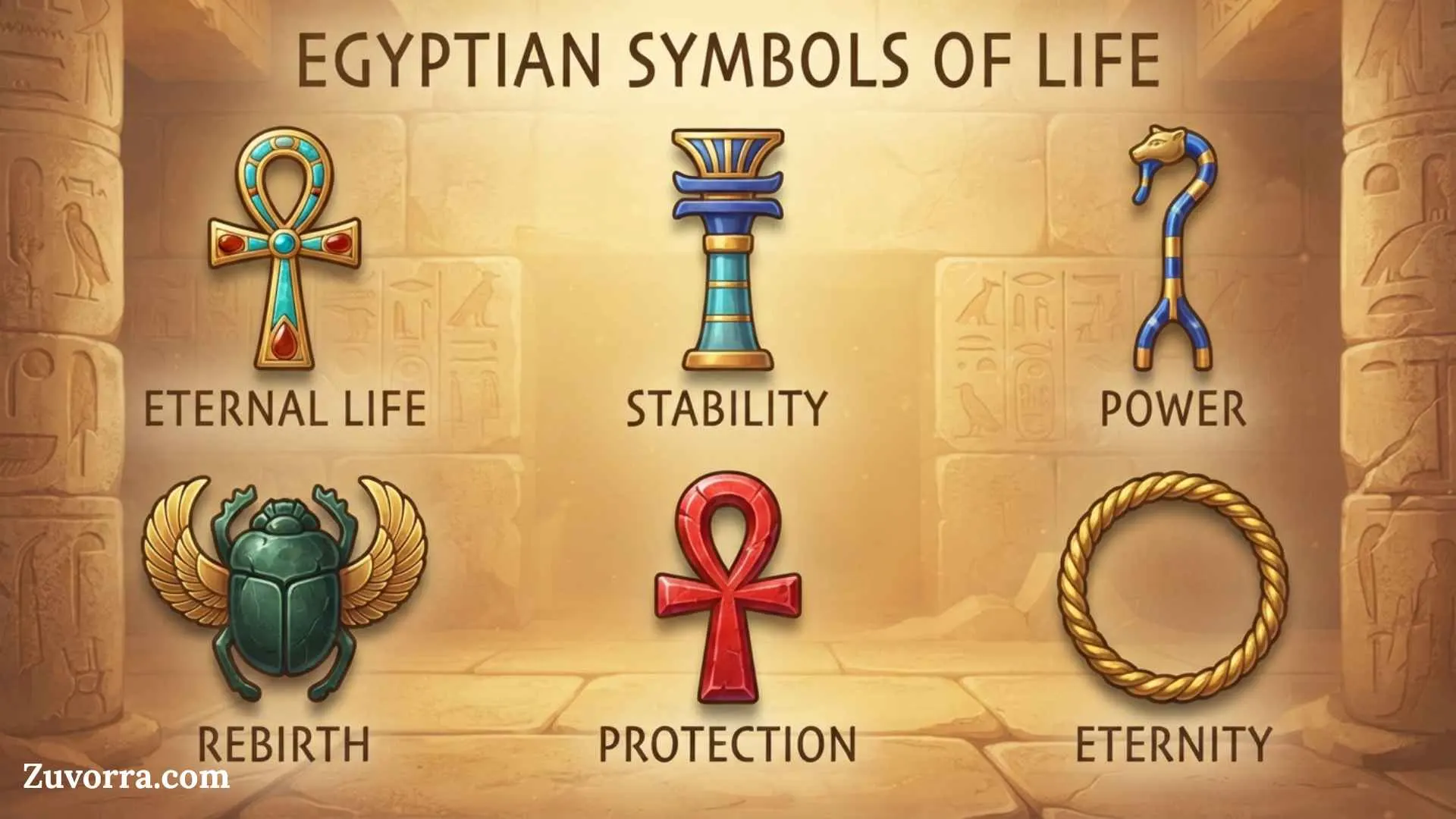
Egyptian symbols of life expressed far more than physical survival. They represented creation, health, fertility, rebirth, divine protection, stability, and the hope of continuing existence after death. The ankh is the clearest and most famous example, but the lotus, scarab, djed pillar, tyet knot, shen ring, and solar disk also carried ideas connected with life and renewal.
You may encounter these symbols in temple reliefs, tomb paintings, hieroglyphic inscriptions, museum collections, jewelry, tattoos, architecture, and modern spiritual art. Understanding them requires looking beyond their shapes. Each symbol belonged to a larger religious system in which the gods maintained life, the Nile renewed the land, and death marked a transition rather than a final ending.
Quick Meaning
Egyptian symbols of life represent existence, vitality, rebirth, protection, stability, and eternal continuation. The ankh directly means “life,” while symbols such as the lotus and scarab express renewal. The djed represents the stability that sustains life, and the tyet suggests divine protection, especially through the goddess Isis.
Egyptian Symbols of Life Overview
| Symbol | Primary Meaning | Religious Association | Historical Use | Common Modern Meaning |
| Ankh | Life and continued existence | Many gods and pharaohs | Hieroglyph, amulet, temple and tomb image | Life, spirituality, immortality |
| Lotus | Rebirth, creation, renewal | Ra, Nefertum, solar creation | Art, architecture, offerings, funerary imagery | Personal growth and new beginnings |
| Scarab | Renewal, transformation, regeneration | Khepri and the rising sun | Amulets, seals, heart scarabs | Transformation and protection |
| Djed pillar | Stability and endurance | Osiris, Ptah | Ritual objects, amulets, temple reliefs | Strength and resilience |
| Tyet knot | Life, protection, divine care | Isis | Funerary amulets and burial texts | Feminine protection and healing |
| Shen ring | Eternity and encircling protection | Gods, kingship, cosmic order | Royal and religious imagery | Eternal protection |
| Solar disk | Life-giving sunlight and creation | Ra, Aten, Horus | Temples, crowns, royal reliefs | Energy, illumination, divine power |
| Papyrus | Life, growth, fertility, Lower Egypt | Creation landscapes and marsh deities | Columns, art, writing materials | Knowledge, nature, prosperity |
| Frog | Fertility and emerging life | Heqet | Amulets and birth-related objects | Fertility, birth, renewal |
| Nile imagery | Agricultural life and abundance | Hapi and Osiris | Temple scenes, offerings, hymns | Fertility, nourishment, continuity |
What Do Egyptian Symbols of Life Mean?
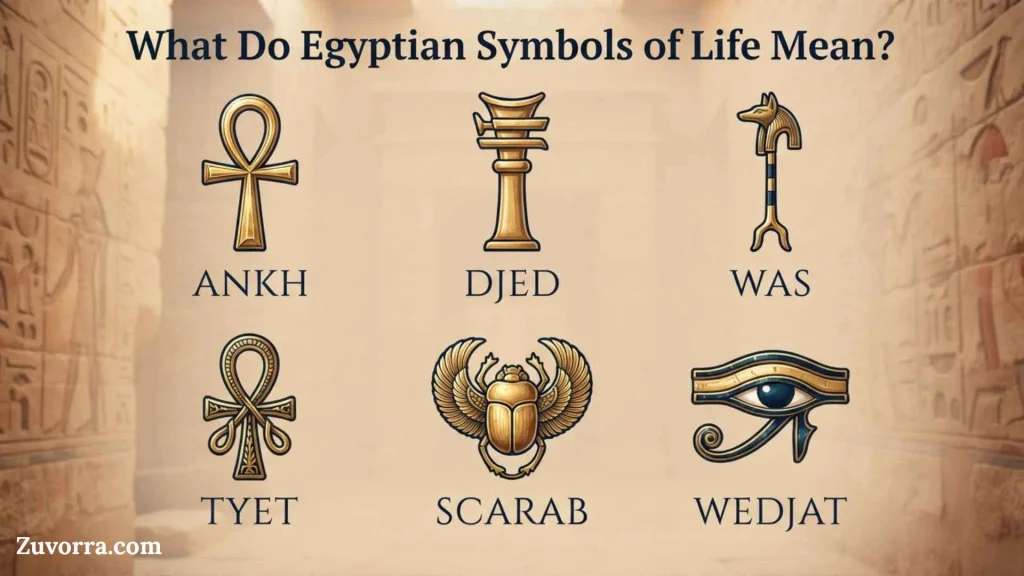
Egyptian symbols of life describe the forces believed to create, preserve, renew, and protect existence. Ancient Egyptians did not usually separate ordinary life, religion, nature, and the afterlife into completely different subjects. Life depended on divine order, called ma’at, as well as sunlight, water, fertile soil, family continuity, proper ritual, and a successful passage into the next world.
The ankh expressed life most directly because it functioned as a hieroglyph for words meaning “life,” “alive,” or “to live.” It also became a broader emblem of life itself. Museum examples show gods carrying the ankh or presenting it to kings, visually communicating the divine gift of vitality.
Other symbols represented conditions that made life possible:
- The sun supplied light, warmth, and a model of daily renewal.
- The Nile made agriculture possible through water and fertile soil.
- The lotus opened with the daylight and became associated with emergence and rebirth.
- The scarab reflected the rising sun and the repeated restoration of life.
- The djed represented stability, permanence, and the strength needed to preserve existence.
- The tyet offered protection through its connection with Isis.
- The shen ring suggested eternity through its unbroken circular form.
Together, these signs reveal that Egyptian life symbolism concerned not only being alive but also remaining whole, protected, ordered, remembered, and capable of renewal.
History and Origin
Life Symbols in Early Egyptian Civilization
Many Egyptian symbols developed from the natural environment of the Nile Valley. The annual agricultural cycle, rising sun, desert horizon, flowering plants, animals, and changing river levels gave Egyptians visible models for creation and renewal.
Some signs appeared during Egypt’s Predynastic or Early Dynastic periods, while others gained fuller religious meanings during the Old, Middle, and New Kingdoms. Their interpretation could also change depending on the god, ruler, ritual, or object with which they appeared.
Egyptian hieroglyphs were not merely decorative pictures. They formed a writing system that used signs as sounds, words, and meaningful images. That flexibility allowed a sign such as the ankh to work linguistically in a written word and symbolically in art. Hieroglyphic writing remained in use for thousands of years, although its meaning was lost to later readers until scholars began deciphering it with the help of the Rosetta Stone.
Development of the Ankh
The exact physical object that inspired the ankh’s shape remains uncertain. Scholars have proposed several possibilities, including a sandal strap, a ceremonial knot, or a combination of male and female elements. None of these theories has been proven conclusively.
What is certain is the sign’s ancient Egyptian meaning. It represented life in writing and became one of the civilization’s most recognizable religious emblems. Surviving Middle Kingdom and New Kingdom objects show that the ankh appeared as a freestanding model, ceremonial implement, amulet, decorative form, and part of royal imagery.
In temple and tomb scenes, a god may hold an ankh toward a pharaoh’s nose. This image is often interpreted as the deity giving the “breath of life.” During the Amarna Period, rays from the Aten were shown ending in hands, and some of those hands offered ankhs to Akhenaten and his family.
Life, Death, and Continuity
Ancient Egyptians did not usually treat death as the total destruction of the person. Their funerary traditions aimed to preserve identity, restore the deceased, and allow continued existence in the afterlife. The body, name, heart, spiritual aspects, and social memory all mattered.
This belief explains why symbols of life appear so often in tombs. An ankh placed on a coffin or funerary object did not deny death. It expressed the wish that life would continue in another form. British Museum examples include funerary figures holding ankhs to represent the desired life after death.
Symbolism and Interpretation
Traditional Meaning
The traditional interpretation of Egyptian life symbols centers on divine vitality. The gods possessed life and could grant it to kings, the dead, and the wider world. A pharaoh shown receiving an ankh was not simply receiving good health. The scene affirmed divine approval, legitimate rule, and the continuation of ordered society.
Life symbols also operated in combinations. The ankh frequently appears beside the djed and was scepter. In that group:
- Ankh means life.
- Djed means stability or endurance.
- Was represents power, authority, or dominion.
Together, the signs communicate a complete royal blessing: life, stability, and power. The Metropolitan Museum of Art identifies this combination as a powerful set of wishes offered between a god and a king.
Positive Symbolism
Most Egyptian life symbols carry constructive meanings:
- Vitality: the energy needed to live and act.
- Health: physical and spiritual well-being.
- Fertility: the creation of children, crops, and abundance.
- Protection: defense against illness, chaos, danger, and spiritual harm.
- Renewal: restoration after decline, sleep, drought, or death.
- Continuity: the survival of a person, family, kingdom, or cosmic order.
- Resilience: the ability to remain stable during change.
- Transformation: movement into a renewed state of being.
These meanings were often interconnected rather than separate. For example, a scarab could express solar rebirth, magical protection, and personal regeneration at the same time.
Negative or Cautionary Interpretations
Ancient Egyptian life symbols were not generally negative. However, modern interpretation can become misleading when symbols are removed from their historical context.
A life symbol placed in a funerary setting does not necessarily indicate fear, death worship, or occult danger. It often expresses restoration and continued existence. Similarly, the djed does not represent stagnation simply because it means stability. In its Egyptian context, stability was necessary for life and cosmic order.
The strongest caution concerns invented meanings. Modern websites sometimes assign specific romantic, psychological, or supernatural meanings to every shape and color. These claims should not be treated as ancient facts unless they are supported by inscriptions, archaeological context, or reputable museum research.
Psychological Interpretation
From a modern psychological perspective, Egyptian life symbols can represent human responses to uncertainty and mortality. Their repeated patterns make invisible ideas easier to imagine:
- A circle suggests continuity.
- A flowering plant represents growth.
- A rising sun suggests another chance.
- A strong pillar conveys emotional endurance.
- A protective knot represents security and connection.
These are modern interpretive observations, not proven ancient psychological theories. They help explain why old symbols still feel meaningful, but they should remain separate from historically documented Egyptian beliefs.
Major Egyptian Symbols of Life
The Ankh: The Direct Symbol of Life
The ankh is the most literal Egyptian symbol of life. It consists of a vertical stem, a horizontal bar, and a loop at the top. In hieroglyphic writing, it represented life and related words.
Gods such as Isis, Osiris, Ra, Hathor, and Amun may be shown holding ankhs. Pharaohs also carry or receive them. The Egyptian Museum in Cairo, for example, describes a statue of Isis in which the goddess holds an ankh in her right hand.
The ankh can represent:
- Earthly life
- Divine life
- Breath and vitality
- Royal legitimacy
- Life after death
- The continuing power of the gods
The common name “key of life” is a useful modern description, but it is not a literal translation of the Egyptian word. Its key-like appearance probably helped that title become popular.
The Lotus: Rebirth and Creation
The Egyptian lotus, especially the blue water lily commonly called a lotus, became a symbol of rebirth because it opens in daylight and closes at night. Its movement seemed to repeat the solar cycle.
Creation traditions sometimes described the young sun emerging from a primordial flower. The god Nefertum was closely associated with the lotus, beauty, fragrance, and the rising sun. Lotus forms appeared in temple columns, cups, jewelry, funerary objects, banquet scenes, and images of offerings.
Its life meanings include:
- Birth from the primeval waters
- Daily renewal
- Youth and beauty
- Purification
- Solar rebirth
- Awakening after death
Modern use often reduces the lotus to general “spiritual awakening.” That meaning is possible as a personal interpretation, but the Egyptian lotus carried specific associations with creation, sunlight, fragrance, and regeneration.
The Scarab: Regeneration and Transformation
The scarab symbol developed from the dung beetle, whose behavior ancient Egyptians connected with the movement of the sun. The god Khepri, whose name relates to becoming or coming into existence, represented the morning sun and repeated creation.
Scarab amulets were among the most common Egyptian protective objects. They appeared as seals, jewelry, commemorative objects, and funerary amulets. Heart scarabs had a special role in burials, where they were associated with the deceased person’s heart and judgment in the afterlife.
The scarab therefore represents:
- Becoming
- Renewal
- Self-generation
- Solar resurrection
- Transformation
- Protective regeneration
It should not be interpreted merely as a symbol of “good luck.” Its deeper meaning concerns the mysterious return of life and the daily re-creation of the world.
The Djed Pillar: Stability That Sustains Life
The djed is a column-like sign with several horizontal bars near the top. Its central meaning is stability, endurance, and permanence. It later became strongly connected with Osiris and was sometimes interpreted as his backbone.
The ceremony known as the Raising of the Djed symbolically restored order and royal power. Because Osiris was associated with death, regeneration, kingship, and the fertile land, raising the pillar could suggest renewed life after collapse.
The djed differs from the ankh:
- The ankh represents life itself.
- The djed represents the stable foundation that allows life and order to continue.
Modern wearers often choose the djed as a symbol of resilience, inner strength, or recovery.
The Tyet Knot: Life and the Protection of Isis
The tyet resembles an ankh with arms that curve downward. It is commonly called the Knot of Isis or Girdle of Isis, although its original form and precise early meaning remain debated.
In funerary use, it was connected with Isis, her protective power, and the restoration of Osiris. Tyet amulets were often made from red materials, possibly relating to the blood, power, or protective magic of the goddess.
The tyet may represent:
- Divine protection
- Regeneration
- Maternal care
- The life-giving power of Isis
- Restoration after death
Although the tyet and ankh look similar, they are distinct signs with different religious associations.
The Shen Ring: Eternal Protection
The shen sign appears as a looped rope or circle with a short tangent line. Its closed form represented encirclement, completeness, eternity, and protection.
When stretched into a longer oval, the idea contributed to the form known as the cartouche, which enclosed royal names. Surrounding the king’s name symbolically protected the ruler’s identity and continued existence.
The shen ring connects with life because eternal protection preserves the person, name, and royal order across time.
The Sun and Solar Disk: Life-Giving Energy
The sun was essential to Egyptian religion because it visibly brought light, heat, time, and agricultural energy. Solar gods such as Ra and Khepri represented different aspects of the sun’s daily journey.
The solar disk could appear alone or as part of a deity’s crown. In Amarna art, the Aten appeared as a disk whose rays ended in hands, sometimes offering the ankh to the royal family. This combined sunlight and life into a single visual statement.
Solar imagery represents:
- Creation
- Illumination
- Divine vitality
- Daily renewal
- Royal authority
- The victory of order over darkness
Papyrus and Nile Plants: Growth and Fertility
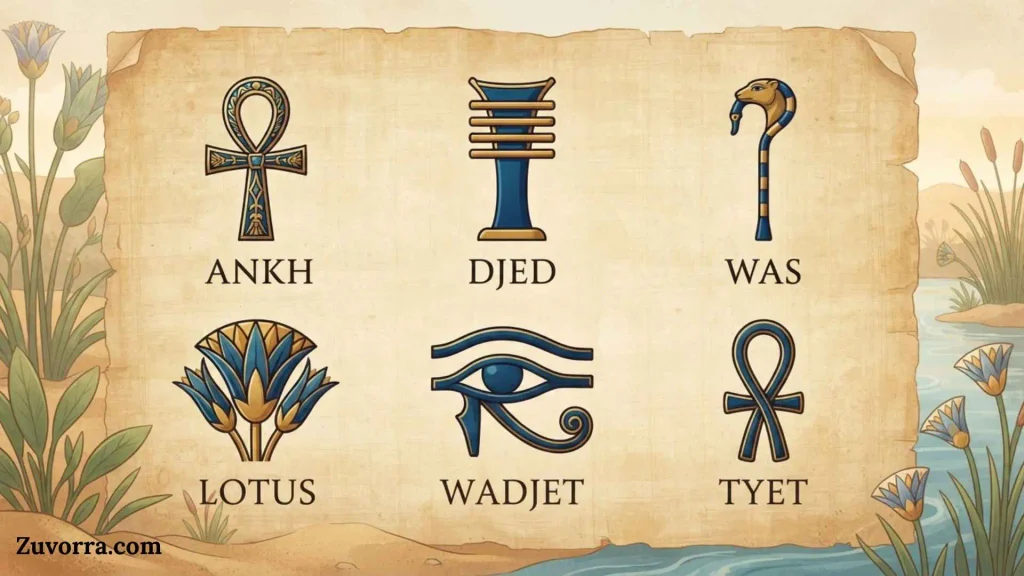
Papyrus grew abundantly in the marshes of Lower Egypt. Its green color, rapid growth, and connection with water made it a natural sign of freshness and life.
Papyrus plants appeared in architecture, furniture, boats, writing materials, and scenes of marshland abundance. Papyrus-shaped columns transformed temples into symbolic landscapes of creation.
Because life in Egypt depended on the Nile, aquatic plants represented more than decoration. They evoked the fertile environment from which ordered life emerged.
Frogs and the Goddess Heqet: Birth and New Life
Frogs appeared in large numbers after the Nile’s waters receded, making them powerful signs of fertility and emerging life. The frog-headed goddess Heqet was associated with childbirth, pregnancy, and the animation of new beings.
Frog amulets could therefore express wishes for:
- Safe childbirth
- Fertility
- New beginnings
- Protection of mothers and infants
- The renewal of nature
This symbolism came from direct observation of the Nile environment rather than from an abstract belief alone.
Cultural Significance
Egyptian life symbols developed within ancient Egypt, but their influence extended far beyond the Nile Valley. Trade, conquest, migration, religious exchange, and later fascination with Egyptian antiquity introduced them to other societies.
Nubia and the Wider Nile Valley
Egyptian and Nubian cultures interacted for centuries. Symbols such as the ankh appeared in the art of Kushite rulers, who adopted and adapted elements of Egyptian religion and kingship. Their use should not be dismissed as simple imitation. Nubian rulers employed Egyptian visual language to express their own authority and sacred legitimacy.
Greek and Roman Egypt
After Alexander the Great and during Roman rule, Egyptian gods and symbols continued to attract worshippers. Isis became especially popular across the Mediterranean. Egyptian imagery appeared alongside Greek and Roman artistic forms, producing new combinations without erasing its original roots.
Coptic Christianity
The looped crux ansata, a cross resembling the ankh, appeared in Christian Egypt. The relationship between the ankh and some early Coptic cross forms remains an important example of symbolic continuity and adaptation. The Metropolitan Museum notes that an ankh-shaped form was used in Byzantine Egypt as an alternative form of the Christian cross.
This does not mean the ancient ankh and Christian cross always had identical meanings. Rather, the familiar Egyptian form could be reinterpreted within a new religious setting.
Modern African and African Diaspora Identity
In the modern period, the ankh has become an emblem of African heritage, cultural pride, continuity, and connection with ancient civilization. It appears in jewelry, clothing, music, political art, and community symbolism.
Modern use may combine historical Egyptian meaning with contemporary ideas about identity and empowerment. That newer meaning is culturally important, even though it should not be presented as identical to every ancient interpretation.
Religious and Spiritual Meaning
Egyptian life symbols belonged to a sacred system in which gods generated and maintained the world. Their religious value came from their connection with divine action.
The ankh was often held by a god because life ultimately came from the divine realm. The scarab represented Khepri’s daily act of bringing the sun into renewed existence. The lotus linked creation with the first sunrise. The djed embodied the restored stability of Osiris. The tyet called upon Isis’s protective and regenerative power.
Amulets did not function only as decorative reminders. Egyptians believed properly made and ritually empowered objects could participate in the qualities they represented. An ankh amulet could convey life; a wedjat eye could promote healing and restoration; a djed could provide stability. The Metropolitan Museum describes Egyptian amulets as miniature forms of deities, animals, objects, and symbols that carried protective or beneficial power.
Modern spiritual interpretations often focus on balance, life energy, reincarnation, or inner awakening. These uses may be personally meaningful, but claims about ancient practice should be checked against evidence. Not every modern mystical teaching comes from historical Egyptian religion.
Scientific, Linguistic, and Digital Meaning
Egyptian life symbols do not have standard scientific, mathematical, engineering, or medical functions. Their importance lies mainly in archaeology, Egyptology, linguistics, art history, religious studies, and cultural history.
In linguistics, the ankh is significant as a hieroglyph that could represent a word or concept related to living. Scholars commonly transliterate the Egyptian consonants as ꜥnḫ, although simplified spellings such as ankh are more familiar to general readers.
The ankh also has a Unicode hieroglyphic character: 𓋹. Its Unicode name is Egyptian Hieroglyph S034. Display depends on whether a device or website supports Egyptian hieroglyphic fonts.
There is no official ankh emoji. Users commonly substitute:
- ✝ for a cross, though its religious meaning differs
- ☥ for the ankh-like Coptic or Egyptian cross character
- 𓋹 for the actual encoded Egyptian hieroglyph
- Egyptian-themed images or custom icons
Where Egyptian Symbols of Life Are Used
Today, life symbols appear in both historical and modern settings.
Temples and Tombs
Ancient reliefs show gods presenting life, power, and stability to kings. Tombs use the same symbols to support rebirth and continued existence.
Amulets and Jewelry
Ancient Egyptians wore or buried small symbolic objects for protection and blessing. Modern necklaces, rings, bracelets, and earrings often reproduce the ankh, scarab, lotus, or Eye of Horus.
Architecture
Lotus and papyrus columns evoked the marshland of creation. Djed forms and protective signs also appeared in temple decoration and funerary structures.
Art and Literature
Painters, sculptors, illustrators, filmmakers, and novelists use Egyptian symbols to suggest mystery, immortality, power, ancient wisdom, or resurrection. Such works may combine authentic imagery with fictional meanings.
Tattoos
Common choices include:
- Ankh for life or immortality
- Lotus for rebirth
- Scarab for transformation
- Djed for resilience
- Tyet for protection
- Ankh and Eye of Horus together for life and healing
Before choosing a tattoo, identify the exact sign and understand its documented meaning. Combining unrelated symbols solely because they look Egyptian can create an inaccurate design.
Logos and Popular Culture
Egyptian symbols appear in fashion, music, games, films, wellness branding, and spiritual businesses. Their modern meaning depends on context and may differ greatly from ancient usage.
Common Variations and Similar Designs
Plain and Decorated Ankhs
Some ankhs have simple outlines. Others include floral patterns, royal names, gods, wings, or combinations with the djed and was scepter.
Ankh and Tyet
The ankh has a straight horizontal crossbar. The tyet usually has arms that curve downward. Confusing them erases the tyet’s close relationship with Isis.
Ankh and Christian Cross
Both have vertical and horizontal elements, but the ankh has a loop at the top. Their histories and religious meanings differ, even though later Egyptian Christianity sometimes adapted looped cross forms.
Scarab and Ordinary Beetle Images
A scarab amulet may include inscriptions, royal names, geometric bases, wings, or solar disks. Not every beetle image automatically carries the same ritual meaning.
Lotus and Water Lily
What popular writing calls the “Egyptian lotus” is often botanically a water lily. The familiar name remains common in discussions of Egyptian symbolism, but careful writing should acknowledge the distinction.
Common Misconceptions
“The Ankh Was Only a Symbol of Immortality”
The ankh represented life broadly, including present vitality, divine life, and continued existence after death. Immortality is only part of its meaning.
“Its Shape Has One Proven Origin”
No single theory about the ankh’s physical origin has gained universal acceptance. Claims that it definitely represents a womb, sandal strap, sunrise, or sexual union go beyond the available evidence.
“Every Egyptian Symbol Had One Fixed Meaning”
Symbols gained meaning through context. A lotus in a banquet scene, a creation image, and a funerary painting may emphasize different aspects of renewal.
“Egyptians Worshipped Death”
Egyptian funerary culture focused heavily on preservation, restoration, memory, and continued life. Elaborate tomb practices reflect a strong concern with life beyond death rather than a simple fascination with dying.
“The Eye of Horus Means Life”
The Eye of Horus relates most directly to healing, restoration, protection, and wholeness. It supports life, but it is not the direct hieroglyph for life as the ankh is.
“All Modern Meanings Are Ancient”
Modern ideas such as personal empowerment, romantic unity, energy healing, and cultural identity may be valid contemporary uses. They should not automatically be labeled ancient Egyptian beliefs.
How to Choose the Right Egyptian Life Symbol
Use this simple guide:
Do you want the most direct symbol of life?
Choose the ankh.
Do you want a symbol of recovery or new beginnings?
Choose the lotus or scarab.
Do you want strength during hardship?
Choose the djed pillar.
Do you want a symbol connected with Isis and protection?
Choose the tyet knot.
Do you want eternity and complete protection?
Choose the shen ring.
Do you want fertility, birth, or emerging life?
Choose the frog of Heqet, papyrus, or Nile imagery.
The best choice depends on the meaning you want to express, not simply which design looks most attractive.
Interesting Facts About Egyptian Symbols of Life
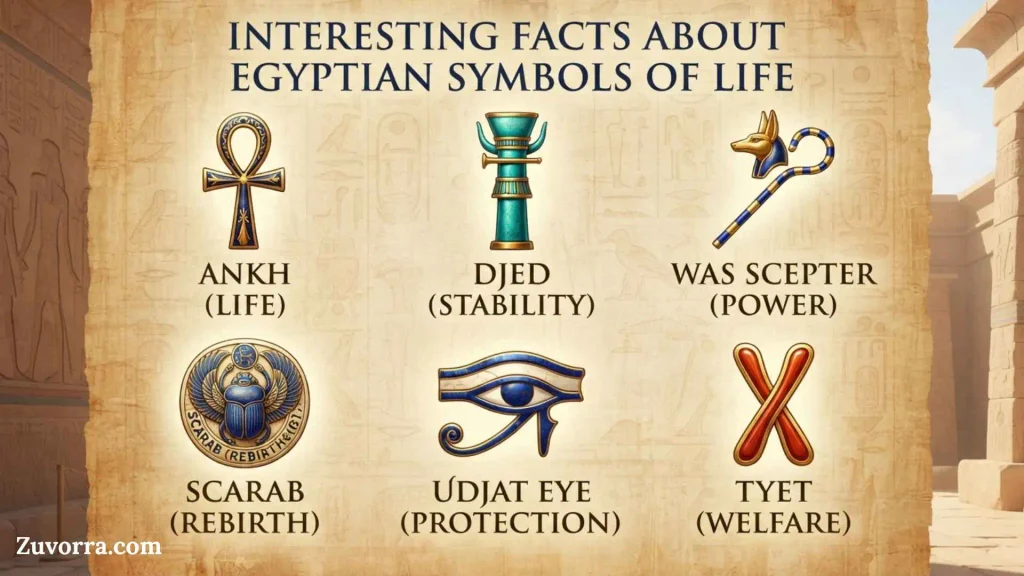
- The ankh was both a written word and a sacred image.
It could function inside hieroglyphic text while also appearing as an object held by a god. - Egyptian gods often offered life through the nose.
In some reliefs, an ankh is placed near a ruler’s nostrils, suggesting breath and divine vitality. - Life, stability, and power formed a symbolic trio.
The ankh, djed, and was scepter often appeared together as a complete royal blessing. - The lotus represented creation as well as rebirth.
It did not merely symbolize personal growth. It could evoke the first emergence of the sun from the primeval waters. - The scarab expressed an Egyptian idea of “becoming.”
Its connection with Khepri made it a sign of existence repeatedly forming itself anew. - Some royal names included the word ankh.
The best-known example is Tutankhamun, whose name can be translated approximately as “living image of Amun.” - The djed was raised during ritual ceremonies.
Physically raising the pillar represented the restoration of stability, kingship, and ordered life. - The tyet and ankh are often confused.
Their shapes are related visually, but the tyet’s curved arms and connection with Isis give it a separate identity. - Egyptian symbols could be combined into visual sentences.
Artists placed signs together so that an image communicated a blessing, royal title, or religious idea. - A symbol’s material could strengthen its meaning.
Green and blue materials suggested growth, water, vegetation, and renewal, while gold evoked the imperishable flesh of the gods and the brilliance of the sun. - Life symbols appeared on everyday objects.
The ankh shape was used in items such as cosmetic spoons, showing that sacred imagery could enter practical and domestic design. - The ankh survived through reinterpretation.
Its form influenced later Egyptian religious art and remains active in jewelry, cultural identity, fashion, and spiritual symbolism today.
Related Egyptian Symbols
Eye of Horus
The Eye of Horus represents healing, protection, restoration, and wholeness. It differs from the ankh because it protects and repairs life rather than directly spelling or embodying life.
Was Scepter
The was scepter represents authority, power, and dominion. It often appears with the ankh and djed, completing a symbolic blessing of life, stability, and power.
Uraeus Cobra
The upright cobra represents royal authority and divine protection. It commonly appears on royal crowns and protects the pharaoh from enemies.
Feather of Ma’at
The feather represents truth, justice, balance, and cosmic order. Since life depended on ma’at, the feather symbolized the ethical and cosmic structure that kept creation functioning.
Sa Symbol
The sa sign is associated with protection. It may appear with deities connected to childbirth and household safety, making it relevant to the preservation of life.
Cartouche
A cartouche encloses a royal name. Its protective boundary helped preserve the king’s identity, which was essential to continued existence in Egyptian thought.
Ouroboros
The serpent biting its tail represents cyclical continuity and cosmic renewal in later Egyptian and Mediterranean imagery. It differs from the ankh by emphasizing endless cycles rather than life as a bestowed divine quality.
Frequently Asked Questions
What is the main Egyptian symbol of life?
The ankh is the main Egyptian symbol of life. It served as a hieroglyph for life and related words, and it appeared in temple scenes, tomb art, amulets, jewelry, and ceremonial objects. Gods often carried it or offered it to pharaohs as a sign of divine vitality and continued existence.
What does the ankh symbol look like?
The ankh has a vertical stem, a horizontal crossbar, and an oval or teardrop-shaped loop at the top. It resembles a cross with a handle. Designs range from plain outlines to highly decorated versions containing royal names, wings, gods, floral details, or additional hieroglyphic symbols.
Does the ankh mean eternal life?
The ankh can represent eternal life, but its meaning is broader. It also refers to ordinary life, divine vitality, breath, health, and the state of being alive. In funerary settings, it expresses continued life after death; in temple scenes, it may represent life granted by a deity.
Is the Eye of Horus a symbol of life?
The Eye of Horus supports the idea of life through healing and restoration, but it is not the direct Egyptian sign for life. Its main meanings include protection, recovery, wholeness, and the restoration of what has been damaged. The ankh remains the clearest symbol specifically meaning life.
Which Egyptian symbol means rebirth?
The lotus and scarab are the strongest Egyptian symbols of rebirth. The lotus opens with the daylight and became connected with solar creation. The scarab represents the morning sun, transformation, and repeated becoming through its association with Khepri.
What Egyptian symbol represents strength and stability?
The djed pillar represents stability, endurance, and lasting strength. It became closely associated with Osiris and was interpreted as his backbone. The djed is suitable for expressing resilience because it symbolizes the firm support that allows life, authority, and cosmic order to continue.
What is the difference between the ankh and the tyet?
The ankh has a straight crossbar and directly represents life. The tyet has downward-curving side elements and is associated with Isis, divine protection, and regeneration. Although they look similar, they had separate names, forms, and religious roles in Egyptian symbolism.
Can anyone wear an ankh?
Anyone can wear an ankh, but respectful use begins with understanding its Egyptian origin and meaning. It may represent life, African heritage, spirituality, or personal renewal. Avoid presenting invented claims as ancient facts, and consider the symbol’s importance in both Egyptian history and modern African cultural identity.
Is there an ankh emoji?
There is no standard colorful ankh emoji. However, the characters ☥ and 𓋹 may display on supported devices. The second is the encoded Egyptian ankh hieroglyph. Its appearance depends on the operating system, browser, app, and installed fonts.
What Egyptian symbol should I choose for a tattoo?
Choose an ankh for life, a lotus for rebirth, a scarab for transformation, a djed for stability, or a tyet for protection linked with Isis. Verify the design before tattooing it, especially when using hieroglyphs. Small changes in orientation or form can create a different sign or an inaccurate inscription.
Key Takeaways
- The ankh is the most direct and widely recognized Egyptian symbol of life.
- Egyptian life symbolism included vitality, health, fertility, protection, stability, rebirth, and existence after death.
- The lotus represents creation and renewal, while the scarab expresses transformation and solar regeneration.
- The djed symbolizes stability, and the tyet conveys the protective power of Isis.
- Egyptian symbols gained meaning from their placement, associated deity, material, color, and ritual context.
- Funerary symbols usually expressed restoration and continued life rather than a fascination with death.
- Modern meanings may be valuable, but they should be distinguished from historically documented interpretations.
- Understanding the exact symbol helps prevent inaccurate tattoos, designs, and cultural claims.
Conclusion
Egyptian symbols of life reveal a civilization deeply concerned with preserving vitality, restoring order, and continuing existence across time. The ankh gave life a recognizable form, while the lotus, scarab, djed, tyet, shen ring, sun, and Nile landscape explained how life begins, survives, changes, and returns.
These symbols remain powerful because they address experiences that still matter: birth, health, loss, recovery, identity, stability, and hope. When understood in their historical and religious settings, Egyptian symbols of life become more than attractive ancient designs. They form a visual language of creation, protection, resilience, and renewal.
References
- The Metropolitan Museum of Art. “Ceremonial Implement in the Shape of an Ankh.” Museum collection record explaining the ankh’s hieroglyphic and symbolic meaning.
- The British Museum. “Ancient Egypt: Symbols of the Pharaoh.” Educational resource describing the ankh as the hieroglyphic word and symbol for life.
- The Metropolitan Museum of Art. “Ancient Egyptian Amulets.” Overview of the forms, functions, and protective roles of Egyptian amulets.
- The Egyptian Museum in Cairo. “Greywacke Seated Statue of Isis.” Collection entry showing Isis holding an ankh as a symbol of life.
- The British Museum. Collection object describing a combined amulet of ankh, djed, was, and heh signs.
- The Metropolitan Museum of Art. “Ankh, Djed, Was on Neb Basket.” Collection record explaining the combined wishes of life, stability, and dominion.
- The Metropolitan Museum of Art. “Akhenaten Sacrificing a Duck.” Collection record describing Aten’s rays offering the ankh to the king.
- The British Museum. “How Egyptian Hieroglyphs Were Decoded.” Historical overview of the hieroglyphic writing system and its decipherment.
I’m Jasper Huxley, a British writer fascinated by the symbols that communicate ideas without words. I explore their meanings, origins, cultural connections, and everyday uses. From ancient markings to contemporary signs, I enjoy uncovering the stories behind visual language and presenting symbolism in a clear, engaging way for curious readers worldwide.
Books:
- The Hidden Language of Symbols
- Symbols, Signs and Their Meanings