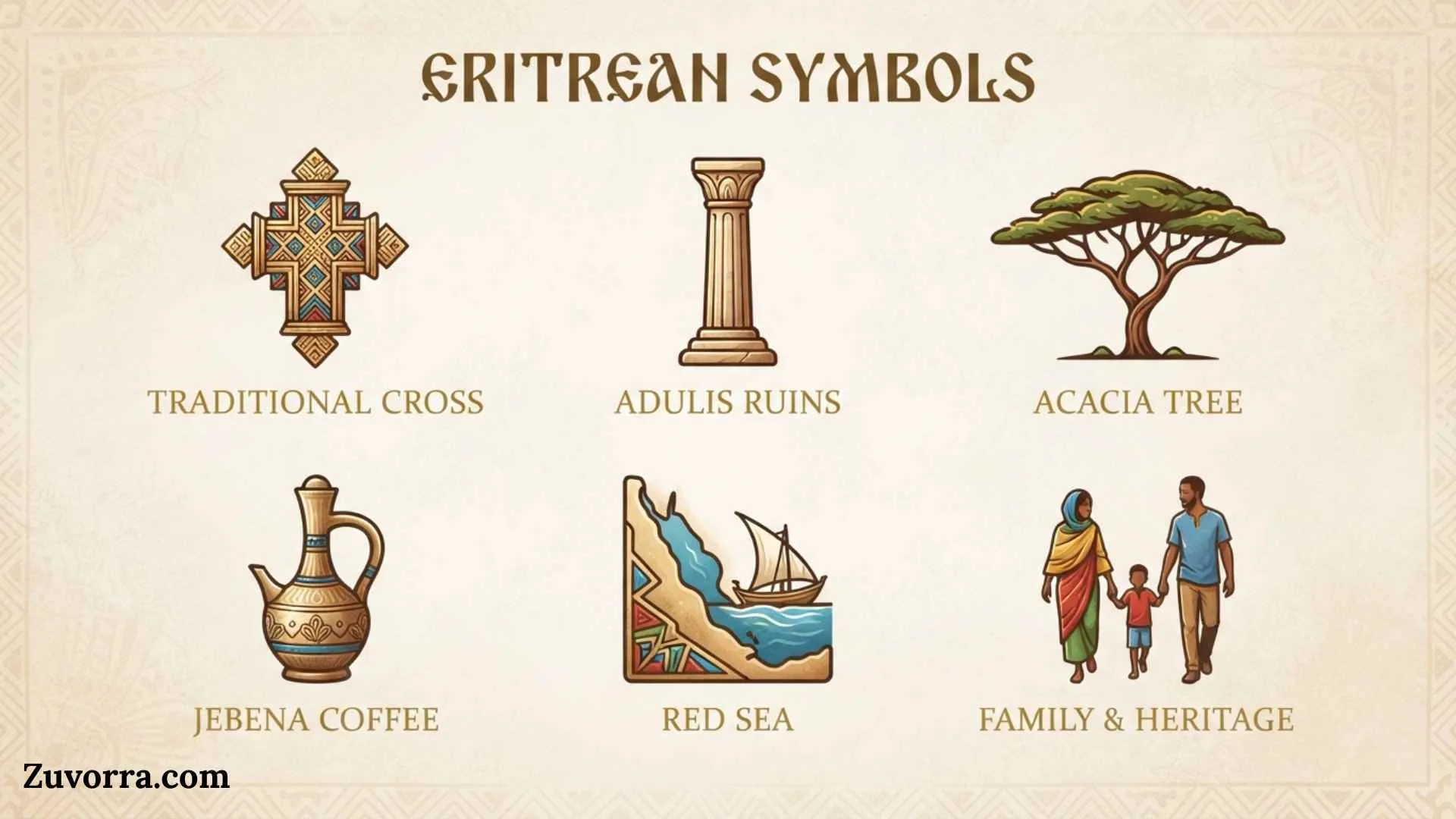
Eritrean symbols express the country’s history, independence, faith, geography, and cultural diversity. The best-known examples are the national flag, the olive wreath, and the camel emblem. Together, they represent sacrifice, peace, resilience, agriculture, the Red Sea, and the long struggle for self-determination.
Yet Eritrean symbolism extends beyond official emblems. Religious crosses, crescents, traditional coffee utensils, woven clothing, Geʽez script, musical instruments, jewelry, and architectural forms also communicate identity. These symbols appear on flags, government documents, currency, clothing, places of worship, independence celebrations, family ceremonies, artwork, and diaspora community events.
Quick Meaning
Eritrean symbols represent national independence, peace, endurance, cultural diversity, religious faith, and attachment to the land and Red Sea. The flag’s colors recall agriculture, the sea, and the independence struggle. Its olive wreath symbolizes peace, while the national camel emblem honors resilience, mobility, and the role of camels in Eritrean life and liberation history.
Eritrean Symbols Overview Table
| Symbol | Primary Meaning | Category | Origin or Context | Common Use Today |
| Eritrean national flag | Independence, sacrifice, peace, land, and sea | National | Adopted after independence and revised in 1995 | Government buildings, schools, public events, international representation |
| Olive wreath and branch | Peace, unity, reconciliation, and historical continuity | National and political | Adapted from Eritrea’s 1952 flag | National flag, public art, commemorative materials |
| Thirty olive leaves | Thirty-year independence struggle | Historical | Associated with the armed struggle from 1961 to 1991 | Flag interpretation, national education, remembrance |
| Camel emblem | Endurance, transport, survival, and liberation | National and cultural | Adopted with independence in 1993 | Official emblem, state publications, civic imagery |
| Green triangle | Agriculture, livestock, fertility, and the land | National | Modern flag symbolism | National flag |
| Blue triangle | The Red Sea and marine resources | National and geographic | Modern flag symbolism | National flag |
| Red triangle | Sacrifice and the independence struggle | National and historical | Linked to the liberation movement | National flag |
| Gold color | Dignity, peace, value, and national hope | National | Used for the olive emblem | Flag and ceremonial designs |
| Eritrean Orthodox cross | Christian faith, protection, and sacred tradition | Religious | Ancient Horn of Africa Christian heritage | Churches, manuscripts, jewelry, processions |
| Crescent and star | Islamic faith and community identity | Religious | Islamic cultural tradition | Mosques, religious art, jewelry, celebrations |
| Geʽez script | Literary heritage, faith, language, and continuity | Linguistic and religious | Ancient writing tradition of the Horn of Africa | Tigrinya writing, religious texts, art, tattoos |
| Jebena coffee pot | Hospitality, conversation, respect, and community | Social and cultural | Horn of Africa coffee tradition | Homes, ceremonies, restaurants, cultural displays |
| Mesob basket table | Sharing, family unity, and hospitality | Domestic and artistic | Regional basket-weaving tradition | Meals, interior decoration, ceremonies |
| Krar lyre | Music, storytelling, emotion, and memory | Artistic | Long-established regional musical tradition | Performances, celebrations, cultural education |
What Do Eritrean Symbols Mean?
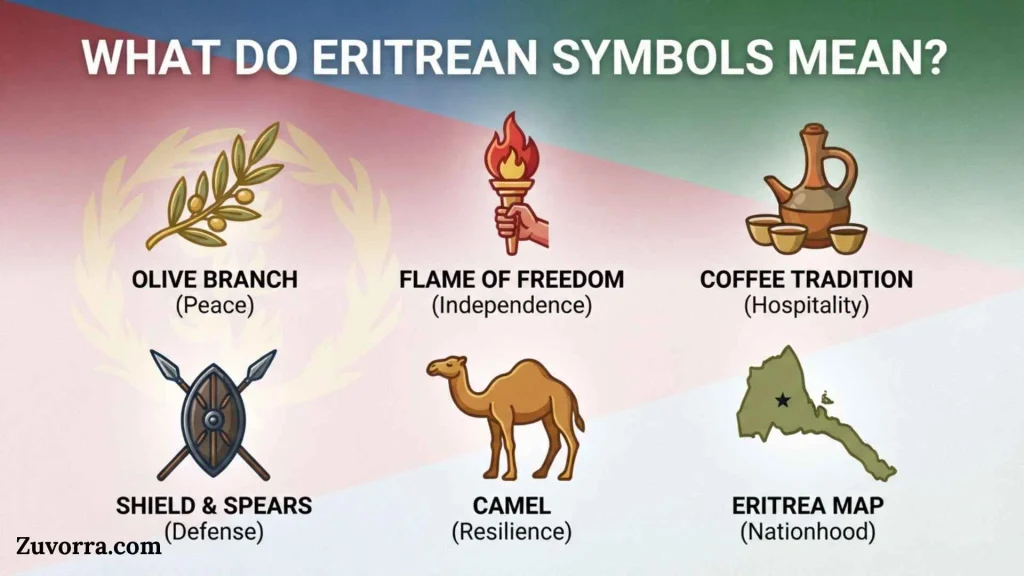
Eritrean symbols communicate several connected ideas rather than one single meaning. At the national level, they tell the story of a country shaped by the Red Sea, farming and pastoral life, colonial rule, federation, annexation, armed struggle, and independence.
Three themes appear repeatedly:
- Sacrifice and liberation: Red, commemorative monuments, martyrs’ imagery, and independence symbols remember those who participated in or suffered during the struggle.
- Peace and rebuilding: The olive branch turns attention from war toward reconciliation, stability, and national development.
- Endurance and self-reliance: The camel symbolizes survival in difficult landscapes and the ability to carry people, food, water, and equipment over long distances.
Cultural symbols add further layers. A cross may express Christian devotion, while a crescent identifies Islamic faith. A jebena coffee pot represents welcome and social connection. Traditional textiles may communicate region, community, age, celebration, or family pride.
Because Eritrea contains several ethnic and linguistic communities, no single folk object represents every Eritrean in exactly the same way. National symbols seek to create shared identity, while local symbols preserve the traditions of particular communities.
History and Origin of Eritrean National Symbols
The 1952 Flag and the Olive Emblem
An important ancestor of the present flag appeared in 1952, when Eritrea entered a federation with Ethiopia. That Eritrean flag had a light blue field with a green olive wreath and upright olive branch.
The olive design later became especially important because it connected modern independence-era symbolism with an earlier period of recognized Eritrean political identity. The present national flag retains a stylized olive wreath and branch, although the design is now gold and placed within a red triangle.
The Eritrean Ministry of Information describes the olive branches as a symbol of peace adapted from the 1952 flag.
The Liberation Movement’s Flag
During the independence struggle, the Eritrean People’s Liberation Front used a flag with green, red, and blue fields arranged in a form closely related to the present design. Its central symbol was different, however.
After independence, Eritrea combined elements of liberation-era imagery with the older olive emblem. This created a visual bridge between armed resistance, earlier autonomy, peace, and statehood.
Independence and the 1993 Flag
Eritrea officially became independent in 1993 after a referendum. A national flag based on the liberation movement’s design was introduced, with the olive emblem replacing the movement’s central insignia.
The country also adopted its camel emblem on May 24, 1993, the date celebrated as Independence Day. Eritrean government material identifies the camel as the national emblem, while the design depicts a dromedary in a desert scene surrounded by an olive wreath.
The 1995 Revision
The present standard form of the flag was officially adopted on December 5, 1995. The design uses a 1:2 proportion, meaning the flag is twice as long as it is high. Eritrean diplomatic information identifies that date as the flag’s official adoption.
The 1997 Constitution states that Eritrea’s flag contains green, red, blue, and gold and that the state will have a national anthem and coat of arms reflecting the history and aspirations of its people.
Symbolism and Interpretation
Red: Sacrifice and the Independence Struggle
The red triangle represents the blood shed during Eritrea’s struggle for independence. It is therefore a symbol of sacrifice, courage, remembrance, and the human cost of liberation.
Red should not be interpreted merely as aggression or violence. In the Eritrean national context, its primary purpose is commemorative. It honors lives lost and hardships endured.
The triangle widens at the hoist and narrows toward the outer edge. A common symbolic reading is that this tapering shape suggests the reduction of bloodshed as the country moves toward peace. This is an interpretation rather than a formally universal rule.
Green: Agriculture and Livestock
Green symbolizes Eritrea’s agricultural land, livestock, vegetation, and hope for productive development. Agriculture and pastoralism have long shaped life in many Eritrean regions, although climate and terrain differ greatly across the country.
The color also carries a broader symbolic association with growth, renewal, food security, and the relationship between communities and the land.
Blue: The Red Sea
Blue represents the Red Sea, which forms Eritrea’s eastern boundary. The sea has influenced trade, fishing, migration, ports, coastal culture, and the country’s geopolitical importance.
The blue field reminds viewers that Eritrea is not only a highland and inland agricultural society. It is also a maritime nation connected to Massawa, Assab, the Dahlak Archipelago, and historic routes linking Africa, Arabia, and the wider world.
Gold: Value, Dignity, and Hope
The olive wreath and branch appear in gold. Official explanations focus more strongly on the olive motif than on an exact separate definition for gold. In symbolic interpretation, gold commonly conveys dignity, value, achievement, and hope.
It is safest to treat these as interpretive associations rather than claim that every gold element has one legally defined meaning.
The Olive Wreath: Peace and Continuity
The olive wreath is the principal peace symbol on the Eritrean flag. Olive branches have represented peace in many Mediterranean, Middle Eastern, biblical, and international traditions.
Within Eritrean symbolism, the wreath also provides historical continuity. It recalls the emblem used on the 1952 flag while expressing the desire to build peace after the independence struggle. Eritrean sources describe the olive design as representing peace.
The Thirty Leaves: Thirty Years of Struggle
The wreath is commonly described as having thirty leaves, representing the approximately thirty years of armed struggle for independence. The war is generally dated from 1961 until 1991, when liberation forces gained control of the country.
This detail turns the wreath into both a peace symbol and a historical timeline. It remembers conflict while directing attention toward a peaceful future.
The Camel: Endurance and National Survival
The camel represents strength, endurance, mobility, and survival in dry environments. Camels have supported transportation, trade, pastoral livelihoods, and communication across the Horn of Africa for centuries.
In Eritrean liberation history, camels carried food, water, weapons, medical materials, and other supplies through difficult terrain. The animal therefore became associated with the logistical endurance of the independence movement.
Unlike the olive emblem on the flag, the camel appears in the national emblem. It is surrounded by an olive wreath, linking resilience with peace.
Positive and Negative Interpretations
| Symbolic Theme | Positive Interpretation | Possible Negative or Sensitive Association |
| Red | Courage, sacrifice, liberation | War, death, trauma, political conflict |
| Camel | Resilience, service, survival | Hardship, scarcity, environmental struggle |
| Olive wreath | Peace, reconciliation, continuity | May appear idealized when conflict continues |
| National flag | Unity, independence, belonging | Can become politically contested in divided communities |
| Religious symbols | Faith, morality, community | May emphasize religious boundaries if used divisively |
| Traditional dress | Heritage, beauty, family pride | Can be oversimplified as representing every Eritrean group |
Symbols do not operate outside history. One person may view the flag mainly as a sign of liberation, while another may connect it with government authority or personal experiences of migration. These differences do not erase the symbol’s official meaning, but they show how memory shapes interpretation.
Cultural Significance
Eritrea is culturally diverse, with nine recognized ethnolinguistic groups commonly identified as the Afar, Bilen, Hedareb, Kunama, Nara, Rashaida, Saho, Tigre, and Tigrinya. Languages, clothing, music, architecture, marriage customs, and artistic traditions vary among communities.
For that reason, “Eritrean symbols” should not be reduced to highland Tigrinya imagery alone. A woven dress, head covering, musical rhythm, household object, or jewelry design may have a strong meaning in one community without serving as a national symbol for all.
Traditional Clothing
White woven garments are widely associated with formal occasions, religious celebrations, weddings, and cultural pride in several highland communities. Decorative borders may use colored thread, geometric patterns, crosses, or floral forms.
Clothing can indicate celebration, modesty, age, marital context, religion, or regional tradition. However, meanings depend on the garment and community. It is inaccurate to assign one fixed message to every embroidered design.
The Mesob
A mesob is a colorful woven basket table commonly used for serving shared food. Its circular shape naturally supports interpretations of unity, equality, and communal life because diners gather around one central meal.
The mesob is both practical and symbolic. It reflects skilled basket weaving, hospitality, and the social value of eating together.
The Jebena and Coffee Ceremony
The jebena is a clay coffee pot with a rounded body, narrow neck, and pouring spout. In Eritrean homes and community spaces, preparing coffee can be a structured act of hospitality.
Roasting beans, sharing the aroma, brewing coffee, and serving several rounds create time for conversation. The ceremony may welcome guests, mark a visit, support neighborhood relationships, or bring family members together.
The jebena is not an official state emblem, but it has become one of the most recognizable visual signs of Eritrean and broader Horn of Africa hospitality.
Musical Instruments
The krar, a bowl-shaped lyre, is associated with songs, storytelling, celebration, social commentary, and emotional expression. Drums and other instruments also carry regional and ceremonial meanings.
Musical symbols often preserve memory more effectively than official images. A melody can recall a village, language, wedding, religious festival, political period, or family history.
Religious and Spiritual Meaning
Christianity and Islam have deep roots in Eritrea, and both traditions contribute important symbols to the country’s visual culture.
Eritrean Orthodox Crosses
The Eritrean Orthodox Tewahedo tradition uses processional crosses, hand crosses, pendant crosses, manuscript crosses, and architectural cross designs. Many have complex interlaced or lattice patterns.
The cross represents the crucifixion and resurrection of Jesus Christ, salvation, divine protection, and Christian identity. Interwoven designs may also be interpreted as eternity, spiritual unity, or the connection between heaven and earth.
Crosses appear on church roofs, priestly objects, religious books, necklaces, tattoos, textiles, paintings, and festival decorations. Designs vary, so not every cross has a separate fixed symbolic code.
The Crescent
The crescent is widely recognized as a symbol associated with Islam, although it is not a central theological symbol in the same way that the cross is in Christianity.
In Eritrean Muslim communities, crescents may appear on mosques, calendars, jewelry, decorative art, and materials connected with Ramadan or Eid. The symbol can represent religious identity, the lunar calendar, community, worship, and sacred time.
Geʽez Script
Geʽez is an ancient liturgical language written in the Ethiopic or Geʽez script. The script remains important in Eritrean Orthodox worship and manuscript culture. Modern Tigrinya also uses a form of this writing system.
As a symbol, Geʽez script represents literacy, sacred learning, historical continuity, religious tradition, and cultural identity. Individual characters do not usually possess independent mystical meanings, despite claims sometimes found in decorative or tattoo content.
Religious Coexistence
The presence of both crosses and crescents in Eritrean cultural settings reflects the country’s major Christian and Muslim traditions. They should be understood as living religious symbols, not merely decorative national motifs.
Using either symbol respectfully requires attention to its sacred context, especially on clothing, commercial products, or tattoos.
Where Eritrean Symbols Are Used
National Flags and Government Buildings
The flag appears at ministries, diplomatic missions, schools, border posts, public squares, official ceremonies, and international events. It is also displayed during Independence Day observances on May 24.
Currency and State Materials
National imagery may appear on banknotes, coins, stamps, passports, seals, publications, and institutional logos. These uses turn symbols into everyday reminders of state identity.
Memorials and Public Art
Red, olive branches, camel imagery, maps, and liberation scenes often appear in memorial settings. They may commemorate fighters, civilians, major battles, independence, or national rebuilding.
Jewelry and Tattoos
People may wear or tattoo the Eritrean map, flag, olive wreath, Geʽez lettering, crosses, crescents, or combinations of these elements. In diaspora communities, such designs often express heritage, homesickness, family roots, or pride.
Before using Geʽez text, the spelling should be checked by a fluent reader. Decorative fonts can alter letters, and one incorrect character may change the intended word.
Weddings and Family Celebrations
Traditional clothing, woven baskets, coffee pots, crosses, jewelry, henna, bread, music, and dance can become symbols of family continuity. Their exact meanings vary by religion, region, and community.
Diaspora Events
Outside Eritrea, national colors and cultural objects often carry stronger emotional meaning. A flag, coffee ceremony, song, or embroidered garment can reconnect people with language, family history, and homeland.
Common Variations
The National Flag and the Civil Flag
The official national flag contains the gold olive wreath and branch. Simplified or unofficial versions may omit details, distort the number of leaves, use incorrect proportions, or place the emblem too close to the center.
Such designs may remain recognizable, but they are not always accurate reproductions.
Olive Wreath Versus Camel Emblem
These two symbols are often confused:
- The flag emblem is a gold olive wreath surrounding an upright olive branch.
- The national emblem features a camel in a desert scene surrounded by an olive wreath.
The camel does not normally appear on the national flag.
Cross Designs
Eritrean crosses vary from simple pendants to elaborate processional crosses. Some resemble Ethiopian Orthodox cross traditions because the churches share historical, liturgical, and artistic connections.
A cross should not be labeled exclusively Eritrean merely because it uses interlaced geometry. Provenance, maker, church tradition, and regional style matter.
Coffee-Pot Designs
Jebenas differ in shape, surface decoration, handle style, and color. Plain black pottery, patterned forms, and modern souvenir versions may all appear.
The cultural meaning comes mainly from the preparation and sharing of coffee, not from one required decorative pattern.
How to Identify an Eritrean Symbol
Use this simple decision guide:
Does it use green, red, blue, and gold in triangular fields?
↓
It is probably the Eritrean national flag or a flag-inspired design.
Does it show an olive branch inside a wreath?
↓
It likely refers to peace, the 1952 emblem, national continuity, or the thirty-year struggle.
Does it show a camel surrounded by olive branches?
↓
It is probably the Eritrean national emblem.
Does it use an interlaced cross or Geʽez lettering?
↓
It may be connected with Eritrean Orthodox Christianity, Tigrinya language, or wider Horn of Africa traditions.
Does it show a clay coffee pot or woven basket table?
↓
It likely symbolizes hospitality, shared food, family, and social connection rather than official state authority.
Common Misconceptions
“The Camel Appears on the Flag”
The national camel emblem and the flag’s olive emblem are separate designs. The official flag features an olive wreath and upright branch, not a camel.
“Every Leaf Represents One Year”
The thirty-leaf interpretation refers collectively to the thirty-year independence struggle. It does not assign a separate named event to each leaf.
“The Olive Wreath Began in 1993”
The present use developed after independence, but the olive motif has an earlier Eritrean history. It appeared on the 1952 flag and was later incorporated into the current national design.
“Red Means Hatred or Aggression”
In the flag’s official historical context, red represents bloodshed and sacrifice during the independence struggle. Reading it only as aggression ignores its commemorative meaning.
“All Eritrean Cultural Symbols Are Tigrinya”
Eritrea contains several communities with distinct languages and traditions. Highland clothing, Geʽez script, or Orthodox crosses may be widely visible, but they do not represent every local tradition equally.
“Eritrean and Ethiopian Symbols Are Identical”
The countries share some religious, linguistic, artistic, and regional heritage, especially in highland traditions. However, Eritrea has its own national flag, emblem, political history, and diverse cultural expressions. Similarity does not erase distinct identity.
“Geʽez Letters Have Universal Secret Meanings”
Geʽez is a real writing system, not a collection of mystical symbols. Letters represent sounds and form words. Sacred importance comes from liturgical and historical use, not from invented character-by-character meanings.
Interesting Facts About Eritrean Symbols
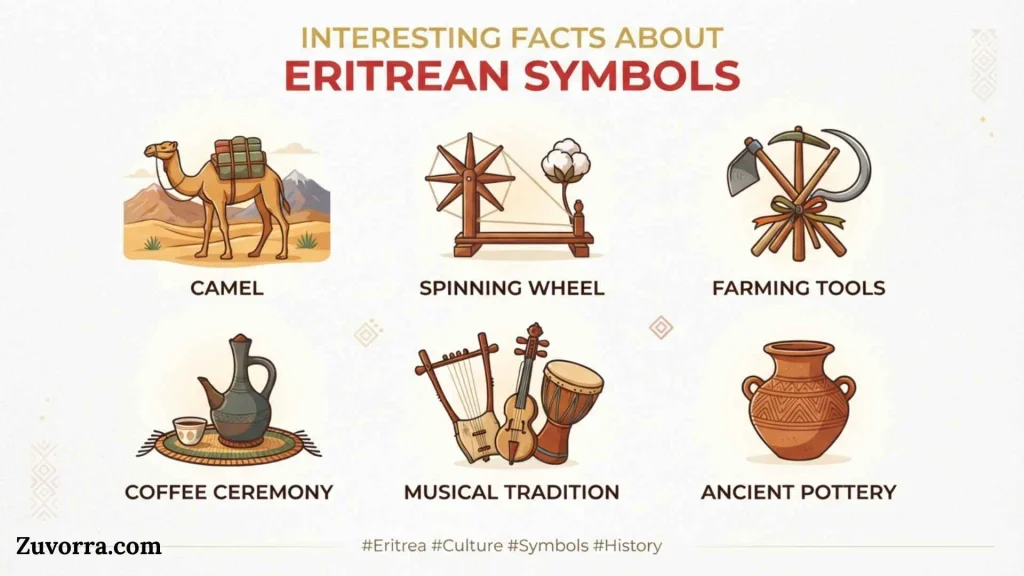
- The flag combines two political eras.
Its triangular color layout recalls the liberation movement, while the olive emblem reaches back to the 1952 Eritrean flag. - The olive wreath looks backward and forward.
It remembers earlier political identity and the independence struggle while expressing peace as a future goal. - The camel is honored for practical service.
Its national importance is not based only on desert scenery. Camels transported vital supplies through difficult terrain. - The flag links three landscapes.
Green evokes productive land, blue identifies the coast and Red Sea, and the red central field recalls the human history connecting them. - The national flag contains no Unicode character of its own.
It is represented digitally through the regional-indicator emoji sequence 🇪🇷 rather than a single Eritrean-symbol character. - The red triangle resembles Eritrea’s elongated geography.
The resemblance is often noted in visual interpretations, although the flag remains a stylized design rather than a precise map. - Thirty leaves turn decoration into historical memory.
The wreath’s structure makes the length of the independence struggle visible within the flag itself. - The olive and camel appear together only in the state emblem.
On the national emblem, the peace wreath surrounds the endurance symbol, creating a message of strength directed toward peace. - Coffee utensils act as social symbols.
A jebena may communicate welcome before anyone speaks. Its presence suggests that time and attention are being offered to guests. - Geʽez script connects language with sacred history.
It serves modern linguistic needs while also linking readers with centuries of Christian manuscript and liturgical tradition. - Diaspora use can change a symbol’s emotional weight.
Abroad, a flag or coffee ceremony may represent memory, belonging, and family continuity more strongly than it does in everyday domestic settings. - Some Eritrean symbols are shared across borders.
Cross styles, coffee traditions, instruments, and clothing forms may also appear in Ethiopia, Sudan, Djibouti, or the wider Red Sea region. Cultural exchange often predates modern borders.
Related Symbols
Ethiopian Orthodox Crosses
These share religious and artistic history with Eritrean Orthodox crosses. The difference often depends on church origin, regional craftsmanship, provenance, and national context rather than one easily recognized shape.
Olive Branch
The olive branch is an international symbol of peace. In Eritrea, it has the added meanings of historical continuity, national identity, and remembrance of the independence struggle.
Camel Symbols in the Red Sea Region
Camels represent transport, endurance, wealth, and pastoral life in many African and Arabian cultures. Eritrea’s emblem gives the animal a specific national connection to liberation logistics and survival.
Red Sea Imagery
Waves, fish, boats, ports, coral, and islands may symbolize coastal Eritrea. Unlike the flag’s blue triangle, these are usually cultural, commercial, or artistic motifs rather than official national emblems.
Eritrean Map Outline
The map shape is popular in jewelry, logos, clothing, and tattoos. It expresses territorial identity and attachment to the homeland but is not a replacement for the official flag or coat of arms.
Independence Torch and Martyrs’ Imagery
Torches, raised hands, memorial statues, and liberation scenes may symbolize freedom, sacrifice, collective action, and remembrance. Their meanings depend heavily on historical and political context.
Frequently Asked Questions
What is the main symbol of Eritrea?
Eritrea has more than one major national symbol. Its flag is the most internationally recognizable, while the camel serves as the central figure in the national emblem. The olive wreath links both forms of official imagery by representing peace, continuity, and the country’s historical journey toward independence.
What does the Eritrean flag symbolize?
The green field symbolizes agriculture and livestock, blue represents the Red Sea, and red recalls bloodshed during the independence struggle. The gold olive wreath and branch represent peace. Its thirty leaves are commonly understood to commemorate the approximately thirty years of armed struggle from 1961 to 1991.
Why is there an olive branch on Eritrea’s flag?
The olive branch represents peace and connects the current state with an earlier Eritrean flag introduced in 1952. Its reuse after independence created a bridge between historical identity and the goal of peaceful nation-building following decades of conflict.
Why is the camel Eritrea’s national emblem?
The camel symbolizes endurance, mobility, and survival in demanding environments. It also honors the practical role camels played in transporting food, water, equipment, and other supplies during the independence struggle. This historical service gave the animal a distinctive national meaning.
What do the thirty leaves mean?
The thirty leaves of the olive wreath represent the thirty-year struggle for independence. They transform the wreath from a general peace sign into a historical memorial. The leaves should be understood collectively rather than as thirty separately named battles, leaders, or events.
Does the Eritrean flag have a star?
The present national flag does not contain a star. Its central gold design is an upright olive branch surrounded by an olive wreath. Confusion may arise from earlier liberation-movement imagery or from other African flags that use stars as symbols of unity or independence.
What religious symbols are common in Eritrea?
Crosses are important in Eritrean Orthodox, Catholic, and Protestant Christian settings, while crescents appear in Muslim religious and community contexts. Geʽez script also carries sacred importance in Orthodox worship. These symbols represent living faith traditions and should not be treated only as decorative designs.
What does the Eritrean coffee ceremony symbolize?
The coffee ceremony symbolizes hospitality, patience, conversation, respect for guests, and social connection. The roasting, brewing, and serving process gives people time to exchange news and strengthen relationships. The jebena coffee pot has therefore become a visual symbol of home and community.
Is the Eritrean flag the same as the EPLF flag?
No. The national flag’s overall triangular layout is related to the flag of the Eritrean People’s Liberation Front, but the central designs differ. The independent state placed the historic olive wreath and branch on the flag to emphasize peace and continuity rather than retain the movement’s original insignia.
Can Eritrean symbols be used in tattoos?
They can, but the design should be checked carefully. Confirm flag proportions, Geʽez spelling, religious meaning, and the distinction between the olive emblem and camel emblem. Sacred crosses or Islamic symbols deserve particular respect because they represent active religious traditions, not simply national decoration.
Key Takeaways
- Eritrean symbols reflect independence, peace, sacrifice, endurance, faith, land, and the Red Sea.
- The flag uses green for agriculture and livestock, blue for the sea, and red for sacrifice during the independence struggle.
- The gold olive wreath and upright branch symbolize peace and connect the current flag with the 1952 Eritrean flag.
- The wreath’s thirty leaves commemorate the approximately thirty-year armed struggle for independence.
- The camel emblem represents endurance, transport, survival, and the contribution of camels during the liberation period.
- Crosses, crescents, and Geʽez script reflect Eritrea’s Christian and Muslim religious heritage.
- The jebena, mesob, traditional clothing, and musical instruments represent hospitality, family, artistry, and cultural memory.
- Eritrea’s nine ethnolinguistic communities have distinct traditions, so no single folk design represents every group.
- Shared Horn of Africa imagery should not be assigned exclusively to one modern country without evidence.
- Official meanings should be separated from personal, artistic, political, and psychological interpretations.
Conclusion
Eritrean symbols form a visual language of memory and identity. The national flag tells a compact story through color: green for land and livelihood, blue for the Red Sea, red for sacrifice, and gold for the peace represented by the olive wreath. The camel adds a message of endurance, service, and survival.
Cultural and religious symbols deepen that story. Crosses, crescents, Geʽez writing, coffee pots, basket tables, clothing, and musical instruments connect national identity with home, worship, hospitality, language, and community.
Understanding Eritrean symbols therefore requires more than identifying an image. It means recognizing the history behind it, distinguishing official meanings from interpretation, and respecting the diverse people who continue to give those symbols life.
References
- Constitution of Eritrea, Article 4, available through WIPO Lex and the International Constitutional Law Project.
- Eritrea Ministry of Information, “Respecting Eritrean National Symbols.”
- Eritrea Ministry of Information, “The Emblem of Eritrea.”
- Eritrea Ministry of Information, “Eritrea at a Glance.”
- Embassy of the State of Eritrea in Switzerland, “Facts and Figures.”
- WIPO Lex, “The Constitution of Eritrea.”

I’m Felix Everard, a British writer passionate about the fascinating world of symbols and visual communication. I explore traditional, cultural, historical, and modern symbols, focusing on what they represent and why they matter. Through accessible explanations, I hope to help readers recognise the meanings hidden within familiar signs, shapes, and images.
Books:
- The Complete Guide to Symbolism
- Decoding Signs and Symbols