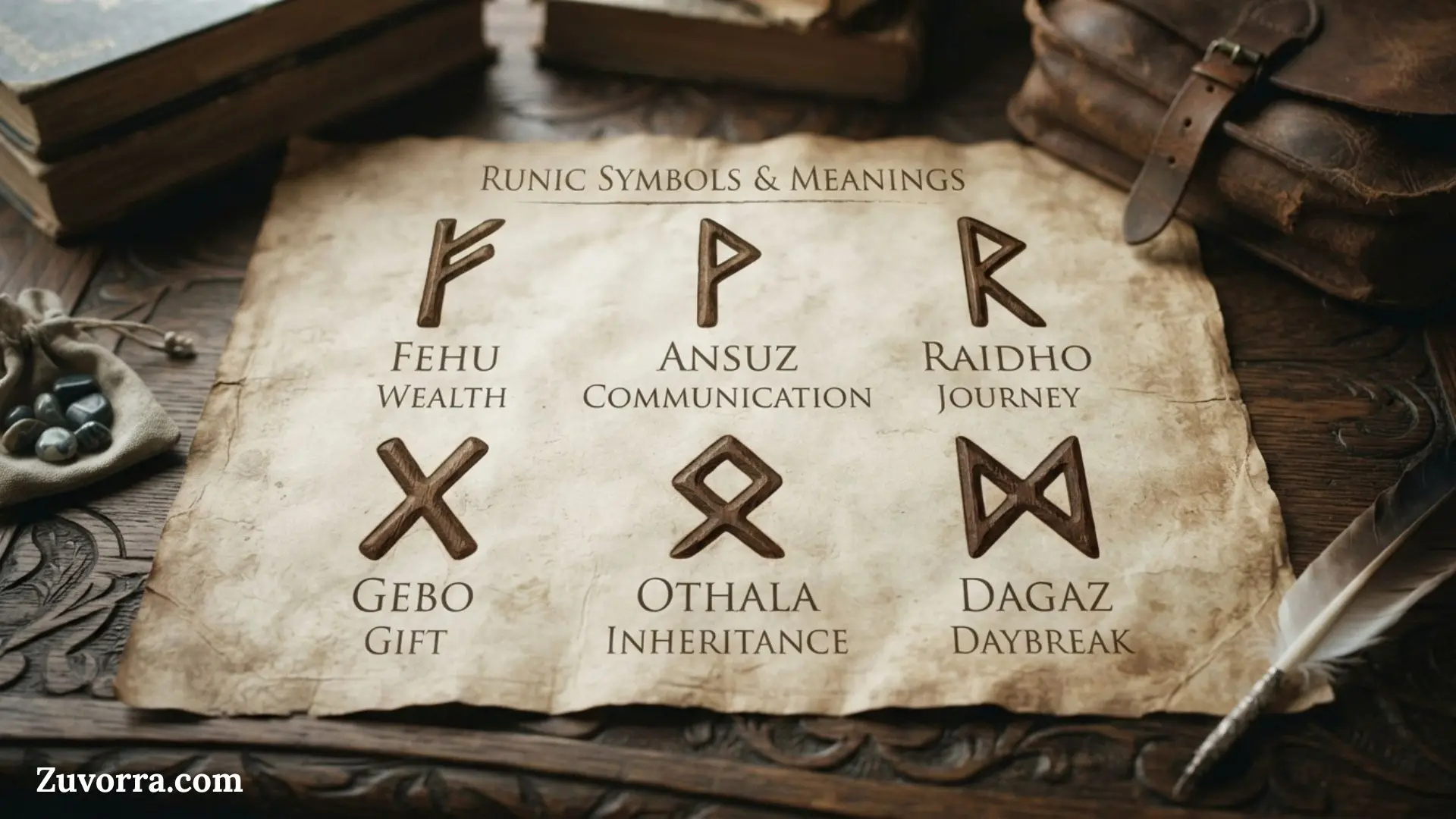
Runic symbols are letters from writing systems once used by Germanic-speaking peoples across northern Europe. Each rune represented a sound, much like a letter in the modern alphabet, while its traditional name also referred to an idea such as wealth, ice, harvest, need, or protection.
Today, you may encounter runes on Scandinavian artifacts, memorial stones, museum displays, jewelry, tattoos, fantasy novels, video games, and modern spiritual tools. Their sharp, angular forms often look mysterious, but they were created primarily for communication.
Understanding runic symbols and meanings requires an important distinction: historically documented rune names and inscriptions are not the same as modern divination meanings. This guide explains both while clearly separating archaeological evidence from later interpretation.
Quick Meaning
Runes are characters from several related Germanic alphabets called futharks. They were used to write names, messages, memorials, ownership marks, and short records. Rune names also carried literal concepts, which later inspired symbolic and spiritual interpretations. However, many fixed “fortune-telling” meanings used today are modern rather than ancient.
Runic Symbols Overview
| Field | Details |
| Symbol group | Runic alphabets |
| Primary purpose | Writing Germanic languages |
| Best-known alphabet | Elder Futhark |
| Other systems | Younger Futhark and Anglo-Saxon Futhorc |
| Cultural origin | Germanic-speaking northern Europe |
| Earliest certain examples | Around the second century CE |
| Common materials | Stone, bone, wood, metal, antler, and everyday objects |
| Historical uses | Names, memorials, ownership, communication, charms, and inscriptions |
| Modern uses | Academic study, historical reconstruction, art, tattoos, fiction, and divination |
| Writing direction | Usually left to right, though early examples vary |
| Unicode range | Runic block U+16A0–U+16FF |
| Emoji equivalent | No official rune emoji set |
| Academic field | Runology |
| Related scripts | Latin, Greek, Old Italic, and other ancient alphabetic traditions |
Runes are encoded digitally in the Unicode Runic block, allowing historical characters such as ᚠ, ᚢ, ᚦ, and ᚨ to appear in compatible fonts and software. Unicode character names often include several traditional rune-name variants because forms and names differed across time and region.
What Do Runic Symbols Mean?
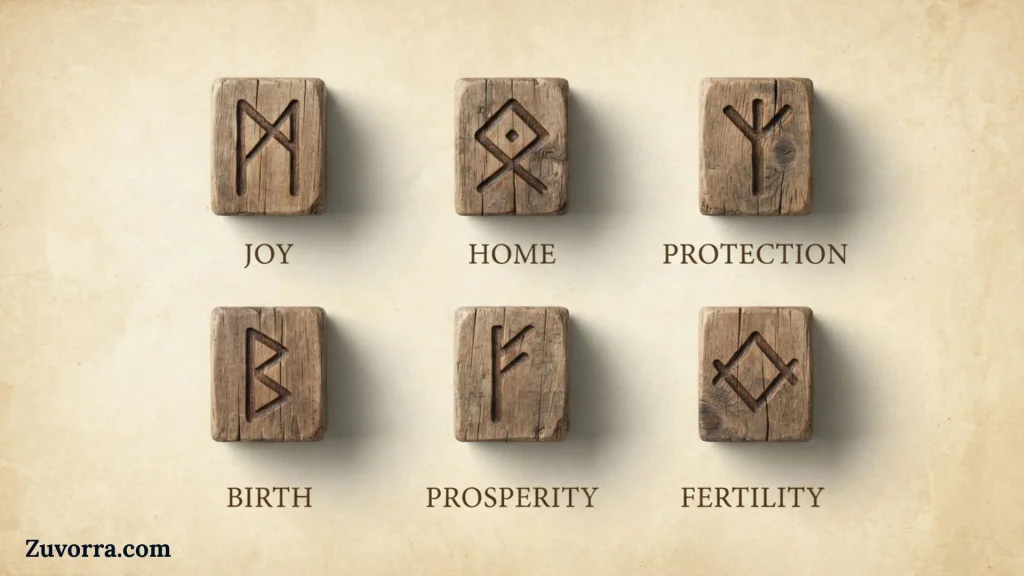
Runic symbols first functioned as letters. A rune normally represented a speech sound, but it also had a name beginning with that sound. For example, the rune ᚠ represented an “f” sound and was associated with a word meaning cattle or movable wealth.
This naming system gave each character an additional conceptual layer. A person could recognize ᚠ as:
- A letter representing the sound “f”
- A rune traditionally called Fehu
- A word connected with livestock and wealth
- A symbol that could suggest resources or prosperity in later interpretation
This does not mean every runic inscription was a coded spiritual message. Most inscriptions should be read as language. They may record a person’s name, identify an object’s maker, commemorate someone who died, or state who owned an item.
Some inscriptions appear to have magical, protective, religious, or ritual purposes. Written evidence also shows that runes could carry mystery and power in Old Norse literary tradition. Still, scholars interpret each inscription through its language, archaeological setting, date, and physical context rather than assigning universal mystical definitions.
The 24 Elder Futhark Runes and Their Meanings
The Elder Futhark is the oldest fully developed runic row known to scholars. Its name comes from its first six characters: F, U, Þ, A, R, and K. It contains 24 runes and was used roughly from the second through the seventh centuries CE.
The symbolic interpretations below begin with the reconstructed or historically recorded rune name. The final column describes common modern associations, not guaranteed ancient definitions.
| Rune | Name | Sound | Literal Name or Concept | Common Modern Interpretation |
| ᚠ | Fehu | F | Cattle, movable wealth | Prosperity, resources, earned success |
| ᚢ | Uruz | U | Aurochs or wild ox | Strength, vitality, endurance |
| ᚦ | Thurisaz | TH | Giant or thorn | Force, danger, defense, conflict |
| ᚨ | Ansuz | A | God or ancestral deity | Speech, wisdom, inspiration |
| ᚱ | Raidho | R | Ride or journey | Travel, movement, right order |
| ᚲ | Kenaz | K | Torch or ulcer, depending on tradition | Knowledge, craft, revelation |
| ᚷ | Gebo | G | Gift | Exchange, generosity, partnership |
| ᚹ | Wunjo | W | Joy or pleasure | Harmony, belonging, satisfaction |
| ᚺ | Hagalaz | H | Hail | Disruption, natural force, change |
| ᚾ | Nauthiz | N | Need or hardship | Necessity, restraint, resilience |
| ᛁ | Isa | I | Ice | Stillness, delay, concentration |
| ᛃ | Jera | Y/J | Year or harvest | Cycles, reward, gradual results |
| ᛇ | Eihwaz | EI | Yew tree | Endurance, death, continuity |
| ᛈ | Perthro | P | Meaning uncertain | Mystery, chance, hidden knowledge |
| ᛉ | Algiz | Z/R | Name uncertain, often linked with elk | Protection, alertness, boundaries |
| ᛊ | Sowilo | S | Sun | Success, clarity, life force |
| ᛏ | Tiwaz | T | The god Týr | Justice, courage, duty |
| ᛒ | Berkano | B | Birch tree | Birth, growth, renewal |
| ᛖ | Ehwaz | E | Horse | Trust, movement, cooperation |
| ᛗ | Mannaz | M | Human being | Humanity, identity, community |
| ᛚ | Laguz | L | Water or lake | Emotion, flow, intuition |
| ᛜ | Ingwaz | NG | The god or hero Ing | Fertility, potential, completion |
| ᛞ | Dagaz | D | Day | Awakening, transformation, hope |
| ᛟ | Othala | O | Inherited property or homeland | Heritage, ancestry, possession |
Rune names were not preserved equally across all periods. Scholars often reconstruct Elder Futhark names by comparing later Old English, Old Norse, and Gothic forms. Therefore, the literal meanings of some runes, especially Perthro and Algiz, remain debated.
History and Origin of Runic Writing
Runes developed among Germanic-speaking communities during the first centuries of the Common Era. Their exact point of origin remains uncertain. Most scholars agree that the inventors of the runic script were influenced by Mediterranean alphabetic writing, but debate continues over whether the strongest model was Latin, Greek, an Old Italic alphabet, or a combination of influences.
The angular design of many runes suited carving into hard materials. Straight lines are easier to cut into wood, bone, antler, and stone than rounded strokes. However, runes were also written on softer materials, and their shapes changed across centuries.
One of the earliest certain runic objects is the Vimose comb from Denmark, dated to about 160 CE. Its short inscription reads harja, possibly a personal name or a word related to “warrior.” The confident execution suggests that runic writing had already been developing before the object was made.
Elder Futhark
Elder Futhark contained 24 characters and spread across parts of Scandinavia and continental Germanic Europe. Surviving examples appear on weapons, jewelry, tools, amulets, combs, stones, and other portable objects.
Its inscriptions are often very short. Personal names, makers’ names, ownership statements, and difficult ritual formulas appear more often than long narratives.
Anglo-Saxon Futhorc
Germanic migrants brought runic writing to Britain. In England and Frisia, the system developed into the Anglo-Frisian Futhorc. Its name reflects changes in the sounds represented by its opening characters.
New characters were added as the language developed sounds that the older 24-rune system could not represent clearly. Anglo-Saxon runes appeared on objects, monuments, coins, manuscripts, and religious works. Cambridge’s account of Old English describes runes as an epigraphic alphabet brought to Britain by the Anglo-Saxons.
Younger Futhark
By the beginning of the Viking Age, Scandinavians had reduced the rune row from 24 characters to 16. This Younger Futhark system had fewer signs even though Old Norse contained many distinct sounds. As a result, one rune could represent several related sounds.
Younger Futhark appears on thousands of Scandinavian runestones and smaller objects. Viking Age runestones frequently commemorate deceased relatives, describe inheritance or travel, identify the person who raised the monument, and sometimes invoke a god or Christian blessing.
Runic writing remained in use after Scandinavia’s conversion to Christianity. Medieval people carved runes in churches, wrote everyday messages on wooden sticks, marked possessions, and used runic calendars. A runic inscription in Norway’s Lom Stave Church even records an informal “I was here” message, showing that not every rune text was solemn or magical.
Symbolism and Interpretation
Runic symbolism grew from the interaction between sound, name, language, mythology, and use. The rune names provided memorable concepts, while certain inscriptions and literary accounts gave runes an aura of sacred knowledge.
Traditional meanings
A rune’s most secure traditional meaning comes from its name. Tiwaz referred to the god Týr, Jera referred to the year or harvest, and Isa meant ice. Historical rune poems describe these concepts through short poetic verses.
These poems are valuable, but they were written down after the Elder Futhark period. They reflect different regional traditions and should not be treated as a single ancient instruction manual.
Positive symbolism
Modern readers commonly associate runes with:
- Courage and personal strength
- Protection and awareness
- Wisdom and communication
- Fertility and renewal
- Ancestry and cultural memory
- Natural cycles and transformation
- Cooperation, generosity, and trust
These themes often grow logically from rune names. For instance, Gebo, “gift,” can represent exchange because gift-giving created social bonds and obligations in Germanic societies.
Difficult or negative symbolism
Not every rune concept is comforting. Hagalaz evokes destructive hail, Nauthiz expresses need or constraint, and Isa suggests frozen stillness. Thurisaz can indicate threatening force, while Eihwaz has associations with the yew tree, longevity, weapons, and death.
Modern diviners often describe these as challenges rather than purely “bad” signs. Historically, however, there is no surviving universal chart dividing runes into lucky and unlucky categories.
Psychological interpretation
In modern reflective practice, people may use rune concepts as prompts. Raidho can inspire questions about direction, Mannaz about identity, and Nauthiz about needs or limitations.
This approach works much like journaling with symbolic images. The rune does not have to predict an event. Instead, its name and associations help the user examine a decision from another perspective.
Cultural Significance
Runes belonged to several Germanic cultures rather than one unified “Viking religion.” Their forms, sounds, and uses varied by century and location.
Scandinavia
Scandinavian runes are strongly associated with the Viking Age because of the region’s many surviving runestones. Yet runic writing existed centuries before Viking expansion and continued into the Christian Middle Ages.
Sweden contains an especially large concentration of Viking Age runestones. These monuments often reveal family relationships, journeys, property claims, social rank, religious change, and local identity.
England and Frisia
The Anglo-Saxon Futhorc expanded to represent Old English and Old Frisian sounds. Some inscriptions combine runic tradition with Christian imagery or texts, showing that conversion did not instantly erase older writing practices.
Continental Europe
Early runic artifacts have been found in areas connected with Germanic peoples across present-day Germany, Denmark, Poland, and neighboring regions. Their distribution reflects migration, trade, warfare, craftsmanship, and cultural contact.
Modern cultural identity
Runes now appear in historical education, language revival, art, reenactment, and modern Germanic Pagan traditions. They also appear in commercial designs that may have little connection to historical usage.
Context matters because some runes have been appropriated by Nazi organizations and later extremist groups. Such misuse does not erase the symbols’ older history, but it can change how a design is perceived in a particular country or community.
Religious and Spiritual Meaning
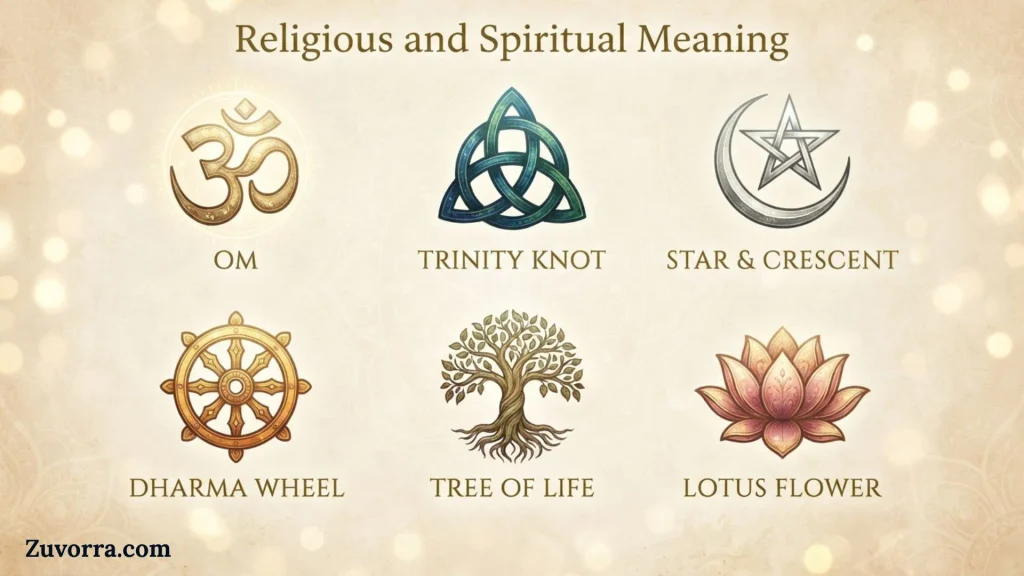
Runes had religious and magical associations, but they were not exclusively sacred signs. Archaeological finds and written sources show a mixture of ordinary literacy, commemoration, ritual language, protection, and possible magical practice.
In Old Norse myth, Odin gains knowledge of the runes through a severe act of self-sacrifice described in the Poetic Edda. This story connects runes with wisdom, ordeal, poetry, and hidden knowledge. It does not explain the historical invention of the alphabet; it expresses a mythological understanding of sacred knowledge.
Certain inscriptions contain repeated words, divine names, formulas, or sequences that scholars interpret as charms. Runes could also be used in healing, cursing, protection, prophecy, or memorial rituals according to medieval literary accounts. The historical reliability of each account must be judged carefully because many texts were recorded by Christian writers centuries after the events they describe.
Modern rune casting usually involves drawing stones or pieces marked with runes and interpreting their concepts. This system draws inspiration from ancient sources but has largely been organized by modern authors. The popular “blank rune,” sometimes called Odin’s rune, is a recent invention and does not belong to any historical futhark.
Scientific, Linguistic, and Digital Meaning
Runes matter scientifically because they preserve evidence about language change, literacy, migration, personal names, religion, and social organization.
Linguistics and runology
Runologists study rune shapes, grammar, spelling, sound values, carving techniques, dates, and archaeological context. A tiny spelling difference may help identify a regional tradition or language stage.
Runes also reveal how spoken Germanic languages changed. The transition from Elder to Younger Futhark reflects major developments between Proto-Norse and Old Norse, even though the newer alphabet used fewer characters.
Archaeology
The object carrying an inscription can be as important as the text. A name carved on a weapon, a memorial on a stone, and a message scratched onto wood served different purposes.
Researchers examine where an object was found, what material it uses, whether the inscription was added before or after manufacture, and whether the carving shows wear.
Digital use
Unicode assigns code points to runic characters so they can be stored and exchanged in digital text. The Runic block covers historical forms from multiple rune rows rather than presenting one simple alphabet. Display depends on whether the device has a font supporting those characters.
Runes are not a substitution font for English. Writing an English word with visually chosen runes may produce a modern transliteration, but it does not automatically create grammatically correct Old Norse or Proto-Germanic.
Where Runic Symbols Are Used
Historical inscriptions
Runes survive on memorial stones, weapons, brooches, amulets, tools, combs, coins, church walls, wooden sticks, and bone objects. Their messages range from formal commemoration to casual notes.
Jewelry and tattoos
People select runes for names, family heritage, protection, strength, or personal change. Before permanently using one, confirm the rune row, sound value, historical form, and cultural context.
Books and entertainment
Fantasy literature often presents runes as magical codes. J. R. R. Tolkien, a scholar of Germanic languages, created fictional writing systems influenced by historical scripts. Games, films, and television frequently blend authentic runes with invented signs.
Art and logos
Angular rune forms work well in logos, album art, clothing, wood carving, and metalwork. Designers should research symbols carefully because a historically innocent rune may also carry a modern political association.
Modern spiritual practice
Rune sets are used for meditation, journaling, ritual, and divination. These practices are modern interpretations inspired by historical names, rune poems, mythology, and occult traditions.
Common Variations of Runic Symbols
Runes do not have one fixed appearance. A character could change shape because of location, period, carving material, writing direction, or the carver’s habits.
Long-branch and short-twig runes
Younger Futhark developed major visual varieties commonly called long-branch and short-twig runes. Long-branch forms often appear on monumental inscriptions, while short-twig forms were more economical, though actual use was not governed by a simple universal rule.
Staveless runes
Some Scandinavian inscriptions use highly simplified forms known as staveless runes. Their main vertical strokes were reduced or removed, creating a compact system that can look unfamiliar even to people who know Younger Futhark.
Bind runes
A bind rune joins two or more runes into one design. Historical bind runes often saved space, formed abbreviations, or created decorative letter combinations.
Modern bind runes are frequently designed as personal talismans by combining supposed symbolic powers. That practice should not be assumed to follow a single ancient method.
Cipher runes
Cipher systems concealed rune values through structured markings. The famous Rök Runestone includes multiple writing techniques, including cipher runes, showing that skilled carvers could manipulate the script creatively.
Common Misconceptions About Runes
“Every rune is an ancient magical symbol”
A rune was first a letter. Some runes appeared in magical or ritual settings, but many inscriptions record ordinary language, names, memorials, and ownership.
“Vikings used Elder Futhark”
Most Viking Age Scandinavians used Younger Futhark, which had 16 runes. Elder Futhark belongs mainly to the earlier Migration Period.
“Rune meanings are fully known”
Several names and interpretations remain uncertain. Perthro and Algiz are famous examples. Confident claims about their exact ancient spiritual meanings often go beyond the evidence.
“Reversed runes have ancient opposite meanings”
Modern readers sometimes interpret an upside-down rune as blocked or reversed energy. No complete historical system of reversal meanings survives from ancient Germanic societies.
“The blank rune is traditional”
The blank rune is a modern addition. Historical rune rows contain written characters, not an empty sign representing fate or the unknowable.
“Runes and Norse symbols are the same”
Runes are letters. Mjölnir, the Valknut, and the Ægishjálmur are pictorial symbols rather than alphabetic runes, although modern designs often combine them.
“English can be translated by replacing letters”
Direct letter swapping creates a transliteration, not a translation. Historically accurate writing requires the correct language, date, rune row, spelling conventions, and sound system.
How to Choose a Rune Responsibly
Use this decision guide before choosing a rune for art, jewelry, or a tattoo:
Do you want to spell a word or name?
↓
Choose the historical language and period first. Then use its matching rune row.
Do you want a symbolic concept?
↓
Begin with the rune’s documented name, such as “gift,” “sun,” or “year.”
Do you want a modern spiritual design?
↓
Label it as a modern interpretation rather than an exact ancient tradition.
Could the rune have a modern extremist association?
↓
Research its present-day context in your country before displaying it publicly.
Are you combining runes?
↓
Decide whether you want a historically styled bind rune or a modern personal emblem.
Interesting Facts About Runes
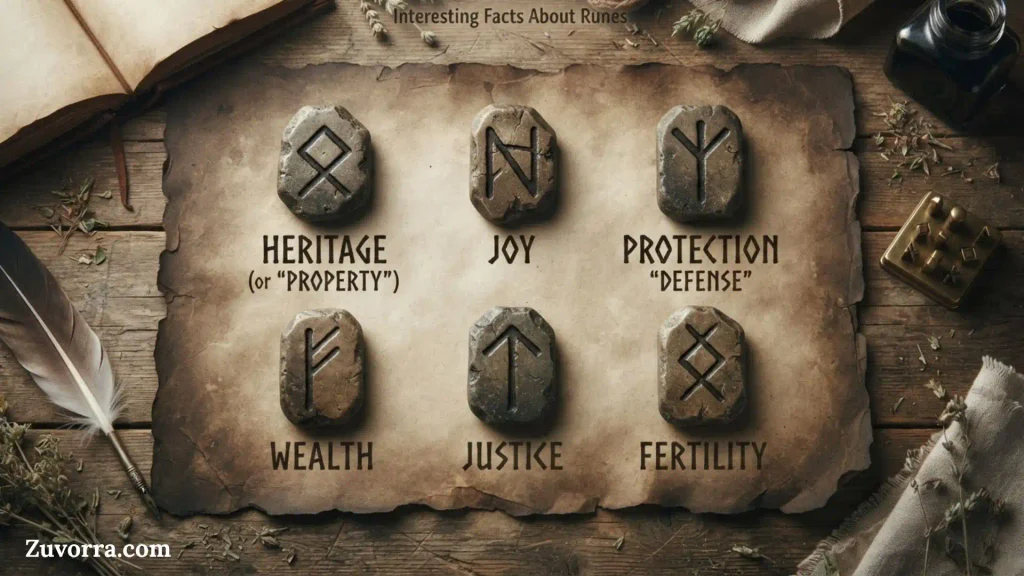
- The word “futhark” works like “alphabet.” It comes from the first six runes, just as “alphabet” comes from Greek alpha and beta.
- The Viking alphabet was shorter than its predecessor. Younger Futhark had only 16 characters, while Elder Futhark had 24.
- One rune could represent several sounds. Viking Age readers used language and context to decide which sound a rune represented.
- Runes were not carved only in stone. Wood was probably widely used, but it survives less often than stone, metal, or bone.
- Rune names served as memory aids. Connecting each sign with a familiar word helped people remember its sound.
- Some runestones contain Christian prayers. Runes continued to function after conversion and were not limited to pre-Christian worship.
- Runes could mark informal messages. Surviving graffiti, jokes, love messages, and signatures reveal everyday literacy.
- Not all inscriptions can be translated confidently. Damage, unusual spelling, unknown words, and meaningless-looking sequences create ongoing debates.
- Rune poems come from different traditions. The Old English, Norwegian, and Icelandic rune poems do not always describe the same rune in the same way.
- Modern fonts can alter historical shapes. A digital rune may appear differently across devices because fonts choose different regional forms.
- Runes sometimes appeared beside Latin letters. Medieval writers could use both systems, showing that scripts did not always replace one another immediately.
- Runology combines several fields. Researchers use linguistics, archaeology, history, manuscript studies, and digital imaging to interpret inscriptions.
Related Symbols and Writing Systems
Ogham
Ogham is an early medieval script associated mainly with Ireland and western Britain. Its characters use groups of strokes along a central line or edge. It is not a Celtic form of runic writing.
Latin alphabet
The Latin alphabet gradually became dominant in Christianized Germanic Europe. Runes and Latin letters sometimes existed side by side during the Middle Ages.
Greek and Old Italic alphabets
These Mediterranean writing traditions are important when discussing the possible origins of rune shapes. Scholars debate which alphabets most strongly influenced early runic development.
Mjölnir
Thor’s hammer is a religious and protective emblem, not a rune. Archaeological hammer pendants are closely connected with Norse identity and worship of Thor.
Valknut
The Valknut is a modern name for a three-triangle motif found on some Scandinavian artifacts. Its original name and exact meaning are unknown, so it should not be given a single certain definition.
Ægishjálmur
Often called the Helm of Awe, this Icelandic magical stave comes from a much later manuscript tradition. Its radial design is not part of the Elder or Younger Futhark.
Vegvísir
Vegvísir is another Icelandic magical sign recorded in a nineteenth-century manuscript. It is frequently marketed as an ancient Viking compass, but it is not known from Viking Age evidence.
Frequently Asked Questions
Are runic symbols Norse or Germanic?
Runes are broadly Germanic. They were used by different Germanic-speaking peoples, including communities in Scandinavia, continental Europe, England, and Frisia. Norse people used runes, especially Younger Futhark, but describing every rune as exclusively Norse or Viking overlooks their wider and earlier history.
What is the most powerful rune?
No historical source identifies one universally most powerful rune. Modern practitioners may favor Tiwaz for courage, Algiz for protection, Sowilo for success, or Ansuz for wisdom. The answer depends on the chosen interpretive system, and those symbolic rankings should not be presented as established ancient fact.
Which rune means protection?
Algiz is the rune most commonly associated with protection in modern rune practice. However, its original name and exact meaning are debated. Thurisaz is also sometimes treated as defensive because of its connection with force or thorns. Neither association guarantees that ancient users viewed it as a universal protection sign.
Which rune represents love?
Gebo is often connected with love, partnership, and balanced exchange because its name means “gift.” Wunjo may represent joy and harmony, while Ehwaz can suggest trust between partners. No Elder Futhark rune simply means romantic love in the same direct way as a modern heart symbol.
Did Vikings use runes for fortune-telling?
Old and medieval sources mention divination, lots, magical writing, and supernatural rune knowledge, but they do not preserve the standardized rune-casting system sold today. Modern divination draws from historical material while adding organized meanings, layouts, reversed readings, and methods developed in more recent times.
Can runes be written from right to left?
Some early inscriptions run right to left or change direction, but left-to-right writing became common. A reversed visual form may therefore reflect writing direction rather than a negative spiritual meaning. The inscription’s date, region, and layout must be considered before interpreting its orientation.
How do I write my name in runes?
First choose a rune row and language period. Then transliterate the sounds of your name rather than replacing each modern letter mechanically. Elder Futhark, Younger Futhark, and Anglo-Saxon Futhorc represent different sound systems, so the historically appropriate spelling may vary greatly.
Are runes considered religious symbols today?
They can be religious symbols for modern Heathens and other Germanic Pagan practitioners, but they are also historical letters used by scholars, artists, reenactors, and language enthusiasts. Meaning depends on context. A rune necklace may express faith, heritage, artistic interest, or a personal symbolic idea.
Is it disrespectful to use runes in tattoos?
Using runes is not automatically disrespectful, but careless use can spread historical errors or unintended messages. Research the correct inscription, period, language, and current political associations. Avoid claiming that a modern bind rune or divination meaning is an exact ancient tradition when evidence does not support that claim.
Are runic symbols available on keyboards?
Most standard keyboards do not provide dedicated rune keys. You can enter runes through a Unicode character picker, copy them from a reliable chart, or install a specialized input method. Correct display requires a font that supports the Unicode Runic block, and appearance may differ between platforms.
Key Takeaways
- Runes were letters before they became popular symbolic or divination tools.
- The Elder Futhark has 24 runes and predates the Viking Age.
- Viking Age Scandinavians mainly used the 16-character Younger Futhark.
- Rune names provide concepts such as gift, sun, ice, year, and wealth.
- Many fixed spiritual definitions used today are modern interpretations.
- Historical inscriptions include names, memorials, ownership marks, charms, and everyday messages.
- Rune shapes and sound values changed across regions and centuries.
- A transliteration into runes is not automatically a translation into Old Norse.
- The blank rune and standardized reversed meanings are modern innovations.
- Cultural and political context should be checked before using a rune publicly.
Conclusion
Runic symbols connect language, history, mythology, craftsmanship, and cultural memory. Their enduring appeal comes partly from their bold appearance and partly from the ideas preserved in names such as gift, sun, journey, ice, harvest, and humanity.
Yet their real history is more interesting than the claim that each rune holds one secret, timeless definition. Runes changed across regions, represented spoken sounds, recorded ordinary lives, marked memorials, and sometimes entered sacred or magical settings.
By separating documented evidence from modern interpretation, you can appreciate runic symbols and meanings without removing them from their historical context. Whether you encounter them on an ancient stone, a museum object, a pendant, a tattoo, or a digital screen, they remain traces of how Germanic-speaking people shaped language into lasting signs.
References
- Cambridge University Press, Old English: Early Germanic Literature and Culture and The Cambridge Companion to Old English Literature.
- Solheim, S., and colleagues, research on early Norwegian runestone traditions published in Antiquity.
- The Unicode Consortium, Runic Character Code Chart, Runic Names List, and Unicode Core Specification.
- The Viking Ship Museum, educational material on Viking Age runes.
- World History Encyclopedia, “Runes,” the Vimose Comb, the Rök Runestone, and runic inscriptions in Lom Stave Church.
I’m Jasper Huxley, a British writer fascinated by the symbols that communicate ideas without words. I explore their meanings, origins, cultural connections, and everyday uses. From ancient markings to contemporary signs, I enjoy uncovering the stories behind visual language and presenting symbolism in a clear, engaging way for curious readers worldwide.
Books:
- The Hidden Language of Symbols
- Symbols, Signs and Their Meanings