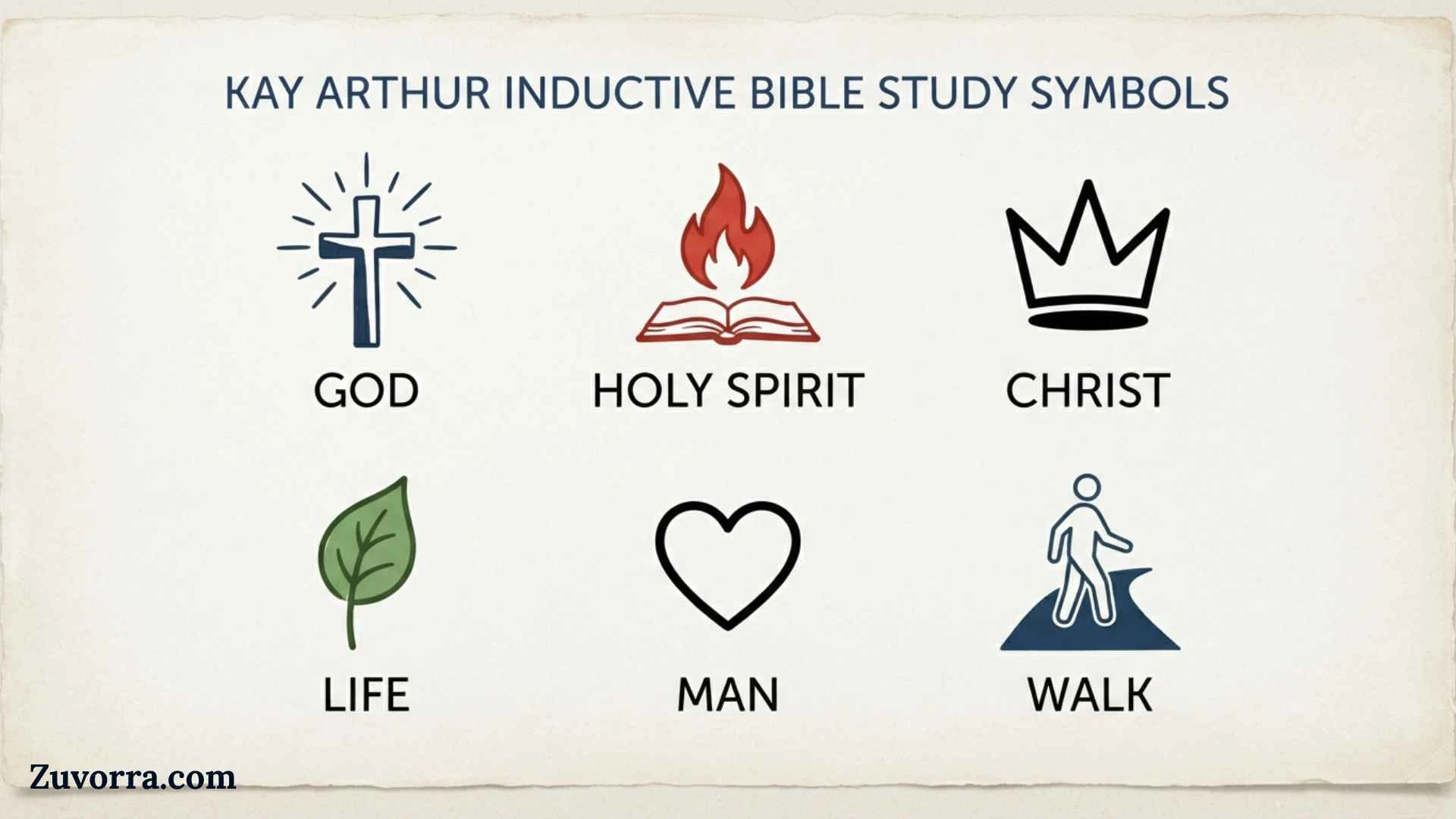
Kay Arthur inductive Bible study symbols are visual marks used to identify repeated words, important people, locations, time references, contrasts, commands, promises, and major themes in Scripture. They are not secret religious signs or fixed theological codes. They are study tools that help readers slow down, observe the biblical text, and recognize patterns before interpreting or applying it.
You may encounter these markings in Precept Bible study workbooks, the New Inductive Study Bible, printed observation worksheets, personal notebooks, or color-coded Bible pages. The exact shapes and colors can vary because the method allows students to use symbols that are clear, memorable, and consistent for them.
Quick Meaning
Kay Arthur inductive Bible study symbols are simple, repeatable visual markings assigned to key words and ideas in a Bible passage. Their purpose is to make repetition, relationships, structure, and emphasis easier to see. The symbols support the observation stage of inductive study rather than supplying an interpretation by themselves.
Symbol Overview Table
| Field | Details |
| Symbol system name | Inductive Bible study key-word markings |
| Primary purpose | To highlight repeated words, themes, people, places, time references, and relationships |
| Category | Bible study and textual observation tool |
| Associated teacher | Kay Arthur |
| Associated organization | Precept |
| Method | Observation, interpretation, and application |
| Historical setting | Developed and taught through the modern Precept Bible Study Method |
| First institutional use | Connected with Precept’s ministry, established in 1970 |
| Common materials | Colored pencils, pens, printed worksheets, notebooks, and digital highlighting tools |
| Common markings | Circles, boxes, triangles, clouds, arrows, underlines, waves, crosses, crowns, and custom drawings |
| Fixed or flexible? | Flexible; suggested symbols exist, but students may create their own |
| Unicode | Not applicable as a single standardized symbol system |
| Emoji equivalent | No official equivalent |
| Modern meaning | A visual aid for close, text-centered Bible study |
| Related practices | Color coding, key-word lists, cross-references, chapter themes, and observation charts |
What Do Kay Arthur Inductive Bible Study Symbols Mean?
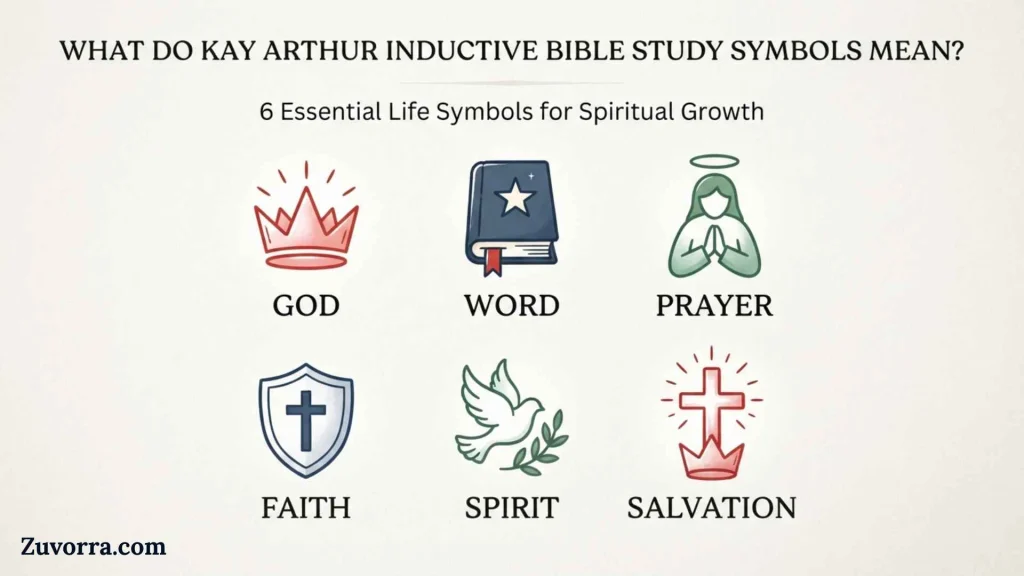
These symbols mean whatever key word, person, place, action, or concept the student has assigned to them. A triangle may represent God, a crown may identify a king or kingdom, a cloud may mark glory, and a heart may highlight love. Their meaning comes from the study legend, not from a universal symbolic language.
The most important principle is consistent distinction. Each major word should receive a marking that is easy to recognize and different from nearby markings. When the same word, synonym, or related pronoun appears again, the student marks it in the same way.
For example, while studying a passage about God’s commands, a reader might:
- Draw a red box around every form of command.
- Mark God with a purple triangle.
- Underline every time phrase in green.
- Draw an arrow beside actions required of the audience.
- Place a cloud around references to glory.
When the page is reviewed, repeated marks create a visual map. The reader can quickly see who acts, what is repeated, when events occur, and which ideas control the passage.
Precept describes key words as repeated terms or words that are otherwise vital to the passage. Marking those words and related pronouns creates visual cues that help readers pay closer attention to what the text actually says.
The Symbols Do Not Create the Meaning
A marking is an observational label, not an interpretation. Drawing a crown around kingdom does not explain which kingdom is meant, when it exists, or how it relates to the surrounding passage. Those questions require context, comparison, and careful interpretation.
This distinction prevents a common mistake: treating the picture as though it carries spiritual authority. The biblical text remains primary. The symbol merely helps the student locate and compare information.
History and Origin of the Marking System
The modern system is closely associated with Kay Arthur and Precept, the ministry she co-founded with her husband, Jack Arthur. Precept has taught an inductive approach to Scripture for more than five decades, organizing the method around three interconnected activities: observation, interpretation, and application.
The symbols grew from the practical needs of the observation stage. Readers examining an entire book needed an efficient way to follow repeated names, themes, places, and phrases across many verses. Colored and shaped markings made those patterns easier to recognize than plain notes alone.
Kay Arthur described beginning with the biblical text, reading according to its literary form, and paying special attention to repetition. She marked repeated words and phrases in distinctive ways because repetition often reveals an author’s emphasis and can help expose the structure of a book.
Earlier Roots in Close Reading
Kay Arthur did not invent careful textual observation itself. Religious readers, scribes, scholars, and teachers have annotated sacred texts for centuries. Underlining, marginal notes, cross-references, and manuscript signs all predate the modern Precept system.
What makes this method distinctive is the organized use of:
- Repeated visual symbols.
- Key-word lists.
- The five W’s and an H.
- Book and chapter themes.
- Observation before outside commentary.
- Interpretation within literary, historical, and biblical context.
- Personal application after meaning has been established.
The marking system therefore belongs to the wider history of annotation, but it serves a specific modern inductive-study framework.
Evolution Into Print and Digital Study
The system first became familiar through printed Bibles, workbooks, and observation worksheets. Today, similar markings can appear in Bible software and digital highlighting palettes. The medium has changed, but the function remains the same: make important textual relationships visible.
Precept also recognizes that students do not need to copy one exact visual chart. Its current guidance states that markings may be as simple as underlining, and readers may use Precept’s recommendations, another system, or symbols they develop themselves.
Symbolism and Interpretation
The symbolism in this method is practical rather than mystical. Shapes are selected because they create quick mental associations.
Traditional Marking Associations
Common associations include:
| Marking idea | Common use | Why it works |
| Triangle | God, Jesus Christ, or the Holy Spirit | The shape is distinctive and can suggest a three-part association |
| Heart | Love, compassion, or the human heart | It has a familiar emotional meaning |
| Crown | King, kingdom, rule, or authority | Crowns commonly represent royal power |
| Cloud | Glory, heaven, or divine appearance | Clouds appear in many biblical scenes involving divine presence |
| Cross | Christ, crucifixion, death, or atonement | It directly recalls Christian crucifixion imagery |
| Arrow | Movement, following, sending, or consequence | Directional shape shows action |
| Wavy line | Water, baptism, sea, or cleansing | The line resembles moving water |
| House outline | House, household, temple, or dwelling | The shape visually resembles a building |
| Circle | Person, recurring concept, or complete unit | Easy to repeat and notice |
| Box | Command, covenant, doctrine, or important statement | Strong boundary makes the term stand out |
| Flame | Fire, furnace, judgment, or refining | The drawing resembles fire |
| Chain or linked loops | Bondage, captivity, covenant, or relationship | Links suggest attachment or restraint |
These are examples, not universal rules. Published symbol sheets may show suggested markings for hundreds of key words, including covenant, faith, grace, gospel, kingdom, judgment, geographical locations, God, Jesus Christ, and the Holy Spirit.
Positive Symbolism
The method can symbolize positive biblical concepts such as:
- Grace
- Faith
- Hope
- Love
- Blessing
- Covenant
- Holiness
- Eternal life
- Fellowship
- Forgiveness
- Salvation
- Obedience
These markings help a reader trace how a biblical author develops a theme. For instance, consistently marking grace in a New Testament letter allows the student to compare its source, recipients, effects, and relationship to faith or obedience.
Negative Symbolism
Students may also mark:
- Sin
- Judgment
- Death
- Idolatry
- False teaching
- Fear
- Captivity
- Evil
- Destruction
- Unbelief
- Rebellion
- Deception
A dark cloud, slash, broken line, or another memorable shape may be used. However, colors do not possess fixed moral meanings. Black does not always mean evil, and red does not always mean sin or blood. Meaning depends on the student’s legend.
Psychological Value
The symbols function as memory and attention aids. Creating a small shape forces the reader to pause over a word rather than racing through the verse. Repeated markings also reduce the effort required to relocate a theme later.
The strongest benefit is not artistic beauty. It is deliberate attention. A simple box used consistently is more useful than an elaborate drawing that takes too long or becomes difficult to reproduce.
Cultural Significance
Kay Arthur’s marking symbols belong mainly to modern evangelical Protestant Bible-study culture, especially communities connected with Precept studies. They reflect a strong emphasis on personal engagement with Scripture, book-by-book study, textual observation, and responsible application.
The method has also crossed denominational and regional boundaries. Readers in different countries may adapt colors, shapes, and terminology to local languages or available materials. A symbol that depends on an English wordplay may be replaced when the study is translated.
Why Symbols Differ Between Readers
Cultural and personal associations affect symbol choice. For example:
- A crown is widely understood as kingship, but its design may vary.
- A color connected with mourning in one culture may represent purity or celebration in another.
- A hand-drawn letter may work in English but not in another writing system.
- Readers with color-vision differences may rely more heavily on shapes and line patterns.
For this reason, consistency within one person’s study is more important than worldwide uniformity.
Respect for the Biblical Context
The use of modern symbols should not be confused with interpreting ancient biblical symbols. A student’s cloud drawn around glory is an annotation. The cloud imagery within Exodus or a prophetic vision is part of the biblical text and must be interpreted in its own literary and historical setting.
That difference matters. Modern markings organize observations; they do not replace historical-cultural study.
Religious and Spiritual Meaning

The symbols have no sacred power in themselves. Within the Precept approach, they support the religious goal of knowing Scripture accurately and applying its teaching faithfully.
The larger method encourages students to begin with prayer, observe what the author says, determine the intended meaning, and then consider how the truth should shape life. Kay Arthur also emphasized asking who, what, when, where, why, and how while reading.
Observation
Observation asks, What does the text say?
Symbols are most directly used here. Students mark:
- Main characters
- Repeated terms
- Pronouns
- Synonyms
- Commands
- Promises
- Warnings
- Time phrases
- Geographical locations
- Comparisons
- Contrasts
- Reasons and results
- Important connective words
Interpretation
Interpretation asks, What does the text mean in context?
At this stage, the markings guide further questions. A reader may examine lists, compare repeated uses, study grammar, consult cross-references, research historical context, and carefully use original-language tools.
Precept warns readers not to remove a verse from its context or force it to say what they want. Interpretation should consider the author’s meaning, the surrounding book, historical and cultural setting, and related Scripture.
Application
Application asks, How should this truth affect belief or conduct?
Application comes after accurate observation and interpretation. The goal is not simply to produce a beautifully marked page. It is to respond appropriately to what the passage teaches. Precept describes application as accepting and living by truth once the text has been accurately observed and interpreted.
Technical Meaning: A Visual Annotation System
From a technical perspective, the markings form a personal visual classification system. Each symbol acts like a tag attached to a word or phrase.
A functional system has four features:
- Distinctiveness: Each major category looks different.
- Consistency: The same concept receives the same mark.
- Simplicity: The symbol can be drawn quickly.
- Retrievability: The reader can locate every occurrence easily.
This resembles annotation used in literary study, language analysis, and qualitative research. The student labels recurring features and then compares the labeled data. However, inductive Bible study includes theological and devotional goals that ordinary textual annotation may not share.
Where the Symbols Are Used
Printed Observation Worksheets
Precept workbooks often provide Bible text with wide margins so students can mark without crowding a personal Bible. Worksheets are especially helpful when a passage contains many repeated themes.
Study Bibles
Readers may mark directly in a wide-margin or inductive study Bible. The New Inductive Study Bible includes tools intended to support observation and book-level study. Precept describes it as a Bible built around the inductive approach, with study guidance, charts, and maps.
Personal Notebooks
A notebook can hold:
- The marking legend
- Lists about key words
- Chapter themes
- Questions
- Word-study notes
- Historical information
- Cross-references
- Applications
Group Bible Studies
Members may compare observations during discussion. They do not need identical symbols, provided each person understands their own markings. Group study can help confirm details, challenge assumptions, and expose interpretations that the text does not support.
Digital Bible Software
Digital tools can reproduce the system through custom highlights, icons, labels, and visual filters. Digital markings are easier to change, but hand marking may encourage some readers to move more slowly.
Common Variations
Shape-Only Systems
A student may use circles, boxes, arrows, and underlines without color. This works well for black-and-white printing and readers who want minimal supplies.
Color-Only Systems
Some readers highlight themes using different colors:
- Yellow for God
- Red for commands
- Blue for locations
- Green for growth or life
- Purple for royalty
This is quick, but similar colors may become confusing when many themes appear.
Combined Shape-and-Color Systems
This is the most flexible approach. The shape identifies the category while color adds another visual distinction. It also remains readable when one color fades or appears similar to another.
Book-Specific Symbols
Not every word needs a permanent symbol across the entire Bible. A study of Ruth may require special markings for kinsman-redeemer, field, and Moab. A study of Daniel may require separate markings for kingdoms, visions, horns, kings, and time periods.
Similar Practices
Bible journaling, thematic highlighting, manuscript study, and verse mapping may also use colors and symbols. The main difference is that the Precept approach places markings within a structured observation-interpretation-application process.
A Practical Starter Symbol Guide
Beginners do not need hundreds of symbols. Start with a small system:
| Category | Suggested mark |
| God | Purple triangle |
| Jesus Christ | Red cross or red triangle |
| Holy Spirit | Blue triangle or dove-like outline |
| Main person | Circle in a unique color |
| Location | Double green underline |
| Time phrase | Small clock or green box |
| Command | Red box |
| Promise | Blue cloud |
| Contrast | Slash or contrasting arrows |
| Comparison | Equal sign or parallel lines |
| Repeated key word | Custom shape and color |
| Conclusion or result | Arrow pointing forward |
Quick Decision Guide
Is the word repeated or essential to the passage?
↓
Yes: Mark it consistently, including clear synonyms and related pronouns.
↓
No: Ask whether it identifies a major person, place, time, command, contrast, or conclusion.
↓
Yes: Use a simple category mark.
↓
No: Leave it unmarked unless later reading shows that it matters.
This prevents the page from becoming so crowded that the markings stop helping.
Common Misconceptions
“There Is One Official Symbol for Every Biblical Word”
Suggested charts exist, but the method does not require every student to use one unchanging code. Precept explicitly allows readers to create a system that makes sense to them.
“Every Important Word Must Be Marked”
Trying to mark everything can hide the passage under too much color. Mark what is repeated, structurally important, or central to the study question.
“The Symbols Reveal Hidden Biblical Messages”
They reveal visible patterns, not secret meanings. Interpretation still depends on context, grammar, literary form, historical setting, and the author’s argument.
“Matching Colors Proves Two Words Mean the Same Thing”
Color shows that the student grouped the words. It does not prove that they are exact synonyms. The surrounding sentences must establish their relationship.
“A Complex Symbol System Is More Spiritual”
Complexity does not equal insight. A simple underline may produce better observation than an artistic symbol that distracts from reading.
“Marking Replaces Commentaries and Language Tools”
Marking comes early in observation. Reliable commentaries, dictionaries, atlases, and original-language resources can later help test and deepen interpretation.
“Personal Application Can Be Read Directly From a Symbol”
A command box shows that a command exists. It does not automatically establish who received it, whether it is universal, or how it applies today.
Interesting Facts About the Marking Method
- The symbols are designed to slow reading down. Their greatest value may occur while drawing them, because the reader must stop and examine the word closely.
- Pronouns matter as much as repeated nouns. Marking he, him, or his with the person they refer to can clarify who performs each action.
- A symbol may be limited to one book. Specialized terms such as kinsman-redeemer or day of the Lord may require unique markings that are not used elsewhere.
- Locations can reveal structure. Repeated place names may show movement, changes of audience, missionary journeys, exile, return, or shifts in narrative scenes.
- Time phrases can correct mistaken readings. Words such as then, after, until, before, and when may establish sequence or limit a statement.
- Connective words often deserve attention. Terms such as therefore, because, but, if, and so that expose logic even when they are not major theological words.
- Lists extend the value of the symbols. After marking a key word, students can record everything the text says about it. The list often reveals more than the marking alone.
- The best symbol is not always pictorial. A box, colored underline, or repeated punctuation mark may be clearer than a drawing.
- Markings can expose literary contrasts. When opposite groups receive separate colors, the author’s argument may become visible across an entire chapter.
- The system can be used without writing in a Bible. Printed text, tracing paper, notebooks, and digital copies allow readers to preserve an unmarked Bible.
- Symbols work across reading levels. Beginners can mark people and places, while experienced students may track conditional clauses, theological terms, and discourse structure.
- A finished page is not the final goal. The purpose is understanding and faithful response, not decoration.
Related Symbols and Study Marks
Paragraph Symbols
A pilcrow, ¶, identifies a paragraph. Unlike a key-word symbol, it marks text organization rather than a theological theme.
Asterisks
An asterisk can flag an important statement, repeated phrase, or note. It is quick but may become vague unless its purpose is defined.
Cross-Reference Arrows
Arrows can connect related verses, causes and effects, or pronouns and antecedents. They show relationships rather than categories.
Brackets and Boxes
Brackets group longer phrases, lists, quotations, or units of thought. Boxes usually isolate one word or short expression.
Underlining
Single, double, straight, and wavy underlines can distinguish people, locations, time phrases, and repeated ideas without requiring drawings.
Color Highlighting
Highlighting is related to symbolic marking but depends mainly on color. Combining color with shapes improves clarity when many categories are present.
Frequently Asked Questions
Are Kay Arthur’s Bible study symbols official or required?
Precept provides recommended markings, but students are not required to copy every suggested shape or color. The system should be distinctive, simple, and meaningful to the person using it. A consistent personal legend is more valuable than reproducing a complicated chart that slows study or causes confusion.
What symbols should a beginner mark first?
Begin with God, Jesus Christ, the Holy Spirit, main people, repeated key words, locations, time references, commands, and contrasts. These categories usually reveal the basic structure of a passage. Add specialized symbols only when the biblical book repeatedly develops another important subject.
Do I need special colored pencils?
No. Ordinary colored pencils, pens, highlighters, or digital tools can work. Colored pencils are popular because they allow light shading, fine lines, and layering without covering printed words. Test any pen or marker first to make sure it does not bleed through thin Bible paper.
Should I mark every occurrence of a key word?
Mark every relevant occurrence within the passage or book you are tracing, including obvious synonyms and pronouns when their connection is certain. Do not force unrelated uses into the same category merely because the English spelling matches. Context determines whether the occurrence belongs to the theme.
Can I use the symbols with any Bible translation?
Yes, although wording differences may affect which words repeat. More literal translations often preserve repeated terms more visibly, while thought-for-thought translations may use varied English expressions. Precept currently offers resources in the NASB 1995 and ESV, but it emphasizes that active study matters more than owning one particular translation.
What should I do when the page becomes too crowded?
Reduce the number of marked categories, use an observation worksheet, or focus on one theme per reading. You can also replace detailed pictures with simple underlines and boxes. Markings should clarify the text. When they make the page harder to read, the system needs simplification.
Are the colors themselves spiritually meaningful?
No official spiritual meaning belongs to the colors. Purple may remind one reader of royalty, while another uses it for prophecy. Red may represent Christ, commands, blood, sin, or judgment. Record your choices in a legend and use them consistently.
How do symbols help with interpretation?
They gather related details into visible groups. Once a word is marked, the reader can list what the passage says about it, compare each occurrence, identify contrasts, and follow the author’s argument. The symbols support interpretation, but context and careful reasoning determine meaning.
Can children use inductive Bible study symbols?
Yes. Children can begin with simple marks for God, people, places, repeated words, and commands. Use only a few bright, easily remembered symbols. The exercise should help them notice what the verse says rather than becoming an art project or a test of drawing ability.
How do I create a personal symbol key?
Write each category, its shape, and its color on a card or notebook page. Test the system on a short biblical book such as 2 John, 3 John, Philemon, Jude, or Obadiah. Revise symbols that are difficult to draw, too similar, or used so often that they clutter the text.
Key Takeaways
- Kay Arthur inductive Bible study symbols are visual observation tools, not sacred codes.
- They identify key words, people, locations, time phrases, commands, contrasts, and themes.
- The method belongs within observation, interpretation, and application.
- Suggested symbols exist, but readers may create their own consistent system.
- Simple markings usually work better than detailed drawings.
- Symbols reveal repetition and relationships but do not determine meaning by themselves.
- Literary, historical, grammatical, and biblical context must guide interpretation.
- A small legend of 8 to 12 marks is enough for most beginners.
- The goal is accurate understanding and faithful application, not a perfectly decorated page.
Conclusion
Kay Arthur inductive Bible study symbols turn a passage into a visible map of its people, actions, themes, locations, and logic. By marking repeated words consistently, readers can slow down and notice details that casual reading often misses.
The method works best when symbols remain servants of the text. They should lead to sharper observation, responsible interpretation, thoughtful discussion, and meaningful application. Whether you use triangles, crowns, clouds, boxes, colors, or simple underlines, the most effective system is the one that helps you see what the biblical author actually wrote.
References
- Precept, “Precept Bible Study Method.”
- Precept, “What Is Inductive Bible Study?”
- Precept, “How to Study the Bible for Yourself: A Step-by-Step Guide.”
- Precept, Precept Bible Study Method Overview.
- Kay Arthur, “Inductive Bible Study: How Kay Arthur Studies the Bible,” published by Logos.
- Precept Scotland, Marking Symbols for Key Words reference sheet.

I’m Jasper Huxley, a British writer fascinated by the symbols that communicate ideas without words. I explore their meanings, origins, cultural connections, and everyday uses. From ancient markings to contemporary signs, I enjoy uncovering the stories behind visual language and presenting symbolism in a clear, engaging way for curious readers worldwide.
Books:
- The Hidden Language of Symbols
- Symbols, Signs and Their Meanings