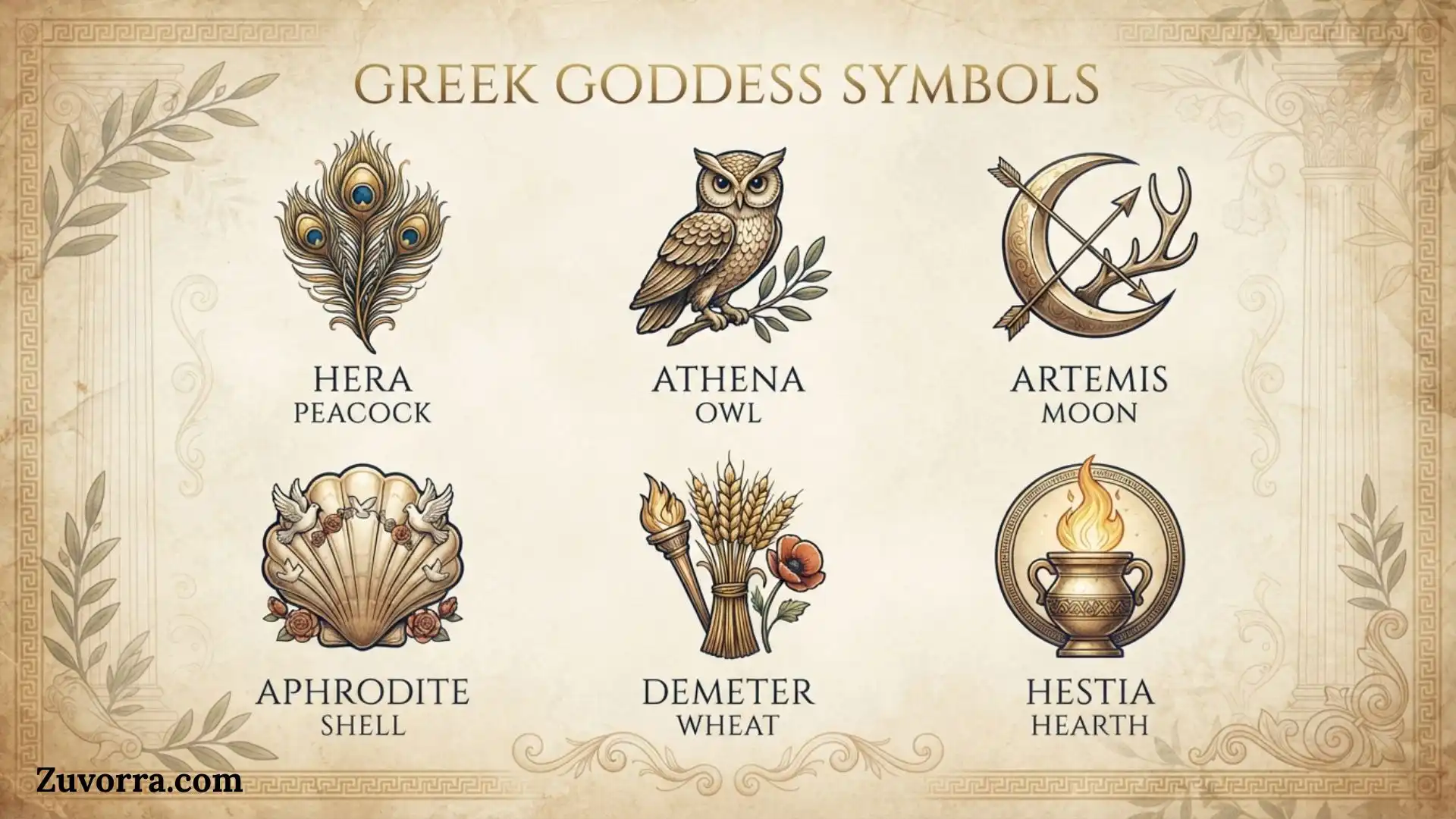
Greek goddess symbols are animals, plants, objects, garments, and natural forces used to identify female deities and express their powers. Athena’s owl represents watchful wisdom, Aphrodite’s dove suggests love and desire, Demeter’s wheat reflects agriculture, and Artemis’s bow symbolizes the hunt. These attributes helped ancient viewers recognize goddesses in temples, pottery, sculpture, coins, and sacred ceremonies.
Today, the same symbols appear in literature, jewelry, tattoos, films, logos, museum collections, and modern spiritual practices. Yet their meanings are often more complex than popular summaries suggest. A pomegranate can represent both fertility and the Underworld, while a torch may stand for guidance, ritual, searching, or passage between realms.
Understanding these symbols reveals how ancient Greek communities viewed wisdom, marriage, nature, warfare, motherhood, death, beauty, justice, and divine power.
Quick Meaning
Greek goddess symbols are visual attributes connected with the identities, myths, powers, and worship of ancient Greek female deities. They include animals such as owls and deer, plants such as wheat and olive trees, and objects such as torches, bows, mirrors, crowns, and shields. Their meanings vary by goddess, region, myth, and historical period.
Greek Goddess Symbols Overview Table
| Greek Goddess | Main Symbols | Primary Meanings |
| Athena | Owl, olive tree, helmet, spear, shield, aegis | Wisdom, strategy, protection, skilled crafts |
| Aphrodite | Dove, rose, myrtle, shell, mirror, sparrow | Love, beauty, desire, attraction |
| Artemis | Bow, arrows, deer, hunting dog, wild animals | Wilderness, hunting, independence, childbirth |
| Hera | Diadem, scepter, peacock, cow, pomegranate | Queenship, marriage, legitimacy, sovereignty |
| Demeter | Wheat, barley, cornucopia, torch, poppy | Agriculture, nourishment, harvest, motherhood |
| Persephone | Pomegranate, flowers, torch, grain | Rebirth, seasonal change, death, return |
| Hestia | Hearth, flame, kettle, veil | Home, family unity, sacred fire |
| Hecate | Twin torches, keys, dogs, crossroads | Thresholds, night, protection, magic |
| Nike | Wings, wreath, palm branch | Victory, success, triumph |
| Iris | Rainbow, wings, herald’s staff, pitcher | Messages, communication, connection |
| Themis | Scales, sword, throne | Divine law, order, fairness |
| Nemesis | Wheel, measuring rod, bridle, scales | Justice, balance, deserved consequences |
| Selene | Crescent moon, chariot, torch | Moonlight, cycles, night |
| Eos | Wings, saffron robe, chariot | Dawn, renewal, beginnings |
| Tyche | Mural crown, cornucopia, wheel, rudder | Fortune, civic prosperity, changing fate |
| Gaia | Earth, fruit, flowers, reclining figure | Earth, fertility, ancestry, creation |
No single Unicode character represents the complete idea of Greek goddess symbols. Modern emojis such as and can suggest individual attributes, but they are not historical sacred signs.
What Do Greek Goddess Symbols Mean?
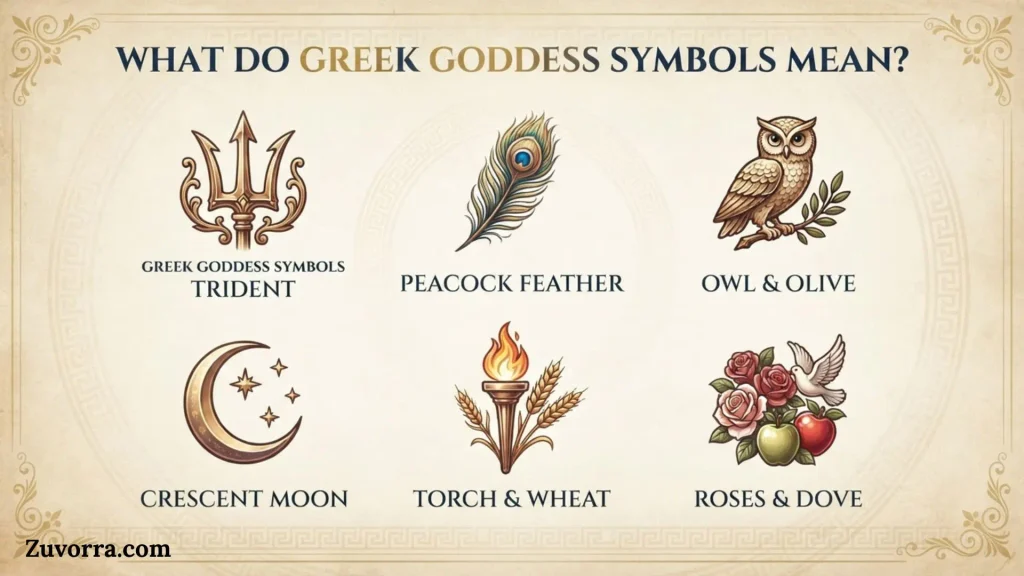
Greek goddess symbols communicate identity, authority, function, and mythological relationships. In ancient art, a figure did not always need a written label. A helmeted woman carrying a spear and aegis could be recognized as Athena. A huntress with a bow, quiver, and deer was likely Artemis.
These visual attributes also expressed what worshippers expected from a deity. Wheat linked Demeter with food and agricultural survival. The hearth connected Hestia with domestic stability. Keys showed Hecate’s ability to guard doors, crossroads, and boundaries.
A symbol could have several meanings at once. Athena’s spear represents warfare, but her warfare is usually strategic and defensive rather than uncontrolled violence. Aphrodite’s shell recalls beauty and the sea, while also connecting with stories of her birth. Persephone’s pomegranate represents marriage, death, fertility, captivity, and seasonal return.
Meanings therefore come from three main sources:
- Myth: An object or animal appears in a goddess’s story.
- Cult: Worshippers use the object in rituals or sacred spaces.
- Art: Artists repeatedly depict the goddess with the same attribute.
A modern interpretation may emphasize personal ideas such as confidence or feminine strength. Ancient meanings, however, were tied to religious practice, city identity, family life, agriculture, warfare, and political authority.
History and Origin of Greek Goddess Symbols
Greek goddess symbols developed gradually rather than through one fixed system. Greek religion did not have a single central scripture or universal authority that standardized every divine image. Religious customs varied among city-states, islands, sanctuaries, and historical periods. Poetry, local traditions, temple rituals, inscriptions, and visual art all contributed to divine identities.
Some attributes may have roots in Bronze Age Aegean religion, although connections between early figures and later Olympian goddesses are often uncertain. During the Archaic and Classical periods, artists increasingly used recognizable objects, animals, clothing, and poses to identify deities.
Early Greek poets also shaped the divine world. Hesiod’s Theogony organized relationships among gods, Titans, and primordial beings, while the Homeric Hymns praised individual deities and described their powers. Surviving hymns are dedicated to Aphrodite, Artemis, Athena, Demeter, Hera, Hestia, Selene, and other divine figures.
Regional exchange also mattered. Greek communities traded and interacted with Egypt, Anatolia, Cyprus, Phoenicia, Mesopotamia, and Italy. Aphrodite’s development, for example, appears to have been influenced by Near Eastern love and fertility goddesses, including Astarte and Ishtar, especially through Cyprus and the eastern Mediterranean.
The Romans later identified many Greek goddesses with their own deities:
- Athena became associated with Minerva.
- Aphrodite became Venus.
- Artemis became Diana.
- Hera became Juno.
- Demeter became Ceres.
- Persephone became Proserpina.
- Hestia became Vesta.
- Nike became Victoria.
This process preserved many symbols but also changed their political, artistic, and religious meanings. Renaissance and later European artists continued using Greco-Roman attributes, helping them survive into modern culture.
Major Greek Goddess Symbols and Their Interpretations
Athena: Owl, Olive Tree, Aegis, Helmet, and Spear
Athena’s symbols express intelligence joined with disciplined power. The owl represents alertness and wisdom, while the olive tree reflects peace, prosperity, cultivation, and the city of Athens. The Metropolitan Museum of Art notes that the owl and olive tree were sacred to Athena and that she commonly appeared with armor, helmet, spear, and aegis.
Her aegis, often shown as a protective goatskin with a snakelike fringe and the Gorgon’s head, represents divine defense and terror directed against enemies. The helmet and spear connect her with strategic warfare. The spindle and loom, less dramatic but equally important, reflect her role as patroness of weaving and skilled crafts.
Modern symbolism often presents Athena as an image of knowledge, leadership, courage, and rational decision-making.
Aphrodite: Dove, Rose, Myrtle, Shell, and Mirror
Aphrodite’s symbols represent attraction, beauty, sexuality, fertility, pleasure, and the power of relationships. Doves and sparrows suggest courtship and desire. Roses and myrtle express beauty, love, fragrance, and growth. Mirrors became associated with physical appearance and self-awareness.
The shell became especially popular in later art because Aphrodite was linked with the sea and with traditions describing her emergence from sea foam. Ancient worship also gave her broader powers than modern romance imagery suggests. She could be connected with marriage, civic unity, warfare, motherhood, and safe sea travel.
Aphrodite’s symbols can therefore represent both affectionate love and the disruptive force of desire.
Artemis: Bow, Arrows, Deer, and Hunting Dogs
Artemis is recognized by her bow, quiver, deer, hunting dogs, and wild surroundings. These symbols express wilderness, movement, hunting skill, independence, protection of young animals, and the dangers of untamed nature.
Ancient and Hellenistic artworks often show her reaching for an arrow or standing beside a deer. The Met identifies deer as one of her attributes and describes statues in which she originally held a bow.
Although later traditions strongly connect Artemis with the moon, the bow and deer are more dependable identifying attributes in early Greek art. She was also associated with childbirth and the protection of young people, creating a meaningful contrast: she remained unmarried yet guarded important transitions in female life.
Hera: Diadem, Scepter, Peacock, Cow, and Pomegranate
Hera’s diadem and scepter are her clearest ancient attributes. They mark her as queen of the gods and symbolize sovereignty, lawful marriage, status, and royal authority. In Greek art, she may appear enthroned, veiled, or crowned.
The cow was an early sacred animal connected with her dignity and maternal power. The peacock became especially prominent in Roman and later artistic traditions through Hera’s Roman counterpart, Juno. Its “eye-covered” tail was linked with the myth of Argus.
The pomegranate can represent fertility, marriage, abundance, and the binding nature of family relationships. Hera’s symbolism is not simply romantic. It reflects the legal, social, dynastic, and political importance of marriage in the ancient world.
Demeter: Wheat, Barley, Torch, Poppy, and Cornucopia
Demeter’s wheat and barley represent agriculture, bread, nourishment, fertility, and dependence on the earth. Her torch recalls her search for Persephone and the ceremonial use of light in the Eleusinian Mysteries.
Art often connects Demeter and Persephone with Triptolemus, the hero whom Demeter sent to teach grain cultivation to humanity.
The cornucopia represents abundance, while poppies may reflect their presence in grain fields and their associations with sleep or altered states. Demeter’s symbols carry both comfort and warning: fertile land sustains life, but the withdrawal of growth creates famine.
Persephone: Pomegranate, Flowers, Grain, and Torch
Persephone’s symbols express a life divided between the world of the living and the realm of the dead. Flowers recall the meadow where she was gathering blossoms before Hades seized her. Grain links her with Demeter and the return of plant life. Torches suggest searching, ritual movement, and passage through darkness.
The pomegranate is her most famous symbol. Because she ate its seeds in the Underworld, it became a sign of binding obligation, marriage, fertility, death, and cyclical return. In the Eleusinian tradition, her descent and return offered a powerful framework for thinking about loss, renewal, and hopes concerning the afterlife.
Hestia: Hearth and Sacred Flame
Hestia’s central symbol is the hearth. It represents the home, shared meals, family continuity, civic unity, hospitality, and sacred order.
Her symbolism is quieter than that of warrior or huntress goddesses because she is usually represented through place and ritual rather than dramatic myth. The domestic hearth stood at the center of household life, while public fire could represent the community itself.
A modern flame may suggest passion, but Hestia’s fire is controlled, stable, and sustaining. It symbolizes continuity rather than destruction.
Hecate: Torches, Keys, Dogs, and Crossroads
Hecate’s paired torches illuminate darkness and mark her role as a guide through uncertain spaces. Keys represent access, guardianship, secrecy, and control over thresholds. Dogs may announce her approach or guard boundaries. Crossroads reflect choice, danger, transition, and contact between different realms.
In later art, Hecate is sometimes shown with three bodies or three faces. This form emphasizes her ability to look in several directions and govern intersecting paths. It should not automatically be treated as proof that she was originally a universal “triple moon goddess.” That modern interpretation blends selected ancient evidence with later spiritual ideas.
Nike: Wings, Wreath, and Palm Branch
Nike’s wings show the speed and mobility of victory. She often carries a wreath or palm branch to honor a winner. In some artworks, a larger deity such as Athena or Zeus holds a small figure of Nike, showing that victory is a divine gift or attribute.
Her image appeared in religious monuments, athletic settings, military art, and later political symbolism. Today, winged victory figures continue to represent achievement, honor, and success.
Themis and Nemesis: Scales, Order, and Balance
Themis represents divine law, established custom, social order, and proper procedure. Modern art often gives her scales and a sword, but the familiar blindfolded Lady Justice developed much later and should not be treated as a standard ancient Greek depiction.
Nemesis represents proportion, accountability, and consequences for excessive pride or undeserved success. Her measuring tools suggest limits and fair distribution. The wheel symbolizes changing fortune, while a bridle can represent restraint.
Together, Themis and Nemesis show that Greek justice involved both correct order and the correction of imbalance.
Cultural Significance
Greek goddess symbols had different meanings across regions because ancient Greece was not one unified religious state. Athens emphasized Athena as civic protector. Eleusis became famous for the worship of Demeter and Persephone. Ephesus developed a distinctive form of Artemis that differed visually and religiously from the familiar Greek huntress.
Sparta, Arcadia, Crete, Cyprus, Sicily, and the Greek colonies of southern Italy maintained local cult titles and practices. A goddess could have several epithets, each highlighting a different role. Aphrodite might protect sailors in one place and marriage in another. Artemis could guard wilderness, childbirth, young people, or a local sanctuary.
This regional diversity explains why the same goddess may appear with different symbols. It also warns against reducing a deity to one modern keyword. Athena is not only “wisdom,” and Aphrodite is not only “romance.” Their symbols reflect layered civic, natural, familial, and religious functions.
Religious and Spiritual Meaning
In ancient Greek religion, symbols were not merely decorative. They helped worshippers recognize divine presence, organize ceremonies, dedicate offerings, and communicate the purpose of a sanctuary.
A worshipper might offer a small animal figure associated with a deity, dedicate a relief showing the goddess, wear ritual clothing, carry torches, or use grain, branches, wreaths, and vessels in ceremonies. Animal sacrifice was a central public ritual, although offerings also included food, drink, incense, textiles, figurines, and valuable objects.
Modern Hellenic polytheists may use traditional symbols devotionally, while artists and spiritual communities often reinterpret them as archetypes. These modern uses deserve respect, but they should be distinguished from claims about ancient practice unless supported by literary, archaeological, or inscriptional evidence.
Is There a Scientific or Technical Meaning?
Greek goddess symbols do not form a scientific notation system. However, goddess names and images appear in technical fields.
Astronomy uses names such as Iris, Selene, Eos, Themis, Nemesis, and Hygiea for celestial objects or scientific concepts. Psychology sometimes uses mythological figures as metaphors for personality patterns, though such interpretations are theoretical rather than ancient religious facts.
Medical imagery also preserves Hygieia’s bowl and serpent, a symbol associated with pharmacy. The goddess Hygieia represented health, cleanliness, and prevention, while her father Asclepius became associated with healing.
In digital communication, goddess symbols usually appear through ordinary emojis rather than standardized deity icons. An owl may suggest Athena, a crescent moon may suggest Selene or Artemis, and a sheaf of grain may suggest Demeter, but context determines the meaning.
Where Greek Goddess Symbols Are Used Today
Greek goddess imagery appears in:
- Museums: To identify figures on pottery, coins, reliefs, and statues.
- Literature: As themes of wisdom, desire, justice, fate, and transformation.
- Tattoos: To represent personal values such as independence or resilience.
- Jewelry: Owls, crescents, pomegranates, keys, and laurel wreaths.
- Logos: Athena and Nike imagery often suggest achievement or intelligence.
- Architecture: Classical decorative programs include goddesses and their attributes.
- Film and games: Mythological symbols help establish characters and powers.
- Education: Visual attributes make myths and ancient art easier to study.
- Modern religion: Some practitioners use historically inspired devotional objects.
- Psychology and self-help: Goddesses may serve as metaphors for human traits.
A Simple Identification Guide
Is the figure armored with an owl or aegis?
↓
Most likely Athena
Does she carry a bow beside a deer?
↓
Most likely Artemis
Is she holding grain, a cornucopia, or torches?
↓
Likely Demeter or Persephone
Does she wear a royal crown and hold a scepter?
↓
Likely Hera
Is she shown with doves, roses, a mirror, or a shell?
↓
Likely Aphrodite
Does she carry keys or twin torches near a crossroads?
↓
Likely Hecate
Context still matters because attributes can overlap.
Common Variations and Similar Symbols
Greek symbols changed across time, place, and artistic medium. A small painted vase could use one clear attribute, while a temple sculpture might present a full narrative scene.
Common variations include:
- Artemis shown as a young huntress, a guardian of animals, or a regional fertility deity.
- Aphrodite shown clothed in early art and increasingly nude in later Classical and Hellenistic traditions. Praxiteles’ famous Aphrodite of Knidos helped shape later representations of the nude goddess.
- Hecate depicted as one woman, three joined bodies, or a torch-bearing guide.
- Athena shown seated, standing, fighting, weaving, or carrying Nike.
- Persephone shown as a maiden, bride, queen, or returning daughter.
- Tyche shown with a city-wall crown, rudder, cornucopia, or wheel.
Similar symbols do not always share the same meaning. A torch may belong to Demeter, Persephone, Hecate, or Artemis. A crown may mark Hera’s queenship or Tyche’s connection with a city. Correct identification depends on the full scene.
Common Misconceptions
Every goddess has one official symbol
Most goddesses have several attributes, and no ancient universal chart assigned one exclusive symbol to each deity.
Artemis was always a moon goddess
Artemis developed lunar associations, especially through connections with Selene and Roman Diana, but her clearest early functions involve hunting, wilderness, animals, young people, and childbirth.
The peacock was Hera’s only sacred animal
The peacock became famous through later Greek and Roman art, but cattle, especially the cow, also had important early associations with Hera.
Hecate’s triple form proves one fixed “maiden, mother, crone” system
Ancient Hecate could appear in triple form, but the widely used maiden-mother-crone interpretation is largely modern and should not be presented as a universal ancient doctrine.
Athena represents peaceful wisdom only
Athena represents intelligence and skilled crafts, but she is also an armed protector and goddess of strategic warfare.
Aphrodite represents harmless romance
Aphrodite’s power includes beauty and affection, but Greek myths also portray desire as overwhelming, politically dangerous, and capable of causing conflict.
Themis was always blindfolded
The blindfold belongs mainly to later European representations of Justice. Ancient Themis was not normally defined by blindness.
10 Interesting Facts About Greek Goddess Symbols
- Symbols functioned like visual name tags. Viewers could recognize a deity even when no inscription appeared.
- One attribute could identify several goddesses. Torches, crowns, animals, and staffs require interpretation within the complete scene.
- Athena’s owl became a civic emblem. Owls appeared prominently on Athenian objects and coinage, linking the goddess with the city.
- Artemis combines opposing ideas. She hunts animals but also protects wildlife and the young, showing that divine roles were not simple categories.
- Persephone’s pomegranate carries several meanings. It can symbolize fertility and life while also binding her to death and the Underworld.
- Hestia is often symbolized without a human image. The actual hearth flame could express her presence more directly than a statue.
- Aphrodite’s symbols changed with artistic taste. Early images often clothed her, while later sculptors made the nude body central to her iconography.
- Nike can appear as both a goddess and an attribute. A small winged Nike in Athena’s hand makes victory part of Athena’s larger authority.
- Regional cult titles changed symbolism. The same goddess could protect a city, sailors, brides, children, or crops depending on her local epithet.
- Modern tattoo meanings are often personal. A wearer may use Medusa, Athena, or Hecate to express survival or independence even when that meaning differs from ancient worship.
Related Greek Symbols
- Medusa’s head: A protective and terrifying image strongly associated with Athena’s aegis.
- Laurel wreath: Mainly linked with Apollo and victory, though it often appears near Nike.
- Cornucopia: A sign of abundance used by Demeter, Tyche, and other deities.
- Caduceus: The staff of Hermes, often confused with medical symbols.
- Rod of Asclepius: A single serpent-entwined staff associated with healing.
- Labrys: A double axe with Bronze Age Aegean religious associations, though its exact meanings remain debated.
- Omphalos: A sacred stone connected especially with Delphi.
- Meander pattern: A Greek decorative motif often interpreted today as continuity, though it was not the personal emblem of one goddess.
- Gorgoneion: A frontal Gorgon face used as an apotropaic, or evil-averting, image.
- Tripod: Strongly associated with Apollo, prophecy, and Delphi rather than a major goddess.
Frequently Asked Questions
What are the most famous Greek goddess symbols?
The best-known examples are Athena’s owl and olive tree, Aphrodite’s dove and rose, Artemis’s bow and deer, Hera’s crown and scepter, Demeter’s wheat, Persephone’s pomegranate, Hestia’s hearth flame, and Hecate’s torches and keys. Each symbol reflects a deity’s myths, powers, worship, or artistic identity.
Which Greek goddess is represented by an owl?
The owl represents Athena, goddess of wisdom, strategic warfare, skilled crafts, and civic protection. It suggests alert vision and intelligent judgment. In ancient Athens, the owl also became a recognizable civic image because Athena served as the city’s patron deity.
Which Greek goddess has a deer symbol?
The deer is most strongly associated with Artemis. It reflects her authority over hunting, wilderness, wild animals, and untamed landscapes. Ancient artworks frequently show Artemis beside a deer or fawn while carrying a bow, arrows, or quiver.
What symbol represents Aphrodite?
Aphrodite has several symbols rather than one official emblem. Doves, roses, myrtle, shells, mirrors, sparrows, and marine imagery can all identify her. These attributes express beauty, desire, sexuality, fertility, attraction, and her important connection with the sea.
What Greek goddess is linked with the pomegranate?
Persephone is most famously linked with the pomegranate because eating its seeds bound her to the Underworld. Hera and Aphrodite can also have pomegranate associations related to marriage and fertility. The surrounding myth or artwork helps determine which goddess the fruit represents.
Which goddess is symbolized by fire?
Hestia is symbolized by the controlled flame of the household and civic hearth. Hecate, Demeter, and Persephone also carry torches, but their flames usually represent searching, ritual travel, guidance, or movement through darkness rather than the stable center of the home.
What is Athena’s strongest symbol?
The owl is Athena’s most widely recognized modern symbol, but her aegis may better express her protective divine authority. Her helmet, spear, shield, olive tree, and weaving tools reveal different parts of her identity, including strategy, civic guardianship, peace, and craftsmanship.
Are Greek goddess symbols religious today?
They can be. Many people use them as artistic, literary, academic, or personal symbols. Modern Hellenic polytheists may also use them devotionally. Their present meaning depends on context, so a pomegranate necklace or owl tattoo is not automatically a religious declaration.
Which Greek goddess represents female strength?
There is no single ancient goddess of all forms of female strength. Athena can represent strategic authority, Artemis independence, Hera sovereignty, Demeter endurance, Hecate guardianship, and Nike victory. The best symbol depends on the kind of strength a person wishes to express.
How can I identify a Greek goddess in ancient art?
Look for a combination of attributes rather than one object. Examine clothing, animals, weapons, plants, companions, setting, and pose. Armor and an owl suggest Athena, while a bow and deer suggest Artemis. Museum descriptions and archaeological context provide the most reliable confirmation.
Key Takeaways
- Greek goddess symbols identify deities and express their powers, myths, and sacred roles.
- Athena’s owl, Artemis’s deer, Aphrodite’s dove, and Demeter’s wheat are among the best-known examples.
- Symbols varied by region, cult title, artistic period, and religious setting.
- One object can belong to several goddesses, so context is essential.
- Ancient meanings should be separated from later Roman, Renaissance, and modern interpretations.
- Goddess symbols still appear in art, literature, tattoos, jewelry, logos, games, and religious practice.
- Reliable interpretation combines mythology, archaeology, inscriptions, art history, and local cult evidence.
Conclusion
Greek goddess symbols formed a rich visual language through which ancient communities expressed divine wisdom, beauty, authority, fertility, protection, justice, death, and renewal. An owl did more than identify Athena, and a pomegranate did more than identify Persephone. Each attribute connected stories, ceremonies, places, and human concerns.
Their continued presence in modern art and culture shows the lasting power of Greek mythology. By studying the symbols in their historical setting, readers can appreciate both their ancient religious significance and their evolving modern interpretations without reducing complex goddesses to simple labels.
References
- The Metropolitan Museum of Art, “Greek Gods and Religious Practices.”
- The Metropolitan Museum of Art, collection records for Athena, Artemis, Demeter, Persephone, and Greek religious art.
- The Metropolitan Museum of Art, “Mystery Cults in the Greek and Roman World.”
- J. Paul Getty Museum, Aphrodite and the Gods of Love exhibition materials.
- Getty Vocabulary Program, Cultural Objects Name Authority iconography records.
- British Museum, “Gods and Goddesses of the Greek and Roman Pantheon.”
- Perseus Digital Library, Hesiod’s Theogony and the Homeric Hymns.

I’m Felix Everard, a British writer passionate about the fascinating world of symbols and visual communication. I explore traditional, cultural, historical, and modern symbols, focusing on what they represent and why they matter. Through accessible explanations, I hope to help readers recognise the meanings hidden within familiar signs, shapes, and images.
Books:
- The Complete Guide to Symbolism
- Decoding Signs and Symbols