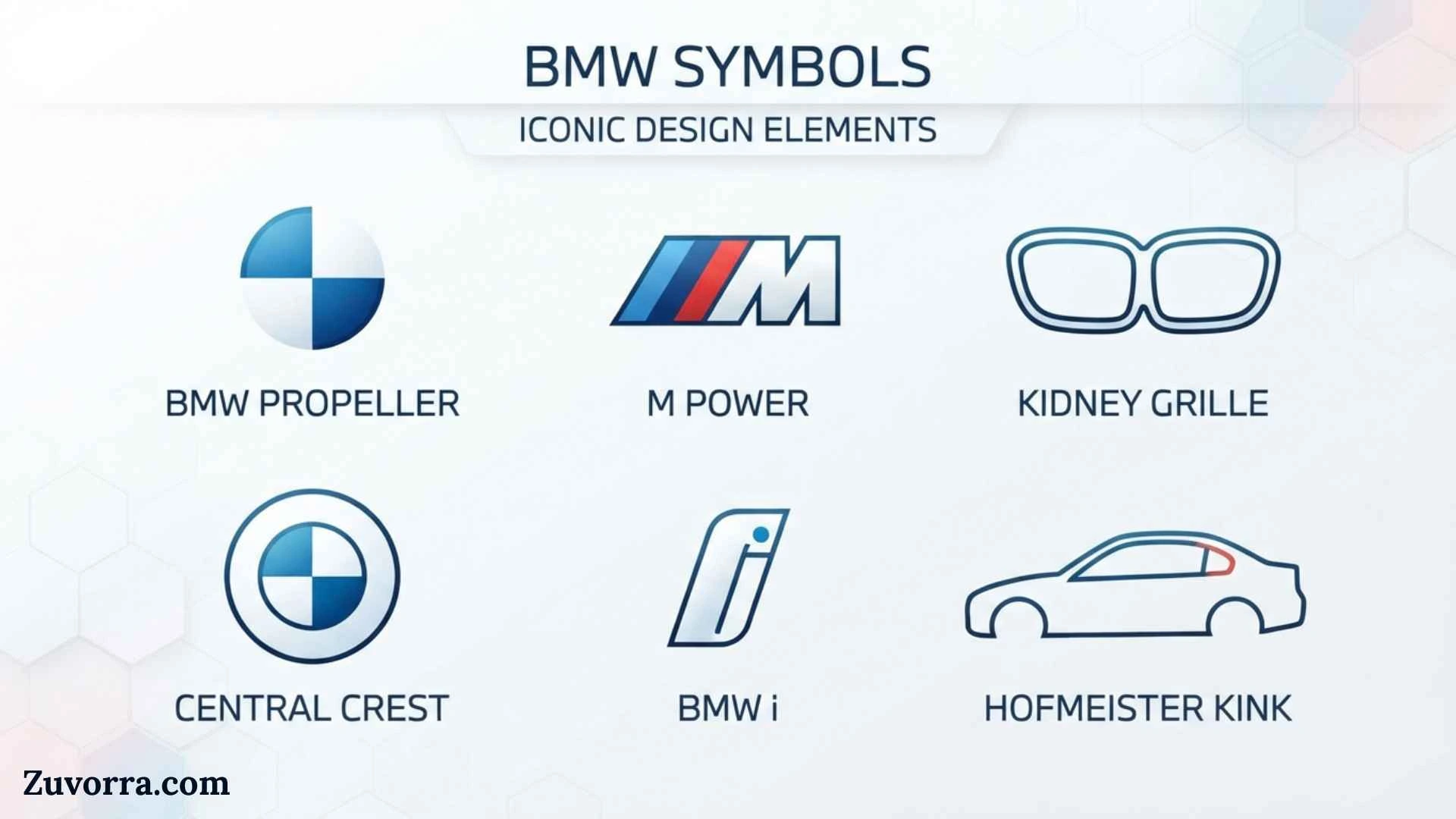
BMW symbols are visual alerts that tell you what your vehicle is doing, which system needs attention, and whether it is safe to continue driving. Some icons simply confirm that a feature is active, while others warn of problems involving the engine, brakes, tires, battery, cooling system, or driver-assistance technology.
Understanding these symbols matters because the color, shape, and accompanying Check Control message can reveal how urgently you should respond. This guide explains the most common BMW dashboard symbols, their meanings, their history, and the practical steps to take when they appear.
Quick Meaning
BMW symbols communicate vehicle status, active features, maintenance needs, and mechanical or safety problems. Green and blue lights usually confirm normal operation. Yellow or orange symbols normally request caution or service. Red warning lights may indicate an urgent condition that requires you to stop safely and investigate before continuing.
BMW Symbols Overview Table
| Field | Details |
| Primary category | Automotive dashboard symbols and brand emblems |
| Main purpose | Communicate vehicle status, warnings, faults, and active systems |
| Common locations | Instrument cluster, head-up display, iDrive screen, steering-wheel controls, exterior badges |
| Main color meanings | Green or blue: active system; yellow or orange: caution; red: urgent warning |
| Warning system | BMW Check Control |
| Vehicle-specific reference | BMW Driver’s Guide or Digital Owner’s Manual |
| Brand symbol | BMW roundel |
| Roundel origin | Introduced in 1917 |
| Roundel colors | Blue and white, based on Bavarian state colors |
| Related symbols | BMW M badge, BMW i branding, Motorsport emblem, road-sign icons |
| Unicode equivalent | Most BMW dashboard symbols do not have exact Unicode characters |
| Emoji equivalent | No official emoji equivalents |
BMW states that Check Control combines warning or indicator lights with text messages in the instrument cluster and, where equipped, the head-up display or central display. An audible signal may also accompany important alerts.
What Do BMW Symbols Mean?
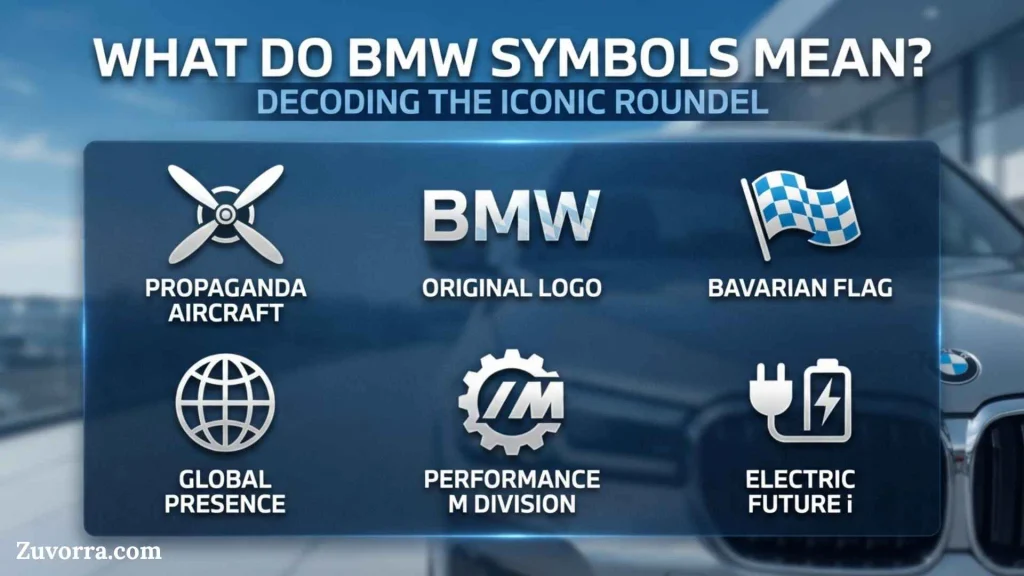
BMW symbols tell the driver whether a system is operating normally, temporarily unavailable, due for service, or experiencing a fault.
The symbol alone is only part of the message. You should also consider:
- Its color
- Whether it remains steady or flashes
- Any text displayed beside it
- Changes in braking, steering, engine performance, or handling
- The model-specific instructions in the owner’s manual
BMW vehicles use Check Control to monitor many functions throughout the car. Depending on the model, the system may display an icon, written explanation, recommended action, sound, or combination of these alerts. Some messages disappear after the condition ends. Others remain until the fault is repaired.
Understanding BMW Warning-Light Colors
Green symbols
Green usually means a feature is switched on and operating normally.
Examples include:
- Low-beam headlights
- Turn signals
- Cruise-control availability
- Lane-detection readiness
- Parking lights
A green symbol normally requires no corrective action.
Blue symbols
Blue commonly indicates high-beam headlights or another lighting-related function.
For example, BMW explains that the high-beam indicator illuminates blue when the vehicle activates its high beams.
White or gray symbols
White and gray icons often provide information rather than warnings. They may indicate that a function is available, selected, inactive, or waiting for operating conditions to be met.
Yellow or orange symbols
Yellow or orange means caution. The vehicle may remain drivable, but a system requires attention, inspection, or adjusted driving.
Common examples include:
- Check Engine light
- Low tire pressure
- Stability-control warning
- Low fuel
- Brake-pad wear
- Driver-assistance limitation
- Service reminder
Do not automatically ignore a yellow symbol. Some yellow alerts can become serious if the underlying problem worsens.
Red symbols
Red indicates an urgent safety, mechanical, or operating condition.
Examples include:
- Low engine-oil pressure
- Excessive engine temperature
- Brake-system warning
- Charging-system failure
- Unfastened seat belt
- Open door while moving
- Parking brake engaged
When a red mechanical warning appears, reduce speed, find a safe place to stop, and read the Check Control message. Continuing to drive could cause damage or create a safety risk.
Common BMW Dashboard Symbols and Their Meanings
Check Engine Symbol
Appearance: An outline shaped like an engine.
The Check Engine light means the engine-management or emissions system has detected a fault. Causes range from a loose fuel cap or sensor issue to misfiring, fuel-delivery trouble, or emissions-control failure.
A steady yellow light usually means the car needs diagnosis soon. A flashing light can indicate an active misfire or another condition that may damage the catalytic converter. Reduce power demand and arrange professional inspection promptly.
Engine-Oil Pressure Symbol
Appearance: An oil can with a drop.
A red oil-can symbol commonly warns that engine-oil pressure is too low. This is not simply a reminder to schedule an oil change.
Stop the engine safely as soon as possible. Check the oil level only when conditions allow and follow the owner’s manual. Driving with insufficient oil pressure can quickly damage internal engine components.
A yellow oil symbol may indicate a low oil level, an oil-level measurement issue, or a service-related condition, depending on the BMW model.
Engine Coolant Temperature Symbol
Appearance: A thermometer above waves.
This symbol warns that the engine or cooling system is too hot. Possible causes include low coolant, a failed water pump, cooling-fan trouble, thermostat failure, or a coolant leak.
Turn off unnecessary electrical loads, stop safely, and allow the vehicle to cool. Never open a hot cooling system because pressurized coolant can cause severe burns.
Battery or Charging-System Symbol
Appearance: A rectangular battery with positive and negative signs.
A red battery symbol means the electrical charging system may not be supplying enough power. The problem could involve the alternator, drive belt, battery connection, wiring, or energy-management system.
The engine may continue running temporarily using stored battery power, but it can shut down once that power is depleted. Switch off nonessential electrical equipment and seek service without unnecessary delay.
Brake-System Warning Symbol
Appearance: An exclamation mark or the word “BRAKE” inside a circle.
This red warning can indicate:
- The parking brake is engaged
- Brake-fluid level is low
- A hydraulic brake problem exists
- The braking system needs urgent inspection
First confirm that the parking brake is fully released. If the warning remains, especially with reduced braking performance or an unusual pedal feel, stop driving and obtain assistance.
Brake-Pad Wear Symbol
Appearance: A circle surrounded by broken curved lines.
This symbol generally means the brake-pad wear sensor has detected that the pads are approaching their service limit. It does not necessarily mean the brakes have failed, but delaying replacement can damage the rotors and reduce braking reliability.
BMW also uses service indicators for items such as brake pads and brake fluid.
Anti-Lock Braking System Symbol
Appearance: “ABS” inside a circle.
The ABS light means the anti-lock braking system has detected a fault. Conventional braking may remain available, but the system may not prevent wheel lock during hard braking.
Drive carefully, increase following distance, and have the fault checked. If ABS appears together with red brake warnings, treat the situation as more urgent.
Dynamic Stability Control Symbol
Appearance: A car with wavy skid lines.
This icon relates to Dynamic Stability Control, often shortened to DSC.
When the light flashes, the system is actively regulating brake force or engine power to help stabilize the vehicle. Reduce speed and adapt to the road surface.
When it remains illuminated, DSC may be switched off, initializing, or experiencing a fault. BMW notes that a steady DSC warning can mean driving stabilization is restricted or unavailable.
Tire Pressure Monitoring Symbol
Appearance: An exclamation mark inside a tire-shaped curve.
This warning means one or more tires may have lost pressure, or the tire-pressure monitoring system requires attention.
Reduce speed and avoid sharp steering or heavy braking. Check all tires for visible damage and measure their pressure when safe. Inflate them according to the vehicle’s specified cold-tire pressures, not the maximum number printed on the tire sidewall.
A rapidly deflating tire, strong vibration, or major handling change requires an immediate stop.
Airbag and Restraint-System Symbol
Appearance: A seated person with a circular airbag in front.
This symbol warns of a possible fault involving airbags, seat-belt tensioners, occupancy sensors, or related restraint components.
The vehicle may still drive normally, but one or more protective systems might not operate as intended in a collision. Arrange diagnosis as soon as practical.
Seat-Belt Symbol
Appearance: A seated person wearing a belt.
This red symbol means the driver or a passenger has not fastened a seat belt. It may be accompanied by a chime.
Heavy objects placed on a passenger seat can sometimes activate the occupancy sensor. Secure the item elsewhere rather than fastening a belt around loose cargo.
Power-Steering Warning Symbol
Appearance: A steering wheel, sometimes with an exclamation mark.
This icon means steering assistance may be reduced or unavailable. The vehicle may require significantly more effort to steer, especially at low speed.
Stop safely, switch the vehicle off, and restart it if the manual recommends doing so. If the warning remains or steering feels abnormal, avoid continuing except as necessary to reach safety.
Transmission Warning Symbol
Appearance: A gear or transmission-shaped icon with an exclamation mark.
A transmission warning may indicate overheating, an electronic-control issue, restricted gear selection, or an emergency operating mode.
Drive gently and read the accompanying message. If the car shifts harshly, will not select a gear, or displays a red warning, stop and request assistance.
Low-Fuel Symbol
Appearance: A fuel pump.
The fuel-pump icon means the fuel reserve has been reached. Refuel soon.
Do not repeatedly drive with extremely low fuel. Besides risking a breakdown, low fuel can expose the fuel system to heat and inconsistent fuel delivery under certain driving conditions.
Diesel Particulate Filter Symbol
Appearance: A filter-shaped rectangle with dots or exhaust lines.
On diesel models, this icon can indicate that the diesel particulate filter has collected excessive soot or cannot complete regeneration.
Repeated short journeys, low-speed driving, or system faults can prevent proper regeneration. Follow the vehicle-specific guidance because the correct response depends on the model, driving conditions, and whether other engine warnings are present.
Glow-Plug Symbol
Appearance: A yellow coil.
Diesel BMW models use this symbol to indicate preheating. Wait for the light to turn off before starting when required.
If it flashes or remains illuminated while driving, the glow-plug or engine-management system may need inspection.
Washer-Fluid Symbol
Appearance: A windshield with spraying water.
This symbol means windshield-washer fluid is low. Refill it with a suitable product for the expected temperature.
Although it is not a mechanical emergency, clear visibility is essential, especially in winter weather, road salt, rain, or heavy traffic.
Exterior-Light Fault Symbol
Appearance: A bulb with an exclamation mark or radiating lines.
This warning means an exterior lamp may have failed or the lighting system has detected a fault.
Check the headlights, brake lights, turn signals, taillights, and license-plate lights. Some modern LED units require professional repair rather than a simple bulb replacement.
Headlight Symbol With an “A”
Appearance: A headlamp icon marked with the letter A.
This indicates automatic high-beam control. BMW explains that a green light shows the automatic function is operating with low beams, while a blue light appears when the system activates the high beams.
Lane Departure Warning Symbol
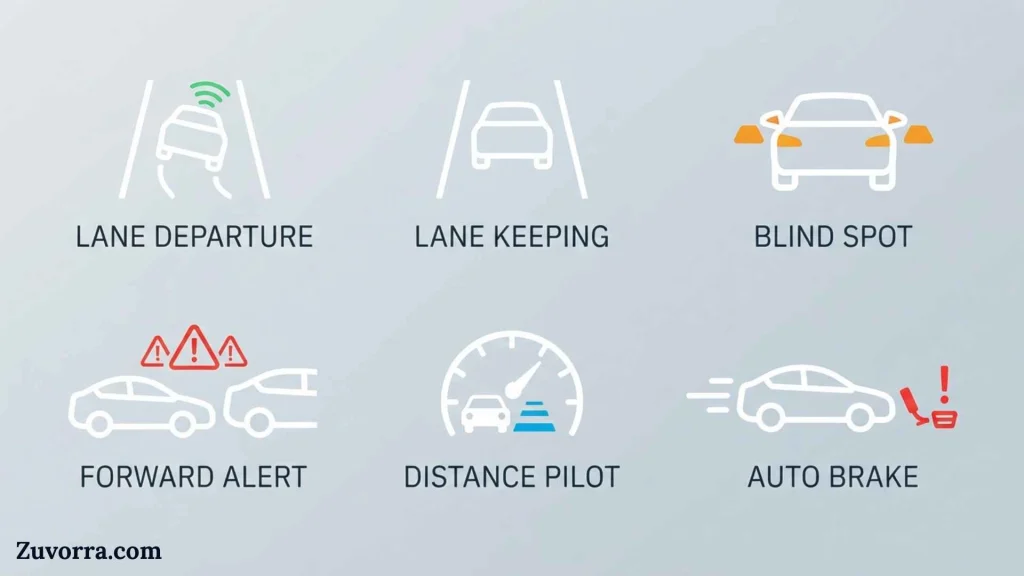
Appearance: A vehicle between two lane lines.
The symbol indicates the status of Lane Departure Warning or a related lane-support system.
A green indicator generally means the system is switched on, has detected at least one lane boundary, and is ready to respond.
Gray, yellow, flashing, or crossed-out versions may mean lane markings are not detected, the system is limited, driver input is required, or a fault exists. Exact behavior varies by model and software version.
Collision-Warning Symbol
Appearance: A vehicle, triangle, person, or obstacle with warning marks.
This icon warns of a possible collision with a vehicle, pedestrian, cyclist, or other detected hazard. It may flash red and sound an alarm when immediate driver action is needed.
Brake and steer as conditions require. Driver-assistance systems support the driver but do not replace attention or control.
Parking-Sensor Symbol
Appearance: A letter P, vehicle outline, and curved detection waves.
This symbol identifies Park Distance Control, Parking Assistant, or related sensor functions.
Green or white may indicate availability. Yellow or red zones on the display show an obstacle becoming closer. A crossed-out or warning version may indicate dirty sensors, obstruction, poor weather, or a system fault.
History and Origin of BMW Symbols
BMW’s best-known symbol is the circular blue-and-white roundel. It was introduced in 1917 and incorporated the colors of Bavaria, the German state associated with the company’s origins. BMW’s official history states that products displayed the emblem from 1917 onward.
The company name comes from Bayerische Motoren Werke, meaning Bavarian Motor Works. The outer black ring of the early emblem carried the BMW lettering, while the center used alternating blue and white sections.
Is the BMW Logo a Propeller?
The common belief that the BMW logo was created as a spinning aircraft propeller is incomplete.
BMW manufactured aircraft engines during its early history, but the original emblem’s central pattern primarily reflected Bavarian colors. The propeller interpretation became popular after advertisements in the late 1920s showed the roundel inside a rotating propeller. BMW acknowledges that this advertising image helped establish the lasting association.
Therefore, the logo can legitimately evoke aviation today, but the historical design did not begin simply as a literal propeller drawing.
How the BMW Logo Evolved
The roundel has retained its basic structure for more than a century, but details have changed:
- Lettering became cleaner and more modern.
- Outlines and shading changed across different periods.
- Three-dimensional effects appeared in some late-20th-century versions.
- BMW introduced a flatter communication logo in 2020 for selected digital and brand applications.
- Vehicle badges continue to use physical materials and finishes suited to each model.
BMW announced its updated brand design in March 2020 for online and offline communication while preserving the familiar roundel structure.
Symbolism and Interpretation
The BMW roundel represents geographic identity, engineering heritage, continuity, and premium mobility.
Traditional meaning
Its blue and white center connects the brand with Bavaria. The circular shape suggests unity, motion, mechanical precision, and continuity, although these are design interpretations rather than official religious meanings.
Modern meaning
Today, many people associate the BMW symbol with:
- German engineering
- Driving performance
- Premium vehicles
- Motorsport
- Technological development
- Brand heritage
These associations developed through BMW’s products and marketing rather than through any universal symbolic code.
Positive symbolism
For owners and enthusiasts, BMW badges may represent achievement, mechanical interest, individuality, or membership in an automotive community.
Negative interpretations
Brand symbols can also attract criticism related to status display, consumerism, cost, or aggressive driving stereotypes. These are social perceptions, not meanings built into the emblem itself.
Psychological interpretation
Dashboard symbols use simplified shapes and standardized colors because drivers must recognize information quickly. Red creates urgency, yellow encourages caution, and green confirms normal operation. Their practical value comes from rapid recognition rather than decoration.
Cultural Significance
The BMW emblem has a consistent corporate meaning worldwide, but its social associations vary.
In Germany, it may strongly evoke Bavarian industry and national automotive engineering. In other markets, it may function mainly as a luxury or performance symbol. Motorsport fans may connect it with racing history, while technology-focused drivers may associate it with electric vehicles, digital services, and driver assistance.
Dashboard icons are more standardized across regions because manufacturers must make safety information understandable to drivers from different language backgrounds. However, laws, terminology, units, and equipment availability can vary by country.
Scientific and Technical Meaning
BMW dashboard symbols form part of a human-machine interface. Sensors, electronic control units, software, and vehicle networks monitor components and send status information to the instrument cluster.
A warning light does not always identify the failed part directly. For example, a stability-control warning may result from a wheel-speed sensor, low voltage, steering-angle data, or another connected system. Diagnostic equipment is often needed to read fault codes and determine the actual cause.
The Check Control system can combine:
- Sensor data
- Control-unit status
- Warning colors
- Text instructions
- Audible alerts
- Head-up display messages
- Stored service information
This layered approach helps distinguish a temporary operating condition from a persistent fault. BMW provides model-specific explanations through its Driver’s Guide app and Digital Owner’s Manuals.
Where BMW Symbols Are Used
BMW symbols appear in many places throughout the vehicle and brand environment.
Instrument cluster
The main display shows speed, warning lights, navigation prompts, driver-assistance status, and Check Control messages.
Head-up display
Equipped models can project selected warnings, speed information, navigation guidance, and assistance icons into the driver’s forward view.
iDrive control display
Detailed messages may explain a dashboard warning and recommend a response.
Steering wheel and control buttons
Icons identify cruise control, voice commands, media controls, heating, driver assistance, and customizable functions.
Exterior and interior badges
The BMW roundel appears on the hood, trunk, wheels, steering wheel, keys, and branded accessories.
Mobile applications
The My BMW App and BMW Driver’s Guide provide vehicle information and manual access. BMW notes that the Driver’s Guide includes explanations of indicator and warning lights and can identify some interior functions through image-based features on supported phones.
Common Variations
BMW M symbol
The M badge identifies BMW’s performance division and related products. Its stripes are commonly shown in light blue, dark blue or violet, and red beside the letter M.
The historic BMW Motorsport emblem used offset semicircular bands. BMW brought an anniversary-inspired version back for certain M and M Performance vehicles during BMW M’s 50th-anniversary period.
BMW i symbol
The “i” designation is associated with BMW’s electrified and technology-focused model family. It appears in names such as the i4, i5, i7, and iX.
Black-and-white roundel
Some high-end or special branding applications have used a monochrome interpretation of the roundel. BMW introduced a black-and-white heritage-related identity for selected luxury communication in 2017.
Dashboard symbol variations
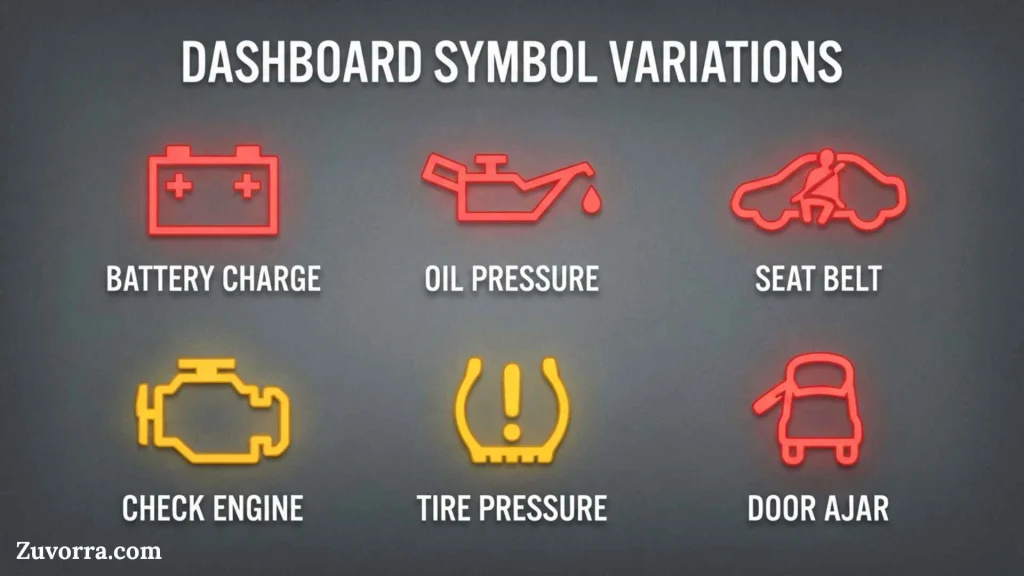
The same warning may look slightly different depending on:
- Model year
- Instrument-cluster design
- Operating-system version
- Gasoline, diesel, hybrid, or electric powertrain
- Regional regulations
- Optional equipment
Always use the manual matched to the vehicle’s VIN when exact identification matters.
Common Misconceptions
Every red light means the engine will fail immediately
Not necessarily. A red seat-belt symbol or open-door alert does not indicate engine damage. Red means urgency, but the type of urgency depends on the icon and message.
A yellow light is always safe to ignore
False. Yellow usually permits cautious operation, but some conditions can worsen quickly. A flashing Check Engine light, rapidly falling tire pressure, or stability problem deserves prompt action.
Resetting a warning fixes the vehicle
Clearing a message or fault code does not repair its cause. The warning may return, and deleting diagnostic information can make troubleshooting harder.
All BMW models use identical icons
The core symbols are similar, but their design and meaning can vary by generation, market, and equipment.
The BMW roundel was designed as a propeller
The propeller connection became famous through later advertising. The original emblem drew primarily on BMW’s name, predecessor-brand structure, and Bavarian colors.
The dashboard symbol alone provides a complete diagnosis
A symbol identifies a system or condition, not always the failed component. Proper diagnosis may require fault-code scanning, electrical testing, mechanical inspection, or software analysis.
What Should You Do When a BMW Warning Appears?
Use this decision guide:
Is the symbol red and related to oil, temperature, brakes, steering, or charging?
↓
Stop safely and read the Check Control message.
Is the vehicle losing power, overheating, vibrating, smoking, or handling abnormally?
↓
Switch it off when safe and request professional assistance.
Is the symbol yellow with no major driving symptoms?
↓
Drive cautiously, check the manual, and arrange inspection soon.
Is the symbol green, blue, white, or gray?
↓
Confirm that it represents an active or available feature.
Are you unsure what the icon means?
↓
Use the BMW Driver’s Guide or VIN-specific Digital Owner’s Manual rather than relying on a generic chart. BMW directs owners to enter the 17-digit VIN to access compatible digital manuals.
Interesting Facts About BMW Symbols
- The roundel dates to 1917. Its long use makes it one of the most recognizable surviving elements of BMW’s identity.
- The center uses Bavarian colors. Blue and white connect the emblem to the company’s regional roots.
- The propeller story came later. Aviation-themed advertising helped turn a secondary interpretation into a popular origin myth.
- BMW symbols are vehicle-specific. A symbol can gain a different message or urgency depending on model, powertrain, and software.
- Some warnings use several communication channels. A light may appear with text, sound, and a head-up display alert.
- A flashing icon can mean something different from a steady one. Flashing DSC shows active intervention, while a steady light may indicate deactivation or malfunction.
- Automatic high-beam status uses two colors. Green shows the automatic lighting function is operating, while blue identifies active high beams.
- BMW provides image-based symbol help. On supported devices, the Driver’s Guide can identify certain interior functions through the phone camera.
- The M emblem has its own heritage. Its racing identity developed separately from the standard blue-and-white roundel.
- Warning lights often reveal networked problems. One failed sensor can affect several connected systems and illuminate multiple icons.
- Not every dashboard light signals a failure. Many simply confirm that headlights, turn signals, cruise control, or assistance systems are active.
- The VIN is the safest route to an exact definition. It connects the owner to information tailored to the correct model and equipment.
Related BMW Symbols
MINI winged badge
MINI belongs to BMW Group but uses a winged circular emblem. It emphasizes the MINI brand’s separate British identity and design heritage.
Rolls-Royce double-R emblem
Rolls-Royce Motor Cars is part of BMW Group but retains its own linked “RR” monogram and Spirit of Ecstasy hood ornament.
BMW Motorsport emblem
This historic variation surrounds or accompanies the roundel with colored Motorsport bands. It differs from the standard badge by emphasizing competition heritage.
M badge
The M symbol identifies high-performance vehicles, packages, and components. Not every vehicle carrying an M-related badge is a full BMW M model, so the exact model designation matters.
Electric charging symbol
A plug or charging-station icon appears on electric and plug-in hybrid models. It represents connection status, charging progress, or a charging-system message rather than the BMW brand itself.
Road-sign recognition symbols
BMW driver-assistance displays can reproduce speed-limit, stop, no-entry, and other road signs. These symbols come from traffic systems, not from BMW branding.
Frequently Asked Questions
What is the most serious BMW dashboard symbol?
Red oil-pressure, coolant-temperature, brake-system, steering, and charging warnings are among the most serious. Stop safely and read the accompanying Check Control message. The correct response depends on the exact icon, vehicle behavior, and model-specific instructions.
Can I drive with a yellow BMW warning light?
You can often drive cautiously for a limited period, but yellow does not mean the problem should be ignored. Check for unusual sounds, reduced performance, tire damage, or handling changes. Read the vehicle message and arrange service promptly when recommended.
What does the triangle with an exclamation mark mean in a BMW?
A triangle with an exclamation mark is commonly a general Check Control indicator. It means the vehicle has stored or displayed a message requiring your attention. Open the Check Control information through the instrument cluster or iDrive system to view the specific condition.
Why are several BMW warning lights on at once?
Several lights may appear when connected systems share a sensor, electrical supply, communication network, or control unit. For example, a wheel-speed sensor fault can affect ABS, stability control, and driver assistance. Diagnostic fault codes are needed to identify the root cause.
What does the car with wavy lines symbol mean?
It represents Dynamic Stability Control or traction-related intervention. A flashing light usually means the system is actively stabilizing the vehicle. A steady light may mean the system is disabled, initializing, or faulty. Slow down and adapt to road conditions.
What does the BMW tire symbol mean?
The tire-shaped symbol with an exclamation mark indicates low tire pressure, rapid pressure loss, or a monitoring-system problem. Check the tires for damage and measure their pressure safely. Do not reset the monitor until the tires are correctly inflated and inspected.
How do I find the exact meaning of a symbol for my BMW?
Use the BMW Driver’s Guide or the VIN-specific Digital Owner’s Manual. BMW’s Driver’s Guide organizes indicator and warning lights by color, while the digital-manual service uses the vehicle’s 17-digit VIN to provide compatible information.
Does the BMW logo represent an airplane propeller?
Not originally in the simple sense often claimed. The blue and white sections reflect Bavarian colors. Later advertisements placed the emblem inside a rotating aircraft propeller, strengthening the aviation association and creating the popular propeller explanation.
What does the BMW M symbol mean?
The M stands for BMW’s motorsport and high-performance identity. It is associated with racing development, performance vehicles, M Performance products, and specialized design. The colored stripes reflect the visual history of BMW Motorsport rather than a dashboard warning.
Why did my BMW warning disappear after restarting?
Some temporary faults disappear when a system resets or operating conditions change. However, the vehicle may retain a diagnostic code even when the light goes out. If the warning returns, affects driving, or involves a safety system, arrange an inspection rather than assuming the problem is solved.
Key Takeaways
- BMW symbols communicate active features, maintenance needs, and vehicle faults.
- Green and blue usually show normal operation.
- Yellow or orange calls for caution, inspection, or service.
- Red mechanical warnings may require an immediate safe stop.
- Always read the accompanying Check Control message.
- A warning icon identifies a system, not necessarily the exact failed component.
- The BMW roundel was introduced in 1917 and uses Bavarian blue and white.
- The famous propeller interpretation developed through later advertising.
- Symbol designs vary by model, year, powertrain, region, and software.
- The VIN-specific owner’s manual is the most reliable reference.
Conclusion
BMW symbols form a practical language between the vehicle and its driver. The roundel communicates more than a century of Bavarian identity and automotive heritage, while dashboard icons provide immediate information about safety, maintenance, lighting, performance, and driver-assistance systems.
Learning the colors and recognizing high-priority warnings can help you respond calmly and prevent a minor problem from becoming expensive or dangerous. Because BMW designs and technologies vary, use this guide for general understanding and confirm every unfamiliar symbol through the Check Control message or your vehicle’s official owner’s manual.
References
- BMW Group, “BMW Group History”
- BMW Group PressClub, “Introducing BMW’s New Brand Design for Online and Offline Communication”
- BMW USA, “BMW Driver’s Guide App”
- BMW USA, “Digital Owner’s Manuals”
- BMW USA, “Why Do I Get a Check Control Message in My BMW?”
- BMW USA, “Dynamic Stability Control”
- BMW USA, “What Does the Headlight Symbol With an A Mean?”
- BMW Group PressClub, BMW M anniversary and Motorsport emblem materials

I’m Jasper Huxley, a British writer fascinated by the symbols that communicate ideas without words. I explore their meanings, origins, cultural connections, and everyday uses. From ancient markings to contemporary signs, I enjoy uncovering the stories behind visual language and presenting symbolism in a clear, engaging way for curious readers worldwide.
Books:
- The Hidden Language of Symbols
- Symbols, Signs and Their Meanings