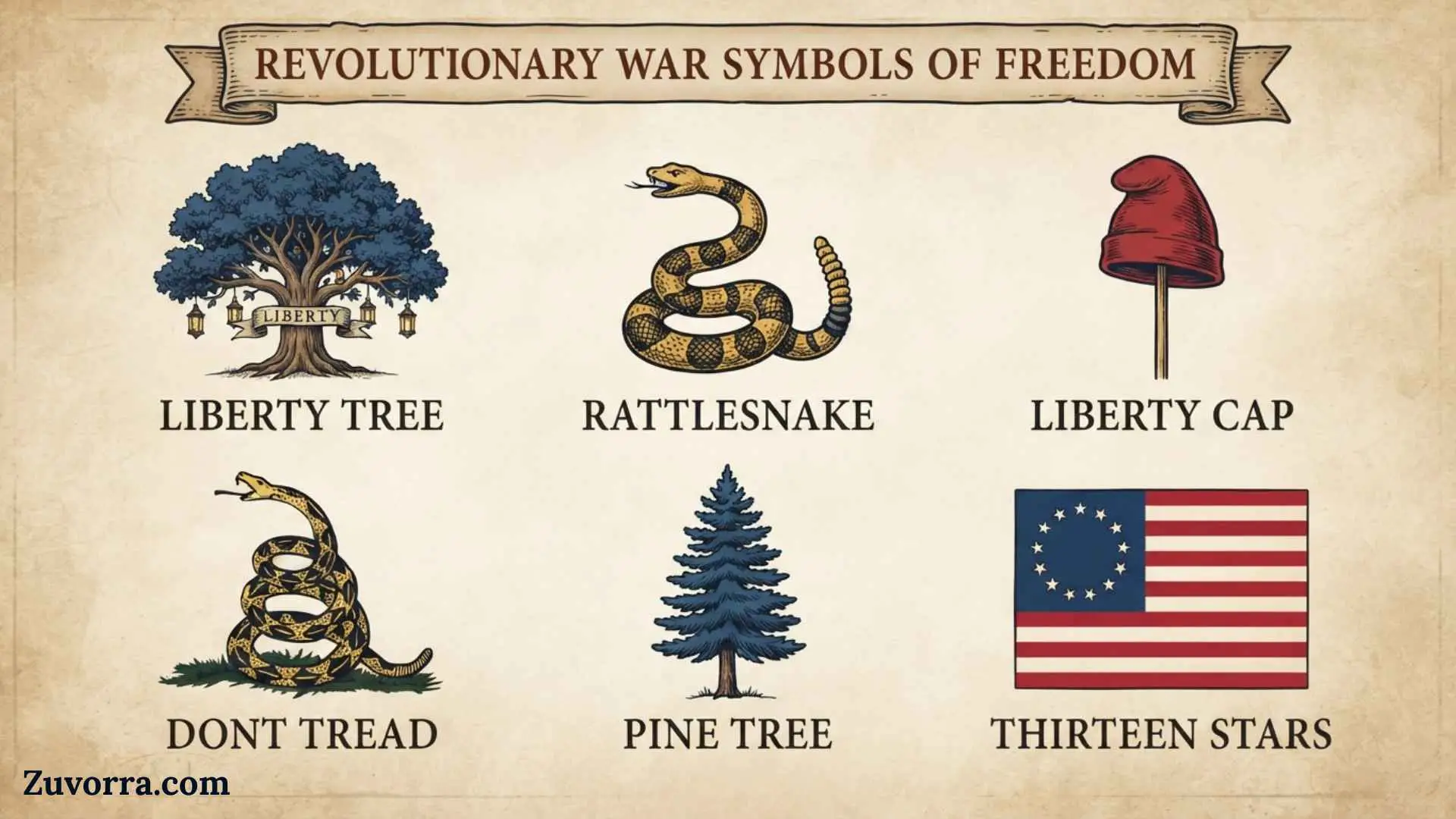
Revolutionary War symbols of freedom gave visible form to ideas that could not be held in the hand: liberty, unity, resistance, natural rights, and independence from British rule. Colonists displayed these symbols on flags, newspapers, coins, medals, meeting places, military equipment, and public monuments.
The best-known examples include the Liberty Tree, liberty pole and cap, rattlesnake, “Join, or Die” snake, pine tree, thirteen stripes, bald eagle, and broken chains. Each carried a distinct message. Some called the colonies to unite. Others warned against oppression or celebrated the creation of a new republic.
These symbols still appear in museums, textbooks, political art, government seals, historic reenactments, tattoos, clothing, and public debate. Understanding their original context helps separate documented Revolutionary meaning from later interpretations.
Quick Meaning
Revolutionary War symbols of freedom represented resistance to tyranny, cooperation among the colonies, political independence, and the natural right to self-government. Trees and liberty caps expressed freedom from oppressive authority, snakes warned against attack, thirteen-part designs represented colonial unity, and broken chains pictured liberation from political bondage.
Symbol Overview Table
| Symbol | Primary Meaning | Historical Origin | Revolutionary Use | Modern Meaning |
| Liberty Tree | Organized resistance and popular liberty | Boston protests against the Stamp Act | Meeting place and rallying emblem | Civil protest and freedom |
| Liberty pole and cap | Release from oppressive rule | Classical Roman and European imagery | Raised at public gatherings and shown in prints | Political liberty |
| Rattlesnake | Vigilance, courage, and defensive resistance | Colonial American natural symbolism | Used on flags and military banners | Defiance and limited government |
| “Join, or Die” snake | Unity as a condition of survival | Benjamin Franklin’s 1754 woodcut | Reused during the independence movement | Cooperation during crisis |
| Pine tree | Independence and New England strength | Colonial forestry and regional identity | Displayed on New England flags | Self-reliance and regional heritage |
| Thirteen stripes or stars | Union of the colonies and states | Continental flags and national flagmaking | Represented the thirteen rebelling colonies | National unity |
| Broken chains | Liberation from bondage or tyranny | Classical allegorical art | Used in images of Liberty and independence | Emancipation and human freedom |
| Bald eagle | Sovereignty, strength, and the new republic | Chosen for the Great Seal after independence | Became a national emblem after the war | United States identity |
| Liberty Bell | Independence and the continuing promise of liberty | Pennsylvania State House bell | Later associated with the Declaration | Freedom and civil rights |
| Goddess of Liberty | Political freedom personified | Classical Libertas imagery | Appeared in prints, maps, medals, and seals | Democratic ideals |
What Do Revolutionary War Symbols of Freedom Mean?
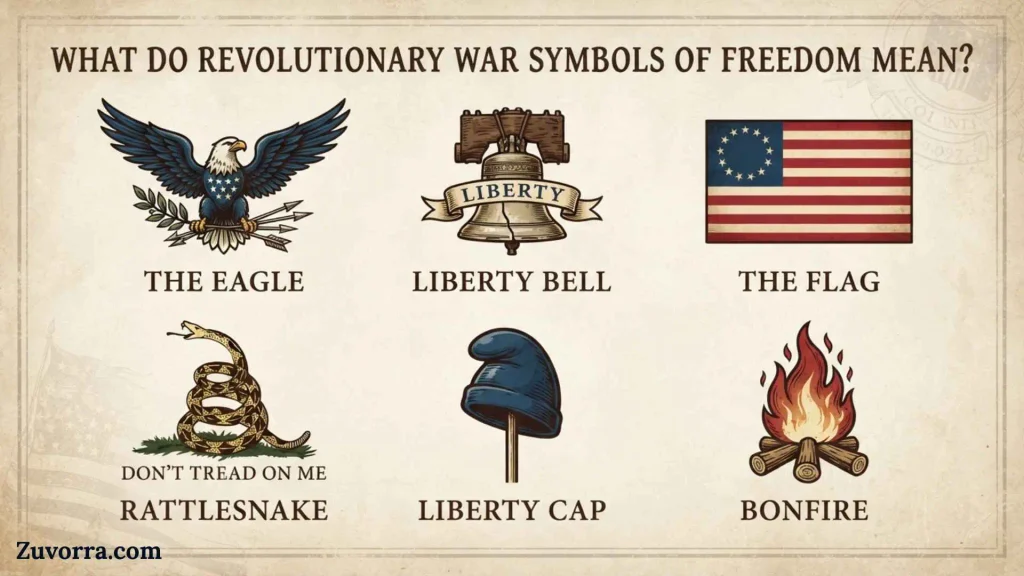
Revolutionary symbols translated political arguments into memorable pictures. A person did not need to read a long pamphlet to understand a severed snake labeled “Join, or Die” or a rattlesnake accompanied by “Don’t Tread on Me.”
Their central meanings were:
- Liberty: People possessed rights that rulers should not violate.
- Unity: Separate colonies had to cooperate to defend their interests.
- Resistance: Unjust power could be challenged.
- Vigilance: Freedom required citizens to watch for threats.
- Self-government: Political authority should rest on the consent of the governed.
- Independence: The colonies could become sovereign states rather than remain under British control.
The symbols were not interchangeable. The Liberty Tree emphasized public organization. The liberty cap drew on an older visual language of liberation. The rattlesnake communicated readiness to defend oneself. Thirteen stripes turned thirteen separate colonies into one political body.
Their power came from repetition. When people saw the same tree, snake, cap, or motto in newspapers, on flags, and at public demonstrations, the image became part of a shared revolutionary vocabulary.
History and Origin
Symbols Before Independence
Many Revolutionary symbols existed before fighting began in 1775. Colonial resistance developed over years of disputes involving taxation, representation, trade regulation, military authority, and parliamentary power.
Political organizers needed ways to communicate across colonies with different governments and interests. Symbols answered that need. They simplified complex arguments and created a sense of shared purpose.
Some images came from the natural environment, including snakes and pine trees. Others came from classical history, especially Roman ideas of republican government and liberty. Still others grew from actual colonial places and practices, such as gathering beneath Boston’s Liberty Tree.
The Liberty Tree
Boston’s Liberty Tree became one of the earliest physical symbols of resistance. Protesters gathered near the tree during opposition to the Stamp Act of 1765, and the site became associated with the Sons of Liberty, public announcements, effigies, and political action. The tree functioned as both a meeting place and a symbol of popular authority outside official government buildings.
British troops cut down the Boston Liberty Tree during the siege of the city. Destroying it removed a practical gathering point, but it also confirmed the tree’s symbolic importance. Similar “liberty trees” later appeared in other communities and political movements.
The Liberty Pole and Liberty Cap
Liberty poles were tall wooden poles raised in public spaces. They often carried flags, signs, or liberty caps. Raising one allowed a community to claim a visible center for resistance.
The cap placed on some poles came from classical traditions. In Roman culture, a cap was associated with formerly enslaved people who had gained freedom. Early modern European artists adapted that idea into an emblem of political liberty.
American printers and artists used the liberty cap in allegorical figures, maps, seals, and engravings. Paul Revere helped introduce a female Britannia or Liberty figure carrying a pole and cap into colonial resistance imagery. The image allowed colonists, who were still British subjects during the early protests, to claim traditional British liberty while opposing British policy.
The “Join, or Die” Snake
Benjamin Franklin published the “Join, or Die” woodcut in The Pennsylvania Gazette on May 9, 1754. It showed a snake cut into sections labeled for British North American colonies. Franklin originally used it to argue for colonial cooperation during the French and Indian War, not to demand independence from Britain.
The image gained a new context during the Revolutionary period. Printers reused and adapted it as conflict with Britain grew. The divided snake offered a simple warning: colonies acting separately were weak, but colonies acting together could survive.
The cartoon’s deeper roots also matter. The Library of Congress notes that Franklin drew from European emblem traditions in which a divided snake and related mottos represented unity, political organization, and collective survival.
The Rattlesnake and “Don’t Tread on Me”
The rattlesnake became a different kind of symbol. Unlike the cut snake, it usually appeared alive, alert, and prepared to strike.
Its meaning combined restraint and danger. A rattlesnake does not need to pursue an attacker to appear threatening. Its warning rattle suggests that it will defend itself when disturbed. Revolutionary Americans used that behavior as a metaphor for a people who wanted liberty but would resist aggression.
Christopher Gadsden, a South Carolina delegate to the Continental Congress, is associated with the yellow flag showing a coiled rattlesnake above the words “Don’t Tread on Me.” Rattlesnake imagery also appeared in naval and military settings during the war.
The Pine Tree
The pine tree carried economic, regional, and political meanings. Tall white pines were valuable for ship masts, and British efforts to reserve selected trees for the Crown caused resentment in New England.
During the Revolutionary era, the pine appeared on several New England banners. The National Park Service explains that pine-tree flags associated with the Battle of Bunker Hill reflected New England’s independent economic power, especially its lumber resources.
Some flags joined the pine tree with the motto “An Appeal to Heaven.” The wording invoked the idea that when earthly authorities denied justice, people could appeal to a higher moral judge. The phrase carried political and religious force without serving as a universal symbol for every colonist.
Thirteen Stripes and Stars
Thirteen-part designs represented the colonies that entered rebellion against Britain. Stripes, stars, links, and other repeated elements turned separate political communities into a single visual unit.
The Grand Union Flag, raised by Continental troops around Boston on January 2, 1776, contained thirteen alternating stripes but retained the British Union emblem in its canton. It reflected a transitional moment when Americans were creating collective military identity even before independence had been formally declared.
After independence, stars increasingly expressed a new union of sovereign states. Unlike a crown, a ring or field of stars could suggest equality among the states rather than hierarchy beneath a monarch.
Liberty as a Woman
Artists frequently personified liberty as a woman. She might wear or hold a liberty cap, carry a pole, stand beside an eagle, or appear above broken chains.
This figure drew from Libertas, the Roman personification of liberty, but American artists adapted her to Revolutionary events. She appeared in engravings, medals, maps, public buildings, and later national art.
Benjamin Franklin commissioned the Libertas Americana medal near the end of the war. It commemorated American victories at Saratoga and Yorktown while recognizing the importance of French support. Its imagery connected American independence to an international classical language of liberty.
Symbolism and Interpretation
Traditional Meanings
In their Revolutionary context, these symbols supported several related ideas:
- Political rights should not depend entirely on royal favor.
- Colonies had to unite to resist powerful opponents.
- Citizens could organize outside established institutions.
- Defensive force might be justified against oppression.
- Independence required courage, sacrifice, and public participation.
The imagery worked because it made abstract arguments concrete. A chain could break. A snake could unite. A tree could grow. A cap could mark release from servitude.
Positive Symbolism
Most symbols presented freedom as active rather than passive. Liberty had to be planted, raised, defended, joined, or declared.
The Liberty Tree suggested growth and community. The thirteen stripes suggested cooperation. The rattlesnake represented alertness and self-defense. Broken chains expressed release. The eagle, adopted after independence, suggested national confidence and sovereign power.
Negative and Confrontational Meanings
Revolutionary symbolism also carried warnings. A severed snake pictured death through disunity. A coiled rattler threatened retaliation. Liberty poles could become centers of political confrontation, and opposing groups sometimes tore them down.
British artists sometimes reused colonial symbols to portray revolutionaries as disorderly, violent, or fanatical. A symbol’s meaning therefore depended on who displayed it and who viewed it.
Psychological Interpretation
Symbols help people form group identities. A repeated image can turn many local grievances into one shared cause.
Revolutionary symbols used three especially powerful psychological patterns:
- Threat: Snakes and chains showed danger or oppression.
- Belonging: Thirteen repeated elements encouraged collective identity.
- Moral purpose: Liberty figures and appeals to heaven framed resistance as principled rather than merely self-interested.
This does not prove that every colonist understood each image in the same way. Symbols condensed arguments, but they did not erase political disagreement.
Cultural Significance
British American Colonists
For Patriot supporters, liberty symbols connected colonial resistance to inherited English rights, Enlightenment political thought, classical republicanism, and local traditions of self-rule.
Loyalists often interpreted the same displays differently. They could see liberty poles, crowds, and revolutionary flags as signs of intimidation, rebellion, or lawlessness.
Indigenous Nations
The Revolution involved many Indigenous nations with their own political systems, alliances, territories, and concepts of sovereignty. Colonial snake imagery should not be treated as a complete representation of Indigenous beliefs.
Some Founders studied and discussed Indigenous confederacies when debating colonial cooperation. However, claims that a single Indigenous political model directly created the United States system often oversimplify a complex and debated history. Indigenous nations made strategic decisions based on their own survival and interests, not merely as supporting figures in a colonial story.
African Americans and Enslaved People
The language of liberty had an unavoidable contradiction in a society that permitted slavery. Enslaved and free Black people used Revolutionary arguments about natural rights to challenge bondage, petition for freedom, serve in military forces, and demand fuller inclusion.
Broken chains therefore gained meanings beyond separation from Britain. In later American art, abolitionism, emancipation, and civil rights movements used chains and liberty figures to expose the distance between national ideals and lived reality.
France and the Atlantic World
American Revolutionary imagery belonged to a wider Atlantic culture. Classical liberty caps, female personifications, republican emblems, and broken chains circulated across Europe and the Americas.
France’s military and financial support proved essential to the American victory. Later French and American symbols of liberty influenced one another, although each country developed its own political meanings. The Statue of Liberty, dedicated long after the Revolution, commemorated Franco-American friendship rooted in the Revolutionary alliance.
Religious and Spiritual Meaning
Revolutionary symbols were primarily political, but some carried religious language. “An Appeal to Heaven” presented resistance as a moral appeal beyond human courts. Sermons, days of prayer, biblical comparisons, and providential language also shaped how many people understood the conflict.
The Liberty Tree could evoke biblical trees of life, justice, or righteous growth, but no single religious interpretation governed its use. The tree’s documented public role was political organization.
Religious meaning also varied among Anglicans, Congregationalists, Presbyterians, Quakers, Baptists, Catholics, Deists, and other communities. Some believers defended resistance. Others emphasized peace, loyalty, or obedience to established authority.
It is therefore more accurate to say that Revolutionary symbols were sometimes given spiritual significance than to label them sacred symbols in the formal religious sense.
Where Revolutionary Symbols Are Used
Flags and Military Banners
Rattlesnakes, pine trees, thirteen stripes, mottoes, and regional emblems appeared on colonial, naval, militia, and regimental flags. Flag design was not fully standardized during the war, so multiple variations existed.
Newspapers and Political Prints
Printed images allowed symbols to travel. Franklin’s snake, Paul Revere’s engravings, broadsides, cartoons, and illustrated pamphlets helped readers recognize political messages quickly.
Maps, Coins, Medals, and Seals
Liberty figures, caps, eagles, stars, and classical designs appeared on maps and commemorative objects. The Libertas Americana medal is a major example of Revolutionary events being translated into classical allegory.
Public Places and Architecture
Liberty trees and poles occupied streets, commons, and gathering areas. Today, Independence Hall and the Liberty Bell serve as physical symbols of freedom and democratic government. Independence Hall is associated with both the Declaration of Independence and the Constitution.
Books, Museums, and Classrooms
Textbooks and exhibitions use these symbols to explain propaganda, political communication, colonial unity, and national identity. Their strongest educational value comes from examining who created an image, when it appeared, and what political purpose it served.
Tattoos, Clothing, and Logos
Modern users often select rattlesnakes, liberty trees, muskets, bells, or 1776 imagery to express patriotism, independence, military identity, or resistance to government authority.
Modern use does not automatically preserve the original meaning. Context, accompanying words, and the identity of the group using the image all affect interpretation.
Common Variations
Snake Variations
The most important distinction is between:
- Segmented snake: Usually connected to “Join, or Die” and colonial unity.
- Coiled rattlesnake: Commonly associated with the Gadsden flag and defensive warning.
- Extended rattlesnake: Found on some naval and military designs.
- Snake with thirteen rattles: A later or stylized way of linking the animal to the thirteen colonies.
Liberty Tree Variations
The tree may appear as:
- A real gathering place
- A leafy tree on a flag
- A tree labeled “Liberty”
- A stump representing suppression
- A modern tree logo representing civic participation
Liberty Cap Variations
The cap may rest on a pole, be held by a female figure, or be worn on the head. It is often called a Phrygian cap, although historians distinguish between ancient Phrygian headwear and the Roman cap of manumission that more directly shaped the freedom symbol.
Thirteen-Part Designs
Thirteen colonies have been represented by stars, stripes, links, arrows, letters, circles, and other repeated forms. The number matters more than the specific arrangement.
Simple Symbol Identification Guide
Does the image show a snake cut into labeled pieces?
↓
It most likely represents colonial unity through “Join, or Die.”
Does it show a coiled rattlesnake with a warning motto?
↓
It most likely represents vigilance and defensive resistance.
Does it show a cap raised on a pole?
↓
It represents liberation from oppressive authority.
Does it show a pine tree?
↓
Look for New England, naval, economic, or “Appeal to Heaven” context.
Does it use thirteen repeated elements?
↓
It probably represents the thirteen colonies or original states.
Common Misconceptions
“Join, or Die” Was Created for the Revolution
It was created in 1754 during the French and Indian War. Franklin used it to promote colonial unity under the British Empire. Revolutionary printers later reused it in a new political setting.
Every Revolutionary Flag Looked Like the Modern U.S. Flag
Revolutionary forces used many flags. Designs included British elements, regional symbols, pine trees, snakes, mottoes, stripes, and regimental emblems. Standardization developed gradually.
The Liberty Bell Rang to Announce Independence on July 4
The bell’s famous connection to July 4 has been strengthened by later legend. Public readings of the Declaration took place after Congress adopted and began circulating the document. The bell’s status as a national freedom symbol grew strongly in the nineteenth century, especially through abolitionist use.
The Rattlesnake Always Has One Political Meaning
Its Revolutionary meaning involved defensive resistance, but modern groups use it in different ways. It can represent patriotism, individual rights, military identity, anti-authoritarianism, or partisan causes. Its meaning should be judged from context.
Liberty Applied Equally to Everyone in 1776
Revolutionary language expressed broad principles, but political rights remained limited by race, sex, property rules, legal status, and slavery. Later movements used the founding language of liberty to demand that its promises be expanded.
The Bald Eagle Was a Major Battlefield Symbol Throughout the War
The eagle became the official national emblem through the Great Seal process after independence. Snakes, pine trees, stripes, and liberty imagery were more common in much wartime symbolism.
Interesting Facts

- America’s earliest famous political cartoon featured a snake. Franklin’s 1754 woodcut used a divided animal to turn colonial cooperation into an unforgettable life-or-death choice.
- The “Join, or Die” snake did not include every later colony in a separate segment. Colonial geography and political grouping shaped its labels, showing that symbols often simplify reality.
- British troops physically destroyed the Boston Liberty Tree. The act showed that authorities understood the tree as more than a plant; it was a center of organized resistance.
- Liberty poles were both symbols and functioning communication sites. People gathered around them, attached signs or flags, and used their location to make public authority visible.
- Several proposed Bunker Hill flag traditions include a pine tree. The competing designs reveal how collective memory can preserve several versions of a symbol when documentation is incomplete.
- The Grand Union Flag retained the British Union emblem. Its design captured the uncertain transition from protesting British subjects to citizens of an independent country.
- Franklin used classical symbolism to celebrate modern military events. The Libertas Americana medal linked Saratoga and Yorktown to ancient visual ideas of liberty and protection.
- The female figure of America changed over time. Britannia-like figures, Liberty, Columbia, and eventually the Statue of Liberty each personified the nation in different periods.
- Broken chains carried a double meaning. They could represent freedom from British rule, but they later became especially powerful in abolitionist and emancipation imagery.
- Revolutionary symbols crossed national borders. American and French artists shared classical republican images, while the alliance between the two countries gave liberty symbolism an international dimension.
- The Liberty Bell’s meaning expanded after the Revolutionary generation. Abolitionists and later civil rights advocates helped turn it into a symbol of unfinished freedom rather than only a relic of independence.
- No single symbol tells the complete Revolutionary story. Unity, resistance, sovereignty, slavery, Indigenous diplomacy, military struggle, and political exclusion require different symbols and perspectives.
Related Symbols
Statue of Liberty
The Statue of Liberty was created long after the war, but it commemorates Franco-American friendship and extends the Revolutionary language of liberty into immigration, democracy, and international freedom.
Liberty Bell
The bell represents independence and the continuing struggle to apply liberty more fully. Its cracked surface has also become a metaphor for an imperfect national promise.
Bald Eagle
The eagle symbolizes the sovereignty and authority of the United States. It differs from the rattlesnake because it represents an established nation rather than colonies warning an opponent.
Uncle Sam
Uncle Sam personifies the federal government and the American nation. He developed after the Revolution and is more closely tied to government recruitment, war, and national duty.
Columbia
Columbia was a female personification of the United States. Like Liberty, she appeared in classical clothing, but she represented the country itself as much as the abstract principle of freedom.
Fasces
The fasces is an ancient Roman bundle symbolizing authority through unity. It appears in American civic art, but its later association with twentieth-century Fascism requires careful historical context.
Broken Shackles
Broken shackles focus directly on emancipation from enslavement or captivity. They overlap with Revolutionary liberation imagery but carry a more specific connection to abolition and human bondage.
Frequently Asked Questions
What was the main symbol of freedom during the Revolutionary War?
There was no single official symbol. The Liberty Tree and liberty pole strongly represented popular resistance, while snakes represented unity or defensive warning. Thirteen stripes expressed colonial union. Which symbol mattered most depended on the place, date, audience, and political message.
Why did colonists use a rattlesnake?
Colonists viewed the rattlesnake as distinctly American, watchful, and dangerous when attacked. Its warning rattle made it a useful metaphor for defensive resistance. The image told Britain that Americans did not seek needless conflict but would strike back if their liberties were violated.
What does “Don’t Tread on Me” mean?
In its Revolutionary setting, the phrase warned others not to violate colonial rights or provoke armed resistance. The rattlesnake made the warning vivid. Today the motto may express individual liberty, limited government, military pride, or political protest, depending on its context.
What did the Liberty Tree represent?
The Liberty Tree represented organized public resistance. Colonists gathered near it, posted notices, displayed effigies, and coordinated protest. Because it was a real meeting place as well as an emblem, it joined the physical act of political assembly with the broader ideal of liberty.
What is the difference between the Gadsden flag and “Join, or Die”?
The Gadsden flag shows a whole, coiled rattlesnake and warns, “Don’t Tread on Me.” It emphasizes vigilance and defense. “Join, or Die” shows a snake cut into pieces and emphasizes unity. One warns an opponent; the other warns divided colonies.
Why was the pine tree a symbol of independence?
The pine tree represented New England’s forests, shipbuilding resources, economic strength, and resistance to Crown control over valuable timber. When placed on flags, it communicated regional identity and self-reliance. In some designs, religious language added an appeal to higher justice.
What did thirteen stripes mean during the Revolution?
The thirteen stripes represented the colonies united in resistance and, later, the original states. Repeating the same form suggested that separate political communities belonged to one cause. The stripes became a lasting feature of the national flag even as the number of states increased.
Were Revolutionary symbols religious?
Most were political, but some had religious dimensions. “An Appeal to Heaven” invoked divine judgment, while sermons and biblical language shaped Patriot arguments. Yet symbols such as the rattlesnake, Liberty Tree, and thirteen stripes did not have one fixed religious meaning shared by all colonists.
Did all colonists support these freedom symbols?
No. Loyalists could view Patriot flags, liberty poles, and public gatherings as rebellious or threatening. Indigenous nations, enslaved people, free Black communities, pacifists, and different religious groups also approached the conflict from distinct positions. Revolutionary symbolism never represented one unanimous colonial viewpoint.
Are Revolutionary symbols still appropriate to use today?
They can be used in historical, educational, artistic, commemorative, and political settings. Responsible use requires attention to the symbol’s original meaning, later adaptations, and current associations. A museum display, tattoo, protest banner, and government emblem may communicate very different messages.
Key Takeaways
- Revolutionary War symbols turned ideas such as liberty, unity, and resistance into recognizable images.
- The Liberty Tree and liberty pole represented public organization against oppressive authority.
- The segmented “Join, or Die” snake called for unity.
- The Gadsden rattlesnake warned against violating colonial rights.
- Pine trees represented New England strength, resources, and independence.
- Thirteen stripes and stars pictured separate colonies becoming one political union.
- Liberty caps and broken chains came from older traditions of liberation.
- Meanings changed as abolitionists, civil rights advocates, political groups, and national institutions reused the symbols.
- Historical context is essential because modern interpretations may differ sharply from Revolutionary ones.
- The ideals expressed by these symbols were powerful, but their application in the eighteenth century remained unequal and incomplete.
Conclusion
Revolutionary War symbols of freedom were not decorative details. They were tools of persuasion, identity, protest, military organization, and nation-building. A tree could mark a place where citizens challenged authority. A divided snake could warn that disunity meant defeat. A raised cap could picture release from political bondage.
Their lasting importance comes from both their clarity and their complexity. They expressed liberty while the meaning of liberty remained contested. They united many colonists while excluding or overlooking others. Later generations adopted the same images to support abolition, civil rights, patriotism, individual liberty, and competing political causes.
Reading these symbols historically does not weaken them. It reveals why they were powerful, how their meanings evolved, and why they continue to shape American ideas about freedom.
References
- Library of Congress, “Join or Die,” Benjamin Franklin woodcut, May 9, 1754.
- Library of Congress, “Benjamin Franklin: In His Own Words—A Cause for Revolution.”
- Library of Congress, “With Peace and Freedom Blest: Woman as Symbol in America.”
- Library of Congress, “Mapping a New Nation: Abel Buell’s Map.”
- National Park Service, “Anger and Opposition to the Stamp Act.”
- National Park Service, “Flags of Bunker Hill: Banners of Liberty.”
- National Park Service, “Independence Hall: International Symbol of Freedom.”
- Smithsonian’s National Zoo, “Timber Rattlesnake: A Symbol Woven Through America’s Story.”
- Smithsonian Institution, “Libertas Americana, France, 1782–83.”
- National Archives, “America’s Founding Documents.”

I’m Jasper Huxley, a British writer fascinated by the symbols that communicate ideas without words. I explore their meanings, origins, cultural connections, and everyday uses. From ancient markings to contemporary signs, I enjoy uncovering the stories behind visual language and presenting symbolism in a clear, engaging way for curious readers worldwide.
Books:
- The Hidden Language of Symbols
- Symbols, Signs and Their Meanings