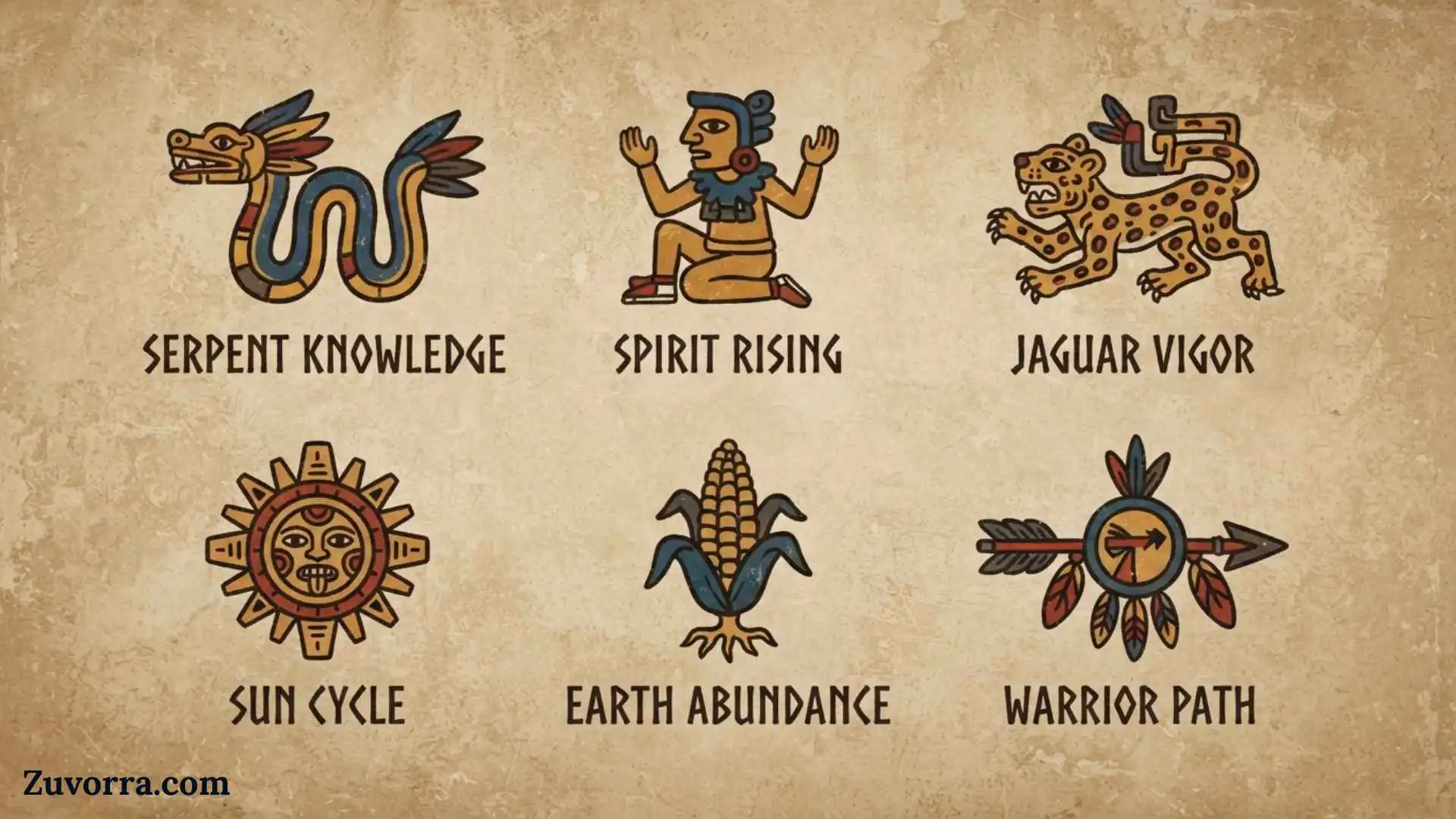
Chichimeca symbols are visual signs connected with the Indigenous peoples historically called Chichimecas, including images of bows, arrows, caves, footprints, animals, landscapes, body paint, and lineage emblems. They often communicate migration, ancestry, warfare, survival, sacred geography, and political identity.
However, there is no single, universal “Chichimeca symbol.” The word Chichimeca described several culturally and linguistically different peoples of north-central Mexico. Their symbolism must therefore be understood through specific communities, historical manuscripts, archaeological evidence, and living traditions rather than treated as one fixed alphabet of signs.
Quick Meaning
Chichimeca symbols commonly represent ancestry, migration, hunting skill, resistance, sacred landscapes, and belonging to a particular lineage or community. Frequently seen motifs include the bow and arrow, footprints, caves, hills, animals, body paint, and place-name glyphs. Their exact meaning changes according to the group, region, manuscript, and historical setting.
Chichimeca Symbols Overview
| Field | Details |
| Symbolic tradition | Indigenous visual communication of north-central and central Mexico |
| Primary meanings | Ancestry, migration, identity, survival, warfare, territory, and sacred origin |
| Cultural category | Pictorial, ceremonial, political, geographic, and historical symbolism |
| Associated peoples | Chichimeca-Jonaz, Guachichiles, Zacatecos, Guamares, Pames, Caxcanes, Tecuexes, and Toltec-Chichimeca communities |
| Important region | La Gran Chichimeca, the Bajío, northern Mesoamerica, Guanajuato, San Luis Potosí, Zacatecas, Querétaro, and surrounding areas |
| Major historical sources | Historia Tolteca-Chichimeca, Codex Cuauhtinchan 2, Codex Xolotl, colonial maps, chronicles, and archaeological remains |
| Common motifs | Bow, arrow, footprints, caves, hills, animals, vegetation, body paint, shields, and bundles |
| First known use | No single date; relevant traditions existed before European contact and were recorded extensively in early colonial manuscripts |
| Modern use | Murals, community art, cultural festivals, educational materials, jewelry, tattoos, logos, and heritage projects |
| Unicode | No dedicated Unicode character |
| Emoji equivalent | No official equivalent may suggest certain motifs but are not authentic substitutes |
| Related traditions | Nahua pictorial writing, Otomí symbolism, northern Mexican rock art, and Mesoamerican place-name glyphs |
What Do Chichimeca Symbols Mean?
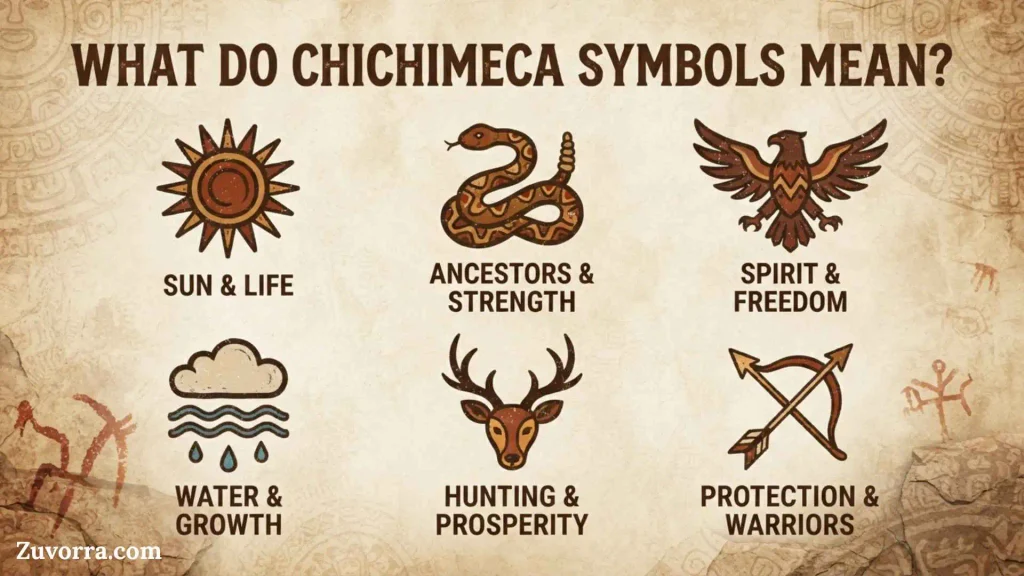
Chichimeca symbols express relationships rather than one simple definition. They can show where a people came from, which route they traveled, who governed them, what territory they claimed, or what qualities they valued.
A bow, for example, may identify a hunter or warrior. In another context, it may mark a group described by chroniclers as skilled archers. Footprints can trace a migration route, while a hill may represent a named settlement rather than merely a mountain.
Meaning depends on four elements:
- The community represented
- The historical source
- The symbol’s position within a larger scene
- The accompanying names, dates, people, or landscape features
This contextual approach is essential because Chichimeca imagery was not a modern logo system. Many images worked as parts of pictorial histories in which people, paths, places, speeches, rituals, and political events appeared together.
The signs may function as semasiographs, meaning images that communicate ideas without spelling every word phonetically. Some also operate as name glyphs, geographic markers, calendar signs, or mnemonic devices that helped knowledgeable readers recount a longer oral history. Scholars studying Indigenous Mexican manuscripts therefore describe these works as sophisticated graphic communication systems rather than simple illustrations.
History and Origin of Chichimeca Symbolism
The symbolism associated with Chichimeca peoples developed across a large part of north-central Mexico. This broad region was later called La Gran Chichimeca by Spanish writers.
“Chichimeca” did not name one unified nation with a single language, government, religion, or artistic style. Nahua and Spanish sources used it for different populations, including Guachichiles, Zacatecos, Guamares, Pames, Caxcanes, Tecuexes, and other communities. Some were mobile hunters and gatherers, while others practiced agriculture, lived in permanent settlements, or participated in complex regional political networks.
The term also appears in central Mexican origin histories. Several Nahua dynasties claimed Chichimeca ancestry because it could symbolize antiquity, frontier strength, hunting ability, legitimate migration, or descent from prestigious founders. In these traditions, “Chichimeca” was not always an insult. It could become a respected ancestral identity.
Pictorial Manuscripts
Much of what people now recognize as Chichimeca symbolism comes from early colonial manuscripts produced by Indigenous painters and writers.
The Historia Tolteca-Chichimeca, created in the Cuauhtinchan region during the 16th century, combines Nahuatl alphabetic writing with pictorial scenes. It records migrations, family relationships, territorial claims, wars, alliances, and the foundation of communities. Scholars date the work broadly to the middle decades of the 1500s.
Codex Cuauhtinchan 2 presents another important visual narrative. One of its best-known images concerns Chicomoztoc, the legendary Place of the Seven Caves, from which seven Toltec-Chichimeca groups emerge before traveling toward new lands.
These records were not neutral snapshots. Indigenous communities used them to preserve memory, explain authority, defend land rights, and establish relationships between ancestors and territory during the colonial period.
Change After Spanish Colonization
Spanish colonization transformed Chichimeca visual traditions. Christian imagery, European mapmaking, alphabetic writing, heraldry, and colonial legal formats entered Indigenous records.
At the same time, Indigenous painters continued using footprints, hills, caves, roads, personal glyphs, genealogies, and other established forms. The result was often a mixed visual language in which European and Indigenous elements appeared together.
The Chichimeca War, generally dated from 1550 to 1590, also influenced later representations. Colonial sources frequently portrayed northern peoples as violent or uncivilized to justify military campaigns, settlement expansion, forced labor, and missionary activity. Such portrayals must be read critically because they often served colonial interests rather than providing balanced descriptions.
Major Chichimeca Symbols and Their Interpretations
The Bow and Arrow
The bow and arrow symbolize hunting, military skill, mobility, defense, and knowledge of the landscape.
Northern groups used archery effectively in hunting and warfare. Spanish accounts repeatedly emphasized Chichimeca archers, especially during resistance to colonial expansion. As a result, the archer became one of the most recognizable visual identities associated with Chichimeca peoples.
Positive meanings include:
- Courage
- Accuracy
- Self-reliance
- Protection
- Readiness
- Survival knowledge
Negative interpretations usually come from hostile colonial portrayals that equated weapons with savagery. The weapon itself does not prove that a community was naturally warlike. It often represented a practical technology needed for food, defense, and life in demanding environments.
Footprints
Footprints usually indicate travel, migration, sequence, or direction.
In Mesoamerican manuscripts, a trail of footprints can connect one settlement to another. Their placement tells the reader which route a group followed and sometimes in what order events occurred.
Footprints may also represent:
- Pilgrimage
- Exile
- Settlement
- Ancestral movement
- Territorial memory
- A transition between stages of life
A footprint should not automatically be interpreted as a Chichimeca emblem. It is a widespread convention within Indigenous central Mexican pictorial writing.
Chicomoztoc and the Seven Caves
Chicomoztoc means the legendary Place of the Seven Caves. In migration histories, it acts as a place of emergence from which multiple peoples begin their journeys.
The cave is both geographic and symbolic. It may represent a womb-like origin, an ancestral homeland, an entrance into the earth, or a shared place from which separate lineages emerged.
The number seven identifies a set of groups in particular traditions. It should not be treated as a universal Chichimeca sacred number in every region.
Codex Cuauhtinchan 2 connects Chicomoztoc with seven Toltec-Chichimeca peoples and their patron deity, Itzpapálotl.
Hills and Place-Name Glyphs
A hill often represents an altepetl, a Nahuatl political and territorial community. It may also form part of a place-name glyph.
In Mesoamerican visual language, the image of a hill does not merely mean nature or elevation. Its shape, color, attached objects, and written gloss may identify a specific town.
For example, an animal, plant, tool, or architectural element placed on a hill can create a visual name. These glyphs were useful in maps, migration narratives, boundary records, and legal documents.
Caves, Rocks, and Desert Landscapes
Natural features symbolize origin, shelter, danger, water access, territorial knowledge, and spiritual presence.
For communities living in dry or semi-dry environments, hills, springs, caves, plants, and pathways were practical markers. They helped define hunting grounds, travel routes, settlement boundaries, and places where ceremonies or important events occurred.
Modern viewers sometimes reduce desert symbolism to hardship. Indigenous perspectives may also emphasize abundance, knowledge, adaptation, and a close relationship with local ecosystems.
Red Body Paint
Red pigments are strongly associated in historical descriptions with some Chichimeca groups, especially the Guachichiles. The name Guachichil has often been interpreted through Nahuatl as referring to heads painted red.
Body paint could communicate group identity, ceremonial preparation, beauty, status, warfare, protection, or transformation. Its meaning depended on the material used and the occasion.
It is misleading to describe red paint as a universal uniform worn by every Chichimeca person. Practices varied among peoples and periods.
Animals
Animals may function as personal names, lineage markers, environmental references, divine beings, or metaphors for human qualities.
Commonly relevant animals in wider central and northern Mexican imagery include:
- Eagles
- Deer
- Rabbits
- Coyotes
- Serpents
- Butterflies
- Jaguars
- Birds of prey
The eagle can suggest authority, solar power, hunting, or noble identity. Deer may evoke hunting and sustenance. A coyote can express adaptability or wilderness, while a serpent may refer to water, fertility, land, power, or a named person.
Animal meanings should never be assigned without examining the original cultural context.
The Sun and Celestial Signs
The sun may represent time, warmth, direction, life, divine power, or a calendar date.
Some historical writers connected Chichimeca communities with solar reverence, but evidence varies greatly between groups. Broad claims that “the Chichimecas worshiped the sun” oversimplify a diverse region and rely too heavily on colonial generalization.
Celestial images in manuscripts may also function as date signs or parts of a narrative rather than independent objects of worship.
Cultural Significance
Chichimeca symbolism remains important because it preserves histories that colonial sources often distorted or erased.
For descendant communities, symbols can support cultural continuity. A bow, landscape, language inscription, dance costume, or ancestral scene may affirm a connection with territory and family history.
For historians, pictorial images reveal how Indigenous people explained political legitimacy. Migration was not always represented as random wandering. It could be a purposeful journey guided by ancestors, sacred powers, agreements, and territorial rights.
For museums and educators, the symbols also provide a way to correct the idea that northern Mexico lacked complex cultural traditions. Mobile or semi-mobile life did not mean that people had no history, spirituality, technology, or social organization.
The surviving Chichimeca-Jonaz community, whose language is known as Úza̱’, is centered primarily around Misión de Chichimecas near San Luis de la Paz, Guanajuato. INALI recognizes Chichimeco Jonaz as an Indigenous language grouping and continues to support its written standard and cultural use.
Religious and Spiritual Meaning
There was no single Chichimeca religion. Beliefs differed across communities, environments, and historical periods.
Sacred meaning was often connected with:
- Mountains and caves
- Springs and rain
- Celestial cycles
- Animals
- Ancestors
- Hunting
- Fire
- Community ceremonies
- Origin places
In Toltec-Chichimeca narratives, Chicomoztoc holds special importance as an ancestral place of emergence. It links landscape, sacred history, and political identity.
Itzpapálotl, whose name is often translated as “Obsidian Butterfly,” appears as a patron figure in traditions associated with the migration from Chicomoztoc. Her imagery belongs to a broader central Mexican religious world and should not be labeled the universal goddess of all Chichimeca peoples.
After colonization, Catholic saints, crosses, churches, and Christian festivals became part of many Indigenous community traditions. This process did not always erase earlier meanings. Communities could reinterpret Christian symbols through local ideas about protection, territory, ancestors, and ceremonial obligation.
Where Chichimeca Symbols Are Used
Historical Codices
The most reliable historical examples appear in manuscripts such as the Historia Tolteca-Chichimeca, Codex Cuauhtinchan 2, and Codex Xolotl.
Maps and Land Records
Hills, water, roads, footprints, plants, and buildings helped identify places, boundaries, and migration routes. The Historia Tolteca-Chichimeca and regional maps have been used to study territorial relationships around Cuauhtinchan and neighboring communities.
Murals and Public Art
Modern murals may combine archers, desert landscapes, Indigenous faces, native plants, and Úza̱’ language phrases. These works often emphasize survival and cultural pride.
Dance and Clothing
Ceremonial clothing, feathers, paint, bows, textiles, and other objects may communicate community identity. Modern performances can preserve traditions while also introducing newer artistic choices.
Jewelry and Tattoos
People sometimes choose cave, arrow, eagle, sun, or archer designs to honor ancestry. Anyone considering such a design should identify its source and avoid presenting a modern invention as an ancient tribal emblem.
Community Logos and Educational Materials
Cultural organizations, schools, festivals, and language programs may use symbolic imagery to promote heritage. These modern designs can be meaningful without being exact copies of precolonial signs.
Common Variations and Similar Symbols
| Motif | Common variation | Possible meaning | Important distinction |
| Bow and arrow | Single arrow, crossed arrows, full archer | Hunting, defense, skill | Crossed arrows may be a modern adaptation |
| Footprints | Bare feet arranged along a path | Travel or migration | Used widely in Nahua pictorial writing |
| Cave | One opening or seven chambers | Origin, emergence, ancestry | Seven caves specifically suggest Chicomoztoc |
| Hill | Rounded hill with added object | Town or named place | Often a glyph, not merely scenery |
| Red paint | Face, head, or body coloring | Identity, ritual, warfare | Especially associated with some groups, not all |
| Eagle | Full bird, head, feathers, or wings | Authority, vision, hunting | Meaning varies by lineage and source |
| Sun | Circular disk with rays | Time, life, sacred power | May also serve as a calendar marker |
| Obsidian butterfly | Butterfly with stone or blade features | Itzpapálotl, transformation, power | Belongs to a broader central Mexican tradition |
Common Misconceptions
“There Is One Official Chichimeca Symbol”
No historical evidence supports one universal emblem for every Chichimeca people. Modern websites often select a bow, sun, or geometric design and label it “the Chichimeca symbol” without identifying a source.
“Chichimeca Means Dog People”
The word’s etymology is debated. A popular explanation connects it with Nahuatl words for “dog,” but linguistic discussions note that vowel length affects meaning and that the term may instead relate to a place called Chichiman. It is safer to acknowledge uncertainty than repeat a simple translation as fact.
“All Chichimecas Were Nomads”
Some communities were mobile or semi-mobile, but others farmed, built settlements, joined political alliances, and developed complex social structures.
“Chichimeca Art Was Only Rock Art”
Rock art is important in northern Mexico, but Chichimeca-related symbolism also appears in codices, maps, body decoration, material objects, colonial records, architecture, and living community art.
“Every Aztec Symbol Is Chichimeca”
The traditions overlap because Nahua histories often include Chichimeca ancestry. Still, an image from an Aztec calendar or temple cannot automatically be called Chichimeca.
“Colonial Drawings Are Exact Photographs of Precolonial Life”
Codices and colonial illustrations were created for particular audiences and purposes. They combine memory, political argument, Indigenous convention, and sometimes European influence.
A Simple Guide to Identifying a Chichimeca Symbol
Does the design come from a named codex, artifact, community, or historical record?
↓
Yes: Identify the manuscript, page, region, people, and date.
↓
No: Treat the claimed meaning cautiously.
Does the source say “Chichimeca” as a broad label?
↓
Determine whether it refers to Chichimeca-Jonaz, Guachichil, Zacateco, Toltec-Chichimeca, or another specific group.
Is the design sold as an “ancient tribal symbol” without documentation?
↓
Consider it a modern adaptation until reliable evidence proves otherwise.
Interesting Facts About Chichimeca Symbols
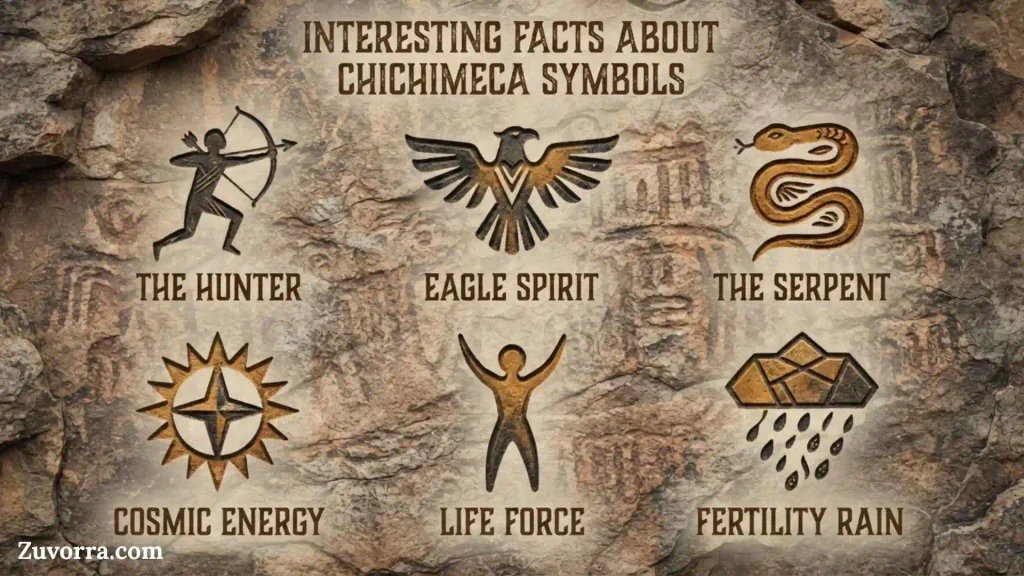
- Images could preserve legal claims. Pictorial histories helped communities explain ancestral possession of land, not simply tell legends.
- Footprints function like verbs. A trail can visually communicate “they went,” “they migrated,” or “they arrived.”
- A hill can be a written place-name. Added plants, animals, colors, or objects may turn a landscape image into a specific name.
- Chichimeca identity could carry prestige. Central Mexican rulers sometimes valued Chichimeca ancestry as a sign of ancient origin, toughness, and legitimate migration.
- The bow represented knowledge as well as combat. Effective archery required an understanding of materials, animal movement, terrain, distance, and weather.
- Chicomoztoc joins myth with political history. The Seven Caves narrative connects different communities through a shared origin while preserving their separate identities.
- Red pigment had more than one purpose. It could relate to identity, appearance, ritual action, status, or warfare rather than having one fixed meaning.
- Many manuscripts are multimedia records. They combine pictorial writing, alphabetic Nahuatl, Spanish annotations, maps, genealogy, and oral tradition.
- Modern Chichimeca culture is living, not extinct. The Chichimeca-Jonaz community continues to protect Úza̱’ language, dance, art, and cultural knowledge.
- There is no dedicated Chichimeca Unicode character. Digital symbols such as arrow emojis are modern approximations and should not be presented as authentic historical glyphs.
Related Symbols
Nahua Place Glyphs
These identify towns, mountains, waterways, rulers, and personal names. They overlap with Chichimeca-related codices but belong to a broader pictorial writing tradition.
Chicomoztoc
The Seven Caves image represents ancestral emergence and migration. It is more specific than a general cave symbol.
Itzpapálotl
The Obsidian Butterfly is a powerful central Mexican deity associated with particular Toltec-Chichimeca origin traditions, not every northern community.
The Otomí or Hñähñu Symbolic Tradition
Otomí-speaking peoples shared regions and historical relationships with groups called Chichimeca. Their textile, ritual, and manuscript symbols should still be studied on their own terms.
The Mexica Eagle
The eagle in Mexica state symbolism is not automatically Chichimeca, although both traditions may associate eagles with power, ancestry, warfare, or celestial forces.
Northern Mexican Rock Art
Geometric forms, animals, handprints, and human figures appear at many rock-art sites. Their meanings require site-specific archaeological study and cannot be decoded through a universal symbol chart.
Frequently Asked Questions
What is the main Chichimeca symbol?
There is no single official Chichimeca symbol. The bow and arrow is the motif most commonly associated with Chichimeca identity because several groups were known for hunting and archery. Other important images include footprints, caves, hills, animals, red body paint, and place-name glyphs.
What does the Chichimeca bow and arrow mean?
It generally represents hunting ability, protection, military skill, mobility, and survival. In colonial history, it also became associated with resistance to Spanish expansion. Its meaning should not be reduced to violence because the bow was equally important for acquiring food and navigating local environments.
What do the seven caves represent?
The Seven Caves represent Chicomoztoc, a legendary place of origin in several central Mexican migration traditions. Groups emerge from separate cave chambers before beginning journeys toward new territories. The image communicates shared ancestry, political relationships, separation into distinct peoples, and the sacred importance of origin places.
Are Chichimeca symbols Aztec symbols?
Not exactly. Chichimeca and Mexica histories overlap, and both can appear within Nahua pictorial traditions. Yet the terms describe different identities and historical contexts. An Aztec or Mexica symbol should not be labeled Chichimeca unless a reliable manuscript, artifact, or scholarly source establishes that connection.
Did Chichimecas have a written language?
Different peoples called Chichimeca spoke different languages, so no single Chichimeca language or script existed. Some Toltec-Chichimeca histories were recorded through Nahua pictorial writing and alphabetic Nahuatl. The modern Chichimeca-Jonaz community speaks Úza̱’, an Oto-Manguean language recognized by INALI.
What does red paint mean in Chichimeca culture?
Red paint could mark identity, ritual preparation, beauty, status, protection, or readiness for conflict. It is especially associated in historical descriptions with the Guachichiles. Its exact purpose differed by group and occasion, so it should not be treated as a universal code shared by all Chichimeca peoples.
Is the eagle a Chichimeca symbol?
Eagles appear in central Mexican imagery and can represent power, the sky, hunting, warfare, or noble authority. Some Chichimeca-related lineages may have used eagle imagery, but there is no evidence that one eagle design served as a universal Chichimeca emblem.
Can I use a Chichimeca symbol as a tattoo?
You can choose a historically documented motif, but research its community, manuscript, and meaning first. Avoid copying sacred or community-specific designs without understanding them. A bow, migration path, or landscape-inspired image can be adapted respectfully when its source is acknowledged and false claims of authenticity are avoided.
Are Chichimeca people still alive today?
Yes. Chichimeca identity continues most visibly among the Chichimeca-Jonaz or Úza̱’ people of Guanajuato. Other Mexican communities may also trace ancestry to peoples historically classified as Chichimeca. Modern identity should not be confused with the broad colonial category applied to many different populations.
Where can authentic Chichimeca symbols be studied?
Begin with publications and digital collections from Mexico’s Instituto Nacional de Antropología e Historia, Universidad Nacional Autónoma de México, Instituto Nacional de Lenguas Indígenas, and the Bibliothèque nationale de France. The Historia Tolteca-Chichimeca and Codex Cuauhtinchan 2 are especially valuable starting points.
Key Takeaways
- “Chichimeca” historically referred to several peoples rather than one unified civilization.
- No single image serves as the official symbol of every Chichimeca community.
- Bows, arrows, footprints, caves, hills, animals, and body paint are important recurring motifs.
- The bow commonly represents hunting, defense, survival knowledge, and resistance.
- Footprints show movement, while hills often identify towns or territories.
- Chicomoztoc, the Seven Caves, symbolizes ancestral emergence and migration.
- The meaning of each image depends on its community, source, location, and narrative context.
- Colonial descriptions often contain stereotypes and must be interpreted carefully.
- Modern Chichimeca-Jonaz people continue living cultural and linguistic traditions.
- Reliable interpretation requires documented codices, museum records, archaeology, and community knowledge.
Conclusion
Chichimeca symbols form a rich visual record of ancestry, movement, landscape, survival, political legitimacy, and cultural memory. Their meanings cannot be reduced to one arrow, animal, or geometric sign because the peoples called Chichimecas were diverse.
The most responsible way to understand these images is to ask where they appear, who created them, which community they represent, and what role they play within the full scene. Studied in context, Chichimeca symbols reveal not a collection of mysterious decorations, but sophisticated ways of preserving history, territory, identity, and relationships between people and place.
References
- Instituto Nacional de Antropología e Historia. Research and cultural resources concerning Codex Cuauhtinchan 2, Chicomoztoc, Cuauhtinchan, and the Historia Tolteca-Chichimeca.
- Instituto Nacional de Lenguas Indígenas. Catálogo de las Lenguas Indígenas Nacionales and Atlas entries for Chichimeco Jonaz or Úza̱’.
- Bibliothèque nationale de France. Catalogue and manuscript records for the Historia Tolteca-Chichimeca.
- Universidad Nacional Autónoma de México, Instituto de Investigaciones Históricas. Studies of Nahua pictorial writing and Indigenous graphic communication.
- Kirchhoff, Paul, Lina Odena Güemes, and Luis Reyes García, editors. Historia Tolteca-Chichimeca. CIESAS and Fondo de Cultura Económica.
- Gradie, Charlotte M. “Discovering the Chichimecas.” The Americas, volume 51, number 1.
- Powell, Philip Wayne. Soldiers, Indians, and Silver: The Northward Advance of New Spain, 1550–1600. University of California Press.

I’m Felix Everard, a British writer passionate about the fascinating world of symbols and visual communication. I explore traditional, cultural, historical, and modern symbols, focusing on what they represent and why they matter. Through accessible explanations, I hope to help readers recognise the meanings hidden within familiar signs, shapes, and images.
Books:
- The Complete Guide to Symbolism
- Decoding Signs and Symbols