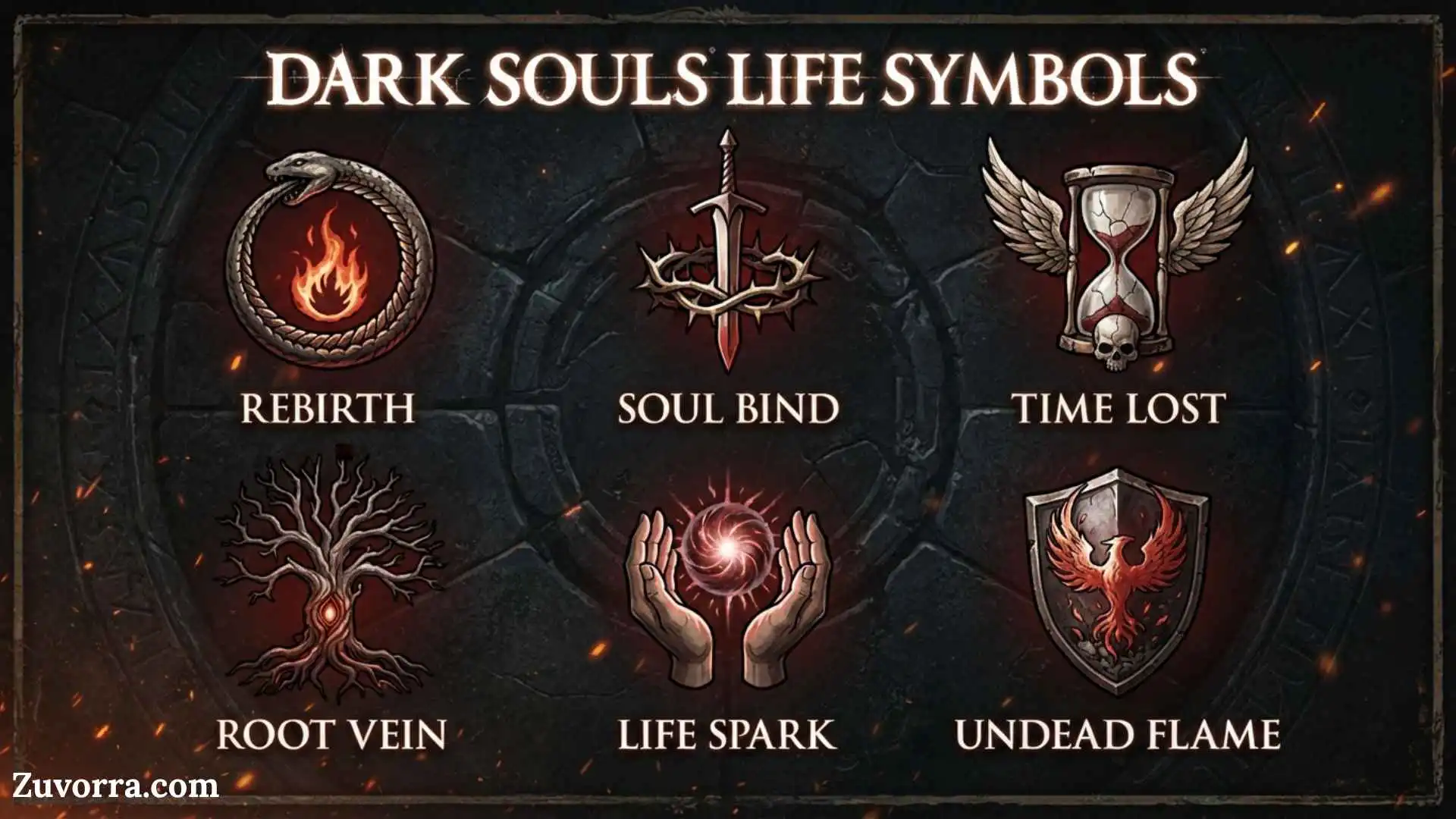
Dark Souls symbols express the series’ central ideas: life, death, fire, darkness, memory, identity, sacrifice, and endless renewal. Players encounter them as brands on the body, glowing bonfires, covenant emblems, humanity sprites, summon signs, bloodstains, rings, weapons, and sacred objects.
These images are not merely decoration. Many also function as gameplay systems. A bonfire represents hope while serving as a checkpoint. The Darksign marks a supernatural curse while explaining resurrection. Humanity represents both an item and the hidden nature of humankind. Together, these symbols turn the world of Lordran into a visual story about resisting decay in a dying age.
Quick Meaning
Dark Souls symbols represent the struggle between fire and darkness, life and undeath, purpose and Hollowing. The Darksign symbolizes the Undead curse, bonfires represent temporary safety and renewal, Humanity reflects human identity and the Dark Soul, while covenant emblems show loyalty to competing gods, ideals, and factions.
Dark Souls Symbol Overview
| Symbol | Primary Meaning | Category | Origin in the Series | Common Use | Broader Interpretation |
| Darksign | Undead curse and rebirth | Lore and item symbol | Dark Souls | Returns the bearer to a bonfire | Cyclical suffering, lost identity |
| Bonfire | Rest, recovery, and hope | Environmental symbol | Dark Souls | Checkpoint, healing, leveling | Refuge within a hostile world |
| Humanity | Human essence and connection to darkness | Item and lore symbol | Dark Souls | Reverse Hollowing, kindle bonfires | Identity, inner self, mortality |
| Dark Soul | Origin of human fragments | Mythic concept | Found by the Furtive Pygmy | Foundation of humanity | Hidden power and human potential |
| First Flame | Source of disparity and the Age of Fire | Cosmic symbol | Creation myth of the series | Central object of world history | Civilization, change, unstable order |
| Sunlight emblem | Faith, cooperation, and radiant power | Covenant symbol | Warriors of Sunlight | Cooperative multiplayer | Hope, fellowship, devotion |
| Summon sign | Invitation across worlds | Multiplayer symbol | Online systems | Calls another player into a world | Trust and temporary companionship |
| Red invasion sign | Hostility and challenge | Multiplayer symbol | Online systems | Invades another player’s world | Conflict, ambition, predation |
| Bloodstain | Death, loss, and warning | Multiplayer and gameplay symbol | Dark Souls | Shows deaths or holds lost resources | Memory and consequences |
| Lordvessel | Divine authority and inherited duty | Sacred object | Anor Londo | Enables major progression | Burden of kingship and destiny |
| Covenant emblem | Membership and allegiance | Faction symbol | Various kingdoms and orders | Identifies covenant duties | Loyalty, ideology, social identity |
| Coiled sword | Fire linked to sacrifice | Weapon and bonfire symbol | First Flame mythology | Embedded within bonfires | Binding oneself to a repeating cycle |
These are fictional designs rather than historical writing symbols. They have no official Unicode characters or exact emoji equivalents, although players sometimes use dark-circle imagery as informal substitutes.
What Do Dark Souls Symbols Mean?
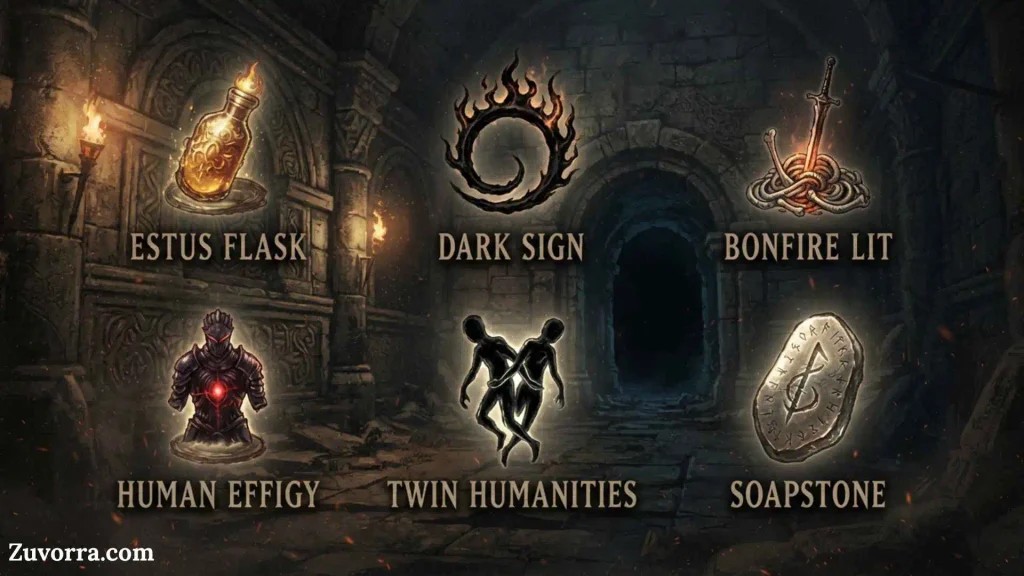
Dark Souls symbols communicate lore through objects, environments, and game mechanics rather than long explanations. Their meanings often work on three levels at once:
- Mechanical meaning: What the symbol does during gameplay.
- Narrative meaning: What it represents within the fictional world.
- Interpretive meaning: What players may understand philosophically or psychologically.
The bonfire is the clearest example. Mechanically, it restores health and provides a respawn point. The original game manual explains that bonfires allow players to recover, manage Humanity, refill Estus, and remove certain negative effects. The official game description also calls the bonfire a symbol of life and hope because it offers warmth and calm in an otherwise dangerous world.
Narratively, however, bonfires are tied to the fading First Flame and the sacrifices made to preserve the Age of Fire. This means their warmth is comforting but not entirely innocent. Every flame reminds the player that the world survives by consuming fuel.
Dark Souls therefore avoids simple meanings such as “fire is good” or “darkness is evil.” Its symbols gain power from uncertainty. Fire can sustain civilization, but it can also demand endless sacrifice. Darkness can frighten the gods, yet it is closely connected to humanity.
History and Origin of Dark Souls Symbolism
Dark Souls symbolism originated within the fictional mythology designed by FromSoftware for the 2011 action role-playing game. The series was created as a dark fantasy world in which history survives through ruins, item descriptions, architecture, dialogue, armor, and repeated visual motifs rather than a single complete narrative.
The first game takes place primarily in Lordran, a decaying land associated with ancient gods, ruined kingdoms, dragons, demons, knights, and Undead pilgrims. Bandai Namco describes the game as a dark fantasy experience built around exploration, death, persistence, multiplayer encounters, and interconnected environments.
The First Flame and the Birth of Disparity
The foundational image is the First Flame. Before it appeared, the world existed in an undifferentiated Age of Ancients. The coming of fire introduced contrasts: heat and cold, life and death, light and dark.
This origin explains why paired opposites appear throughout the series. Dark Souls does not treat them as completely separate forces. Each side exists because the other exists. Light creates shadow. Life creates the possibility of death. Order eventually produces decay.
The Lords and Their Souls
Powerful beings discovered great souls within the Flame. Gwyn received the power of light, the Witch of Izalith gained a soul connected to life, and Nito became associated with death. The Furtive Pygmy found the Dark Soul, which was later connected to humanity.
These mythic figures became symbols themselves. Gwyn represents the defense of divine order. Nito embodies death as a natural force. The Witch of Izalith reflects creation that turns destructive. The Pygmy symbolizes forgotten origins and power hidden beneath apparent weakness.
From Mythology to Gameplay
The game’s symbolism became distinctive because it was built into player behavior. Death leaves a bloodstain. Cooperation begins with a glowing mark on the ground. Rest requires sitting beside a sword-driven flame. Losing purpose transforms a person into a Hollow.
The official manual directly connects death, bloodstains, bonfires, Humanity, Hollowing, ghosts, summons, and invasions to the game’s systems. As a result, players do not merely read about the mythology. They repeatedly perform it.
Major Dark Souls Symbols and Their Interpretations
The Darksign
The Darksign is a burning circular mark placed upon the Undead. Its in-game description states that it identifies an accursed Undead who returns after death but may eventually lose their mind and become Hollow. Using the Darksign returns the player to the last bonfire while sacrificing carried souls and Humanity.
Visually, the Darksign resembles a dark center surrounded by a ring of fire. This design captures its central contradiction: humanity, associated with darkness, is enclosed or controlled by flame.
Its meanings include:
- The inability to escape death
- A curse disguised as immortality
- The control of humanity by the Age of Fire
- Repetition without true renewal
- The fear of losing identity
The Darksign is sometimes mistaken for a symbol of evil. It is more accurately a mark of condition and imprisonment. Its bearer may become heroic, cruel, compassionate, or Hollow.
The Bonfire
The bonfire is the most recognizable Dark Souls symbol. It usually consists of a coiled sword thrust into ash and surrounded by flame.
Bonfires provide checkpoints, replenish resources, and create moments of safety. The official publisher explicitly describes them as symbols of life and hope, while the manual explains their gameplay functions.
The bonfire represents:
- Rest after hardship
- Renewal through sacrifice
- Community between strangers
- Temporary safety
- The persistence of memory
- Attachment to the Age of Fire
Its meaning is bittersweet. A bonfire comforts the player, yet it belongs to a system that keeps a declining age alive.
Humanity
Humanity appears as a dark, softly glowing form with a pale outline. It does not resemble an ordinary human body. Instead, it looks fluid, unstable, and almost embryonic.
Mechanically, Humanity can restore health, reverse Hollowing, and strengthen bonfires. The manual identifies the Humanity meter and explains that Humanity can be offered at bonfires to return from Hollow form and fortify the flame.
Symbolically, Humanity represents:
- The inner essence of humans
- Connection to the Dark Soul
- Individual identity
- Social connection
- Potential hidden within darkness
- A resource that can be shared, stolen, or sacrificed
Its dark appearance challenges the assumption that darkness must mean corruption. Within Dark Souls, darkness may also represent the natural inheritance of humankind.
The First Flame
The First Flame symbolizes the beginning of difference, history, civilization, and mortality. It gave structure to the world, but its fading creates the central crisis of the series.
Positive interpretations include warmth, order, knowledge, and life. Negative interpretations include fear of change, political control, sacrifice, and the artificial extension of a dying system.
The Flame therefore works as a symbol of both creation and dependency. Once rulers build their world around it, they become unable to imagine existence without it.
The Dark Soul
The Dark Soul is not simply an evil counterpart to the other Lord Souls. It is the source from which humanity is understood to descend or fragment.
Its symbolism includes:
- Shared human origin
- Strength through division
- The overlooked power of ordinary beings
- The future beyond divine rule
- Fear of human independence
Unlike concentrated divine power, the Dark Soul becomes significant through countless fragments. This gives it a social meaning: humanity’s collective strength may be greater than the authority of a single god.
Hollowing
Hollowing has a physical appearance, but it is also a symbolic process. An Undead becomes increasingly corpse-like and may eventually lose memory, reason, and purpose.
Hollowing is not presented as death alone. It is the loss of meaningful direction. Characters often endure extraordinary suffering while they still possess a duty, relationship, belief, or goal. Once that purpose disappears, mental collapse follows.
Psychologically, Hollowing can be interpreted as despair, burnout, isolation, or identity erosion. These are reader interpretations, not clinical claims. The game uses fantasy transformation to explore what happens when persistence loses its reason.
The Coiled Sword
The coiled sword appears within bonfires and later gains greater importance across the series. Its spiral shape suggests binding, circulation, and concentrated energy.
A sword normally represents conflict or authority. When embedded in a bonfire, however, it also becomes fuel, key, ritual object, and anchor. It joins violence to renewal, suggesting that the peace of the bonfire rests upon sacrifice.
Sunlight and the Sun
The sun is most closely associated with the Warriors of Sunlight, cooperative play, lightning miracles, and Solaire of Astora. Its emblem communicates radiant faith and assistance.
The sun’s symbolism includes:
- Fellowship
- Optimism
- Divine aspiration
- Shared victory
- The search for personal meaning
Yet the series complicates even this positive symbol. Seeking one’s “own sun” may inspire courage, but blind devotion can make a person vulnerable to illusion.
Summon Signs
Summon signs are glowing inscriptions placed on the ground. They allow players to invite others into their worlds for cooperation or confrontation.
The manual describes cooperative play as beginning when one player writes a summoning sign and another touches it.
White or golden signs generally suggest assistance. Red signs signal deliberate combat. Their deeper meaning comes from the series’ fragmented worlds: people are separated, yet they can briefly reach one another through symbolic marks.
Bloodstains
A bloodstain records loss. The player’s own stain holds dropped souls and Humanity, while stains left by others can reveal the final moments before their deaths. The official manual explains both functions.
Bloodstains symbolize:
- Consequence
- Memory
- Warning
- Shared vulnerability
- The possibility of recovery
They turn failure into information. Another player’s death may prevent yours, making private loss part of collective knowledge.
Cultural and Philosophical Significance
Dark Souls symbols belong to a fictional culture, but they draw upon broad artistic and philosophical traditions.
Medieval European Imagery
The series uses ruined castles, Gothic arches, cathedral-like interiors, armored knights, royal tombs, bells, sacred vessels, and pilgrimage. These elements create a world that feels historically familiar without representing one specific European civilization.
Covenants resemble religious orders, knightly brotherhoods, secret societies, and sworn military groups. Their emblems help distinguish communities with different rules and duties.
Japanese Aesthetic Influence
Although much of the setting resembles European dark fantasy, the series was created by a Japanese studio. Its treatment of impermanence, decay, emptiness, and incomplete knowledge can be read alongside Japanese artistic sensitivity to transience.
This does not mean each symbol has a fixed Buddhist or Shinto meaning. Direct one-to-one comparisons oversimplify the fictional world. The more useful observation is that Dark Souls repeatedly finds beauty in ruins, endings, silence, and things that cannot last.
Existential Interpretation
Many players interpret the series through existential themes. The protagonist receives limited certainty, faces repeated death, and must decide whether to continue.
Under this reading:
- Bonfires represent reasons to continue.
- Hollowing represents surrender of purpose.
- Souls represent accumulated effort.
- Bloodstains represent the cost of failure.
- Summon signs represent solidarity.
- The final choice represents responsibility under uncertainty.
The games do not offer a single required philosophy. Their ambiguity invites players to form meaning through action.
Religious and Spiritual Meaning
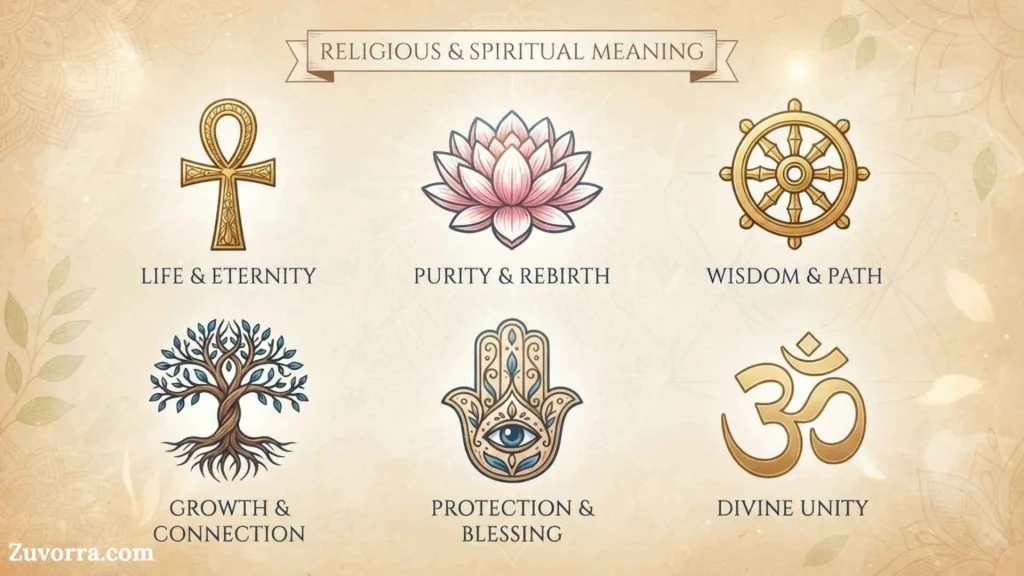
Dark Souls does not reproduce one real-world religion. It creates fictional gods, miracles, covenants, clerics, sacred relics, pilgrimages, sins, confessions, prophecies, and rituals.
The series’ religious symbols often examine how belief shapes power.
Fire as Sacred Power
Fire functions almost like a sacred principle. It orders time, supports kingdoms, empowers miracles, and becomes the focus of ritual sacrifice.
However, sacredness does not guarantee moral goodness. The preservation of fire may protect life while also defending hierarchy and delaying necessary change.
Covenants as Religious Communities
Covenants require loyalty, offerings, duties, and rewards. Some encourage cooperation, while others promote invasion, vengeance, protection, hunting, or service to a ruler.
They show how symbols create group identity. An emblem tells members whom they serve, how they should behave, and who stands outside the group.
Linking the Fire as Sacrifice
To link the fire is to offer oneself to continue the Age of Fire. The act resembles ritual self-sacrifice, martyrdom, royal duty, and cosmic renewal.
Whether this sacrifice is noble, manipulated, necessary, or futile remains deliberately uncertain. That uncertainty is central to the symbol’s power.
Technical and Digital Meaning
Dark Souls symbols also serve as a visual language for gameplay.
Interface Icons
The heads-up display uses icons for status effects, equipment, Humanity, health, stamina, and collected souls. The manual notes that status icons appear when conditions such as poison affect the player.
These icons reduce complex information to quick visual signals. A skull, colored meter, glowing counter, or equipment image can immediately change the player’s decision.
Multiplayer Communication
Ghosts, bloodstains, written messages, summon signs, and invasion signs create indirect communication between players. Bandai Namco identifies seeing spirits, observing deaths, leaving messages, summoning allies, and invading opponents as defining online features.
The signs are practical network tools, but the game presents them as supernatural traces between overlapping worlds.
No Official Unicode Character
The Darksign, Humanity sprite, bonfire emblem, and covenant insignias do not have standardized Unicode code points. Fans must use images, custom fonts, stickers, or approximate emoji when representing them in ordinary text.
Where Dark Souls Symbols Are Used
Dark Souls imagery appears in several settings:
- Video games: Menus, environments, equipment, covenant screens, multiplayer signs, and lore objects
- Official merchandise: Bonfire statues, art books, clothing, soundtrack packaging, and collector’s editions
- Fan art: Illustrations of the Darksign, Humanity, bonfires, knights, and covenant emblems
- Tattoos: Especially the Darksign, bonfire, coiled sword, sun emblem, and “Praise the Sun” imagery
- Cosplay: Covenant badges, armor crests, weapons, shields, and sacred objects
- Online communities: Avatars, profile banners, reaction images, memes, and forum icons
- Critical writing: Discussions of death, persistence, environmental storytelling, and game design
- Other games: Soulslike titles often borrow the visual language of checkpoints, recoverable death markers, mysterious factions, and decaying sacred worlds
Official Dark Souls merchandise has repeatedly featured the bonfire as a central collectible image, showing how strongly it represents the franchise outside gameplay.
Common Variations
Flaming and Unlit Darksigns
The Darksign may appear as a bright ring of flame, a dark circular brand, or a simplified black-and-orange emblem. Fan designs often increase symmetry or add textured flames.
Bonfire Designs
Bonfires differ in flame intensity, sword design, surrounding ash, and environmental placement. Some fan versions use a straight sword, while official imagery usually emphasizes the coiled sword.
Covenant Emblems
Each covenant uses distinct imagery reflecting its purpose. Sunlight symbols favor radiant circles and warm colors. Darkwraith imagery uses darkness, skeletal armor, and predatory shapes. Gravelord imagery centers on death, bone, and disease. Darkmoon imagery favors lunar and judicial associations.
Summon-Sign Colors
Color carries immediate mechanical meaning:
| Sign Color | Typical Meaning |
| White | Cooperative summoning |
| Gold | Sunlight covenant cooperation |
| Red | Hostile duel or invasion |
| Dark or violet tones | Covenant-specific hostility or unusual multiplayer roles |
Exact systems vary between games, so players should identify the title before assuming that every color follows identical rules.
Common Misconceptions
“The Darksign Is the Dark Soul”
The Darksign and Dark Soul are related but not identical. The Dark Soul is a foundational source of humanity. The Darksign is a mark associated with the Undead curse and the containment or control of humanity.
“Fire Always Represents Good”
Fire offers warmth and life, but it also supports a fading order. Extending the Age of Fire may require deception, sacrifice, and resistance to natural change.
“Darkness Always Represents Evil”
Darkness can represent danger, the Abyss, corruption, or fear. It can also represent humanity, future possibility, and freedom from divine rule. Context determines its meaning.
“Hollowing Means Looking Undead”
Physical decay is only one aspect of Hollowing. The deeper threat is the loss of memory, reason, identity, and purpose.
“Every Symbol Has One Official Explanation”
FromSoftware often provides fragments rather than complete definitions. Item descriptions, dialogue, architecture, and mechanics support interpretation, but many conclusions remain debated.
“All Symbols Work the Same Across the Trilogy”
Dark Souls, Dark Souls II, and Dark Souls III reuse major themes while changing details. Humanity, Human Effigies, Embers, bonfire travel, Hollowing, covenants, and multiplayer signs do not function identically in every game.
A Simple Guide to Identifying a Dark Souls Symbol
Does it look like a burning ring on a person?
↓
It is probably the Darksign, representing the Undead curse.
Is it a sword surrounded by flame and ash?
↓
It is a bonfire, symbolizing rest, renewal, and the Age of Fire.
Is it a dark, floating human-like shape with a white edge?
↓
It is Humanity, representing human essence and the Dark Soul.
Is it a glowing mark on the ground?
↓
Check its color. It may be a summon sign, duel sign, invasion sign, or message.
Does it feature a radiant sun?
↓
It is likely connected to the Warriors of Sunlight, cooperation, miracles, or Solaire.
Does it appear on a shield, ring, robe, or covenant menu?
↓
It may be a faction or covenant emblem showing allegiance.
Interesting Facts About Dark Souls Symbols
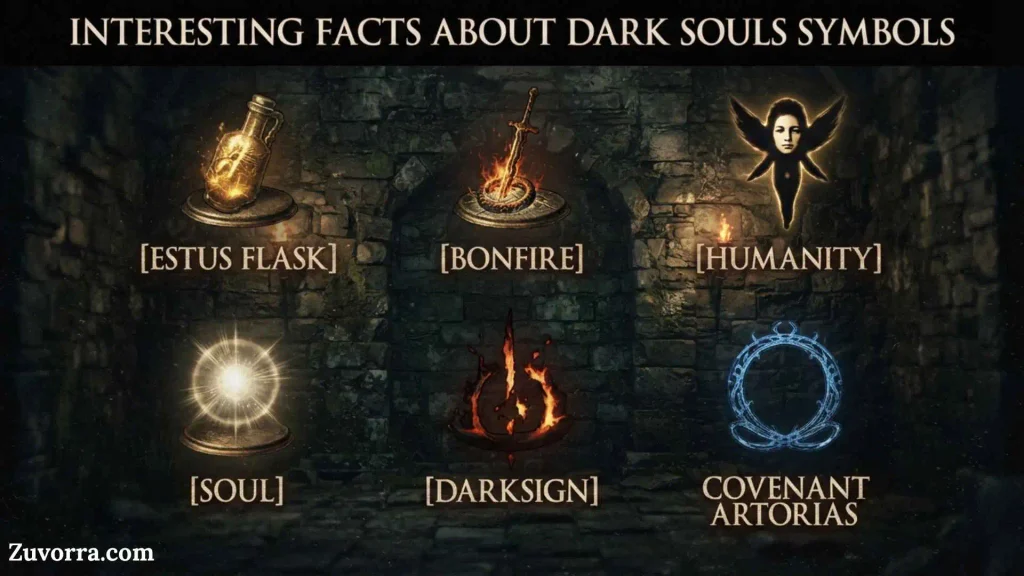
- The bonfire is both shelter and warning. It restores the player, but resting also revives many defeated enemies. Safety and danger remain connected.
- The player learns symbolism through repetition. Dying, recovering a bloodstain, resting, summoning, and kindling teach the mythology through actions rather than lectures.
- Humanity is visually dark but mechanically valuable. This reverses the common fantasy idea that light is always beneficial and darkness is automatically corrupt.
- Bloodstains turn failure into communication. A death that harms one player may help another recognize a trap.
- The Darksign resembles a closed cycle. Its ring shape visually supports themes of repetition, imprisonment, and history returning to its beginning.
- The sun symbol gained meaning through community behavior. Cooperative players and fans transformed “Praise the Sun” into a wider expression of encouragement and shared enthusiasm.
- Bonfires connect solitary and social play. Players rest alone, yet online systems allow kindling and other actions to create effects that cross between worlds. The original manual describes shared kindling as an online feature.
- The coiled sword unites violence and comfort. A weapon forms the center of the game’s safest recurring image.
- Covenant symbols operate like uniforms. They identify values, expected behavior, allies, enemies, and rewards without requiring lengthy explanation.
- Decay is part of the visual language. Broken statues, faded heraldry, empty thrones, cracked stone, and ruined temples show that institutions can outlive their original purpose.
- The symbols rarely provide moral certainty. Fire, darkness, faith, humanity, sacrifice, and immortality can each become helpful or destructive.
- The official marketing recognizes the bonfire’s symbolic role. Bandai Namco describes it not only as a checkpoint but as an image of life, hope, warmth, and calm.
Related Symbols
Ember
Embers represent remaining fire, restored strength, and connection to the Lords of Cinder. They are especially important in Dark Souls III.
Human Effigy
The Human Effigy serves as a major symbol of identity and restored humanity in Dark Souls II. Its figure-like shape emphasizes the idea of recovering the self.
Estus Flask
The Estus Flask symbolizes stored fire, healing, and dependence on bonfires. It transforms the power of flame into a portable source of survival.
White Sign Soapstone
This object creates cooperative summon signs. It differs from the sign itself because it is the tool that writes the symbol across worlds.
Red Eye Orb
The Red Eye Orb represents invasion, predation, and the Darkwraith tradition. Unlike cooperative signs, it allows the user to enter another world as an enemy.
Sunlight Medal
The Sunlight Medal represents successful cooperation and devotion to the Warriors of Sunlight. It turns shared victory into a covenant offering.
Skull and Curse Icons
Skull imagery usually warns of death, curse, or severe danger. Unlike the Darksign, these are primarily interface warnings rather than central cosmic symbols.
Lord Souls
The Lord Souls symbolize concentrated forms of primordial power. They differ from ordinary collected souls, which act as both experience and currency.
Frequently Asked Questions
What is the main symbol of Dark Souls?
The bonfire is the franchise’s most recognizable symbol because it combines gameplay, story, and emotion. It serves as a checkpoint and place of recovery while representing hope, warmth, sacrifice, and the fading Age of Fire. The Darksign is equally important to the lore because it marks the Undead curse.
What does the Darksign symbolize?
The Darksign symbolizes undeath, forced rebirth, cyclical suffering, and the threat of Hollowing. Its flaming ring can also be interpreted as humanity or darkness enclosed by fire. It does not automatically identify its bearer as evil. It marks a supernatural condition shared by the Undead.
Why is the bonfire important in Dark Souls?
The bonfire allows the player to recover, manage key resources, and return after death. Symbolically, it offers temporary peace in a hostile world. Its deeper meaning is complicated because bonfires are tied to the First Flame and the sacrifices used to preserve an aging cosmic order.
What does Humanity represent?
Humanity represents the inner essence of humans and their connection to the Dark Soul. It can restore human form and strengthen bonfires in the first game. Its dark appearance suggests that darkness is not merely evil; it may also contain identity, potential, community, and the natural future of humankind.
Is the Dark Souls sun symbol religious?
Within the fictional world, the sun emblem has religious qualities because it is associated with faith, miracles, covenant devotion, and reverence for light. It is not an official symbol of a real religion. Fans commonly connect it with Solaire, cooperation, optimism, and the phrase “Praise the Sun.”
What does Hollowing symbolize?
Hollowing symbolizes the destruction of identity and purpose. An Undead may survive many deaths, but losing motivation, memory, or meaningful connection can lead to mental collapse. Players often interpret it as a metaphor for despair or emotional exhaustion, although the game does not present it as a medical diagnosis.
Are Dark Souls symbols based on real medieval symbols?
The designs draw heavily from medieval European armor, heraldry, churches, tombs, religious orders, and royal imagery. However, most major emblems are original fictional creations. They combine familiar visual traditions with the series’ mythology rather than copying one historical culture or religion exactly.
What is the difference between the Darksign and Humanity?
Humanity is the dark essence associated with human beings and fragments of the Dark Soul. The Darksign is the fiery mark connected to the Undead curse. In simplified terms, Humanity concerns what humans are, while the Darksign concerns the condition imposed upon the Undead.
What does a Dark Souls bonfire tattoo mean?
A bonfire tattoo commonly represents perseverance, recovery, hope during hardship, and the courage to continue after failure. It may also commemorate the game itself. Because the bonfire depends on fuel and sacrifice, some wearers interpret it as a reminder that survival carries a cost.
Are Dark Souls symbols copyrighted?
The original game artwork, logos, character designs, covenant emblems, and other branded imagery are protected intellectual property belonging to their respective rights holders. Personal fan art or tattoos are different from commercial reproduction. Anyone planning to sell merchandise should seek qualified legal guidance rather than assuming fan use permits commercial use.
Key Takeaways
- Dark Souls symbols combine gameplay functions with philosophical meaning.
- The Darksign represents the Undead curse, repeated death, and threatened identity.
- Bonfires symbolize rest, hope, renewal, and sacrifice.
- Humanity reflects human essence and connection to the Dark Soul.
- Fire is not purely good, and darkness is not purely evil.
- Hollowing concerns lost purpose as much as physical decay.
- Summon signs and bloodstains transform multiplayer systems into symbols of connection.
- Covenant emblems communicate loyalty, ideology, and expected behavior.
- Many interpretations remain intentionally uncertain.
- The series’ strongest symbols teach meaning through player action.
Conclusion
Dark Souls symbols make the series’ mythology visible. A burning ring tells the story of cursed immortality. A sword within a bonfire offers comfort while hinting at sacrifice. A dark Humanity sprite challenges the belief that light alone represents goodness. A glowing summon sign proves that even isolated people can briefly reach one another.
Their lasting appeal comes from this combination of clarity and mystery. Players understand what each symbol does, yet must decide what it ultimately means. Through fire, darkness, death, memory, and renewal, Dark Souls turns ordinary game icons into reflections on identity, purpose, power, and the courage to continue.
References
- Bandai Namco Entertainment Europe, Dark Souls official game page and feature overview.
- Namco Bandai Games and FromSoftware, Dark Souls: Prepare to Die Edition PC Manual.
- Bandai Namco Entertainment Europe, Dark Souls Trilogy official website.
- Bandai Namco Entertainment Store, official Dark Souls bonfire collectible description.
- Dark Souls Wikidot, Darksign in-game description and gameplay information.

I’m Jasper Huxley, a British writer fascinated by the symbols that communicate ideas without words. I explore their meanings, origins, cultural connections, and everyday uses. From ancient markings to contemporary signs, I enjoy uncovering the stories behind visual language and presenting symbolism in a clear, engaging way for curious readers worldwide.
Books:
- The Hidden Language of Symbols
- Symbols, Signs and Their Meanings