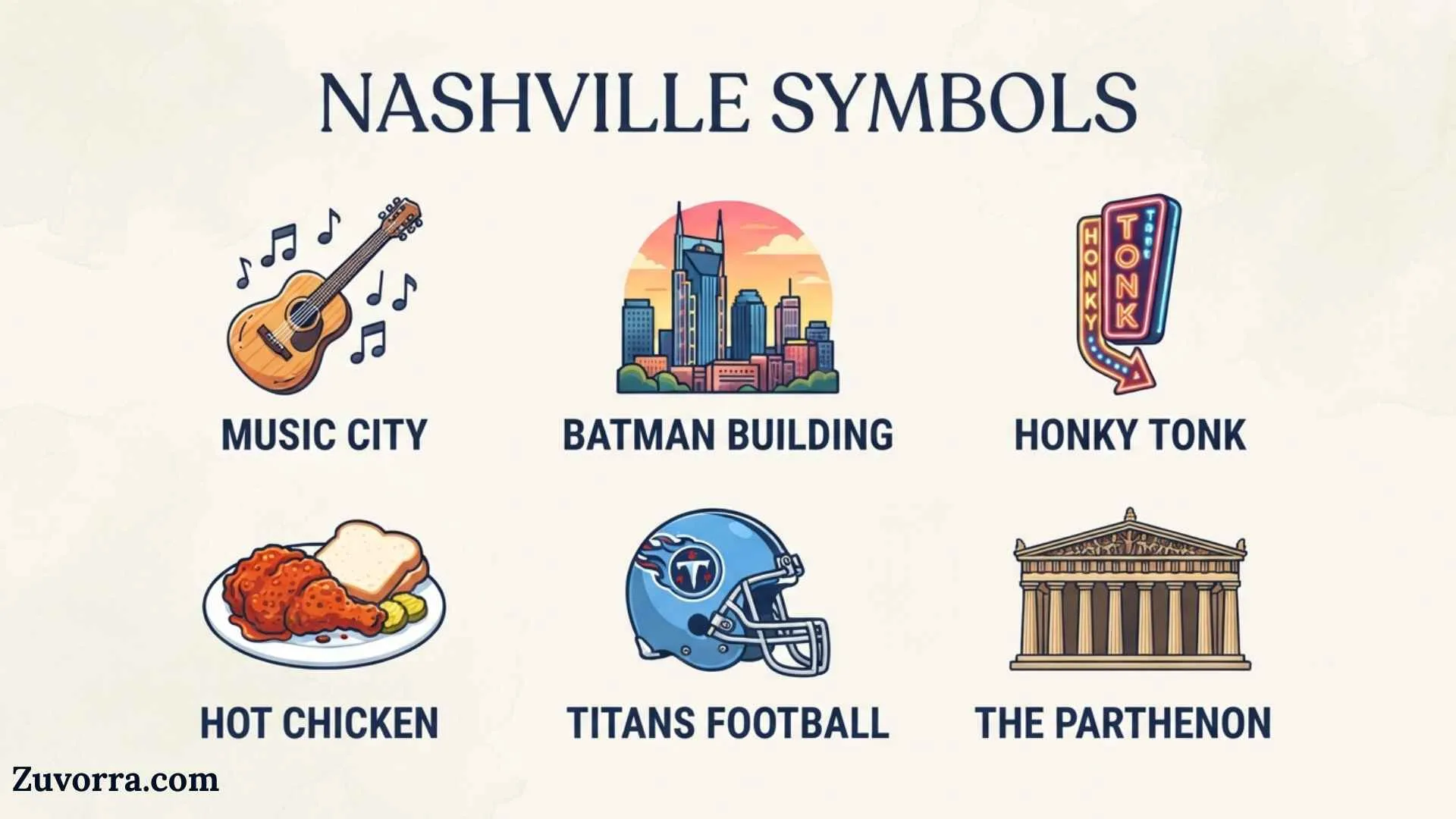
Nashville symbols tell the story of a city shaped by government, music, education, architecture, transportation, and Southern culture. The official Metro seal and flag represent civic unity, while guitars, musical notes, the Parthenon, the Ryman Auditorium, and the downtown skyline express Nashville’s public identity as “Music City” and the “Athens of the South.”
You may encounter these symbols on government buildings, street signs, tourism materials, sports uniforms, souvenirs, murals, tattoos, album covers, and business logos. Some are legally recognized emblems. Others are unofficial icons that became meaningful through history, popular culture, and everyday use.
Quick Meaning of Nashville Symbols
Nashville symbols represent civic unity, musical creativity, cultural ambition, and local pride. The official Metro seal and flag symbolize the consolidated government of Nashville and Davidson County. Unofficial symbols, including guitars, music notes, the Parthenon, the Ryman Auditorium, and the skyline, reflect the city’s music industry, classical heritage, architectural identity, and creative spirit.
Nashville Symbols Overview Table
| Nashville Symbol | Primary Meaning | Category | Origin or Association | Common Modern Use |
| Metro Nashville seal | Government, unity, opportunity, strength | Official civic emblem | Adopted in 1963 after metropolitan consolidation | Government documents, buildings, vehicles, official websites |
| Metro Nashville flag | Civic identity, courage, resources | Official flag | Adopted after Nashville and Davidson County formed Metro government | Public buildings, ceremonies, civic displays |
| Guitar | Music, songwriting, performance | Cultural symbol | Nashville’s recording and live-music industries | Tourism, murals, souvenirs, logos |
| Musical notes | Creativity, sound, entertainment | Cultural symbol | “Music City” identity | Signs, branding, tattoos, public art |
| Parthenon | Education, culture, civic ambition | Architectural symbol | Tennessee Centennial Exposition of 1897 | Tourism, art, city imagery |
| Ryman Auditorium | Country music history and performance | Historic cultural landmark | Former home of the Grand Ole Opry | Concert promotion, photography, heritage tourism |
| Grand Ole Opry circle | Tradition, belonging, musical legacy | Performance symbol | Historic stage floor associated with the Opry | Opry ceremonies, broadcasts, artist milestones |
| AT&T Building skyline profile | Modern Nashville and urban growth | Architectural symbol | Distinctive downtown skyscraper | Skyline graphics, photography, city branding |
| Cumberland River | Geography, trade, movement | Natural and historical symbol | Nashville’s location and early development | Maps, city art, waterfront imagery |
| Three stars of Tennessee | State identity and regional belonging | State-related symbol | Tennessee state flag | Sports imagery, apparel, local designs |
| Honky-tonk neon signs | Live music and nightlife | Entertainment symbol | Lower Broadway music district | Travel advertising, photography, merchandise |
| Hot chicken imagery | Local flavor, resilience, boldness | Food symbol | Nashville culinary tradition | Restaurant branding, festivals, tourism |
What Do Nashville Symbols Mean?
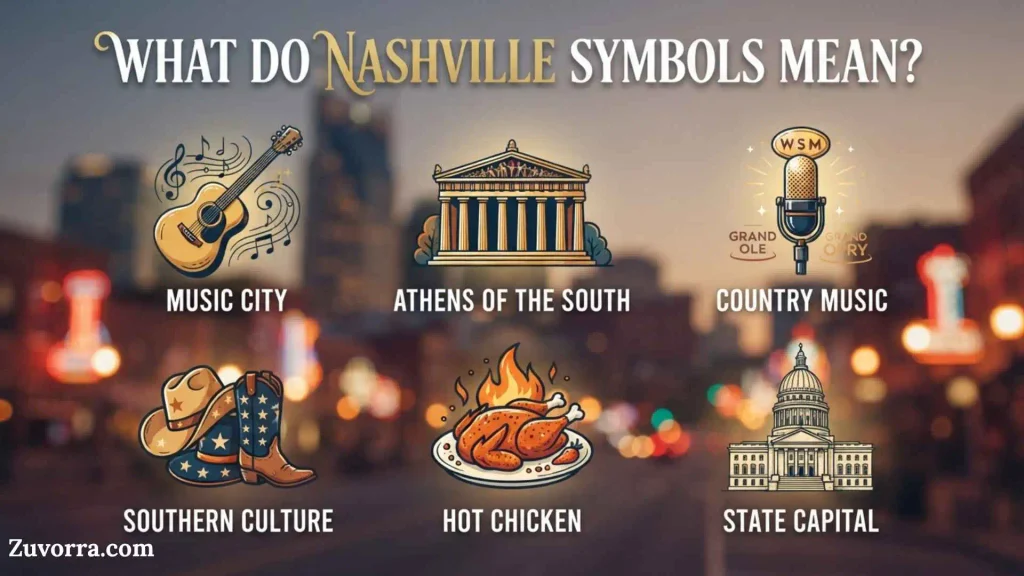
Nashville symbols communicate several connected ideas rather than one fixed meaning. Together, they present Nashville as a city where public institutions, commercial creativity, education, entertainment, and community life meet.
The official seal and flag represent Nashville as a political community. Their role is formal: they identify the Metropolitan Government of Nashville and Davidson County and appear in official settings.
The guitar, microphone, musical note, record, and stage represent the city’s creative economy. They refer not only to country music but also to gospel, blues, rock, pop, Americana, classical music, jazz, and songwriting.
The Parthenon represents intellectual and artistic ambition. It connects Nashville with its long-standing nickname, the “Athens of the South,” which reflects the city’s educational institutions and cultural aspirations.
The Ryman Auditorium and Grand Ole Opry symbolize continuity. They remind viewers that Nashville’s musical identity developed through live performance, radio broadcasting, religious architecture, migration, business, and storytelling.
Finally, the skyline and Cumberland River represent place. They distinguish Nashville from a general idea of the American South and connect its identity to a recognizable physical landscape.
History and Origin of Nashville’s Official Symbols
The Metropolitan Government Seal
The official seal belongs to the Metropolitan Government of Nashville and Davidson County. It was approved on April 2, 1963, through Resolution 63-1, the first resolution adopted by the first Metropolitan Council. Its adoption followed the consolidation of Nashville’s city government with Davidson County government.
The seal contains several visual elements, including an eagle, a shield, compass points, and imagery inherited from earlier local emblems. The official historical explanation connects the eagle with superiority, judgment, and strength in the face of danger. The compass points represent broad horizons and future opportunities for the people of Nashville and Davidson County.
One unusual element associated with Nashville’s older emblem is the image of a Native American man holding a skull. Metro historical material acknowledges that the precise origin and meaning of this imagery remain uncertain. A search ordered by Mayor Thomas L. Cummings in 1949 did not produce a definitive explanation. Therefore, claims that assign it a single proven meaning should be treated cautiously.
This uncertainty makes the seal historically important but also complicated. It reflects how civic emblems can preserve imagery whose original context has been lost or poorly documented.
The Nashville Flag
Nashville’s official flag places the Metro seal inside a white disc on a blue field, with a gold vertical stripe near the outer edge. The design emerged during the creation of the consolidated Metropolitan Government in 1963.
Blue is traditionally explained as representing the courage and conviction of Nashville’s leaders. Gold represents the richness of the area’s land and resources. The central seal gives the flag governmental authority and connects it directly to the unified Nashville-Davidson County administration.
Unlike tourism graphics featuring guitars or skylines, the flag is not merely promotional. It serves as an official marker of local government and civic jurisdiction.
Symbolism and Interpretation
Civic Unity
The Metro seal and flag primarily symbolize consolidation. Before 1963, Nashville and Davidson County operated through separate local governments. The new emblem helped provide a shared visual identity for the metropolitan system.
In this context, the circle of the seal may be interpreted as completeness and unity. This is a general design interpretation rather than a documented legal definition. Circular seals commonly communicate continuity, authority, and institutional stability.
Opportunity and Direction
The compass points in the official emblem have a documented meaning: they represent unlimited horizons and future opportunities.
This symbolism fits Nashville’s history as a regional center for transportation, publishing, education, health care, government, and entertainment. Directional imagery suggests movement beyond existing limits.
Strength and Protection
The eagle represents strength, judgment, and the ability to rise above danger. It also connects Nashville’s local government to the broader visual language of the United States, where eagles commonly symbolize national authority and vigilance.
The shield reinforces this meaning. Shields traditionally represent defense, public responsibility, lawful authority, and the protection of a community.
Creativity and Self-Expression
Guitars and musical notes express creativity more than government. They suggest songwriting, performance, collaboration, emotion, and personal storytelling.
A guitar can represent both the performer onstage and the songwriter working privately. This distinction matters in Nashville, where the composition and publishing of songs are as central to the city’s identity as concerts and celebrity culture.
Positive and Negative Interpretations
Most Nashville symbols carry positive meanings:
- Creativity and artistic opportunity
- Civic pride and community identity
- Cultural preservation
- Educational achievement
- Entertainment and celebration
- Economic growth
- Personal ambition
However, symbols can also invite criticism. Music imagery may reduce Nashville to a tourist stereotype while overlooking its universities, civil rights history, immigrant communities, religious institutions, health care industry, and neighborhoods.
The older imagery in the Metro seal can also raise questions about historical representation, Indigenous identity, and the use of poorly understood symbols in modern government. Responsible interpretation should acknowledge uncertainty rather than inventing a comforting explanation.
Cultural Significance of Nashville Symbols
Nashville as “Music City”
The phrase “Music City” is Nashville’s strongest cultural identity. Guitars, records, microphones, stars, boots, and neon signs act as visual shortcuts for that identity.
These images appear throughout Lower Broadway, Music Row, entertainment venues, museums, murals, hotels, restaurants, and visitor merchandise. Nashville’s tourism organization also promotes guitar displays and a Guitar Trail, showing how the instrument functions as a citywide icon rather than a symbol limited to one venue.
Although the guitar is often associated with country music, Nashville’s musical culture is broader. The city has deep connections with gospel, blues, rock, pop, Christian music, classical performance, jazz, and music publishing.
The Parthenon and the “Athens of the South”
Nashville’s Parthenon is one of the city’s most recognizable nonmusical symbols. The original structure was built for the Tennessee Centennial Exposition of 1897 as a full-scale replica of the ancient Parthenon in Athens, Greece. The first foundation stone was laid in 1895.
The building represented Nashville’s educational and cultural reputation. The city had become known as the “Athens of the South” because of its colleges, universities, publishing activity, and intellectual institutions.
The temporary exposition structure was later replaced by a permanent version constructed between 1921 and 1931 using brick, stone, reinforced concrete, and cast concrete aggregate.
Today, the Parthenon symbolizes more than classical architecture. It represents civic ambition: Nashville wanted to be recognized as a center of learning and art, not only commerce or politics. The institution itself describes the building as a symbol of civic pride dating to 1897.
Ryman Auditorium
Ryman Auditorium symbolizes the relationship between religion, public gathering, broadcasting, and country music.
The building began as the Union Gospel Tabernacle. It later became the best-known former home of the Grand Ole Opry, hosting the program from 1943 to 1974. Its role in the birth and development of country music contributed to its recognition as a National Historic Landmark.
The Ryman is often called the “Mother Church of Country Music.” The nickname combines its religious architectural origins with its musical legacy. Its red-brick exterior, arched windows, wooden pews, and stage have become recognizable symbols of authenticity and tradition.
The Grand Ole Opry Stage Circle
A circle of wood embedded in the Grand Ole Opry House stage serves as one of Nashville’s most emotionally meaningful performance symbols. It connects the current venue with the Ryman stage and represents continuity between generations of performers.
For musicians, standing inside the circle can symbolize acceptance, achievement, responsibility, and participation in a living tradition. The Opry continues to present established artists and rising performers, making the circle a symbol of both heritage and future possibility.
Lower Broadway Neon
Neon signs, illuminated guitars, boots, and venue marquees symbolize Nashville’s public nightlife. Their meaning is immediate: live music, movement, energy, and entertainment.
Yet Lower Broadway represents only one part of Nashville. Treating neon honky-tonk imagery as the city’s complete identity can erase quieter but equally important places, including neighborhood music venues, churches, campuses, civil rights sites, recording studios, and community arts spaces.
Religious and Spiritual Meaning
Nashville does not have a single sacred symbol shared by all residents. Its official seal is governmental rather than religious. However, several important Nashville icons have religious connections.
Ryman Auditorium began as a gospel tabernacle, so its architecture carries the memory of revival meetings and Christian worship. Its later identity as a music venue shows how a sacred gathering space can acquire a broader cultural function without completely losing its religious associations.
Gospel music is also central to Nashville’s musical heritage. Churches, choirs, religious publishers, Christian recording companies, and historically Black educational institutions helped shape the city’s sound.
The Parthenon draws from ancient Greek religious architecture and contains a modern full-scale statue of Athena Parthenos. In ancient Athens, the original Parthenon was a temple associated with the goddess Athena. In Nashville, however, the structure functions as an art museum and cultural landmark, not as an active pagan temple. The Athena statue should therefore be understood through historical, artistic, and mythological context rather than modern religious practice.
Where Nashville Symbols Are Used
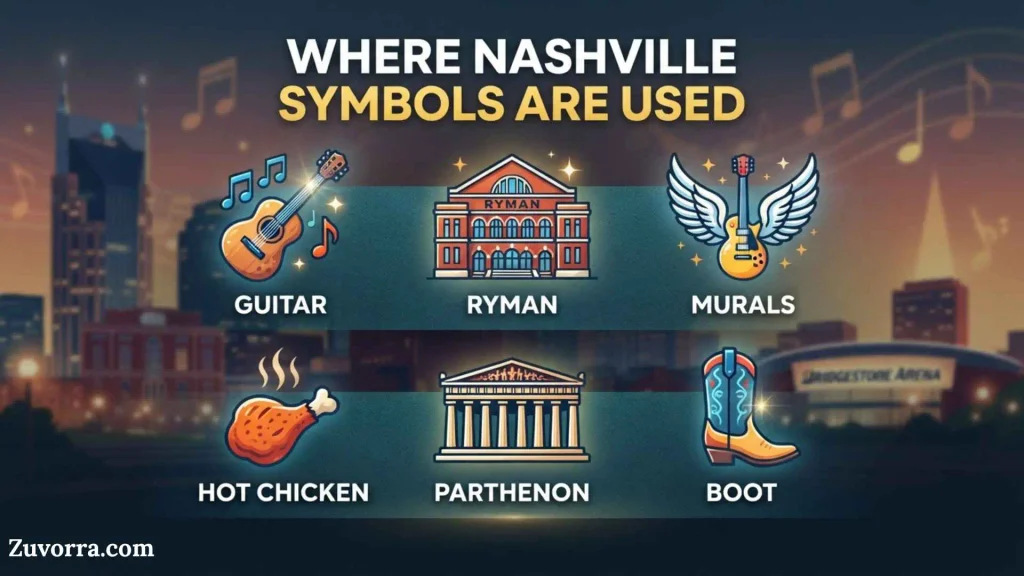
Government and Public Administration
The Metro seal appears on:
- Official government websites
- Council documents and resolutions
- Municipal buildings
- Public vehicles
- Departmental materials
- Civic signs and publications
- Formal ceremonies
Its use communicates governmental authority. Businesses should not reproduce it in ways that falsely suggest official endorsement.
Tourism and Souvenirs
Unofficial symbols dominate visitor merchandise. Common examples include:
- Guitar-shaped signs
- Music notes
- Vinyl records
- Cowboy boots
- Neon lettering
- The Parthenon
- Ryman Auditorium
- The skyline
- Tennessee’s three stars
- “Music City” typography
- Hot chicken illustrations
These designs combine place recognition with emotional memory. A visitor may buy a guitar ornament not because the object has a fixed symbolic definition, but because it recalls a concert, trip, or personal connection.
Architecture and Public Art
Murals often combine multiple Nashville symbols in one composition. A single artwork may feature the skyline, guitars, the Cumberland River, sports logos, flowers, records, and local food.
This layered approach reflects how city identity works. Nashville is not represented by one universal icon. Its meaning emerges from a network of landmarks, industries, neighborhoods, and shared stories.
Tattoos and Jewelry
Nashville-inspired tattoos commonly feature:
- Skyline outlines
- Guitar silhouettes
- Musical notes
- Area code references
- The Tennessee tri-star
- Ryman windows
- Parthenon columns
- Coordinates
- River lines
- Song lyrics
A Nashville tattoo may mark a birthplace, a move, a music career, a relationship, a memorable journey, or a sense of belonging. The wearer’s personal story matters more than any universal interpretation.
Sports and Entertainment Branding
Blue and gold, stars, musical imagery, and skyline forms often appear in Nashville sports culture. Teams and local businesses use them to connect performance, energy, and hometown identity.
These designs may resemble official civic colors without being official government emblems. Context determines whether a symbol represents the city administration, a sports organization, a private company, or Nashville culture in general.
Common Variations of Nashville Symbols
Official Seal Variations
The Metro seal may appear in full color, monochrome, simplified, embossed, engraved, or digitally adapted forms. Details can become less visible when the emblem is printed at a small size.
A simplified version may remain recognizable, but alteration can obscure historically significant features. Formal users should rely on approved government artwork rather than recreating the seal from memory.
Guitar Variations
Nashville guitar symbols may depict:
- Acoustic guitars for songwriting, folk, or country music
- Electric guitars for rock, blues, or contemporary performance
- Guitar picks for musicianship and music businesses
- Guitar necks incorporated into lettering
- Winged or flaming guitars for energy and freedom
- Broken strings for struggle, loss, or perseverance
The type of guitar changes the mood, but all variations connect to music and creative identity.
Skyline Variations
Some skyline designs focus on the distinctive AT&T Building, widely nicknamed the “Batman Building” because its twin spires resemble the pointed ears of Batman’s mask.
Other skyline images include riverfront buildings, bridges, stadiums, cranes, or the State Capitol. A skyline design may represent nostalgia, urban progress, tourism, or concern about rapid development.
Tennessee Tri-Star Designs
The three white stars inside the Tennessee state flag belong to the state rather than Nashville alone. In Nashville designs, they communicate regional identity and membership within Tennessee.
Because Nashville is the state capital, the tri-star often appears alongside the city skyline, guitars, or the State Capitol. It should not be mistaken for an exclusively Nashville-specific emblem.
How to Choose the Right Nashville Symbol
Use this simple decision guide:
Do you need a formal government symbol?
↓
Use the official Metro seal or flag only in an accurate, authorized context.
Do you want to represent Nashville’s music culture?
↓
Choose a guitar, musical note, microphone, record, Ryman outline, or Opry-inspired stage image.
Do you want to highlight education and art?
↓
Use the Parthenon, Athena, classical columns, or museum imagery.
Do you want a symbol of hometown identity?
↓
Choose the skyline, Cumberland River, local coordinates, or a neighborhood landmark.
Do you want a broader Tennessee connection?
↓
Use the tri-star, state outline, or Tennessee flag colors, while recognizing that these are statewide symbols.
Are you designing a tattoo or personal keepsake?
↓
Select the symbol connected to your own story rather than choosing the most famous tourist image.
Common Misconceptions
“Nashville has one official symbol.”
Nashville has official governmental emblems, especially the Metro seal and flag, but the phrase “Nashville symbols” usually includes unofficial cultural icons. A guitar may be more recognizable to tourists, yet it does not replace the legal civic emblem.
“The guitar means only country music.”
The guitar is strongly associated with country music, but Nashville supports many musical traditions. In modern designs, the instrument can represent songwriting, recording, touring, worship music, blues, rock, pop, folk, or creativity in general.
“The Parthenon is an ancient building.”
Nashville’s Parthenon is a modern American replica inspired by the ancient structure in Athens. Its first version was created for the 1897 Tennessee Centennial Exposition, and the permanent building was completed decades later.
“The Nashville Parthenon is an active temple.”
It is an art museum and cultural landmark. Its architecture and Athena statue reference ancient Greek religion, but the building does not serve as an operating ancient Greek temple.
“The Ryman has always been a concert hall.”
The Ryman began as the Union Gospel Tabernacle. Its later musical importance developed through public events and its long association with the Grand Ole Opry.
“Every three-star design represents Nashville.”
Three stars most directly reference Tennessee’s state flag. Nashville uses tri-star imagery because it is located in Tennessee and serves as the state capital, not because the stars belong exclusively to the city.
“The meaning of every detail in the Metro seal is known.”
It is not. Metro historical information states that the origin and meaning of some older emblem imagery remain uncertain. Confident modern explanations may be interpretations rather than documented historical facts.
Interesting Facts About Nashville Symbols
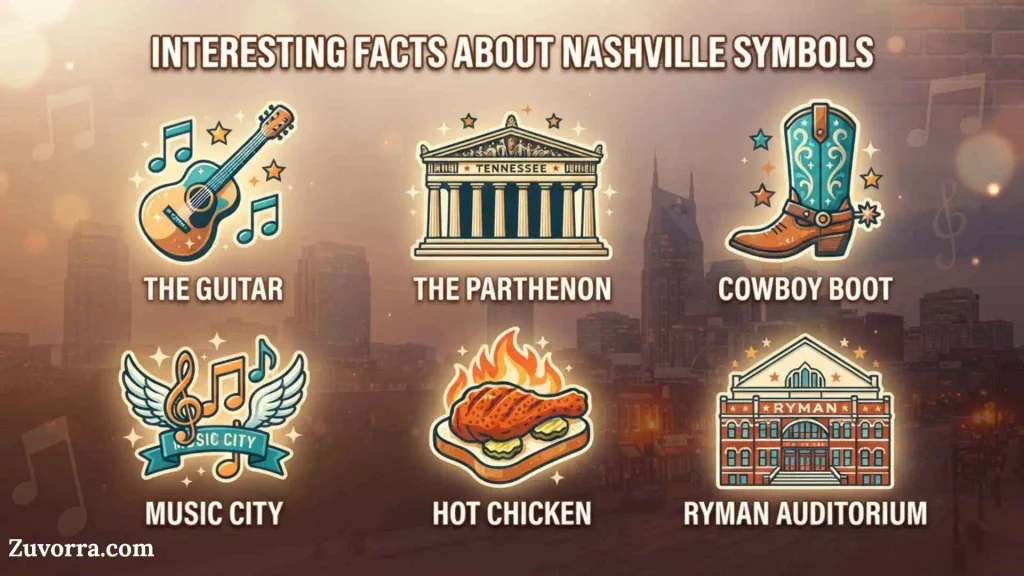
- The Metro seal was approved through the first resolution of the first Metropolitan Council. This connects the emblem directly to the creation of Nashville’s consolidated government in 1963.
- The meaning of part of Nashville’s older emblem remains unresolved. Even a historical investigation requested by Mayor Thomas L. Cummings did not establish a definitive explanation for all its imagery.
- The compass points have an official interpretation. They represent unlimited horizons and opportunities for the people of Nashville and Davidson County.
- The first Nashville Parthenon was built as an exposition structure. It was created for Tennessee’s 1897 Centennial Exposition rather than as a permanent museum.
- The permanent Parthenon took nearly a decade to construct. Work on the lasting structure extended from 1921 to 1931.
- Nashville’s Athena statue was commissioned in the twentieth century. The city selected sculptor Alan LeQuire in 1982 to create the full-scale replica of Athena Parthenos.
- The Parthenon contains casts connected to the famous Parthenon sculptures. Its collection includes casts molded from surviving fragments held in London.
- Ryman Auditorium was home to the Grand Ole Opry for more than three decades. The Opry performed there from 1943 through 1974, strengthening the building’s national musical significance.
- The Grand Ole Opry is more than a building. It is a continuing live performance tradition that has occupied several homes, which is why its strongest symbols include the stage, radio microphone, and wooden circle.
- Nashville’s skyline has an unofficial superhero connection. The AT&T Building’s pointed towers led residents and visitors to call it the “Batman Building,” turning a commercial skyscraper into a popular city icon.
- Neon is symbolic because Nashville music is visible as well as audible. Bright marquees make live performance part of the streetscape, especially along Lower Broadway.
- Nashville symbols often combine ancient and modern ideas. A single city image may place classical Parthenon columns beside a modern skyline and guitar, representing education, growth, and entertainment at once.
Related Symbols
Tennessee Tri-Star
The tri-star represents Tennessee as a whole. It differs from the Metro seal because it expresses state identity rather than Nashville-Davidson County government.
Tennessee State Capitol
The Capitol symbolizes Nashville’s political role as the state capital. It represents lawmaking, state history, and public authority rather than the music business.
Music Note
A music note is more universal than a guitar. It represents sound, melody, and musical literacy without pointing to one genre or instrument.
Microphone
The microphone emphasizes singing, broadcasting, recording, and public voice. It is especially relevant to Nashville’s radio and live-performance history.
Vinyl Record
A record symbolizes the recording industry, preservation of sound, album culture, and nostalgia. It can also represent the business side of Music City.
Classical Column
A column refers to the Parthenon and Nashville’s “Athens of the South” identity. It suggests education, order, endurance, and cultural ambition.
Cumberland River Wave
A wave or river line represents geography, trade, travel, and the city’s development along the Cumberland River. It is less commercial than guitar imagery and often feels more personal.
Star
A star may represent Tennessee, artistic fame, ambition, performance, or the Music City Walk of Fame. Its meaning depends heavily on color, number, and context.
Frequently Asked Questions
What is the official symbol of Nashville?
The most authoritative official emblem is the seal of the Metropolitan Government of Nashville and Davidson County. It was adopted in 1963 following metropolitan consolidation. Nashville also has an official flag featuring the seal. Guitars and music notes are famous cultural icons, but they are not substitutes for the official government emblem.
What does the Nashville seal represent?
The seal represents metropolitan government, civic unity, strength, and opportunity. Its eagle is associated with judgment and strength, while its compass points symbolize broad horizons and future possibilities. Some inherited imagery has no fully documented explanation, so not every detail should be assigned a definite modern meaning.
Why is a guitar a symbol of Nashville?
The guitar represents Nashville’s music industry, songwriting culture, recording studios, performance venues, and global reputation as Music City. It is especially linked with country music, but it also represents rock, gospel, blues, pop, folk, and other genres created and performed throughout the city.
Why does Nashville have a Parthenon?
The original Nashville Parthenon was constructed for the Tennessee Centennial Exposition of 1897. It reflected the city’s reputation as the “Athens of the South,” a nickname connected with education and culture. The permanent replica now operates as an art museum and major civic landmark.
What does the Ryman Auditorium symbolize?
Ryman Auditorium symbolizes live performance, country music history, religious heritage, and cultural continuity. It began as a gospel tabernacle and later became the best-known former home of the Grand Ole Opry. Its architecture and stage remain powerful symbols of authenticity in Nashville’s music culture.
Is the Batman Building an official Nashville symbol?
No. The AT&T Building, commonly called the Batman Building because of its twin spires, is an unofficial architectural icon. Its distinctive shape makes it central to many skyline illustrations, photographs, postcards, logos, and tattoos representing modern Nashville.
What do the colors on Nashville’s flag mean?
Blue is associated with the courage and conviction of Nashville’s leaders, while gold represents the richness of the region’s land and resources. The white disc provides a clear field for the official Metro seal, which identifies the unified Nashville-Davidson County government.
Are the three stars a Nashville symbol?
The three stars primarily belong to Tennessee’s state flag. They represent statewide identity, not Nashville alone. Nashville designs frequently include them because the city is Tennessee’s capital and an important cultural center, but the tri-star should be described as a Tennessee-related symbol.
What Nashville symbol works best for a tattoo?
The best choice depends on the personal meaning you want to preserve. A guitar suits a music connection, the skyline represents home or travel, Parthenon columns suggest learning and culture, and the Cumberland River may symbolize roots or movement. Avoid copying an official seal without considering its complexity and context.
Does Nashville have a flower, animal, or bird as an official city symbol?
The best-known official Nashville emblems are the Metro seal and flag. Tennessee has official state plants, animals, birds, and other designations, but these should not automatically be labeled official Nashville symbols. Always distinguish city emblems from statewide symbols and informal local icons.
Key Takeaways
- Nashville’s official symbols are the Metro government seal and flag.
- The seal was adopted in 1963 after Nashville and Davidson County consolidated their governments.
- Its eagle represents strength and judgment, while its compass points represent opportunity.
- Some older imagery in the seal has no proven historical explanation.
- Guitars and musical notes represent Nashville’s broad creative and recording culture.
- The Parthenon symbolizes education, art, civic pride, and the “Athens of the South.”
- Ryman Auditorium represents religious history, live performance, and country music heritage.
- The Grand Ole Opry stage circle symbolizes continuity and artistic belonging.
- The skyline, Cumberland River, neon signs, and hot chicken are unofficial but recognizable local icons.
- Tennessee’s three stars represent the state, not Nashville alone.
- The correct symbol depends on whether the purpose is governmental, cultural, artistic, commercial, or personal.
Conclusion
Nashville symbols form a visual record of the city’s many identities. The Metro seal and flag express civic authority and metropolitan unity. The guitar, microphone, Ryman Auditorium, and Grand Ole Opry celebrate musical creation and performance. The Parthenon represents learning and cultural ambition, while the skyline and Cumberland River connect those ideas to a specific place.
Understanding these differences prevents a common mistake: treating every familiar Nashville image as an official emblem. Some symbols belong to government, some to Tennessee, and others grew from public memory, tourism, architecture, or personal experience.
Together, the most meaningful Nashville symbols reveal a city that respects tradition while continually rewriting its own song.
References
- Metropolitan Government of Nashville and Davidson County, Metro Clerk, “The Seal and Flag of the Metropolitan Government of Nashville and Davidson County.”
- Metropolitan Government of Nashville and Davidson County, “Facts About Metro Nashville Government.”
- The Parthenon, “Mission and History” and “Architecture.”
- The Parthenon, “Collections” and “Exhibits.”
- Grand Ole Opry, “History” and “About the Opry.”
- National Park Service, National Historic Landmark records for Ryman Auditorium.
- Nashville Convention and Visitors Corp., official Music City visitor resources.

I’m Rupert Ashbourne, a British author interested in how symbols have shaped human communication throughout history. I examine signs, emblems, markings, and visual representations, explaining their meanings and cultural significance. My aim is to make symbolism approachable while helping readers understand how simple shapes and images can carry surprisingly powerful messages.
Books:
- The Meaning of Symbols
- A History of Signs and Emblems