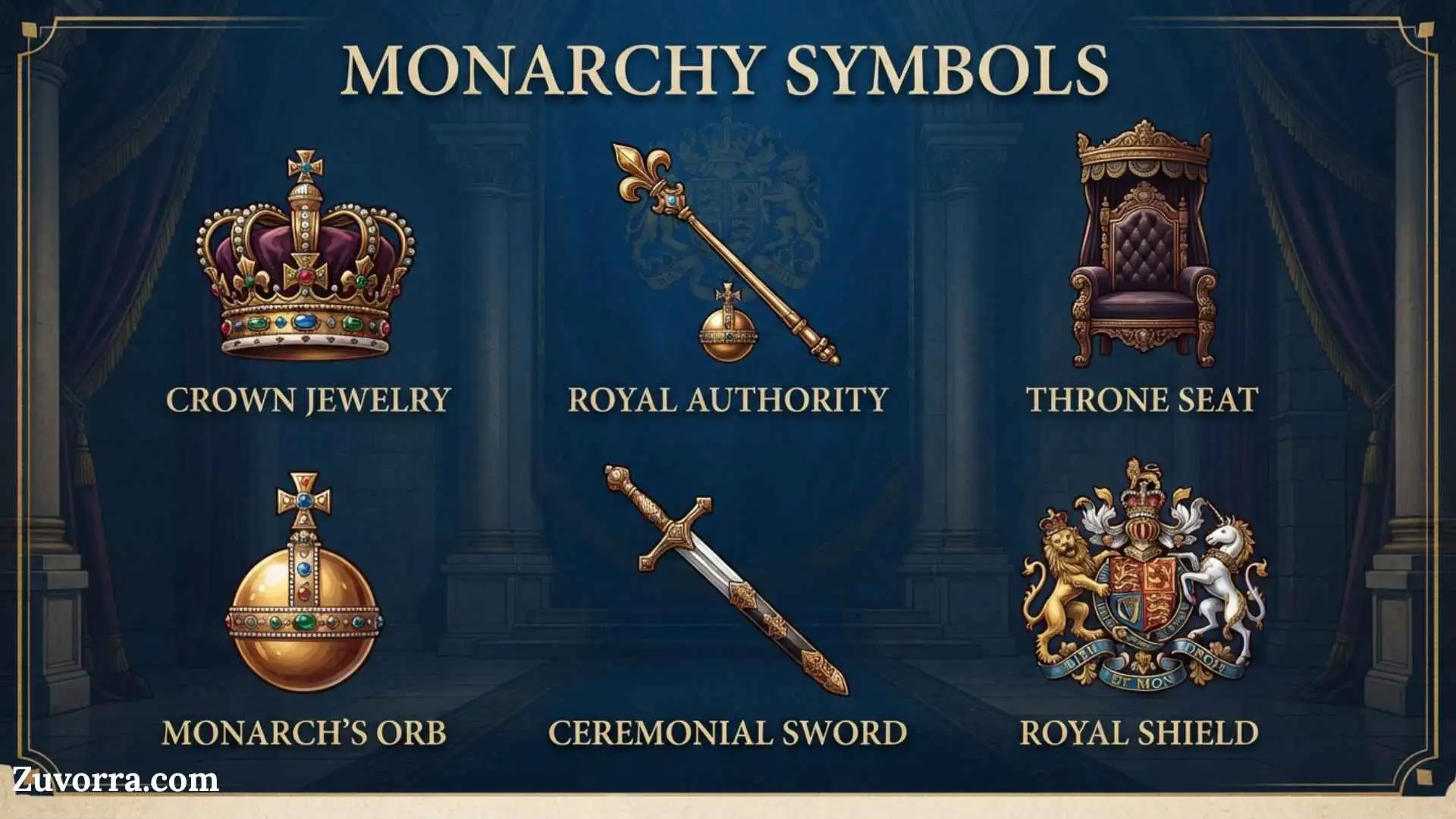
Monarchy symbols are visual objects, ceremonies, animals, colors, and emblems that represent a sovereign’s authority, legitimacy, duties, and connection to the state. The crown is the best-known example, but royal symbolism also includes thrones, scepters, orbs, maces, swords, coats of arms, seals, robes, lions, eagles, and royal monograms.
These symbols appear on national flags, coins, government buildings, official documents, military badges, jewelry, royal residences, and coronation regalia. They do more than decorate a ruler. Each object communicates a political or ceremonial idea, such as lawful succession, justice, protection, religious responsibility, national unity, or continuity across generations.
Quick Meaning of Monarchy Symbols
Monarchy symbols represent royal authority, sovereign legitimacy, national continuity, and the responsibilities of a king, queen, emperor, or empress. Crowns signify sovereignty, scepters express governing power, thrones mark the seat of rule, and coats of arms identify a royal house or state. Their meanings vary by culture, religion, and political system.
Monarchy Symbols Overview Table
| Symbol | Primary Meaning | Historical Origin | Common Use | Modern Interpretation |
| Crown | Sovereignty and royal rank | Ancient royal and sacred headwear | Coronations, heraldry, coins | Monarchy, excellence, authority |
| Throne | Seat of legitimate rule | Ancient Egypt, Mesopotamia, and other early states | Ceremonies, palaces, official art | Office and institution of monarchy |
| Scepter | Governing power and command | Ancient staffs of authority | Coronation regalia, royal portraits | Lawful leadership |
| Orb | Sovereignty over the earthly realm | Christian European regalia | Coronations and heraldry | Sacred responsibility of the ruler |
| Sword | Justice, defense, and military duty | Ancient warrior kingship | Coronations, processions, state ceremonies | Protection and lawful force |
| Mace | Delegated royal or institutional authority | Medieval weapon transformed into an emblem | Parliaments, universities, civic ceremonies | Legal and constitutional authority |
| Royal coat of arms | Dynasty, territory, and sovereign identity | Medieval heraldry | Government documents, courts, buildings | State authority and historical identity |
| Royal seal | Authentication and lawful approval | Ancient administrative seals | Decrees, treaties, appointments | Official consent and legitimacy |
| Royal cypher | Personal identity of a monarch | Monograms used by rulers | Mailboxes, uniforms, buildings, documents | Reign-specific state branding |
| Robe or mantle | Dignity, office, and sacred status | Ancient and medieval ceremonial dress | Coronations and state occasions | Continuity and ceremonial rank |
| Lion | Courage, strength, and kingship | Ancient Near Eastern and European imagery | Heraldry, flags, architecture | National strength and royal courage |
| Eagle | Imperial power and elevated vision | Ancient Mediterranean and Near Eastern empires | Standards, seals, coats of arms | Empire, independence, command |
| Fleur-de-lis | Royal identity and dynastic tradition | Medieval European heraldry | Crowns, coats of arms, textiles | French monarchy and noble heritage |
| Canopy or baldachin | Elevated and protected status | Sacred and royal processions | Enthronements, royal entries, worship | Honor and ceremonial distinction |
There is no single universal Unicode character for monarchy. The crown emoji, is the closest popular digital equivalent, although it represents only one part of royal symbolism.
What Do Monarchy Symbols Mean?
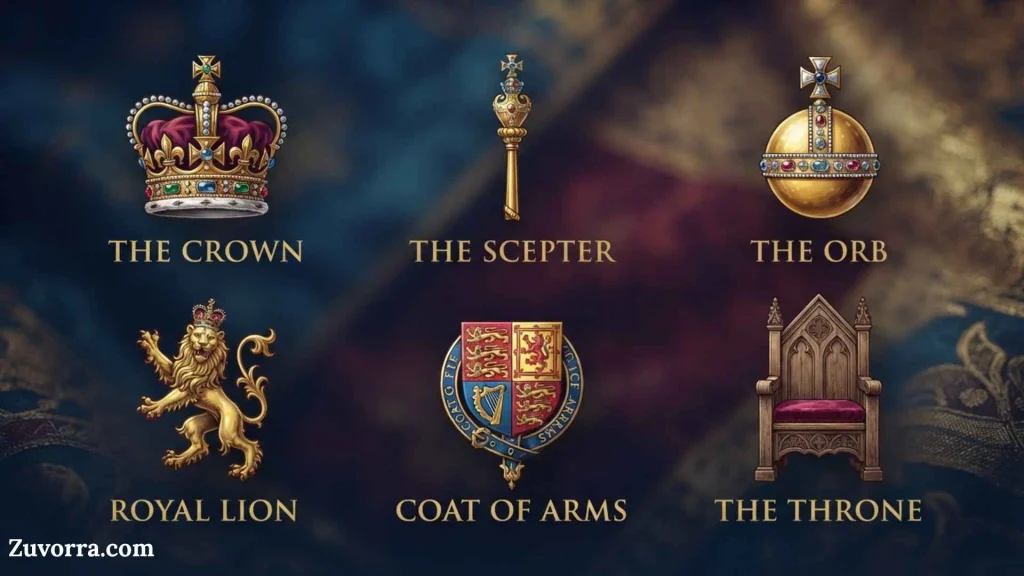
Monarchy symbols make an abstract institution visible. A monarchy is not represented only by the individual ruler. It also includes laws of succession, ceremonies, national traditions, royal duties, and the idea that the state continues even when one sovereign dies and another succeeds.
For this reason, royal symbols often carry several meanings at once:
- Authority: The ruler has recognized power to govern or perform constitutional duties.
- Legitimacy: The monarch’s position follows accepted law, inheritance, election, conquest, or sacred tradition.
- Continuity: The royal office survives beyond the life of one individual.
- Protection: The sovereign is expected to defend the territory and its people.
- Justice: Royal power should uphold law rather than depend only on personal will.
- Unity: The monarch may serve as a shared figure above regions, parties, or social groups.
- Sacred duty: In some traditions, rulers receive religious blessing or hold a ceremonial relationship with the divine.
- Dynastic identity: Heraldic animals, colors, flowers, and monograms distinguish one royal house from another.
A symbol’s meaning also depends on context. A crown above a shield may indicate royal jurisdiction. A crown in advertising may simply suggest luxury, quality, or superiority. A throne in a religious painting may represent divine authority rather than a human monarchy.
History and Origin of Royal Symbols
Monarchy symbols did not emerge from one civilization. Different societies created visible signs of leadership long before the modern words king, queen, and monarchy developed.
Ancient Kingship and Sacred Authority
Early rulers needed ways to appear different from priests, warriors, officials, and ordinary citizens. Distinctive clothing, elevated seats, staffs, headdresses, parasols, weapons, and sacred animals helped establish that difference.
In ancient Egypt, royal imagery connected the pharaoh with political unity and cosmic order. The red crown represented Lower Egypt, while the white crown represented Upper Egypt. Their combined form expressed rule over the united kingdom. Egyptian rulers and the god Osiris were also shown with the crook and flail, insignia associated with kingship.
The crook resembled a shepherd’s staff and could suggest guidance or guardianship. The exact ancient meaning of the flail remains debated, so it should not be reduced to one modern interpretation. Together, however, the objects clearly identified royal or divine authority in Egyptian art.
Ancient Mesopotamian rulers used horned headwear, rings, rods, maces, thrones, and ceremonial clothing. A British Museum description of Assyrian royal imagery identifies the mace as a sign of authority and the ring as a symbol of god-given kingship.
Diadems, Wreaths, and Imperial Crowns
A diadem was originally a band worn around the head. It became strongly associated with Hellenistic and Persian kingship. Unlike many later jeweled crowns, early diadems could be relatively simple. Their importance came from who wore them and what office they represented.
Greek and Roman societies also used wreaths. Laurel wreaths honored victory and achievement, while radiate crowns associated rulers with the sun. Roman emperors placed their portraits and royal headwear on coins, allowing imperial symbolism to circulate across vast territories.
Later European crowns developed from several traditions, including diadems, helmets, circlets, Christian crosses, jeweled headwear, and ceremonial coronation practices. Their arches, crosses, fleurs-de-lis, gemstones, and shapes varied according to period and rank.
Medieval Heraldry and Coronation Regalia
During the Middle Ages, heraldry created a structured visual language for rulers, nobles, territories, military forces, and institutions. Shields, crests, supporters, crowns, mottos, and badges helped identify royal families and political claims.
Coronation ceremonies strengthened this symbolic system. A monarch might receive a crown, sword, ring, scepter, orb, robes, and other regalia. Each object represented a particular aspect of rule. The ceremony turned political succession into a public ritual involving law, religion, nobility, and national tradition.
In the United Kingdom, the Sovereign’s Orb represents royal power and the Christian world. It is divided by jeweled bands into three sections, traditionally associated with the continents known in medieval Europe.
Monarchy Symbols in Constitutional Government
As monarchies became constitutional, royal symbols did not necessarily disappear. Their meanings often shifted.
A crown could stop representing the monarch’s personal right to command and instead represent the legal institution of the state. Terms such as the Crown may refer to public authority, government functions, state property, or prosecution conducted in the sovereign’s name.
The parliamentary mace demonstrates this evolution. The UK Parliament describes it as a symbol of royal authority, but it also represents the lawful authority of Parliament. The House of Commons cannot formally meet or pass laws without it in place.
Symbolism and Interpretation
Traditional Meaning
Traditionally, royal symbols communicate rank, command, inherited status, and lawful succession. They separate the monarch from other officials and make the transfer of authority visible during accession, coronation, enthronement, or investiture.
The crown identifies the sovereign. The throne identifies the office. The scepter represents active authority. The seal authenticates decisions. The sword demonstrates the ability and duty to enforce justice.
Modern Meaning
In modern constitutional monarchies, symbolism often emphasizes service, stability, cultural heritage, and national continuity rather than unrestricted personal rule.
Royal images may appear on:
- Currency and postage stamps
- Government departments
- Passports and official seals
- Courtrooms and legal documents
- Armed forces badges
- Police insignia
- Public buildings
- Honors and decorations
In these settings, the symbol commonly represents state authority exercised through laws and institutions.
Positive Symbolism
Supporters of monarchy may interpret royal emblems as signs of:
- Stability
- Duty
- National memory
- Public service
- Political continuity
- Shared heritage
- Ceremonial unity
- Protection of constitutional order
A crown displayed during a national ceremony may create a sense of connection between the present and earlier generations.
Negative Symbolism
Monarchy symbols can also represent:
- Unequal inherited privilege
- Colonial rule
- Imperial expansion
- Concentrated authority
- Social hierarchy
- Political exclusion
- Conquest or occupation
The same emblem may inspire loyalty in one community and resentment in another. Historical experience determines much of that response. A crown on a colonial-era building, for example, may symbolize legal heritage to some viewers and foreign domination to others.
Psychological Interpretation
Royal symbols rely on visual signals that people quickly associate with power. Height, symmetry, precious materials, rarity, controlled access, and ritual movement all increase an object’s perceived importance.
A throne elevates the ruler physically. A jeweled crown reflects light and draws attention to the head. A long robe enlarges the wearer’s visual presence. Processions control distance and movement. These design choices turn social authority into a sensory experience.
Cultural Significance Across the World
European Monarchies
European royal symbolism commonly includes crowns, scepters, orbs, swords, coats of arms, mantles, lions, eagles, crosses, and fleurs-de-lis.
Christian symbolism became especially important in medieval coronations. The cross above a crown or orb expressed the belief that earthly authority existed beneath divine authority. However, not all European monarchies used identical ceremonies, and some rulers were never formally crowned.
Ancient Egypt
Egyptian royal identity relied on multiple crowns, the uraeus cobra, the crook and flail, royal cartouches, false beards, thrones, and associations with deities such as Horus and Osiris.
The uraeus, usually shown as an upright cobra on the forehead, served as a protective royal emblem. The double crown represented the unity of Upper and Lower Egypt. These were not merely decorations; they expressed the pharaoh’s role within the religious and political order.
East Asia
East Asian monarchies developed distinct systems rather than copying European crowns. Chinese imperial symbols included the dragon, imperial yellow, jade seals, ceremonial robes, throne halls, and regulated patterns.
The five-clawed dragon became closely associated with the Chinese emperor during several dynastic periods, although rules changed over time. The imperial seal represented legal authenticity, while court dress communicated exact rank.
Japanese imperial symbolism includes the Chrysanthemum Throne, the chrysanthemum crest, and the Imperial Regalia: the mirror, sword, and jewel. These objects connect imperial identity with Shinto tradition and narratives recorded in early Japanese texts.
Korean kingdoms used royal seals, ceremonial robes, dragons, phoenixes, and elaborate crowns. Gold crowns from the Silla kingdom demonstrate how trees, antler-like forms, beads, and metalwork could communicate sacred and royal status. Interpretations of their shapes remain subjects of scholarly discussion.
African Kingdoms
African monarchies have used crowns, beaded veils, stools, umbrellas, fly whisks, staffs, swords, drums, leopard imagery, and sacred textiles.
Among the Asante, the Golden Stool represents the unity and spiritual identity of the nation. It is more than a royal chair and is not treated as ordinary furniture. Other African traditions place authority in regalia worn, carried, sounded, or displayed by officials around the ruler.
These examples show why “crown” should not be treated as the only universal sign of monarchy.
Islamic Monarchies
Islamic royal traditions have included thrones, parasols, swords, seals, banners, calligraphy, robes of honor, standards, and dynastic emblems.
Because Islamic artistic traditions often avoid sacred claims based on images of rulers, inscriptions and calligraphy can carry special importance. Titles, Quranic phrases, dynastic names, and declarations of sovereignty have appeared on coins, architecture, textiles, and seals.
The crescent is sometimes linked with Muslim monarchies, particularly the Ottoman Empire, but it is not a universal symbol of Islam or monarchy.
Religious and Spiritual Meaning
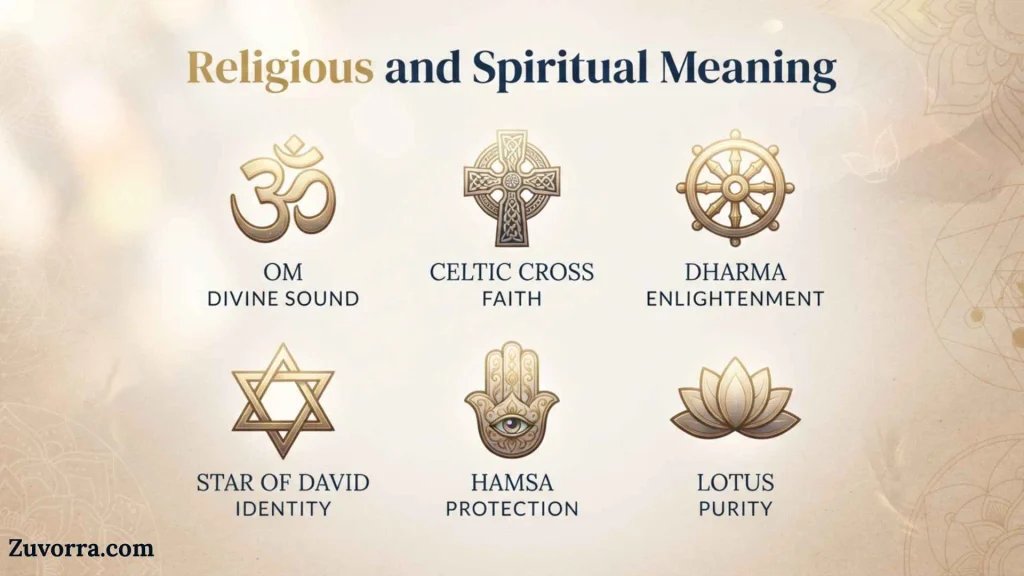
Royal power and religion have often supported one another, but their relationship differs greatly by culture.
In ancient societies, rulers could be treated as gods, descendants of gods, sacred mediators, or guardians of cosmic order. Egyptian kingship linked the pharaoh with divine forces and the maintenance of maat, the principle of truth, balance, and order.
In Christian coronations, anointing with holy oil compares the monarch’s consecration with biblical traditions of anointed rulers. The crown, orb, cross, ring, and ceremonial robes can therefore express both political office and religious duty.
The orb topped with a cross symbolizes the earthly world under Christian authority. The scepter may represent temporal governance, while a dove-topped rod can symbolize spiritual qualities or mercy.
Religious symbolism should not be interpreted as proof that every monarch claimed unlimited divine power. Constitutional law, local custom, religious institutions, and political opposition often restricted rulers even when sacred language surrounded the throne.
Technical, Legal, and Digital Meaning
Monarchy symbols have no fixed mathematical or scientific meaning, but they do have specialized legal, heraldic, and digital uses.
Heraldic Meaning
In heraldry, the exact shape of a crown or coronet can indicate rank, office, or jurisdiction. A royal crown differs from a ducal or princely coronet. The number and form of arches, leaves, crosses, pearls, and fleurs-de-lis may follow local conventions.
Heraldic authorities regulate some royal emblems. In England, Wales, and Northern Ireland, grants of arms are issued under authority delegated by the Crown.
Legal Meaning
The Crown can function as a legal concept separate from the monarch as a private person. Depending on the jurisdiction, it may refer to the state, executive authority, public property, or criminal prosecution.
This does not mean that every use of a crown symbol grants legal authority. Protected emblems may be governed by trademark, heraldic, military, or governmental rules.
Digital Meaning
The crown emoji, 👑, commonly means royalty, success, confidence, leadership, luxury, or admiration. Online users may call someone a “king” or “queen” without referring to an actual monarch.
A crown icon may also indicate:
- Premium membership
- Top ranking
- Game leadership
- Verified status
- Ownership of a group
- A winning player
- Exclusive access
Digital use has weakened the crown’s strictly political meaning while preserving its association with status.
Where Monarchy Symbols Are Used
Royal symbols appear wherever governments, dynasties, institutions, or brands want to communicate authority and prestige.
Coronations and State Ceremonies
Crowns, scepters, orbs, swords, rings, robes, and thrones play formal roles in coronations, enthronements, openings of parliament, royal weddings, funerals, and investitures.
National Flags and Coats of Arms
Some national and regional flags display crowns, royal animals, dynastic colors, or coats of arms. Even former monarchies may retain historic royal imagery after becoming republics.
Coins and Banknotes
Coins have long carried rulers’ portraits, titles, crowns, and dynastic emblems. Currency spreads the sovereign’s image across the territory and confirms the state’s authority to issue money.
Architecture
Royal palaces, courts, gates, bridges, monuments, and government offices may display crowns, initials, lions, eagles, or coats of arms. These marks can identify who built the structure or under which reign it was completed.
Military and Civic Insignia
Crowns often appear on military ranks, police badges, medals, regimental colors, municipal seals, and parliamentary maces. Their presence usually indicates lawful public authority rather than personal ownership by the monarch.
Art, Literature, and Entertainment
Artists use thrones, crowns, and royal robes to identify rulers instantly. In literature, a broken crown can symbolize fallen authority, while an empty throne may represent disputed succession, absence, or political instability.
Jewelry, Tattoos, and Logos
Crown jewelry and tattoos may express confidence, independence, loyalty, ambition, or remembrance. Commercial logos use crowns to suggest premium quality, heritage, or market leadership.
Common Variations of Monarchy Symbols
Open and Closed Crowns
An open crown has no arches over the top. A closed or arched crown includes one or more arches. In European history, closed crowns often communicated sovereign or imperial status, though conventions varied.
Crowns and Coronets
A crown usually belongs to a sovereign or represents the state. A coronet generally indicates a lower noble or princely rank. The difference depends on the heraldic system.
Scepters and Staffs
Some scepters are short and richly jeweled. Others resemble long staffs. A hand, cross, bird, flower, or other emblem may appear at the top.
Royal and Imperial Eagles
A single-headed eagle may represent royal power, courage, or national sovereignty. A double-headed eagle often suggests authority extending in two directions, imperial heritage, or the union of different realms. Its meaning changes among Byzantine, Holy Roman, Russian, Balkan, and other traditions.
Royal Lions
Lions may appear standing, walking, facing the viewer, crowned, or paired as supporters. Heraldry uses precise terms for these positions, and small design differences can identify separate kingdoms or dynasties.
Personal Royal Cyphers
A royal cypher combines a monarch’s initials with a crown or other emblem. It may include the letter R, derived from the Latin rex for king or regina for queen.
In 2022, the College of Arms explained that the cypher of King Charles III uses a stylized form often called the Tudor Crown.
Common Misconceptions About Royal Symbols
“Every Monarch Wears a Crown”
Many monarchs rarely or never wear crowns. Some monarchies use enthronement, proclamation, investiture, or religious ceremonies without a Western-style coronation.
“A Crown Always Means a King”
Crowns can represent queens, emperors, empresses, princes, saints, cities, institutions, military units, or abstract sovereignty. Context determines the meaning.
“The Orb Means the Monarch Owns the World”
The orb is symbolic, not a literal claim of global ownership. In Christian European regalia, it represents earthly sovereignty placed beneath the cross and divine order.
“Royal Symbols Have One Universal Meaning”
The crown is important in Europe, but other cultures have centered royal symbolism on seals, stools, umbrellas, swords, drums, parasols, dragons, sacred animals, or ceremonial clothing.
“All Double-Headed Eagles Mean the Same Empire”
Several states and dynasties adopted double-headed eagles for different political and religious reasons. Similar appearance does not prove identical meaning or direct institutional continuity.
“A Crown Emoji Represents Political Monarchy”
In online communication, usually expresses praise, confidence, luxury, leadership, or top status. It seldom refers to constitutional authority unless the conversation concerns royalty.
Interesting Facts About Monarchy Symbols
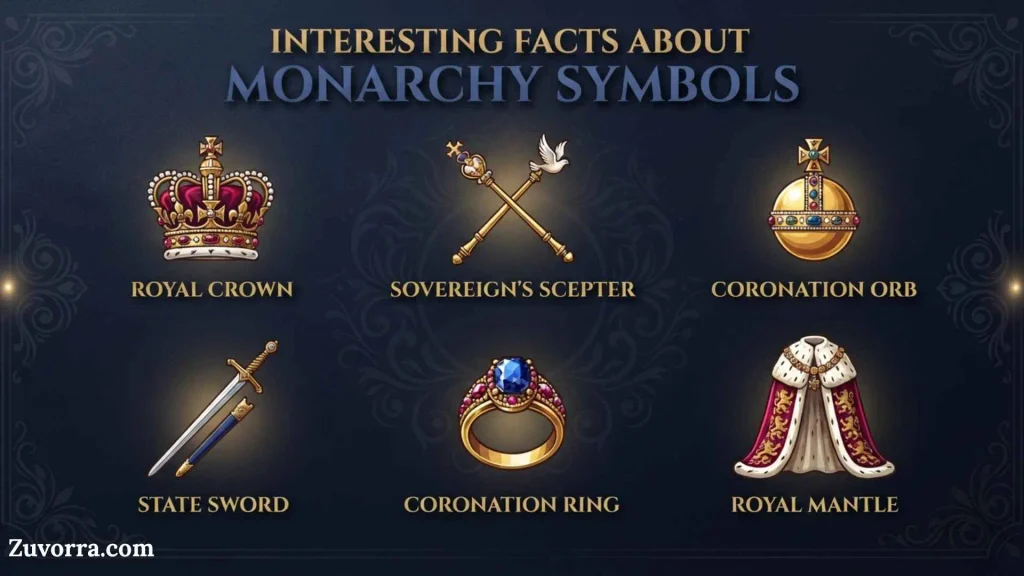
- An empty throne can be as meaningful as an occupied one. It may represent the continuing office of kingship, a deceased ruler, an absent sovereign, or divine authority.
- Royal regalia often belongs to the institution, not the individual. A monarch may use a crown ceremonially without treating it as private jewelry.
- The mace began as a weapon. Over time, it developed into a ceremonial emblem of lawful authority in royal courts, parliaments, universities, and municipalities.
- Heraldic crowns act like visual titles. Their arches, pearls, leaves, and crosses can identify different ranks within a particular heraldic tradition.
- Royal seals once mattered more than signatures. A seal authenticated commands, grants, treaties, and appointments when many documents were handwritten by officials rather than rulers.
- Animals communicate political qualities. Lions suggest courage and strength, while eagles imply command, elevation, vigilance, or imperial reach.
- Royal colors are culturally specific. Purple gained royal associations in parts of Europe and the Mediterranean, while yellow became closely connected with Chinese imperial rule.
- Breaking regalia can be a political act. Revolutionaries may destroy crowns, statues, seals, or royal arms to show that the old order has ended.
- Former monarchies often preserve royal imagery. Crowns and heraldic animals may survive in city arms, military insignia, architecture, or popular culture after a republic is established.
- Not every crown was designed for regular wear. Some are too heavy, fragile, sacred, or ceremonial for ordinary use and appear only during major state occasions.
- The throne may name the whole monarchy. Expressions such as “the British throne” or “the Chrysanthemum Throne” refer to succession and sovereign office, not only to a physical chair.
- Modern brands borrow royal symbolism selectively. They usually keep associations with prestige and leadership while removing the symbol’s legal, hereditary, or religious meaning.
Related Symbols and How They Differ
| Related Symbol | Connection to Monarchy | Main Difference |
| Tiara | Royal or aristocratic head ornament | Usually jewelry rather than a symbol of sovereign office |
| Laurel wreath | Victory and honor | Linked more closely with achievement than inherited rule |
| Halo | Sacred or holy status | Represents sanctity, not political sovereignty |
| Presidential seal | State and executive authority | Represents an elected republican office |
| Papal tiara | Historic symbol of papal authority | Connected with the papacy rather than hereditary monarchy |
| Mitre | Religious office | Worn by bishops and other clergy |
| Laurel crown | Triumph and merit | Typically earned rather than inherited |
| Imperial standard | Personal flag of a sovereign | A textile emblem rather than wearable regalia |
| Fasces | Magisterial authority and unity | Roman civic symbol, not exclusively royal |
| State emblem | National identity | May exist under a monarchy or republic |
Frequently Asked Questions
What is the main symbol of monarchy?
The crown is the most widely recognized symbol of monarchy because it identifies sovereign rank and appears in coronations, coats of arms, coins, flags, and official insignia. However, it is not universal. Some royal traditions place greater importance on thrones, seals, swords, staffs, stools, umbrellas, robes, or sacred animals.
What does a crown symbolize in a monarchy?
A crown usually symbolizes sovereignty, legitimacy, continuity, and royal dignity. Its elevated position on the head emphasizes rank, while precious materials suggest rarity and importance. In religious coronations, crosses or sacred imagery may also express the ruler’s duty to govern under divine or moral law.
What do the scepter and orb represent?
The scepter represents governing authority, justice, and the monarch’s power to direct the state. The orb represents earthly sovereignty. In Christian European tradition, the cross above the globe shows the world beneath divine authority. Their precise meanings depend on the ceremony and the regalia being used.
Why is a throne a symbol of power?
A throne physically elevates and separates the ruler from others. It marks the formal place from which royal authority is displayed. Over time, “the throne” became a metaphor for the monarchy itself, including succession, government, dynastic claims, and the continuing office of the sovereign.
Why do monarchies use lions?
Lions symbolize courage, strength, vigilance, and dominance. Their reputation as powerful animals made them suitable emblems for kings and royal houses. In heraldry, a lion’s pose, direction, color, crown, and number can distinguish one dynasty, territory, or political tradition from another.
Is the eagle always an imperial symbol?
No. Eagles often represent imperial power because of their height, strength, and wide vision, but they can also symbolize national independence, military courage, divine favor, or republican authority. The United States, for example, uses an eagle without being a monarchy. Historical context is essential.
What is the difference between a crown and a coronet?
A crown normally represents a sovereign, kingdom, or state. A coronet usually indicates a prince, duke, count, or another noble rank below the monarch. Exact designs differ by country, and casual speech often uses crown for both. Heraldry treats the distinction more carefully.
Are monarchy symbols religious?
Some are, but not all. Crosses, anointing oil, sacred robes, and ceremonial prayers may give royal symbols a religious dimension. Seals, swords, flags, and coats of arms may be mainly political or legal. Many objects combine sacred, dynastic, constitutional, and cultural meanings.
What does the crown emoji mean?
The crown emoji, commonly means excellence, confidence, leadership, luxury, victory, or admiration. People use it when calling someone a “king” or “queen,” celebrating success, or marking premium status. It represents actual monarchy only when used in a royal, historical, or political context.
Can monarchy symbols be used in tattoos and logos?
Yes, but their meaning changes outside official settings. A crown tattoo may express self-respect, ambition, loyalty, remembrance, or control over one’s life. A logo may use a crown to suggest luxury or quality. Designers should avoid copying protected state emblems or implying official royal approval.
Key Takeaways
- Monarchy symbols make royal authority and succession visible.
- The crown represents sovereignty, but it is not the only royal emblem.
- Thrones symbolize the office of rule as well as the physical seat.
- Scepters represent command, while orbs express earthly sovereignty.
- Swords communicate justice, defense, and lawful force.
- Coats of arms identify royal houses, territories, and political claims.
- Royal seals and cyphers authenticate authority and identify a particular reign.
- Meanings differ across European, African, Asian, Middle Eastern, and ancient traditions.
- Sacred symbolism does not always imply unlimited political power.
- Modern constitutional monarchies often use royal emblems to represent the state rather than personal rule.
- Crowns in tattoos, emojis, games, and logos usually mean status or excellence.
- Historical context determines whether a royal symbol inspires pride, neutrality, or criticism.
Conclusion
Monarchy symbols are a visual language of sovereignty, duty, legitimacy, and historical memory. Crowns, thrones, scepters, orbs, swords, maces, seals, animals, and coats of arms each reveal a different part of how societies understand royal power.
Their meanings have never remained completely fixed. An object that once expressed a ruler’s personal command may now represent constitutional government, ceremonial service, or cultural heritage. In other settings, the same image may recall inequality, empire, or colonial authority.
Understanding monarchy symbols therefore requires more than identifying a crown or throne. It requires examining who used the symbol, where it appeared, what political system supported it, and how later generations interpreted it. That context transforms royal imagery from decoration into a record of law, belief, identity, and power.
References
- The Metropolitan Museum of Art. “Kings and Queens of Egypt.”
- The Metropolitan Museum of Art. “Figure of Osiris.”
- The British Museum. Collection records and educational materials on ancient royal diadems, Assyrian kingship, and imperial coinage.
- The Royal Household. “The Coronation Regalia.”
- UK Parliament. “The Mace” and “Serjeant at Arms.”
- College of Arms. “Royal Cypher,” “Granting of Arms,” and official heraldic resources.

I’m Jasper Huxley, a British writer fascinated by the symbols that communicate ideas without words. I explore their meanings, origins, cultural connections, and everyday uses. From ancient markings to contemporary signs, I enjoy uncovering the stories behind visual language and presenting symbolism in a clear, engaging way for curious readers worldwide.
Books:
- The Hidden Language of Symbols
- Symbols, Signs and Their Meanings