Positivity symbols are visual signs associated with hope, happiness, growth, peace, encouragement, and emotional strength. You may see them in jewelry, tattoos, artwork, spiritual spaces, greeting cards, logos, clothing, architecture, social media, and everyday messages.
No single image represents positivity in every culture. A rising sun may suggest a fresh start, while a lotus can represent growth through hardship. A rainbow often signals hope after difficulty, and a smile communicates friendliness or joy. Understanding these differences helps you choose a symbol that matches the message you truly want to express.
Quick Meaning
Positivity symbols represent hopeful thoughts, favorable outcomes, happiness, renewal, peace, resilience, love, or personal growth. Common examples include the sun, rainbow, lotus flower, smiley face, heart, four-leaf clover, upward arrow, butterfly, tree of life, and peace sign. Their exact meanings depend on culture, religion, history, and context.
Positivity Symbols Overview Table
Because positivity is an idea rather than one fixed emblem, it is represented by many different signs.
| Symbol | Primary Meaning | Historical or Cultural Connection | Common Modern Use | Emoji or Unicode Form |
| Sun | Life, warmth, optimism | Solar traditions worldwide | Art, wellness, logos | U+2600 |
| Sunrise | New beginnings | Daily cycle of renewal | Motivational designs | U+1F305 |
| Rainbow | Hope after hardship | Religion, folklore, nature | Pride, hope, inclusion | U+1F308 |
| Lotus | Growth through difficulty | Hinduism, Buddhism, ancient Egypt | Meditation, tattoos, jewelry | 🪷 U+1FAB7 |
| Smiley face | Happiness, friendliness | Modern graphic culture | Messages, branding, clothing | ☺ U+263A |
| Heart | Love and compassion | Religious and artistic traditions | Messages, health, relationships | U+2665 |
| Four-leaf clover | Good luck | European and Irish folklore | Charms, cards, jewelry | U+1F340 |
| Butterfly | Transformation | Global folklore and art | Memorials, tattoos, personal growth | U+1F98B |
| Dove | Peace and hope | Biblical, Jewish, Christian, and secular use | Ceremonies, memorials, logos | 🕊 U+1F54A |
| Peace sign | Peace and nonviolence | British nuclear disarmament movement | Activism, fashion, music | ☮ U+262E |
| Tree of life | Growth and connection | Many religious and mythic traditions | Jewelry, family art, spirituality | No single standard emoji |
| Upward arrow | Improvement and progress | Mathematical and directional notation | Business, fitness, technology | ↑ U+2191 |
| Infinity sign | Endless possibility | Mathematics and modern symbolism | Jewelry, relationships, tattoos | ∞ U+221E |
| Star | Guidance and achievement | Religion, navigation, heraldry | Awards, ratings, inspiration | U+2605 |
| Seedling | Growth and potential | Agriculture and natural cycles | Sustainability, education, wellness | U+1F331 |
What Do Positivity Symbols Mean?
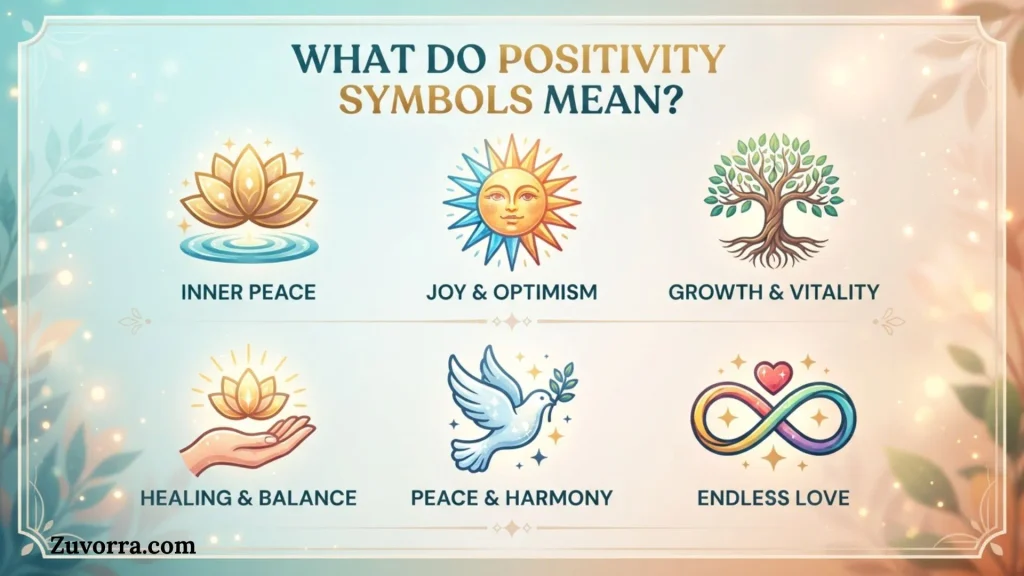
Positivity symbols communicate the belief that life can improve, challenges can be overcome, and meaningful possibilities remain ahead. They turn abstract qualities such as optimism, courage, gratitude, and inner peace into recognizable images.
Different symbols emphasize different forms of positivity:
- Hope symbols point toward a better future.
- Happiness symbols express joy, friendliness, or celebration.
- Growth symbols represent learning, healing, and transformation.
- Peace symbols communicate harmony and nonviolence.
- Luck symbols express the wish for favorable events.
- Love symbols represent care, compassion, and human connection.
- Strength symbols remind people to remain steady during hardship.
The meaning also depends on how a symbol is used. A butterfly on a graduation card may represent a new stage of life. The same butterfly on a memorial may symbolize the soul, remembrance, or peaceful transition. Context changes interpretation.
History and Origin of Positive Symbolism
Positive symbolism is almost as old as visual communication itself. Early societies used the natural world to express ideas about safety, abundance, fertility, protection, and renewal. The sun supported crops, fire provided warmth, trees produced food, and water sustained life. These useful forces naturally became signs of blessing and well-being.
Ancient civilizations also created symbolic systems around gods, celestial bodies, plants, animals, colors, numbers, and geometric forms. Egyptian art connected the rising sun with rebirth. Greek and Roman traditions used laurel wreaths to honor achievement. Asian religious art developed rich meanings around the lotus, wheel, bamboo, crane, and other images.
Religious traditions later shaped many symbols that remain familiar today. The rainbow became a sign of covenant in the Hebrew Bible. The dove gained associations with peace and the Holy Spirit in Christianity. Light often represented divine truth, knowledge, purity, or guidance in Judaism, Christianity, Islam, Hinduism, Buddhism, and other traditions.
Modern society created new positive signs as well. The familiar yellow smiley face became widely recognized after commercial artist Harvey Ball designed a version in 1963 for a workplace morale campaign. It later moved through advertising, popular culture, fashion, music, and digital communication.
Digital technology expanded positive symbolism further. Unicode now standardizes many smiling faces, hearts, plants, gestures, stars, rainbows, and celebratory signs so they can be used across devices and platforms.
25 Popular Positivity Symbols and Their Meanings
1. Sun
The sun represents life, warmth, vitality, clarity, and optimism. Its daily return after darkness makes it a natural image of hope.
In art and wellness branding, sunlight often suggests energy, confidence, health, and emotional openness. A bright sun can also symbolize truth because light reveals what darkness hides.
2. Sunrise
A sunrise is one of the clearest symbols of a fresh start. It marks the end of night and the beginning of another day.
People often choose sunrise imagery after recovery, grief, career changes, or personal transformation. Its message is simple: the past has ended, but another opportunity has begun.
3. Rainbow
A rainbow symbolizes hope, beauty, promise, diversity, and relief after hardship. Because it appears when sunlight passes through water droplets, it visually joins rain and light.
In the biblical flood narrative, the rainbow represents a covenant. In modern society, it is also strongly associated with LGBTQ+ pride and diversity. Therefore, its meaning may be spiritual, meteorological, social, or personal depending on context.
4. Lotus Flower
The lotus symbolizes purity, awakening, resilience, and spiritual growth. It grows from muddy water but produces a clean, striking flower, making it a powerful image of rising above difficult conditions.
The lotus holds major importance in Hindu and Buddhist traditions. It appears with deities, enlightened figures, meditation imagery, sacred architecture, and philosophical teachings. Its meanings vary among traditions, so it should not be reduced to a generic “good vibes” design.
5. Smiley Face
The smiley face stands for happiness, friendliness, approval, humor, and emotional warmth. Its simple eyes and curved mouth can communicate a positive mood without words.
Today, smiley designs can also be playful, nostalgic, sarcastic, or ironic. Harvey Ball’s 1963 design became especially influential, but smiling faces existed in art and informal markings before his commercial version.
6. Heart
The heart represents love, compassion, kindness, affection, and emotional connection. It can refer to romantic love, family bonds, friendship, charity, courage, or care for humanity.
A heart’s color may adjust its meaning. Red usually suggests passionate love, pink tenderness, green healing or nature, and white peace or purity. These color meanings are conventions rather than universal rules.
7. Four-Leaf Clover
The four-leaf clover is a symbol of good luck and rare opportunity. Most clovers have three leaflets, so finding a four-leaf form is unusual.
It is often linked with Ireland, although the three-leaf shamrock has the deeper traditional connection to Irish identity and Saint Patrick. The four-leaf clover is mainly a broader luck charm.
8. Butterfly
A butterfly represents transformation, freedom, beauty, renewal, and personal growth. Its life cycle from caterpillar to chrysalis to winged adult makes it an effective symbol of change.
Butterflies are also used in memorial art. In that setting, they may represent the soul, a continuing bond, peaceful transition, or the lasting influence of someone who has died.
9. Dove
The dove symbolizes peace, reconciliation, innocence, gentleness, and hope. A dove carrying an olive branch is especially connected with the biblical account of Noah, in which the returning bird signals that floodwaters are receding.
Doves now appear in religious artwork, peace campaigns, funerals, weddings, and international organizations. A white dove is symbolic, but actual doves occur in several colors.
10. Peace Sign
The circular peace sign represents nuclear disarmament, peace, and nonviolent activism. British designer Gerald Holtom created it in 1958 for the Campaign for Nuclear Disarmament.
Its lines combine semaphore positions for the letters N and D, standing for “nuclear disarmament.” It later became a broader emblem of antiwar movements, youth culture, music, and peaceful resistance.
11. Victory Hand
The raised index and middle fingers can symbolize victory, peace, goodwill, or friendly confidence. The surrounding culture and hand orientation matter.
In many places, the palm-out gesture communicates peace or victory. In parts of the United Kingdom and other regions, reversing the hand can be insulting. This is a strong example of why gesture symbols need cultural context.
12. Thumbs-Up
A thumbs-up often means approval, agreement, success, or encouragement. It appears in conversations, workplaces, rating systems, and social media.
However, gestures do not carry identical meanings everywhere. In some settings, a thumbs-up can appear dismissive, overly casual, or offensive. Use it carefully in formal and cross-cultural communication.
13. Tree of Life
The tree of life represents growth, rootedness, family, wisdom, interconnection, and the cycle of existence. Its roots suggest ancestry and stability, while its branches point toward development and possibility.
Versions of a sacred or cosmic tree appear in Mesopotamian imagery, Norse mythology, Jewish mysticism, Christianity, Islam, Hindu traditions, and many other cultural systems. These traditions should be understood separately rather than treated as one identical symbol.
14. Upward Arrow
An upward arrow represents progress, ambition, improvement, direction, and rising performance. It is especially common in business reports, fitness programs, education, technology, and personal development.
Its message comes from physical orientation. “Up” is often associated with increase, success, higher status, or emotional improvement, while “down” may suggest decline.
15. Infinity Symbol
The infinity sign represents endlessness, unlimited possibility, lasting love, and continuity. In mathematics, it indicates a quantity or concept without a finite bound rather than an ordinary number.
In jewelry and tattoos, the sign often means eternal commitment or an unbreakable bond. This modern emotional meaning differs from its precise mathematical use.
16. Star
A star can symbolize guidance, hope, excellence, achievement, fame, or divine light. Stars historically helped travelers navigate, which supports their association with direction.
They also appear in flags, religious art, awards, military insignia, schoolwork, product ratings, and entertainment. Shape, color, point count, and setting may significantly change the meaning.
17. North Star
The North Star, or Polaris, represents dependable guidance and a stable sense of direction. Because it appears near the north celestial pole, it has long helped navigators identify north in the Northern Hemisphere.
Metaphorically, a “North Star” means a guiding purpose, principle, or long-term goal. Organizations sometimes use the phrase for the central measure that directs their decisions.
18. Seedling
A seedling symbolizes potential, patience, new life, education, and steady progress. Unlike a full-grown tree, it focuses on beginnings and the care required for development.
It is common in environmental campaigns, schools, wellness programs, sustainable businesses, and personal growth imagery. Its positive message is realistic: growth begins small and needs support.
19. Bamboo
Bamboo often represents resilience, flexibility, integrity, and long life in East Asian art and philosophy. Its ability to bend without easily breaking makes it an effective metaphor for strength through adaptability.
In Chinese artistic traditions, bamboo is also admired for its upright structure and evergreen quality. Interpretations vary across regions and schools of thought.
20. Dragonfly
The dragonfly is often associated with change, movement, adaptability, and self-realization. Its shimmering wings and ability to move rapidly across water contribute to its modern positive image.
Cultural meanings differ widely. Some traditions view dragonflies favorably, while others connect them with danger, mystery, or supernatural forces. It is not universally a symbol of joy.
21. Phoenix
The phoenix represents renewal, endurance, and rising after destruction. In later Western tradition, the legendary bird dies in fire and emerges again, making it a popular image of recovery.
The phoenix is often chosen after illness, loss, failure, addiction recovery, or major personal change. Similar rebirth birds appear in different traditions, but their stories are not always identical.
22. Laurel Wreath
The laurel wreath symbolizes victory, honor, achievement, and excellence. Ancient Greeks and Romans associated laurel crowns with athletic, poetic, military, and civic distinction.
The word “laureate,” as in poet laureate or Nobel laureate, reflects this heritage. Today, laurel branches commonly frame badges, academic seals, awards, and premium logos.
23. Open Hands
Open hands represent welcome, generosity, trust, honesty, and the willingness to give or receive help. They can also suggest prayer, surrender, cooperation, or protection.
In charity and health-care logos, open hands often communicate support. In religious art, their position may carry a more specific ritual or theological meaning.
24. Sparkles
Sparkles symbolize excitement, cleanliness, improvement, celebration, magic, or something newly refreshed. In digital messages, they may emphasize a positive statement or make ordinary words feel special.
They are also used around objects to show that something is polished, excellent, or transformed. Unicode includes several star-like and sparkling characters used in modern communication.
25. Anchor
An anchor symbolizes stability, hope, safety, and the ability to remain grounded. Sailors depend on anchors to hold vessels in place, creating a natural connection with security.
In Christian symbolism, the anchor has also represented hope and steadfast faith. In modern tattoos, it may honor maritime service, family stability, or a person who provides emotional support.
Symbolism and Interpretation
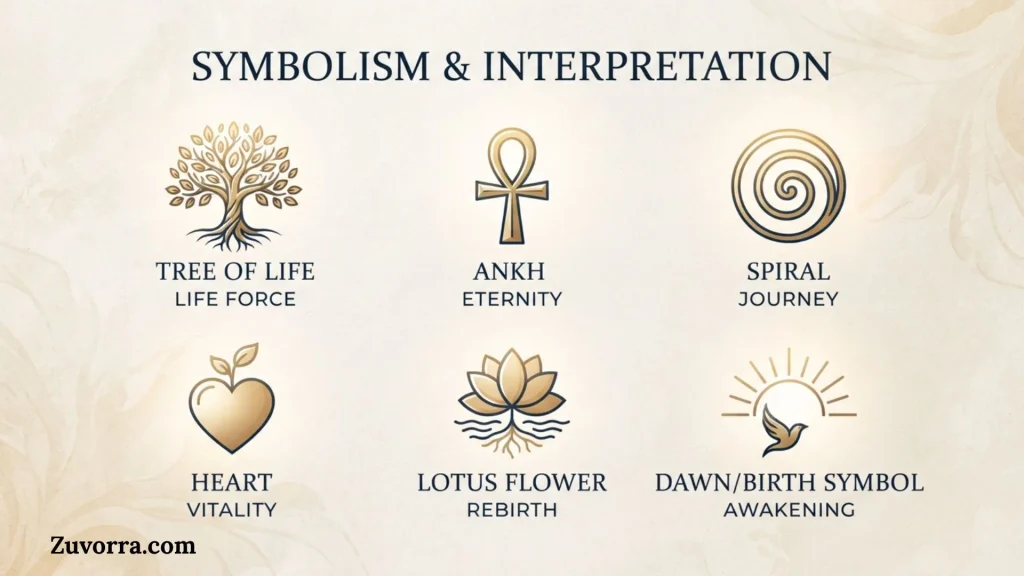
Traditional Meanings
Traditional positive symbols often arose from survival needs. Sunlight meant warmth. Rain supported crops. Trees offered food and shelter. Healthy plants suggested abundance. Calm birds represented safety because animals often react to environmental danger.
Victory symbols developed through public ceremony. Wreaths, crowns, raised hands, banners, and stars marked achievement or authority. Religious communities added ideas such as grace, salvation, enlightenment, blessing, and eternal life.
Modern Meanings
Modern positivity symbols are more personal and flexible. People combine old imagery with affirmations, dates, initials, colors, and minimalist designs.
A lotus tattoo may represent recovery rather than formal Buddhist practice. An upward arrow may mark career progress. A semicolon may express continuation after a mental health struggle. A sunrise may remember the moment someone chose to begin again.
Positive and Negative Interpretations
A symbol described as positive can still carry negative or complicated meanings.
| Symbol | Positive Reading | Possible Complication |
| Sun | Joy and vitality | Heat, drought, exposure |
| Rainbow | Hope and inclusion | Meaning may become politicized |
| Smiley face | Friendliness | Sarcasm or forced cheerfulness |
| Butterfly | Transformation | Fragility or impermanence |
| Fire | Energy and renewal | Destruction and danger |
| Crown | Achievement | Pride, hierarchy, or domination |
| Arrow | Progress | Aggression when shown as a weapon |
| White color | Peace or purity | Mourning in some cultures |
The most accurate interpretation comes from the symbol’s culture, setting, color, accompanying text, and intended audience.
Psychological Interpretation
Positive imagery can act as a mental cue. A symbol does not automatically change someone’s life, but it can remind that person of a chosen value or goal.
For example:
- A sunrise wallpaper may support a morning routine.
- A seedling necklace may remind someone to be patient.
- An anchor tattoo may reinforce emotional steadiness.
- A star on a classroom chart may reward progress.
- A heart in a message may soften the tone and express care.
The practical value lies in the association people build around the image.
Cultural Significance
Cultures often share broad themes, but they do not always assign the same meaning to a symbol.
Western Traditions
Common Western signs of positivity include the smiley face, heart, rainbow, sun, peace sign, four-leaf clover, horseshoe, star, laurel wreath, and thumbs-up. Many combine Christian, Greek, Roman, Celtic, commercial, and popular-cultural influences.
South Asian Traditions
The lotus, diya lamp, rangoli patterns, sacred syllables, elephants, peacocks, and auspicious geometric designs may represent light, prosperity, wisdom, beauty, welcome, or spiritual awakening.
These images can have specific Hindu, Buddhist, Jain, Sikh, regional, or household meanings. They should not be used as interchangeable “positive icons.”
East Asian Traditions
Bamboo, cranes, plum blossoms, koi, dragons, red decorations, and certain written characters may express longevity, perseverance, fortune, courage, or prosperity.
Meanings differ between Chinese, Japanese, Korean, Vietnamese, and other traditions. Even shared imagery can develop distinct regional interpretations.
Indigenous Traditions
Indigenous peoples have their own visual languages, ceremonial objects, colors, animals, and sacred designs. A motif that outsiders label “positive” may belong to a specific nation, clan, story, or ritual.
Respectful use requires identifying the community of origin and avoiding imitation of restricted or sacred designs.
Middle Eastern and Mediterranean Traditions
The hamsa hand, blue eye-shaped amulets, olive branches, pomegranates, and geometric patterns may represent protection, peace, abundance, blessing, or beauty.
The hamsa appears in Jewish, Muslim, Christian, and regional folk contexts, but its name and interpretation vary.
Religious and Spiritual Meaning
Positive symbolism often communicates a spiritual movement from darkness toward light, disorder toward harmony, or suffering toward renewal.
In Christianity, the cross can represent salvation and hope despite its origin as an instrument of execution. The dove may represent the Holy Spirit or peace, while the anchor can symbolize steadfast hope.
In Buddhism, the lotus represents purity and awakening, while the Dharma wheel is connected with the Buddha’s teaching and the path toward liberation.
In Hindu traditions, the lotus appears with divine beauty, purity, creation, prosperity, and spiritual consciousness. Lamps represent the victory of light over darkness and knowledge over ignorance.
In Judaism, light, the menorah, the Tree of Life, and the Hebrew word chai, meaning “life,” can carry positive religious significance.
In Islam, light is a powerful spiritual metaphor, while geometric and calligraphic art may express order, beauty, remembrance, and devotion. No single decorative form represents all Islamic belief.
Spiritual meanings should be presented with care. A sacred symbol is not merely decoration to the people who worship with it.
Scientific, Mathematical, and Digital Meanings
Some positive-looking symbols also have formal technical meanings.
Plus Sign
The plus sign indicates addition or a positive value in mathematics. In medicine, a cross-like mark may identify health services, although protected emblems such as the Red Cross have specific legal and humanitarian status.
Upward Arrow
In diagrams and interfaces, an upward arrow may mean increase, upload, move up, scroll upward, north, or a higher level. Its inspirational meaning of “progress” grows from these directional uses.
Infinity Sign
In mathematics, infinity expresses unboundedness. It does not simply mean “a very large number.” Its romantic meaning of everlasting love is a later symbolic adaptation.
Stars and Ratings
Stars are used to measure reviews, rank quality, save favorites, or identify important content. A five-star display often communicates excellence, but its exact value depends on the rating system.
Emoji
Unicode assigns code points and standardized names to characters, but each platform may draw an emoji differently. This means the same smiling face, heart, plant, or gesture can look slightly different across devices.
Where Positivity Symbols Are Used
Positive signs appear wherever people need to communicate encouragement quickly.
Jewelry and Tattoos
People wear symbols to express identity, remember a turning point, honor someone, or carry a private reminder. Common choices include butterflies, suns, stars, hearts, lotuses, anchors, arrows, and infinity signs.
Before choosing a permanent design, research its cultural and religious background.
Logos and Branding
Brands use rising suns, leaves, open hands, smiling faces, stars, and upward lines to suggest trust, health, progress, friendliness, or innovation.
The most effective logo matches the organization’s real values. A green leaf does not prove that a company is environmentally responsible.
Architecture and Interior Design
Sunbursts, trees, flowers, sacred geometry, stained-glass rainbows, and light-filled spaces can create a feeling of welcome or renewal. Hospitals and wellness centers often use nature imagery because it feels calm and familiar.
Books, Art, and Literature
Writers and artists use dawn, spring, birds, gardens, open doors, and journeys to show emotional recovery or opportunity. A symbol can develop throughout a story rather than having one fixed meaning.
Digital Communication
Hearts, smiles, raised hands, sparkles, clapping hands, seedlings, suns, and rainbows help users express support with little text. Tone remains important because an emoji can feel sincere, playful, passive-aggressive, or sarcastic.
Ceremonies and Gifts
Graduations use stars, laurel wreaths, open roads, and upward arrows. Weddings use rings, hearts, doves, flowers, and infinity signs. Recovery gifts often feature anchors, phoenixes, mountains, or sunrises.
Common Variations
Positive designs change through color, style, orientation, and accompanying elements.
Minimalist Designs
Simple line art makes symbols easy to recognize and suitable for tattoos, app icons, stationery, and jewelry.
Nature-Based Designs
Leaves, mountains, flowers, waves, birds, sunlight, and trees connect positive ideas with natural cycles.
Geometric Adaptations
Circles may suggest wholeness, triangles direction, spirals growth, and symmetrical patterns balance. These meanings are common interpretations, not universal laws.
Combined Symbols
Designers often combine symbols to create a more exact message:
- Lotus and moon: inner growth and reflection
- Anchor and heart: stable love
- Arrow and mountain: determined progress
- Sunrise and waves: renewal and emotional flow
- Butterfly and flowers: transformation and new life
- Tree and family names: ancestry and connection
Color Variations
Yellow often suggests cheerfulness, green growth, blue calm, pink tenderness, and gold achievement. Yet color meanings differ across religions, regions, industries, and personal experiences.
How to Choose the Right Positive Symbol
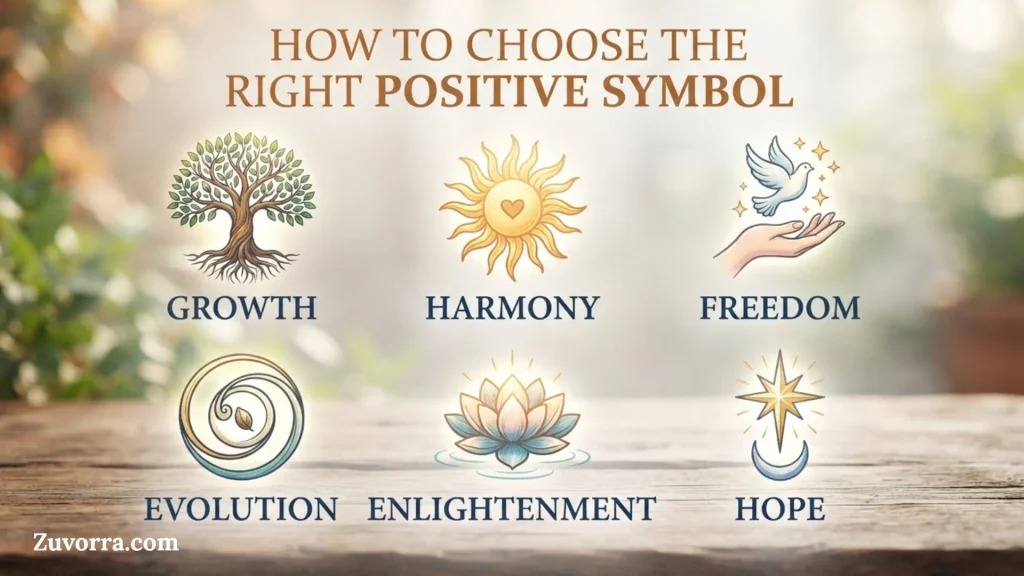
Use this simple decision guide:
What do you want the symbol to express?
↓
A fresh start
Choose a sunrise, seedling, open door, or phoenix.
↓
Emotional healing
Choose a lotus, butterfly, heart, anchor, or growing tree.
↓
Peace and harmony
Choose a dove, olive branch, peace sign, or calm water.
↓
Achievement and confidence
Choose a star, laurel wreath, crown, mountain, or upward arrow.
↓
Good luck
Choose a four-leaf clover, horseshoe, wishbone, or regional fortune symbol.
↓
Love and connection
Choose a heart, infinity sign, interlocking circles, or tree of life.
Before using the design publicly, ask three more questions:
- Does it have a sacred or restricted meaning?
- Could the gesture or color be misunderstood locally?
- Does the symbol match the message and audience?
Common Misconceptions
One Symbol Has One Universal Meaning
Symbols rarely have only one interpretation. Meaning depends on history, region, religion, design, and use.
Every Ancient Symbol Has a Proven Secret Meaning
Online lists often assign unsupported powers to ancient motifs. A historical object should be interpreted through archaeological evidence, texts, and cultural scholarship rather than modern speculation.
A Positive Symbol Guarantees Positive Results
A charm may provide comfort or motivation, but it cannot guarantee luck, healing, wealth, or success.
The Four-Leaf Clover and Shamrock Are the Same
They are related but not identical. A shamrock is traditionally a three-leaf plant associated with Ireland. A four-leaf clover is mainly a luck symbol.
Every Rainbow Has the Same Social Meaning
A rainbow may represent weather, biblical promise, childhood wonder, diversity, peace, or LGBTQ+ pride. Context identifies the intended message.
The Peace Sign Is an Ancient Rune
The familiar circular peace emblem was designed in 1958 for nuclear disarmament. Its structure was based on semaphore signals for the letters N and D, not on an ancient magical alphabet.
All Smiles Show Genuine Happiness
A smile can show warmth, politeness, nervousness, embarrassment, sarcasm, or social cooperation. Both facial expressions and smiley symbols depend on context.
Interesting Facts About Positivity Symbols
- The modern smiley began as a workplace morale design. Harvey Ball created his famous version for an insurance company campaign in 1963.
- The peace symbol contains coded letters. Its central lines combine the semaphore signals for N and D, meaning nuclear disarmament.
- The rainbow is both an ancient and modern sign. It can represent divine promise, natural beauty, inclusion, political movements, or hope after a storm.
- The lotus is positive because of where it grows. Its clean flower rises from muddy water, making the plant a visual lesson in transformation.
- An arrow’s meaning depends on direction. Up often means increase, right may mean forward, and a circular arrow can mean renewal or repetition.
- Not every “lucky” symbol is lucky everywhere. Numbers, colors, animals, and hand gestures may shift from favorable to unfavorable across cultures.
- A star can represent both guidance and ranking. The same basic form appears in navigation, religion, national identity, awards, and online reviews.
- Digital symbols are standardized, but their appearance is not identical. Unicode defines emoji characters and names, while platform designers create their own visual versions.
- Positive symbols often emerge from natural cycles. Dawn, spring, seeds, flowers, and butterflies all show visible change over time.
- Sacred symbols can become secular without losing their older meanings. The dove, lotus, rainbow, and tree of life now appear in everyday design while remaining religiously significant.
- Simple shapes carry emotional associations. Curves often feel softer and more welcoming, while rising lines can suggest motion and ambition. These are design tendencies, not fixed psychological rules.
- Personal meaning can coexist with historical meaning. Someone may choose an anchor because of family memories even though the symbol also has maritime and Christian associations.
Related Symbols
Olive Branch
The olive branch represents peace, reconciliation, and goodwill. It differs from the peace sign because its meaning comes from ancient Mediterranean and biblical traditions rather than modern political design.
Horseshoe
A horseshoe is a luck and protection charm in several European and Western folk traditions. Opinions differ on whether its ends should point upward or downward.
Wishbone
A wishbone represents hope and good fortune. Its meaning comes from the custom of two people pulling a bird’s furcula while making a wish.
Semicolon
The semicolon has become a sign of continuation, especially in mental health awareness. It suggests that a person’s story continues rather than ends.
Mountain
A mountain represents endurance, challenge, perspective, and achievement. Unlike an upward arrow, it highlights the difficulty of the journey as well as the goal.
Open Door
An open door represents opportunity, welcome, freedom, or transition. A closed door may instead suggest privacy, limits, or an ending.
Spiral
A spiral may represent growth, cycles, movement, or inward reflection. Its meaning varies widely among ancient art traditions and modern spiritual practices.
Circle
A circle commonly represents unity, wholeness, eternity, or inclusion because it has no visible beginning or end. Context remains essential, especially when circles form religious or ceremonial designs.
Frequently Asked Questions
What is the main symbol of positivity?
There is no universal main symbol of positivity. The sun is one of the broadest choices because it represents light, warmth, life, and hope. The smiley face is more direct in modern communication, while the lotus, rainbow, heart, and upward arrow express specific forms of positive thinking.
What symbol represents positive energy?
The sun, radiating lines, flame, spiral, and upward arrow can represent positive energy. A sun suggests warmth and vitality, while rising lines suggest movement and progress. In spiritual settings, “energy” may have a specific religious or metaphysical meaning, so the surrounding tradition should be identified.
Which symbol means hope?
Common hope symbols include the anchor, dove, rainbow, sunrise, star, seedling, and light. The anchor has a long Christian association with steadfast hope, while a sunrise offers a wider secular message of beginning again. The best option depends on whether the intended meaning is religious, personal, or universal.
What symbol represents happiness?
The smiley face is the most direct modern symbol of happiness. Sunshine, sunflowers, bright stars, raised hands, balloons, and hearts can also suggest joy. Happiness symbolism often uses open shapes, upward movement, warm colors, and images connected with celebration or friendly human expression.
What symbolizes overcoming hard times?
The lotus, phoenix, butterfly, mountain, anchor, and sunrise all express overcoming hardship. The lotus rises from mud, the phoenix returns after destruction, and the butterfly changes form. A mountain emphasizes endurance, while an anchor focuses on remaining steady during emotional or practical difficulty.
What symbol represents a new beginning?
A sunrise, seedling, open door, new moon, butterfly, or phoenix can represent a new beginning. Choose a seedling for gradual growth, a sunrise for a fresh daily start, a butterfly for personal transformation, or a phoenix for rebuilding after a major loss or failure.
Are positivity symbols religious?
Some are religious, while others are secular or used in both settings. The lotus, dove, sacred light, cross, Dharma wheel, and certain trees have religious meanings. Smiley faces, upward arrows, and modern motivational icons are generally secular. Even religious symbols may also appear in cultural or decorative contexts.
Can I use a positivity symbol as a tattoo?
Yes, but research its origin first. Check whether the image is sacred, culturally restricted, politically sensitive, or easily confused with another emblem. Then consider placement, color, orientation, and accompanying text. A thoughtful design should reflect both your personal meaning and the symbol’s established background.
What colors represent positivity?
Yellow often communicates cheerfulness and energy, green growth and renewal, blue calm and trust, pink tenderness, and gold achievement. These associations are not universal. White can mean purity in some cultures and mourning in others, while red may represent love, luck, danger, sacrifice, or power.
What symbol represents positivity and strength together?
The phoenix, mountain, lion, oak tree, rising sun, and anchor can combine positivity with strength. A phoenix emphasizes recovery, a mountain endurance, an oak stability, and an anchor steadiness. Choose according to the kind of strength you want to express rather than selecting a symbol only for appearance.
Key Takeaways
- Positivity symbols express hope, joy, peace, growth, love, resilience, luck, or progress.
- The sun, rainbow, lotus, smiley face, heart, butterfly, dove, and upward arrow are widely recognized examples.
- Meanings change according to culture, religion, historical period, color, and context.
- Natural cycles such as sunrise, flowering, and transformation inspired many positive signs.
- A sacred image should not be treated as a generic decoration without understanding its tradition.
- Gesture symbols such as the thumbs-up and victory hand can have different regional meanings.
- Unicode standardizes many digital symbols, but their visual appearance varies by platform.
- A symbol can motivate or comfort someone, but it cannot guarantee success, health, or luck.
- The best symbol is one that fits the intended message while respecting its cultural background.
Conclusion
Positivity symbols give visible form to some of humanity’s most important hopes: that darkness will pass, growth will continue, peace is possible, and life can begin again. From the ancient lotus and guiding star to the modern smiley face and upward arrow, each image expresses a different side of encouragement.
The strongest choice is not always the most popular design. It is the one whose history, cultural meaning, and emotional message match your purpose. When chosen thoughtfully, positivity symbols can become meaningful reminders of courage, kindness, connection, renewal, and the possibility of a brighter future.
References
- Unicode Consortium. Emoji List and Full Emoji List, Unicode Emoji, Version 17.0. Official standardized names, code points, and emoji classifications.
- Unicode Consortium. Unicode Technical Standard #51: Unicode Emoji. Technical guidance on emoji characters and presentation.
- Smithsonian Magazine. Who Really Invented the Smiley Face? Historical discussion of Harvey Ball’s 1963 smiley design and its cultural development.

I’m Rupert Ashbourne, a British author interested in how symbols have shaped human communication throughout history. I examine signs, emblems, markings, and visual representations, explaining their meanings and cultural significance. My aim is to make symbolism approachable while helping readers understand how simple shapes and images can carry surprisingly powerful messages.
Books:
- The Meaning of Symbols
- A History of Signs and Emblems