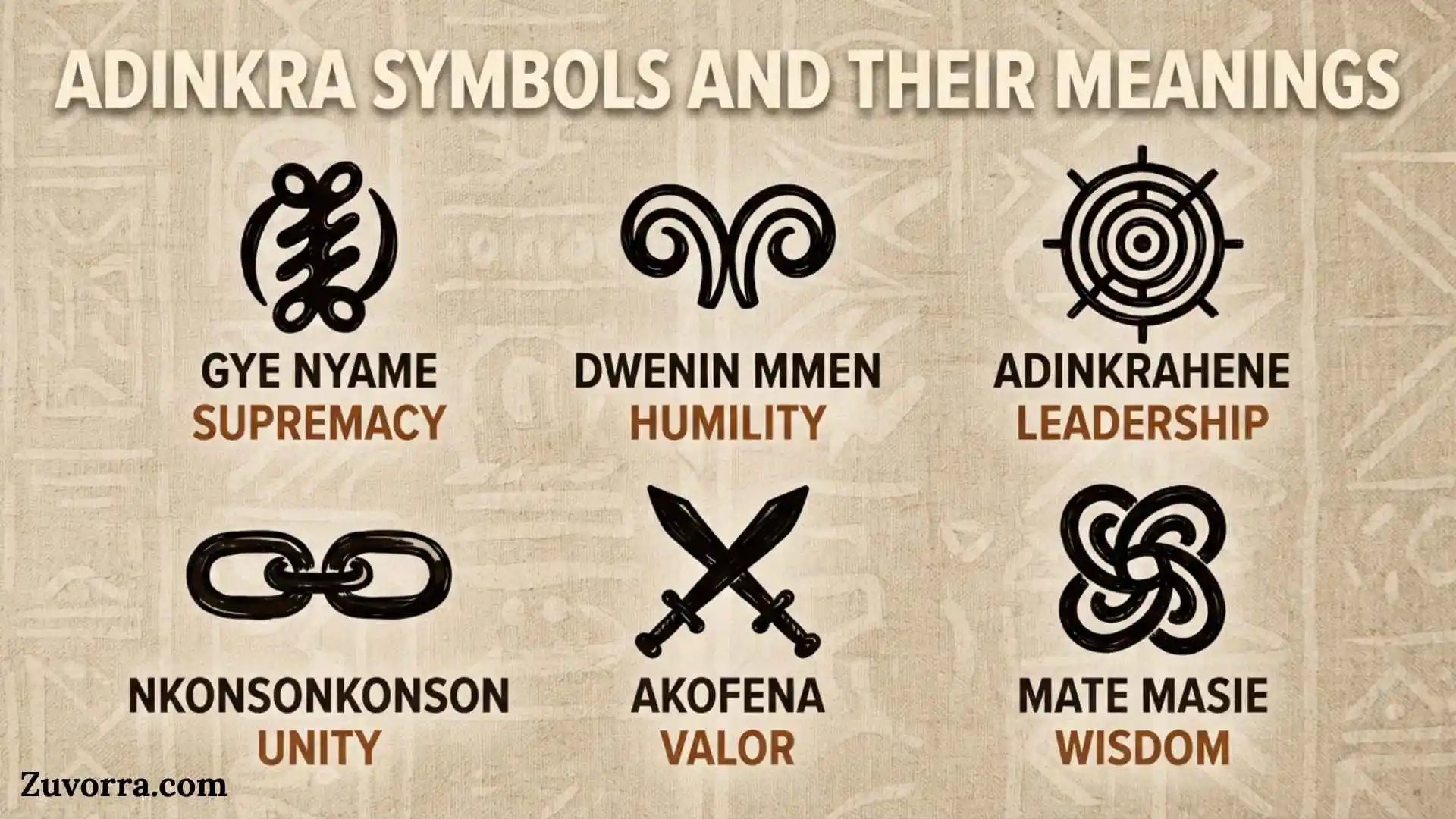
Adinkra symbols are visual expressions of Akan wisdom, history, moral values, and social beliefs. Originating in West Africa, especially among the Asante people of Ghana, these designs communicate ideas about God, leadership, courage, family, love, unity, learning, and human behavior.
You may encounter Adinkra symbols on traditional cloth, pottery, carved stools, jewelry, architecture, logos, tattoos, memorial objects, and contemporary artwork. Their simple geometric forms may look decorative, but many connect to Akan proverbs and contain layers of meaning that become clearer when studied within their cultural setting.
Quick Meaning
Adinkra symbols are traditional Akan visual signs that represent proverbs, values, historical ideas, and philosophical teachings. Developed in present-day Ghana and neighboring areas of Côte d’Ivoire, they communicate concepts such as wisdom, resilience, humility, spiritual protection, cooperation, remembrance, and responsible leadership.
Adinkra Symbol Overview
| Field | Details |
| Symbol tradition | Adinkra |
| Primary purpose | Communicating proverbs, values, beliefs, and social teachings |
| Cultural origin | Akan peoples of West Africa |
| Strongest association | Asante culture in Ghana |
| Geographic roots | Ghana and Côte d’Ivoire |
| Traditional medium | Hand-stamped or hand-drawn cloth |
| Common materials | Cotton cloth, carved calabash stamps, plant-based dye |
| Important historical use | Mourning, funerals, royal display, ceremonies, and social communication |
| Modern uses | Clothing, jewelry, logos, tattoos, public art, education, architecture, and graphic design |
| Language connection | Many names and proverbs are expressed in Akan languages, especially Twi |
| Unicode status | Most Adinkra designs do not have standardized Unicode characters |
| Emoji equivalent | No official Adinkra emoji set |
| Related traditions | Akan goldweights, proverbial staffs, stool carving, kente symbolism, and royal regalia |
What Do Adinkra Symbols Mean?
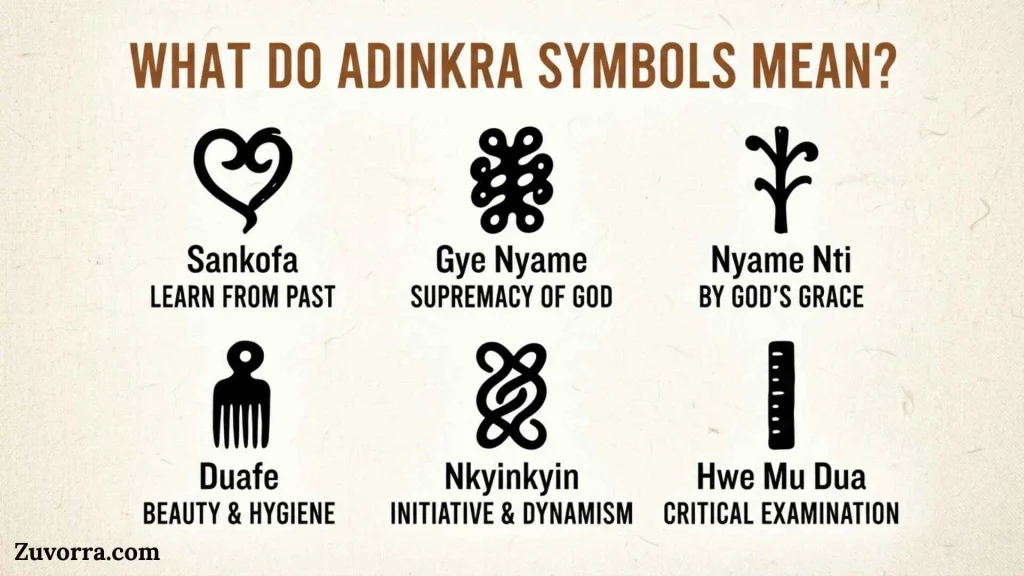
Adinkra symbols express ideas rather than spelling complete sentences. A design may represent a proverb, a moral lesson, an object from everyday life, an animal characteristic, a historical event, or a belief about the relationship between people and the spiritual world.
Their meanings fall into several broad categories:
- Moral qualities: patience, humility, responsibility, honesty, and discipline
- Social values: unity, cooperation, family loyalty, friendship, and hospitality
- Leadership ideals: authority, justice, courage, diplomacy, and service
- Spiritual beliefs: divine presence, destiny, protection, mortality, and the soul
- Life lessons: learning from the past, adapting to change, enduring hardship, and using knowledge wisely
Adinkra should not be treated as a simple picture code in which every shape has one fixed English definition. A symbol often gains meaning from its name, proverb, historical use, placement, color, and combination with other motifs. Museum records also show that symbols arranged together could create messages understood most fully by their intended audience.
History and Origin of Adinkra Symbols
Adinkra developed within the cultural world of the Akan peoples, who live mainly in Ghana and Côte d’Ivoire. The tradition is particularly associated with the Asante, also written Ashanti, whose political and artistic influence helped spread Adinkra cloth and its symbolic vocabulary.
The exact beginning of every symbol cannot be dated with certainty. Designs changed through oral transmission, artistic invention, royal patronage, trade, and contact among Akan communities. For this reason, responsible historical accounts distinguish documented evidence from later legends.
The Gyaman and Asante Tradition
One widely repeated oral account connects the name Adinkra with Nana Kofi Adinkra, a ruler of Gyaman, an Akan state in the region that now includes parts of Ghana and Côte d’Ivoire. According to the tradition, the Asante defeated Gyaman in the early nineteenth century, after which patterned cloth and related knowledge became more strongly established in Asante court culture.
Some versions say the ruler wore a patterned mourning cloth after his capture. Others connect the conflict with royal authority and the Golden Stool. These stories are culturally important, but their details vary and should not be presented as fully verified historical records. Boston University’s African Studies Center identifies the account as an Asante legend rather than an undisputed origin story.
Early Surviving Cloth
One of the best-known early Adinkra textiles entered the British Museum in 1818. Its museum record dates the cloth to 1817 and describes cotton fabric woven in narrow strips, stitched together, and decorated with stamped and hand-drawn patterns. This object provides firm evidence that a developed Adinkra textile tradition existed by the early nineteenth century.
How Traditional Adinkra Cloth Is Made
Traditional artists divide cloth into sections using straight, comb-drawn lines. They then print repeated motifs using stamps carved from dried calabash gourds.
The dark printing substance is called adinkra aduro, often translated as “Adinkra medicine.” Historical museum descriptions explain that it is produced by boiling plant bark and combining the liquid with iron-rich material until it becomes a thick, dark pigment. The exact recipe and technique may vary by workshop.
Dark brown, black, brick-red, and similarly muted cloths have traditionally been associated with mourning. White or lighter Adinkra cloth may be worn for celebrations and other important occasions. Color therefore contributes to meaning rather than serving as decoration alone.
Major Adinkra Symbols and Their Meanings
The following interpretations summarize widely recognized meanings. Spellings and explanations may differ because Akan words are transliterated in several ways and symbols can support more than one lesson.
| Adinkra symbol | Common meaning | Central lesson |
| Gye Nyame | Supremacy of God | Divine power stands above all things |
| Sankofa | Return and retrieve it | Learn from the past to improve the future |
| Dwennimmen | Ram’s horns | Strength should be balanced with humility |
| Nyansapo | Wisdom knot | True wisdom combines knowledge, skill, and judgment |
| Akoma | Heart | Love, patience, goodwill, and emotional endurance |
| Akoma Ntoso | Linked hearts | Understanding, agreement, and unity |
| Fawohodie | Independence | Freedom carries responsibility |
| Aya | Fern | Endurance, resilience, and resourcefulness |
| Adinkrahene | Chief of Adinkra symbols | Leadership, greatness, and authority |
| Nkyinkyim | Twisting movement | Adaptability, initiative, and life’s changing path |
| Mpatapo | Knot of reconciliation | Peacemaking after conflict |
| Wawa Aba | Seed of the wawa tree | Hardiness and perseverance |
| Duafe | Wooden comb | Care, cleanliness, beauty, and feminine qualities |
| Ananse Ntontan | Spider’s web | Wisdom, creativity, complexity, and skill |
| Eban | Fence | Security, safety, and the protection of family |
| Fihankra | Compound house | Brotherhood, security, and shared community |
| Mframadan | Wind-resistant house | Fortitude and readiness for hardship |
| Ese Ne Tekrema | Teeth and tongue | Friendship, cooperation, and mutual dependence |
| Boa Me Na Me Mmoa Wo | Help me and let me help you | Cooperation and shared responsibility |
| Odo Nnyew Fie Kwan | Love does not lose its way home | Genuine love remains connected |
| Sesa Wo Suban | Change your character | Personal transformation and moral renewal |
| Nea Onnim No Sua A Ohu | One who does not know can learn | Knowledge grows through study |
| Nyame Nti | By God’s grace | Faith and trust in divine support |
| Nyame Ye Ohene | God is king | Divine authority |
| Nyame Dua | God’s tree or altar | Sacred presence and worship |
| Hye Won Hye | That which does not burn | Endurance and spiritual permanence |
| Bi Nka Bi | No one should bite another | Peace, restraint, and social harmony |
| Mate Masie | What I hear, I keep | Wisdom, memory, and careful understanding |
| Nkonsonkonson | Chain link | Unity and the strength of human relationships |
| Osram Ne Nsoromma | Moon and star | Love, faithfulness, and harmony |
| Bese Saka | Sack of kola nuts | Wealth, trade, abundance, and economic power |
Gye Nyame: “Except for God”
Gye Nyame is among the most widely recognized Adinkra symbols. Its common translation, “except for God” or “only God,” expresses the supremacy, immortality, and unmatched power of the Creator.
The symbol reflects a traditional Akan belief that the divine is present throughout life and greater than human authority. Today, people use Gye Nyame in clothing, jewelry, architecture, worship spaces, logos, and personal art as a declaration of faith.
Sankofa: Learning From the Past
Sankofa teaches that returning for valuable knowledge is not shameful. The concept is often summarized by the proverb, “It is not taboo to go back and fetch what you forgot.” The Smithsonian identifies Sankofa as an Akan idea about retrieving ancestral knowledge and using it in the present.
Sankofa may appear as a bird turning its head backward while its feet face forward. It also has a stylized heart-shaped form. The backward glance does not encourage people to live in the past. It teaches them to recover useful history while continuing forward.
Dwennimmen: Strength With Humility
Dwennimmen represents ram’s horns. Rams display force when they fight, yet they also lower their heads. This contrast creates a lesson about leadership: power without humility becomes dangerous.
The symbol encourages strong people to remain teachable, respectful, and willing to compromise. The National Museum of African Art notes that the image of two rams locking horns can imply that one must eventually yield.
Nyansapo: The Wisdom Knot
Nyansapo means “wisdom knot.” It represents intelligence, patience, ingenuity, and the practical use of knowledge.
In Akan thought, wisdom involves more than collecting facts. A wise person knows how to choose the right method, respond to changing circumstances, and use experience to achieve a worthy goal. The University of Michigan describes Nyansapo as an especially revered symbol connected with broad knowledge, learning, experience, and sound judgment.
Akoma: The Heart
Akoma means “heart.” It can symbolize love, patience, tolerance, goodwill, and emotional strength. Akan expressions involving the heart may describe a person’s character or capacity to endure.
Although its outline resembles the familiar heart icon used around the world, Akoma should not be reduced to romantic love. It may represent affection within families, patience in relationships, loyalty to a community, and calmness during hardship.
Aya: The Fern
Aya represents a fern, a plant capable of growing in difficult places. It symbolizes endurance, independence, resourcefulness, and the ability to survive hardship.
A person using Aya may be expressing more than toughness. The symbol also suggests adaptation: survival comes from responding intelligently to the conditions around you.
Fawohodie: Freedom and Independence
Fawohodie represents freedom, emancipation, and independence. Its deeper message is that liberty requires discipline and responsibility.
In modern contexts, Fawohodie can express personal autonomy, national liberation, civil rights, or freedom from oppressive conditions. It should not be interpreted as permission to ignore obligations to family or society.
Mpatapo: Reconciliation
Mpatapo represents the knot or bond that joins people after disagreement. It symbolizes reconciliation, peace, forgiveness, and conflict resolution.
Its meaning is practical. Peace does not simply happen when people stop arguing. It requires both sides to repair trust, accept responsibility, and create a renewed relationship.
Symbolism and Interpretation
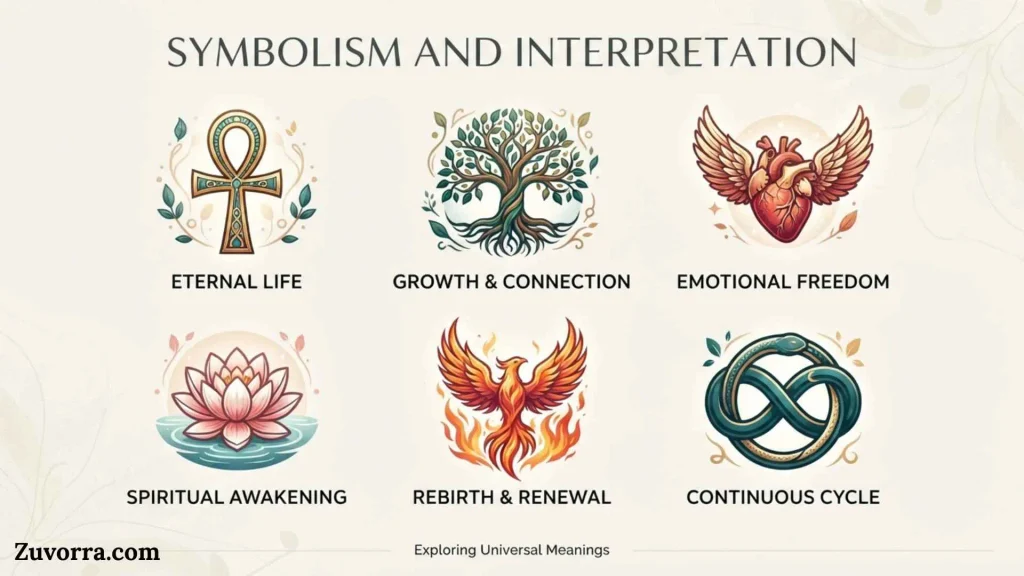
Traditional Interpretation
Traditionally, Adinkra symbols helped place moral and philosophical teachings into visible form. A familiar object such as a comb, fence, seed, knot, house, or animal feature became a memory aid for a proverb.
This connection between image and spoken wisdom made symbols useful during ceremonies, public gatherings, mourning, and royal display. They did not replace oral language. Instead, they worked with speech, memory, poetry, performance, and social knowledge.
Modern Interpretation
Today, Adinkra symbols appear far beyond their original textile setting. Artists, educators, businesses, faith communities, and members of the African diaspora use them to express identity and shared values.
Sankofa may support historical education. Gye Nyame may communicate faith. Fawohodie can represent liberation. Nyansapo may appear in an academic logo. Nkonsonkonson can symbolize organizational unity.
Modern uses remain meaningful when designers understand the original concept and avoid treating the symbol as an anonymous decorative pattern.
Positive and Negative Meanings
Most Adinkra motifs express constructive ideals. However, they often address difficult realities such as death, conflict, hardship, arrogance, jealousy, or irresponsible power.
A symbol may therefore contain a warning as well as an aspiration:
- Strength becomes harmful without humility.
- Freedom becomes unstable without responsibility.
- Knowledge becomes useful only when applied wisely.
- Community requires cooperation, not merely physical closeness.
- Remembering the past should guide progress rather than prevent it.
This moral tension gives Adinkra greater depth than a list of one-word meanings suggests.
Cultural Significance
Adinkra belongs to the broader cultural and intellectual heritage of Akan peoples. It reflects a worldview in which art, language, social conduct, spiritual belief, and historical memory are closely connected.
Within Asante society, visual symbols may appear on textiles, stools, goldweights, royal objects, architectural surfaces, and the staffs carried by royal spokespersons. These art forms often draw upon the same world of proverbs and communal teachings.
Adinkra also contributes to Ghana’s national visual identity. Symbols appear in public buildings, educational materials, product branding, monuments, and clothing. However, calling every use “Ghanaian” should not erase the specific Akan and Asante traditions from which the system developed.
Across the African diaspora, Adinkra has become a language of heritage and cultural recovery. Artists may combine it with African American, Caribbean, Brazilian, or other diasporic traditions. The Smithsonian documents contemporary artists using Adinkra to connect indigenous West African forms with modern artistic practice and questions of identity.
Religious and Spiritual Meaning
Adinkra reflects Akan spiritual thought, but the full system is not a religious alphabet or a collection of magical seals. Some designs refer directly to God, sacred space, destiny, spiritual endurance, or the soul. Others focus on leadership, family, learning, agriculture, trade, or social behavior.
Symbols such as Gye Nyame, Nyame Nti, Nyame Ye Ohene, and Nyame Dua express aspects of divine authority and human dependence upon God. Their meanings developed within Akan religious culture but may also be adopted by African Christians and other modern believers.
Adinkra cloth also has a strong historical relationship with funerals and mourning. In this context, the motifs help people confront death, honor the deceased, affirm continuity, and communicate social values. The word Adinkra itself is commonly associated with parting or saying goodbye.
Spiritual interpretation requires restraint. Not every motif offers supernatural protection, and a modern website’s claim that a symbol “attracts wealth” or “guarantees love” should not be accepted without cultural evidence.
Where Adinkra Symbols Are Used
Traditional Cloth
Stamped cloth remains the best-known medium. Repeated motifs are arranged within grids and separated by lines or embroidered bands. Their sequence, color, and occasion can shape the cloth’s message.
Architecture
Adinkra motifs appear on walls, gates, carved doors, memorials, shrines, and public buildings. The Metropolitan Museum of Art notes their presence among the decorative forms used on traditional Asante buildings.
Jewelry and Personal Accessories
Pendants, bracelets, rings, earrings, beads, and hair accessories frequently feature Gye Nyame, Sankofa, Duafe, and other recognizable motifs. Wearers may choose a design that reflects faith, family history, personal resilience, or cultural pride.
Tattoos
Adinkra tattoos can communicate identity and life principles. Before selecting one, a person should verify the symbol’s name, orientation, traditional interpretation, and cultural context. Online charts sometimes mislabel designs or assign invented meanings.
Logos and Institutions
Schools, nonprofit organizations, churches, cultural associations, and Ghanaian businesses use Adinkra to communicate values quickly. Nyansapo suits learning institutions, while Nkonsonkonson or Akoma Ntoso may represent unity.
Contemporary Art
Artists use Adinkra as pattern, narrative, historical reference, or social commentary. In these settings, the symbols may interact with modern painting, sculpture, photography, textiles, and digital media.
Common Variations and Modern Adaptations
Adinkra designs do not always look identical. A symbol carved into a calabash stamp may differ slightly from the same motif drawn by hand or recreated digitally.
Variations may involve:
- Thicker or thinner lines
- Rotated or mirrored shapes
- Rounded or angular edges
- Additional internal marks
- Simplification for small jewelry
- Repetition within larger patterns
- Color changes for modern fashion
- Combination with words or other African motifs
Sankofa offers a clear example. It appears both as a backward-looking bird and as a symmetrical heart-like design. These forms express the same broad principle but are not visually interchangeable.
The lack of standardized Unicode characters also matters. Most Adinkra symbols cannot be typed as ordinary text. Digital designers usually use custom fonts, illustrations, or image files. As a result, visual distortions and labeling errors can spread easily online.
Common Misconceptions
“Every Adinkra symbol has one exact meaning”
A symbol often supports several related interpretations. Akoma may signify love, patience, and tolerance. Dwennimmen may communicate strength, humility, or responsible leadership.
“Adinkra is an alphabet”
Adinkra is better understood as a visual-symbolic system linked to concepts, proverbs, and cultural teachings. It does not function like an alphabet that represents each sound in ordinary speech.
“All symbols are ancient”
The tradition is historical, but not every design can be proven to come from remote antiquity. Artists have adapted old motifs and created newer ones as society changed.
“Adinkra belongs to all African cultures”
Africa contains thousands of distinct cultural traditions. Adinkra is specifically Akan in origin and is most strongly associated with Ghanaian and Asante heritage.
“Sankofa means going backward”
Sankofa teaches the recovery of useful knowledge. Its purpose is forward movement informed by memory, not rejection of progress.
“Any heart-shaped Adinkra symbol is Sankofa”
Akoma, Akoma Ntoso, Odo Nnyew Fie Kwan, and one form of Sankofa may all involve heart-like curves. Their names and meanings are not the same.
“The symbols guarantee spiritual results”
Adinkra communicates beliefs and values. Wearing a symbol does not automatically produce wealth, protection, love, or success.
Interesting Facts About Adinkra
- Adinkra turns proverbs into visible memory. A small geometric design can recall an entire teaching familiar to the community.
- Traditional stamps are carved from calabash. The dried gourd provides a light, workable material that can hold detailed designs.
- The printing substance has a special name. Adinkra aduro means Adinkra medicine, showing that the pigment is culturally more significant than ordinary ink.
- Color helps communicate the occasion. Dark textiles commonly relate to mourning, while white Adinkra cloth can mark celebration or honor.
- The oldest well-documented surviving cloth dates to 1817. Its preservation gives researchers direct evidence of early nineteenth-century techniques.
- A symbol’s name may matter as much as its shape. Without the Akan name and proverb, much of its intended lesson may disappear.
- Adinkra combines visual and verbal communication. The Smithsonian describes the Asante use of these motifs as a way to link aesthetic forms with spoken messages.
- Symbols can create compound messages. Several motifs placed together may express a broader statement about the wearer, occasion, or community.
- Adinkrahene means “king” or “chief” of Adinkra symbols. Its concentric circles are associated with leadership and greatness. The British Museum identifies it among motifs on historic cloth.
- Adinkra continues to evolve. Contemporary artists use it to explore migration, identity, memory, colonial history, and the relationship between tradition and modernity.
Related Akan Symbols and Art Forms
Akan Goldweights
Small brass weights were historically used in the gold trade. Many display geometric, animal, human, or proverbial forms. They share Adinkra’s interest in turning social wisdom into visual art, though they belong to a different material tradition.
Linguist Staffs
Royal spokespersons, often called linguists in English-language museum descriptions, carry staffs topped with symbolic figures. These designs communicate proverbs about leadership, diplomacy, and authority.
Kente Cloth
Kente and Adinkra are both important Ghanaian textiles, but they are not the same. Kente creates pattern through colored woven strips, while traditional Adinkra uses stamped or drawn motifs on cloth.
Akan Stools
Stools can represent authority, ancestry, office, and personal identity. Some carry carved symbolic forms related to the same moral world found in Adinkra.
Asante Architectural Motifs
Traditional buildings may include geometric and proverbial relief designs. Some are identified as Adinkra, while others belong to a broader Asante decorative vocabulary.
How to Choose an Adinkra Symbol Respectfully
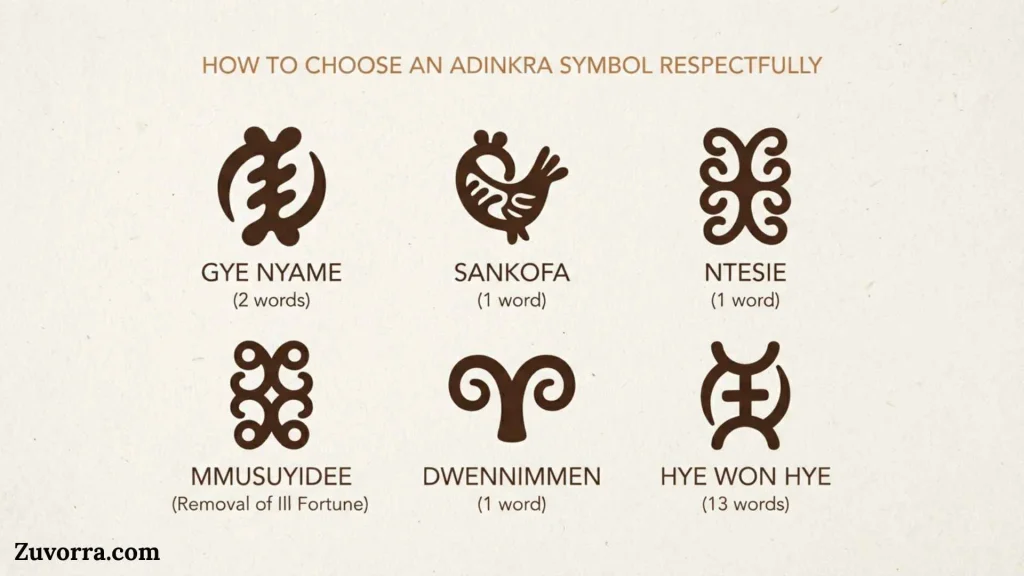
Use this simple decision guide:
What value do you want to express?
↓
Faith → Consider Gye Nyame or Nyame Nti
↓
Learning and judgment → Consider Nyansapo
↓
Resilience → Consider Aya, Wawa Aba, or Hye Won Hye
↓
Unity → Consider Nkonsonkonson or Akoma Ntoso
↓
Peace after conflict → Consider Mpatapo or Bi Nka Bi
↓
Historical reflection → Consider Sankofa
↓
Freedom → Consider Fawohodie
Before using the design permanently, check its Akan name, compare several reliable visual references, and learn the proverb behind it. For tattoos, official logos, or memorial work, consulting a Ghanaian artist or cultural specialist can prevent incorrect orientation, spelling, or interpretation.
Frequently Asked Questions
How many Adinkra symbols are there?
There is no single universally accepted total. Historical collections, regional traditions, modern adaptations, spelling differences, and newly designed motifs make exact counting difficult. Some guides list dozens, while larger catalogs include many more. It is more accurate to view Adinkra as a living symbolic tradition than a closed official set.
What is the most famous Adinkra symbol?
Gye Nyame and Sankofa are among the most internationally recognized. Gye Nyame represents the supremacy of God, while Sankofa teaches people to recover valuable knowledge from the past. Their visibility in jewelry, clothing, education, public art, and diaspora culture has made them widely familiar.
Are Adinkra symbols Ghanaian?
Yes, they are strongly identified with Ghana, particularly the Asante and other Akan peoples. Their cultural region also extends into Côte d’Ivoire, where Akan communities have long lived. Describing them only as generic “African symbols” removes the specific history and language that give them meaning.
What language are Adinkra names written in?
Many names are recorded in Akan languages, especially Twi. English spellings can vary because writers represent Akan sounds differently. Variations such as Dwennimmen and Dwaninmen may refer to the same symbol, so readers should compare the design, proverb, and cultural explanation rather than relying only on spelling.
Is Adinkra a written language?
Adinkra communicates concepts visually, but it does not work exactly like an alphabet or ordinary written language. Its motifs point to proverbs, names, values, and philosophical ideas. A viewer often needs cultural knowledge to understand the complete message, especially when several symbols appear together.
Can anyone wear Adinkra symbols?
People outside Akan culture often wear Adinkra respectfully, especially when they understand the chosen symbol and acknowledge its origin. Problems arise when sellers invent meanings, remove cultural attribution, or market sacred and funerary associations carelessly. Learning the symbol’s name and proverb is a good first step.
Which Adinkra symbol means strength?
Dwennimmen represents strength balanced by humility. Aya expresses endurance and resourcefulness, while Wawa Aba symbolizes toughness and perseverance. The best choice depends on the type of strength intended: leadership strength, survival through hardship, spiritual endurance, or personal resilience.
Which Adinkra symbol represents love?
Akoma is the heart and represents love, patience, goodwill, and emotional endurance. Akoma Ntoso, formed through linked hearts, emphasizes agreement and unity. Odo Nnyew Fie Kwan expresses the idea that true love does not lose its way home.
What does the Sankofa bird hold?
The Sankofa bird is usually shown reaching backward toward an egg on its back. The egg represents valuable knowledge, heritage, or wisdom recovered from the past. Its feet face forward, reinforcing the lesson that remembrance should support future progress rather than prevent it.
Do Adinkra symbols have Unicode characters?
Most do not have official, widely supported Unicode characters. They usually appear online as images, custom font glyphs, or vector graphics. Because these files are not always standardized, users should verify both the shape and label before including a symbol in a publication, logo, or tattoo.
Key Takeaways
- Adinkra symbols originated within Akan culture in West Africa and are closely associated with the Asante of Ghana.
- They represent proverbs, moral values, spiritual ideas, historical memory, and social teachings.
- Traditional Adinkra cloth uses carved calabash stamps and a dark plant-based pigment.
- Symbols may carry several connected meanings rather than one fixed definition.
- Gye Nyame represents divine supremacy, while Sankofa teaches learning from the past.
- Adinkra is a visual communication system, not a conventional alphabet.
- Color, placement, combinations, language, and ceremonial setting can change interpretation.
- Modern uses include clothing, jewelry, tattoos, architecture, logos, education, and contemporary art.
- Respectful use begins with learning the correct name, proverb, origin, and context.
Conclusion
Adinkra symbols and their meanings reveal a rich tradition in which art communicates philosophy. Their lines, circles, knots, animals, plants, and everyday objects preserve teachings about faith, courage, wisdom, responsibility, family, freedom, and remembrance.
Understanding these motifs requires more than matching a picture with a single English word. Their deepest value lies in the relationship between image, Akan language, proverb, history, and social practice. When studied in that full context, Adinkra becomes not merely a collection of attractive designs, but a living record of West African thought.
References
- British Museum. Collection records for historic Adinkra cloths and carved calabash stamps.
- Metropolitan Museum of Art. Records on Asante architecture, prestige cloth, goldweights, and Akan symbolic art.
- Smithsonian Institution, National Museum of African Art, and National Museum of African American History and Culture. Materials on Sankofa, Adinkra, contemporary art, and African diaspora identity.
- Boston University African Studies Center. Educational overview of Adinkra history and the Nana Kofi Adinkra tradition.
- University of Michigan. Educational resources on Akan proverbs and selected Adinkra meanings.
- Saint Louis Art Museum. Collection description explaining Adinkra cloth production, pigment, patterning, and ceremonial colors.

I’m Jasper Huxley, a British writer fascinated by the symbols that communicate ideas without words. I explore their meanings, origins, cultural connections, and everyday uses. From ancient markings to contemporary signs, I enjoy uncovering the stories behind visual language and presenting symbolism in a clear, engaging way for curious readers worldwide.
Books:
- The Hidden Language of Symbols
- Symbols, Signs and Their Meanings