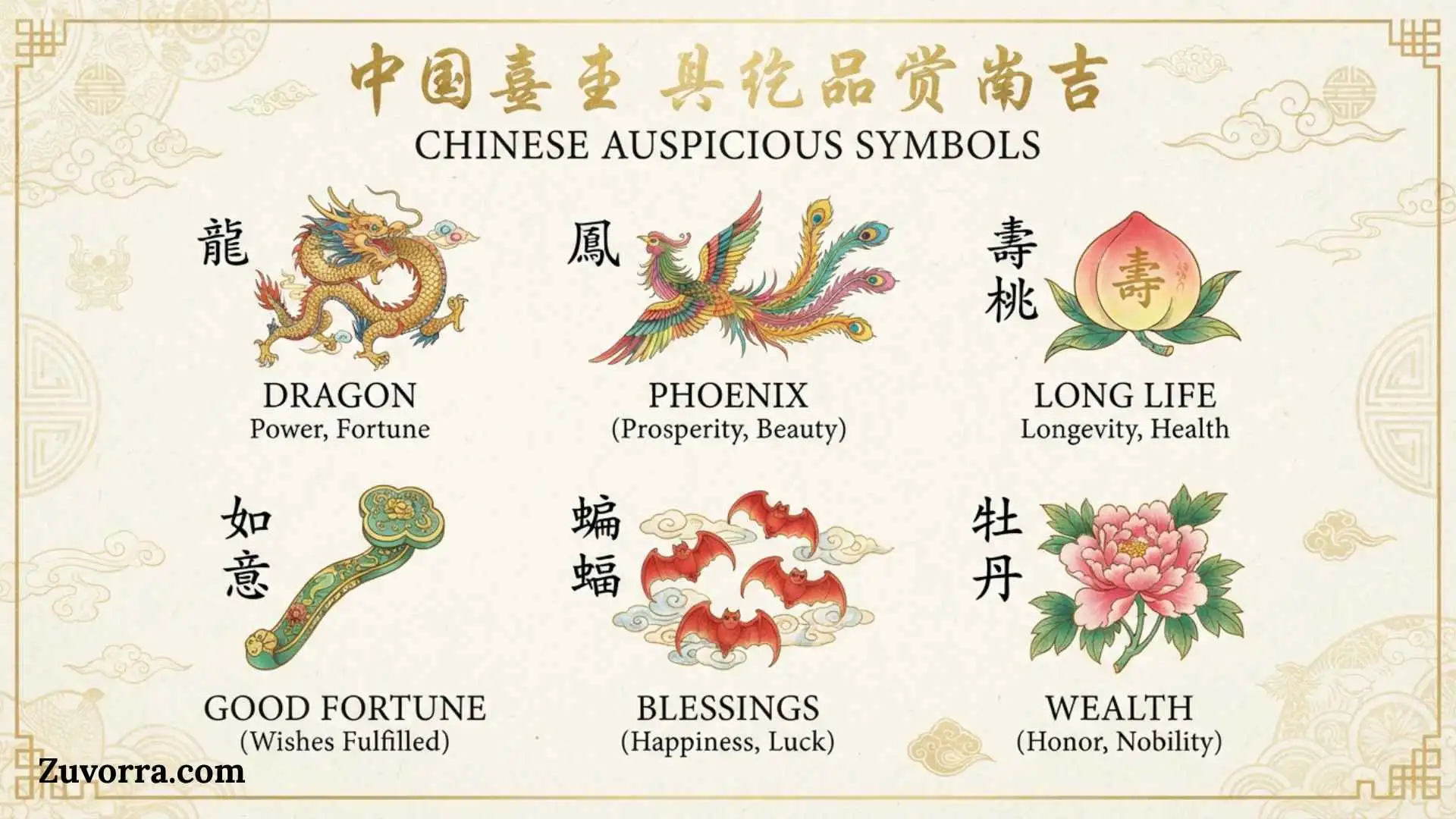
Chinese auspicious symbols are images, characters, animals, plants, colors, and objects that express wishes for good fortune, longevity, prosperity, harmony, success, and family happiness. You may see them on Lunar New Year decorations, wedding gifts, porcelain, embroidered clothing, jewelry, architecture, paintings, red envelopes, and household ornaments.
These symbols are more than attractive designs. Many work as visual blessings, using mythology, religious tradition, natural qualities, and Chinese wordplay to communicate a specific wish. A bat may represent good fortune, a peach may promise long life, and two fish may express abundance and marital harmony.
Quick Meaning
Chinese auspicious symbols are visual signs used to express favorable wishes such as happiness, wealth, health, longevity, fertility, protection, academic success, and marital harmony. Their meanings often come from ancient legends, religious beliefs, natural characteristics, historical customs, or words that sound alike in Chinese.
Chinese Auspicious Symbols Overview Table
| Symbol | Primary Meaning | Cultural Basis | Common Usage | Modern Meaning |
| 福, fú | Good fortune and blessings | Written language and New Year customs | Doors, red envelopes, banners | General good luck |
| 囍, shuāngxǐ | Double happiness | Traditional wedding culture | Weddings, invitations, gifts | Marital joy |
| 壽, shòu | Longevity | Daoist ideas and birthday traditions | Birthday gifts, ceramics, textiles | Long and healthy life |
| Bat | Good fortune | Fú, “bat,” sounds like fú, “fortune” | Porcelain, fabric, architecture | Luck and happiness |
| Dragon | Power, authority, vitality | Mythology and imperial culture | Festivals, art, clothing, logos | Strength and success |
| Phoenix | Virtue, harmony, renewal | Mythology and court culture | Weddings, jewelry, decoration | Grace and rebirth |
| Peach | Longevity and immortality | Legends of the Queen Mother of the West | Birthday art, gifts, ceramics | Health and long life |
| Fish | Abundance and surplus | Yú, “fish,” sounds like “surplus” | New Year art, meals, ornaments | Prosperity |
| Koi or carp | Success and advancement | Legend of the carp crossing the Dragon Gate | Paintings, tattoos, business décor | Ambition and perseverance |
| Crane | Longevity and noble character | Daoist imagery and observations of long life | Art, textiles, jade | Wisdom and endurance |
| Deer | Prosperity, rank, and longevity | Lù, “deer,” sounds like official salary | Paintings, carvings, gifts | Career success |
| Pomegranate | Fertility and many descendants | Numerous seeds | Wedding and family decorations | Family growth |
| Mandarin ducks | Faithful love | Traditional belief that they form devoted pairs | Wedding textiles and paintings | Romantic loyalty |
| Peony | Wealth, honor, and beauty | Imperial and literary associations | Art, clothing, home décor | Prosperity and elegance |
| Lotus | Purity and spiritual growth | Buddhism and the flower’s natural form | Temples, paintings, jewelry | Integrity and enlightenment |
| Ruyi | Wishes fulfilled | Ceremonial scepter and visual rebus | Decorative objects, jade, furniture | Success and satisfaction |
| Chinese knot | Unity, continuity, and luck | Traditional knot-making | New Year décor, jewelry, gifts | Connection and protection |
What Do Chinese Auspicious Symbols Mean?
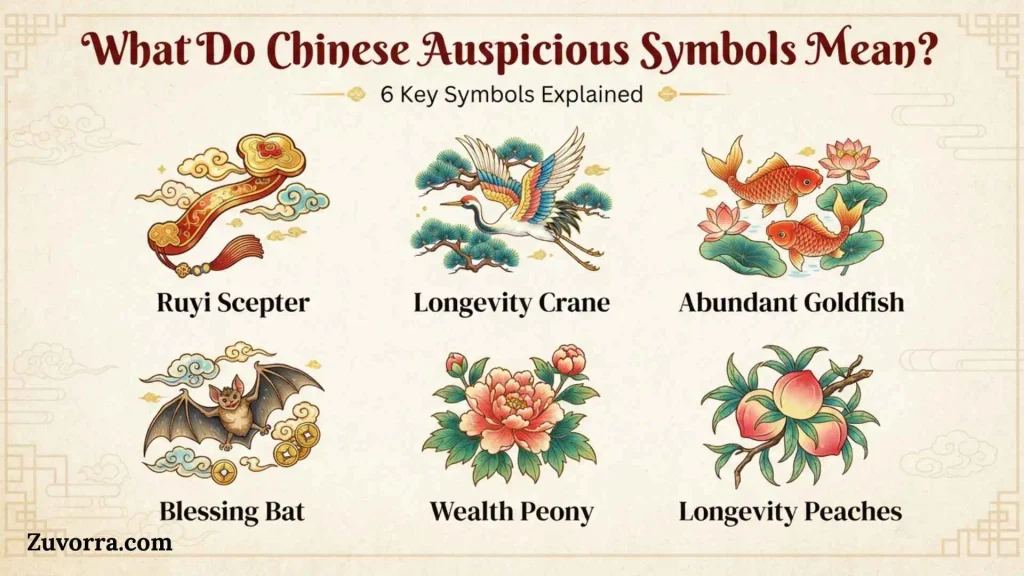
Chinese auspicious symbols communicate blessings without requiring a full written sentence. A single object can represent one wish, while several combined motifs can create a more detailed message.
For example, a bat and a peach together express a wish for both fortune and longevity. Five bats surrounding the character 壽 may represent the Five Blessings gathered around long life. Depending on the historical source, the Five Blessings generally include longevity, wealth, health, virtue, and a peaceful natural death.
The system depends on four main sources of meaning:
Wordplay and Homophones
Many symbols derive their meaning from words that sound alike.
The Chinese word for bat, 蝠, is pronounced fú, like 福, meaning good fortune. Fish, 魚 or 鱼, is pronounced yú, similar to 餘 or 余, meaning surplus. Deer, 鹿, pronounced lù, resembles 祿 or 禄, a term associated with official salary and prosperity.
These sound-based connections turn ordinary animals into visual rebuses. A picture can therefore be “read” as a blessing.
Natural Characteristics
Some objects symbolize qualities people observe in nature. Bamboo bends without breaking, so it represents resilience and moral flexibility. Pine trees remain green in winter, making them signs of endurance. Pomegranates contain many seeds and therefore suggest fertility and numerous descendants.
Mythology and Legend
Mythological stories add deeper meanings. Peaches became signs of immortality through stories about the sacred peach garden of Xiwangmu, the Queen Mother of the West. The dragon represents cosmic energy, rainfall, authority, and beneficial power. The phoenix embodies virtue, harmony, and peaceful rule.
Religious and Philosophical Ideas
Buddhism, Daoism, Confucian ethics, and popular religion all influenced Chinese symbolic art. The lotus expresses purity because it rises clean from muddy water. The crane appears with Daoist immortals. Bamboo, plum, orchid, and chrysanthemum can represent admired moral qualities associated with educated scholars.
History and Origin
Chinese auspicious symbolism developed gradually rather than beginning at one exact moment. Ancient ritual objects, oracle-bone inscriptions, bronzes, tomb decorations, textiles, and jade carvings already used animals, celestial forms, and patterns with social or spiritual importance.
During the Han dynasty, from 206 BCE to 220 CE, tomb art increasingly displayed protective creatures, immortals, directional animals, and scenes expressing hopes for the afterlife. Daoist beliefs about immortality helped strengthen the symbolic roles of peaches, cranes, deer, lingzhi fungus, mountains, and supernatural beings.
Buddhism entered China through Central Asian trade routes and became a major cultural force during the first millennium CE. It introduced and expanded motifs such as the lotus, endless knot, parasol, conch, treasure vase, and wheel of Buddhist teaching.
By the Tang and Song dynasties, symbolic plants, birds, mythical animals, and literary references appeared throughout painting, ceramics, textiles, metalwork, and architecture. Scholar culture also encouraged symbolic associations with moral character. Plum blossoms suggested perseverance, orchids refinement, bamboo integrity, and chrysanthemums dignified retirement.
During the Ming and Qing dynasties, auspicious imagery became especially elaborate. Artists combined animals, plants, characters, colors, and objects into visual puzzles that educated viewers could interpret. Museum collections preserve Ming and Qing textiles, lacquerware, porcelain, jade, and enamel objects decorated with bats, peaches, deer, cranes, fish, pomegranates, flowers, and longevity characters.
These motifs appeared in both elite and popular settings. Imperial workshops used them on court robes and luxury objects, while households displayed them on door prints, wedding goods, festival decorations, furniture, and everyday ceramics.
Symbolism and Interpretation
Chinese auspicious symbols rarely have only one fixed meaning. Their interpretation depends on context, number, color, position, accompanying motifs, and the occasion.
Good Fortune and Happiness
The character 福 is the clearest written sign of blessing and good fortune. It commonly appears on doors during Lunar New Year. Some families display it upside down because the phrase for “fortune is upside down” sounds similar to “fortune has arrived.”
Bats also represent fortune because of the homophone between “bat” and “blessing.” Five bats often symbolize the Five Blessings. Museum examples show bats combined with peaches and longevity characters to intensify the message.
Longevity and Health
The longevity character 壽 appears in many calligraphic forms. Peaches, cranes, deer, pine trees, lingzhi fungus, gourds, and certain immortals may support the same wish.
Peaches became especially powerful longevity emblems through legends of Xiwangmu’s sacred fruit. Cranes were linked with immortals and long life, while evergreen pine suggested endurance. Historical artworks frequently combine these motifs rather than showing them separately.
Wealth and Prosperity
Gold ingots, coins, treasure vessels, peonies, fish, deer, and wealth gods express economic success. Fish are popular during New Year celebrations because the phrase “may there be surplus every year” uses the sound yú, which also means fish.
The peony became known as the “king of flowers” and developed associations with wealth, high status, beauty, and honor. Deer may suggest prosperity because their name sounds like a word connected with an official’s salary.
Marriage and Romantic Harmony
The double-happiness character 囍 is strongly associated with weddings. It consists of two forms of 喜, meaning happiness or joy, placed side by side.
Mandarin ducks symbolize devoted partnership. Paired phoenixes, paired fish, lotus flowers, pomegranates, and intertwined branches may also communicate hopes for affection, fertility, harmony, and descendants.
A Qing dynasty vase in the Metropolitan Museum of Art combines bats, peaches, floral vines, and the double-happiness character, bringing together fortune, longevity, and marital harmony.
Success and Advancement
The carp represents effort followed by transformation. According to a famous legend, a carp that successfully leaps over the Dragon Gate becomes a dragon. It therefore symbolizes passing examinations, winning promotion, overcoming obstacles, and rising in social status.
The dragon itself may represent authority, vitality, achievement, and favorable cosmic power. However, its meaning changes according to historical context. In imperial China, dragon designs could indicate rank and authority, especially when regulated by court dress traditions.
Protection and Stability
Guardian lions, door gods, dragons, tigers, mirrors, coins, and certain written charms have protective functions. Their purpose is not always to “bring luck” in a simple sense. Some are intended to repel harmful forces, maintain order, or guard entrances.
Positive and Negative Interpretations
Most Chinese auspicious symbols are positive, but context still matters.
A dragon usually signifies beneficial power in Chinese culture, not the destructive monster common in some European traditions. Yet a dragon may also suggest overwhelming authority or uncontrolled force when used in a critical story.
The lotus represents purity, but images of broken or dying flowers may suggest loss. A peach normally signifies longevity, while a damaged peach in art could communicate impermanence.
Numbers also affect meaning. Eight is considered favorable because its pronunciation resembles a word for prosperity in several Chinese varieties. Four is often avoided because it sounds similar to “death,” especially in Mandarin and Cantonese. These associations influence addresses, telephone numbers, gifts, floors, and business decisions.
Cultural Significance
Auspicious symbolism appears across Chinese-speaking communities, but customs vary by region, dialect, religion, generation, and family tradition.
In mainland China, Taiwan, Hong Kong, Macau, Singapore, Malaysia, and overseas Chinese communities, familiar symbols may appear during Lunar New Year, weddings, birthdays, business openings, and religious festivals. However, the pronunciation-based meaning of a motif may be stronger in one dialect than another.
Regional artistic traditions also shape design. Cantonese embroidery may favor bold colors and dragons or phoenixes, while Suzhou embroidery is famous for fine, naturalistic stitching. Porcelain produced at Jingdezhen often carried complex courtly and popular symbols.
Neighboring cultures adopted and adapted many Chinese motifs. Dragons, phoenixes, cranes, lotus flowers, the zodiac, and the Three Friends of Winter appear in Korean, Japanese, Vietnamese, and other East Asian traditions. Their meanings overlap, but they are not always identical.
European chinoiserie copied Chinese-looking dragons, birds, flowers, pagodas, and landscapes from the seventeenth century onward. However, European designers often mixed Chinese, Japanese, Indian, and imagined elements. Chinoiserie should therefore not be treated as a reliable guide to authentic Chinese symbolism.
Religious and Spiritual Meaning
Chinese auspicious symbols draw from several religious and philosophical traditions rather than one unified belief system.
Daoist Symbolism
Daoist-influenced imagery often emphasizes longevity, harmony with nature, transformation, and immortality. Cranes, peaches, deer, lingzhi fungus, gourds, mountains, clouds, and islands of immortals appear frequently.
Shou Lao, the Star God of Longevity, is usually shown as an alternative man with an enlarged forehead. He may carry a staff, gourd, or peach and appear beside a deer or crane.
Buddhist Symbolism
The lotus is one of the most important Buddhist motifs. It represents spiritual purity and awakening because it grows from mud without being stained by it.
The Eight Auspicious Symbols of Buddhism include the parasol, pair of golden fish, treasure vase, lotus, conch shell, endless knot, victory banner, and Dharma wheel. These originated within Indian Buddhist tradition and entered Chinese visual culture through the spread of Buddhism.
Confucian and Scholar Symbolism
Confucian symbolism often focuses on moral conduct, learning, family duty, and social harmony. Bamboo may represent integrity, the orchid cultivated character, and the plum blossom perseverance.
The Four Gentlemen of Chinese art are the plum blossom, orchid, bamboo, and chrysanthemum. They correspond to the seasons and model qualities admired in a cultivated person.
Folk Religion
Popular religious practice combines deities, ancestors, protective spirits, historical heroes, and local customs. Door gods protect entrances. Caishen represents wealth. Kitchen God images relate to household morality and fortune.
These symbols may be devotional, decorative, protective, or all three at once.
Digital Meaning and Unicode Use
Many Chinese auspicious characters can be used digitally because they exist in Unicode:
- 福: U+798F, blessing or good fortune
- 壽: U+58FD, traditional form of longevity
- 寿: U+5BFF, simplified Japanese and Chinese form used in certain contexts
- 喜: U+559C, happiness or joy
- 囍: U+56CD, double happiness
- 龍: U+9F8D, traditional dragon
- 龙: U+9F99, simplified dragon
Emoji can suggest related ideas, but they do not always carry the full traditional meaning. Common examples include for a dragon, for fish, for a red envelope, 🪷 for a lotus, for a lantern, and for a peach.
The peach emoji can have unrelated slang meanings in modern digital communication. Context therefore matters when using it as a longevity symbol.
Where Chinese Auspicious Symbols Are Used
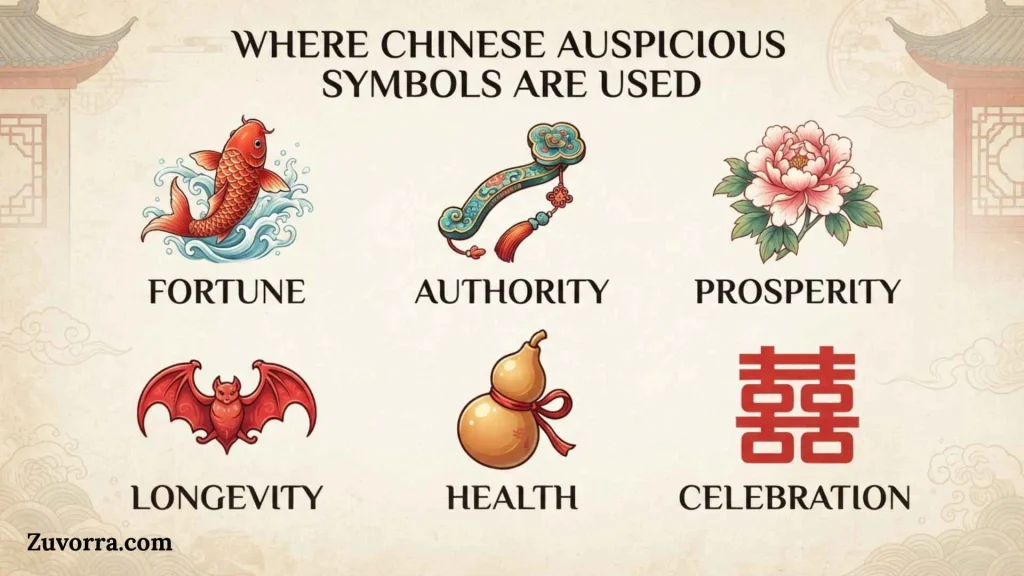
Lunar New Year
Homes and businesses display red couplets, 福 characters, lanterns, zodiac animals, fish, dragons, coins, and images of prosperity gods. The goal is to welcome blessings and begin the year positively.
Weddings
Double happiness, phoenixes, dragons, mandarin ducks, lotus flowers, pomegranates, and paired motifs express marital joy, balance, loyalty, and hopes for children.
Birthdays
Peaches, cranes, deer, pine trees, lingzhi fungus, and the longevity character are traditional choices for honoring older adults.
Architecture
Roof tiles, gates, screens, beams, doors, and stone carvings may feature bats, dragons, clouds, guardian lions, flowers, and geometric longevity patterns.
Clothing and Textiles
Court robes, rank badges, wedding garments, children’s clothing, and embroidered household textiles carry symbols connected with rank, protection, happiness, fertility, and long life.
Ceramics and Decorative Art
Porcelain often uses motifs as carefully constructed messages. A dish with peaches and the 壽 character, for example, communicates longevity through both image and writing.
Jewelry and Jade
Jade pendants may show bats, gourds, fish, dragons, phoenixes, coins, or ruyi forms. The material itself can suggest beauty, durability, virtue, and protection.
Tattoos and Logos
Modern designs use dragons, koi, lotus flowers, phoenixes, knots, and calligraphic characters. Anyone choosing a tattoo should verify the exact character, writing style, cultural context, and orientation before committing to the design.
Common Variations
Single and Combined Motifs
A symbol can appear alone or as part of a visual sentence. A peach alone means longevity. A crane holding a peach strengthens that wish. Five bats surrounding 壽 combine multiple blessings with long life.
Stylized Characters
福, 壽, and 囍 may appear in seal script, calligraphy, circular patterns, or highly geometric designs. A stylized longevity character can look more like an ornament than ordinary writing.
Color Variations
Red commonly expresses happiness, celebration, vitality, and good fortune. Gold suggests wealth and distinction. Yellow historically carried imperial associations. White may symbolize purity but is also linked with mourning, so its meaning depends heavily on context.
Number Variations
Pairs often suit marriage because they represent partnership. Five may refer to the Five Blessings. Eight suggests prosperity, while nine can indicate completeness, endurance, or imperial authority.
Regional Adaptations
A motif may retain its general meaning while changing in shape, pronunciation, or use across Chinese-speaking regions. Overseas communities also combine inherited symbolism with local materials and styles.
Common Misconceptions
Every Chinese Symbol Has One Permanent Meaning
Meanings change with context. A flower’s season, an animal’s direction, the number of objects, and accompanying characters can alter the message.
The Dragon Is Mainly Evil
Traditional Chinese dragons are usually linked with rain, vitality, authority, and cosmic order. This differs sharply from many European dragon traditions.
All Asian Symbolism Is Interchangeable
Chinese, Japanese, Korean, Vietnamese, Tibetan, and other traditions have influenced one another, but each has distinct histories and interpretations.
Any Red Decoration Is a Religious Object
Red is widely used for celebration and good fortune, but many red decorations are social or seasonal rather than devotional.
An Upside-Down 福 Is Always Correct
The custom is popular, especially during New Year, but etiquette varies. Some traditions consider an upside-down 福 appropriate on containers or interior doors but unsuitable on the main entrance.
Chinese Zodiac Animals Are Universal Good-Luck Symbols
Each zodiac animal has positive and challenging associations. Its meaning depends on the year, the person, the artistic setting, and the qualities emphasized.
How to Choose the Right Auspicious Symbol
Use this simple decision guide:
What wish do you want to express?
↓ Good fortune or general luck
Choose 福, bats, red knots, coins, or a ruyi.
↓ Long life and health
Choose peaches, cranes, deer, pine, lingzhi, or 壽.
↓ Marriage and faithful love
Choose 囍, mandarin ducks, paired fish, dragons and phoenixes, or lotus flowers.
↓ Wealth and business success
Choose fish, peonies, gold ingots, deer, wealth gods, or the number eight.
↓ Academic or career advancement
Choose carp crossing the Dragon Gate, brushes, books, or symbols connected with official rank.
↓ Fertility and family growth
Choose pomegranates, gourds, grapes, lotus seeds, or images of children.
The best choice also depends on the recipient. A longevity peach may suit an elder’s birthday but would be less appropriate than double happiness for a wedding.
Interesting Facts About Chinese Auspicious Symbols
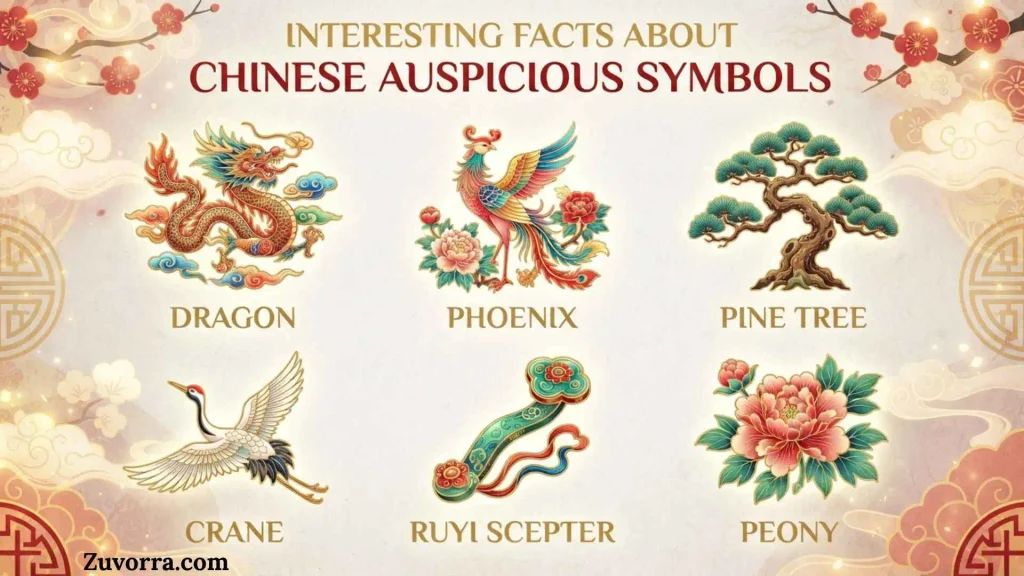
- Pictures can function like sentences.
Several motifs placed together may form a blessing through sound, symbolism, and visual association. - Bats are favorable in Chinese art.
Unlike their ominous reputation in some cultures, bats represent fortune because of the shared pronunciation fú. - Five bats create a larger message.
They often stand for the Five Blessings rather than simply five separate pieces of luck. - The peach has mythical roots.
Sacred peaches in the garden of Xiwangmu were believed to grant extraordinary longevity or immortality. - Fish symbolism depends on language.
The image communicates abundance because “fish” and “surplus” sound alike. - A carp can represent social mobility.
The Dragon Gate legend transformed the fish into a symbol of examination success, promotion, and personal achievement. - Plants can represent moral character.
Bamboo, plum, orchid, and chrysanthemum became models of resilience, refinement, integrity, and dignity. - The double-happiness symbol is not an ordinary word used in everyday sentences.
It functions mainly as a decorative emblem associated with marriage. - Longevity symbols often appear in groups.
Cranes, peaches, deer, pine, lingzhi, and 壽 reinforce one another on birthday and court objects. - Imported “Chinese” designs may not be authentically Chinese.
European chinoiserie often blended several Asian traditions with fantasy. - Numbers add meaning to designs.
One, two, five, eight, and nine can change how an image is interpreted. - Modern symbols still depend on context.
A peach emoji, dragon logo, or koi tattoo may carry meanings unrelated to traditional Chinese culture.
Related Symbols
Eight Auspicious Buddhist Symbols
These include the lotus, endless knot, pair of fish, parasol, treasure vase, conch, victory banner, and Dharma wheel. They have Buddhist religious meanings beyond general good luck.
Chinese Zodiac
The twelve animals represent years in a repeating calendar cycle. They relate to time, personality traditions, compatibility beliefs, and festival culture rather than serving only as luck charms.
Bagua
The eight trigrams of the Yijing, or Book of Changes, represent patterns of change and natural forces. They belong to Chinese cosmology and philosophy, not merely decorative symbolism.
Yin and Yang
The taijitu represents interdependent opposites such as light and dark, movement and stillness, or active and receptive forces. It expresses balance rather than simple good fortune.
Guardian Lions
Often called “foo dogs” in English, these figures are stylized lions placed at entrances to symbolize protection, authority, and stability.
Three Friends of Winter
Pine, bamboo, and plum remain vigorous during harsh weather. Together they express endurance, steadfastness, and renewal.
Frequently Asked Questions
What is the most common Chinese symbol for good luck?
The character 福, pronounced fú, is one of the most common symbols for good fortune. It appears on doors, banners, red envelopes, gifts, and Lunar New Year decorations. Bats also represent good luck because the Chinese words for “bat” and “fortune” have similar pronunciations.
What Chinese symbol means wealth?
Fish, peonies, gold ingots, coins, deer, treasure pots, and images of Caishen can symbolize wealth. Fish are especially popular because the word for fish sounds like the word for surplus. The goal is not merely to gain money but to have resources left over.
Which Chinese symbol represents longevity?
The character 壽 directly represents longevity. Peaches, cranes, deer, pine trees, gourds, lingzhi fungus, and Shou Lao also express wishes for a long life. Artists frequently combine several of these motifs to create a stronger and more elaborate birthday blessing.
Why are bats lucky in Chinese culture?
The Chinese word for bat, 蝠, is pronounced fú, which sounds like 福, the word for blessing or good fortune. This homophone made bats favorable decorative motifs. Five bats often represent the Five Blessings: longevity, wealth, health, virtue, and peaceful completion of life.
What does the Chinese dragon symbolize?
The Chinese dragon commonly symbolizes beneficial power, vitality, rainfall, transformation, authority, and cosmic energy. In imperial settings, it also represented the emperor and regulated rank. Its traditional Chinese meaning differs from the fire-breathing, destructive dragon found in many European stories.
What symbol is best for a Chinese wedding?
The double-happiness character 囍 is the most recognizable Chinese wedding emblem. Dragons and phoenixes, mandarin ducks, paired fish, lotus flowers, pomegranates, and intertwined branches may also express partnership, harmony, fertility, loyalty, and joy.
Is it respectful to use Chinese auspicious symbols in tattoos?
It can be respectful when the wearer researches the symbol, verifies the writing, and understands its cultural context. Avoid copying an unclear image or relying only on automated translation. A qualified Chinese calligrapher or fluent reader should check the character, orientation, and style first.
Why is the number eight considered lucky?
The pronunciation of eight, especially in Cantonese and some other Chinese varieties, resembles words associated with prosperity or becoming wealthy. This sound connection makes eight desirable in telephone numbers, addresses, prices, dates, license plates, and business names.
Are Chinese knots religious symbols?
Chinese knots are not always religious. They commonly represent continuity, unity, love, connection, and good fortune. Some may be attached to religious charms or ceremonial objects, but many are decorative gifts used during festivals, weddings, and family celebrations.
Can one symbol have several meanings?
Yes. A deer can represent official prosperity, longevity, or association with immortals. A lotus may represent purity, Buddhism, harmony, or the birth of children, depending on its companions and context. Interpreting the complete design is more reliable than identifying one motif in isolation.
Key Takeaways
- Chinese auspicious symbols communicate wishes for fortune, health, longevity, wealth, harmony, success, and protection.
- Their meanings often come from homophones, mythology, religion, nature, literature, and historical custom.
- 福 represents good fortune, 壽 represents longevity, and 囍 represents marital happiness.
- Bats signify blessings, fish suggest abundance, peaches express long life, and carp represent advancement.
- Context matters because colors, numbers, placement, and accompanying motifs can change a symbol’s meaning.
- Buddhism, Daoism, Confucian ethics, folk religion, and scholar culture all shaped the symbolic tradition.
- Chinese, Japanese, Korean, Vietnamese, and European adaptations should not be treated as identical.
- Choosing an appropriate symbol requires matching its traditional message to the occasion and recipient.
Conclusion
Chinese auspicious symbols form a rich visual language built from words, legends, religious beliefs, natural forms, and shared social values. They transform bats into blessings, fish into abundance, peaches into long life, and paired birds into promises of devoted love.
Understanding these motifs makes Chinese art and decoration easier to read. A porcelain dish, embroidered robe, wedding banner, jade pendant, or New Year print becomes more than an attractive object. It becomes a carefully designed message about the future people hope to create.
Whether displayed during a festival or adapted in modern jewelry, art, and digital design, Chinese auspicious symbols continue to express enduring wishes for happiness, prosperity, harmony, health, and meaningful human connection.
References
- The Metropolitan Museum of Art. “Box with Landscape Scenes and Auspicious Emblems.” Discussion of bats, deer, cranes, and the longevity character in Qing art.
- The Metropolitan Museum of Art. “Cranes, Peach Tree, and China Rose.” Discussion of cranes, peaches, and lingzhi as longevity and immortality symbols.
- The Metropolitan Museum of Art. “Water Dropper in the Shape of a Crane.” Explanation of peach mythology and longevity symbolism.
- The Metropolitan Museum of Art. “Vase Decorated with Bats and Peaches.” Explanation of the double-happiness character and marital harmony.
- The British Museum. “Dish with Longevity Character.” Explanation of bats as happiness symbols through the pronunciation fú.
- The British Museum. “Jun Ware Water Pot in the Form of a Peach.” Explanation of peaches as emblems of longevity.
- The British Museum. “Cup with Three Auspicious Fruits.” Discussion of peaches and pomegranates as longevity and fertility symbols.
- Victoria and Albert Museum. “Chinoiserie: An Introduction.” Historical context for European interpretations of Chinese decorative motifs.
- Smithsonian National Museum of Asian Art. “Symbols in Asian Art.” Educational overview of symbols found in Asian artistic traditions.

I’m Jasper Huxley, a British writer fascinated by the symbols that communicate ideas without words. I explore their meanings, origins, cultural connections, and everyday uses. From ancient markings to contemporary signs, I enjoy uncovering the stories behind visual language and presenting symbolism in a clear, engaging way for curious readers worldwide.
Books:
- The Hidden Language of Symbols
- Symbols, Signs and Their Meanings