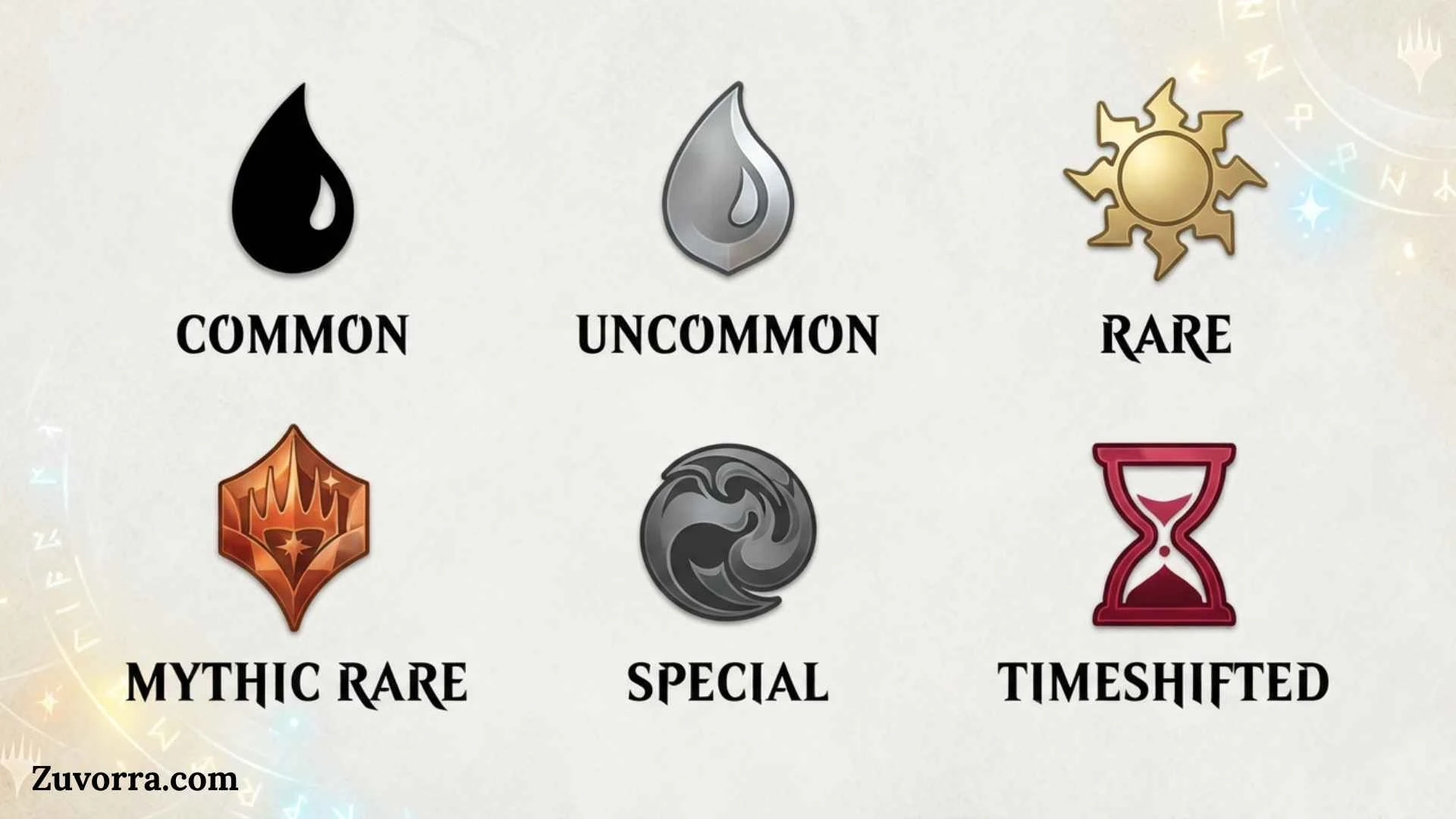
MTG card rarity symbols show how frequently a card appears within a Magic: The Gathering set. On most modern cards, the expansion symbol beside the type line changes color by rarity: black for common, silver for uncommon, gold for rare, and orange-red for mythic rare.
That small icon also identifies the card’s set, so its shape tells you where the card came from, while its color tells you the printed rarity. However, older cards, special bonus sheets, alternate treatments, and unusual products create important exceptions that every player and collector should understand.
Quick Meaning
MTG card rarity symbols identify both a card’s set and its rarity. A black symbol normally means common, silver means uncommon, gold means rare, and orange-red means mythic rare. The symbol’s shape represents the expansion, while its color represents the card’s rarity within that specific printing.
MTG Rarity Symbol Overview
| Symbol Color or Marking | Standard Meaning | Typical Rarity Code | What It Usually Indicates |
| Black | Common | C | Frequently appearing cards that form a set’s foundation |
| Silver | Uncommon | U | Less frequent cards with greater complexity or specialization |
| Gold | Rare | R | Cards printed less often, often with distinctive effects |
| Orange-red | Mythic rare | M | The least frequent standard rarity |
| Purple | Special rarity | Varies | Historically associated with Time Spiral timeshifted cards |
| No colored rarity symbol | Depends on printing | Varies | Common on early cards, tokens, promos, or unusual products |
| Acorn security stamp | Casual-only legality marker | Not a rarity | Identifies certain cards that are not legal in traditional tournament formats |
| Oval security stamp | Authenticity and card-frame feature | Not a rarity | Appears on many modern rares and mythic rares |
| Foil finish | Premium treatment | Unchanged | Does not automatically alter the card’s rarity |
Location on the card: On a traditional Magic card frame, the expansion symbol appears to the right of the type line, between the artwork and rules text.
What Do MTG Card Rarity Symbols Mean?
MTG rarity symbols communicate two separate pieces of information at once.
First, the design or shape identifies the expansion, supplemental product, Commander release, promotional series, or bonus sheet. A set may use a guild mark, weapon, creature silhouette, crown, book, or other image connected to its theme.
Second, the color of that shape normally identifies rarity:
- Black: common
- Silver: uncommon
- Gold: rare
- Orange-red: mythic rare
Wizards of the Coast officially describes common, uncommon, rare, and mythic rare as Magic’s four main rarities. The company also explains that rarity helps control how frequently different cards appear and supports the structure of Limited play, set design, complexity, and collectibility.
Shape and Color Are Not the Same Thing
A frequent beginner mistake is treating the expansion icon itself as the rarity mark. Consider two cards from the same set:
- Both cards display the same expansion-symbol shape.
- The common version displays it in black.
- The rare version displays it in gold.
The cards belong to the same set, but they occupy different rarity levels.
Likewise, two cards from different expansions may both have gold symbols. They are both rares, but their symbol shapes reveal that they came from different sets.
Rarity Belongs to a Specific Printing
Rarity does not permanently belong to a card name. It belongs to a particular version of that card in a particular set.
A card may be:
- Rare in its original expansion
- Uncommon in a later reprint
- Common in a specialized product
- Included on a bonus sheet with a separate rarity structure
This process is often called downshifting when a card moves to a lower rarity. Moving upward to a higher rarity is sometimes called upshifting.
Therefore, never assume that every version of a card has the same symbol color.
The Four Main MTG Rarity Symbols
Black Symbol: Common
A black expansion symbol normally identifies a common card, the most frequently appearing standard rarity.
Commons form the basic structure of most sets. They often include creatures, removal spells, combat tricks, mana fixing, and straightforward effects needed for Draft and Sealed play.
“Common” does not mean useless or financially worthless. Some commons become highly playable because they are efficient, flexible, or important in formats such as Pauper. Older commons can also be scarce because of age, demand, or limited supply.
Silver Symbol: Uncommon
A silver expansion symbol identifies an uncommon card.
Uncommons appear less frequently than commons and often carry more specialized, efficient, or mechanically complex effects. In Limited formats, uncommons frequently support draft themes, reward specific color combinations, or provide stronger build-around cards.
Silver should not be confused with the silver borders used by older humorous “Un-” products. A silver rarity symbol means uncommon. A silver card border historically communicated a different type of casual legality.
Gold Symbol: Rare
A gold expansion symbol identifies a rare card.
Rare cards generally appear less frequently than commons and uncommons. They often include splashy effects, unusual build-around designs, powerful legendary creatures, complex enchantments, specialized lands, and cards that would dominate Limited games if they appeared too often.
However, gold does not guarantee power or value. Some rares serve narrow themes, while some commons become tournament staples. Rarity, competitive strength, and market price are related only indirectly.
Orange-Red Symbol: Mythic Rare
An orange, copper, or reddish-orange expansion symbol identifies a mythic rare.
Mythic rare is the highest of Magic’s four regular rarity levels. Wizards introduced it with Shards of Alara in October 2008. The new level allowed certain cards to appear less frequently than ordinary rares.
Mythic rares often feature:
- Major legendary characters
- Planeswalkers
- Large, dramatic creatures
- Unusual build-around effects
- Story-significant designs
- Mechanically memorable cards
Not every mythic is powerful, expensive, or tournament-ready. The mythic symbol indicates frequency and design position, not a guaranteed level of quality.
History and Origin of MTG Rarity Symbols
Magic: The Gathering launched in 1993, but its earliest cards did not use color-coded expansion symbols to reveal rarity.
Early Expansion Symbols Identified Sets Only
Expansion symbols began appearing early in Magic’s history, starting with releases after the original core set. Their main purpose was to identify the expansion.
Before Exodus, expansion symbols were generally printed in black regardless of whether the card was common, uncommon, or rare. As a result, players could not determine an older card’s rarity simply by looking at the symbol.
Some early core sets had no expansion symbol at all. This is why cards from sets such as Limited Edition Alpha, Limited Edition Beta, Unlimited Edition, Revised Edition, and Fourth Edition require other visual clues for identification.
Exodus Introduced Color-Coded Rarity
Released in June 1998, Exodus introduced two major features: collector numbers and expansion-symbol colors that represented rarity.
Its symbol appeared:
- Black on commons
- Silver on uncommons
- Gold on rares
This change made rarity visible directly on the card rather than forcing players to consult printed checklists, magazines, or community records.
Mythic Rare Expanded the System
For roughly a decade, the standard visible system had three levels. Shards of Alara added mythic rare in 2008, represented by an orange-red version of the set symbol.
Magic has used the four-level structure throughout most modern releases, although product-specific slots, bonus sheets, reprints, and specialty treatments can make pack contents more complicated.
Modern Cards Add More Identification Tools
Modern cards may provide several ways to identify a printing:
- Expansion-symbol shape
- Symbol color
- Three-letter set code
- Collector number
- Copyright line
- Language
- Frame treatment
- Artist credit
- Rarity letter in the collector information
These tools are especially useful when the symbol is difficult to see or when alternate art changes the card’s appearance.
Symbolism and Interpretation
MTG rarity colors are practical classification marks rather than sacred or ancient symbols. Still, their visual hierarchy uses familiar color associations.
Black Suggests a Basic or Standard Level
Black is visually simple and economical. It does not call attention to itself, which suits the most frequent rarity.
The color does not mean that common cards are dark, evil, or connected to black mana. A white, blue, red, green, multicolored, artifact, or colorless card can have a black rarity symbol.
Silver Suggests an Intermediate Tier
Silver visually separates uncommon cards from both the plain black common symbol and the richer gold rare symbol. Its metallic appearance communicates a middle rank without making the card appear to occupy the highest tier.
Gold Signals Scarcity and Importance
Gold has long been associated with wealth, distinction, awards, and prestige in many societies. Magic uses that familiar hierarchy to make rare cards easy to recognize.
This visual meaning remains organizational, not absolute. A gold symbol does not prove that the card is valuable or stronger than every silver-symbol card.
Orange-Red Creates a Level Above Gold
Mythic rare needed to look different from rare while still appearing premium. Its orange-red metallic appearance is warmer and more intense than gold, helping it stand out in a booster pack.
The name “mythic” also suggests characters, objects, or events of exceptional narrative or imaginative importance. Yet mythic rarity remains a production and design category, not a judgment that every card depicts mythology.
Cultural Significance in the Magic Community
MTG rarity symbols have developed a shared meaning across an international player and collector community.
A player opening a booster in the United States, Japan, Germany, Brazil, or another market can usually recognize rarity without translating the card’s text. The colors function as a largely language-independent classification system.
Within the community, the symbols influence several experiences:
Booster Opening
Players often watch the color of the expansion symbol when revealing a card. Gold and orange-red symbols create anticipation because those cards normally occupy less frequent slots.
Draft and Sealed Play
Rarity helps players understand a set’s structure. Commons establish repeatable mechanics, uncommons point toward archetypes, and rares or mythic rares often create memorable moments.
Collecting
Collectors may organize binders by:
- Set
- Collector number
- Color
- Card type
- Rarity
- Foil treatment
- Artwork variation
The expansion-symbol color provides a fast sorting tool, although it cannot identify every modern variant by itself.
Trading and Pricing
Players commonly mention rarity while discussing trades, but experienced collectors know that rarity is only one factor in price. Format demand, supply, age, condition, artwork, language, printing quantity, and reprint history may matter more.
Technical Meaning in Game and Set Design

Rarity is part of Magic’s technical design system. It affects how often cards appear, how Limited environments function, and where designers place complexity.
Frequency in Products
A standard booster product usually contains more commons and uncommons than rares or mythic rares. Exact pack structures vary by product and release, especially with Play Boosters, Collector Boosters, Commander products, bonus sheets, and special inserts.
Because configurations change, the expansion-symbol color should identify the printed rarity rather than be treated as a promise about a particular booster’s contents.
Complexity Management
Designers often put straightforward, repeatable effects at common. More specialized interactions may appear at uncommon, while highly complex or dramatic designs often appear at rare or mythic rare.
This is not a strict power ladder. A simple removal spell may be extremely strong at common, while a complicated rare may be intended mainly for casual deck building.
Limited Environment Control
Cards that would become frustrating or repetitive when opened often may be placed at a higher rarity. This helps prevent every Draft or Sealed pool from being dominated by the same unusual effect.
Digital Identification
Digital card databases and deck-building platforms often represent rarity with letters:
- C for common
- U for uncommon
- R for rare
- M for mythic rare
Official Magic card codes have also used additional classifications for basic lands, tokens, and special categories, showing that internal data systems can be more detailed than the four visible colors.
Where MTG Rarity Symbols Are Used
You can encounter rarity symbols in several places beyond a physical card.
Physical Cards
The traditional location is beside the type line. Borderless and showcase treatments may alter the layout, but the set icon and collector information usually remain available.
Official Card Galleries
Wizards of the Coast publishes card image galleries for current sets. These galleries allow players to examine card treatments, expansion symbols, set codes, and collector numbers.
Gatherer and Card Databases
Official and third-party databases allow users to filter cards by rarity, set, format legality, color, type, and other characteristics. Gatherer, Wizards’ official card database, lists the rarity assigned to each printing.
Booster Packaging and Product Guides
Official collecting guides explain which rarities and treatments may appear in each booster slot. This matters because current products can mix cards from a main set, Commander set, Special Guests group, bonus sheet, or reprint list. For example, Magic: The Gathering Foundations products use distinct set codes and symbols for FDN, J25, FDC, and SPG cards.
Collection Apps and Store Listings
Scanning apps, inventory programs, online marketplaces, and game stores use rarity data to identify versions and organize stock. Accurate identification requires more than selecting “rare”; the set symbol and collector number are equally important.
Common Variations and Special Symbols
The standard four colors cover most modern cards, but several exceptions deserve attention.
Purple Time Spiral Symbol
The original Time Spiral timeshifted sheet used a purple expansion symbol. Wizards treated these cards as a special rarity because they appeared through a dedicated booster slot rather than the normal common, uncommon, and rare structure.
Purple is therefore not a fifth universal rarity used across all Magic sets. It belongs to a specific historical product structure.
Pre-Exodus Black Symbols
A black symbol on a card printed before Exodus does not reliably mean common. Earlier symbols did not use color to show rarity, so rare and uncommon cards could also display black icons.
Check the set, card list, collector records, or an official database instead.
Cards Without Expansion Symbols
Some early core-set cards have no expansion symbol. Certain tokens, promotional objects, playtest cards, and specialty printings may also use layouts that do not follow the normal system.
The lack of a symbol does not automatically mean the card is common, fake, or misprinted.
Bonus-Sheet and Special-Guest Symbols
A booster may contain cards from a separately identified bonus group. These cards can have their own set code, symbol, collector-number sequence, and rarity distribution.
Their inclusion does not always make them legal in the same formats as the main expansion. Set membership, rarity, and format legality are separate properties.
Foil and Showcase Treatments
A foil card normally keeps the rarity of its non-foil version. Likewise, borderless art, extended art, retro frames, serialized treatments, and showcase frames do not create a new standard rarity by themselves.
A premium treatment may be harder to open than a regular version, but pull frequency is not the same as printed rarity.
Acorn and Oval Stamps
The security stamp at the bottom of certain modern cards should not be confused with the expansion symbol.
In Unfinity, an acorn-shaped stamp marks cards intended for casual Un- play rather than traditional tournament formats. An oval stamp identifies cards handled through the normal Eternal-legality system. These stamps concern authenticity or legality, not common, uncommon, rare, or mythic status.
How to Identify a Card’s Rarity
Use this quick decision guide:
Does the card have a modern expansion symbol?
↓
Yes: Check its color.
- Black = common
- Silver = uncommon
- Gold = rare
- Orange-red = mythic rare
↓
Is the card from before June 1998?
- Do not trust the symbol color alone.
- Search the exact set and card name.
↓
Does it have a purple or unusual symbol?
- Check whether it belongs to a bonus sheet or special rarity.
↓
Is it foil, borderless, showcase, or extended art?
- The treatment may be scarce, but it does not automatically change rarity.
↓
Still uncertain?
- Use the set code and collector number in an official card database.
Common Misconceptions
“Every Black Symbol Means Common”
This is true for most regular cards printed from Exodus onward, but not for earlier cards. Pre-Exodus symbols did not communicate rarity through color.
“Mythic Rare Means the Card Is Powerful”
Mythic cards are less frequent in standard rarity structures, but they are not guaranteed to be competitively strong. Power depends on format, rules interactions, mana cost, deck support, and metagame conditions.
“Rare Cards Are Always Expensive”
Many rares have low market prices because supply exceeds demand. Meanwhile, useful commons and uncommons may become valuable due to competitive play, scarcity, older print runs, or limited reprints.
“Foil Is a Rarity”
Foil is a finish or treatment. A foil common remains a common unless the specific printing is officially assigned another rarity.
“The Gold Oval at the Bottom Means Rare”
The oval security stamp is not the rarity symbol. Look beside the type line or check the collector information.
“All Versions of a Card Have One Rarity”
Reprints can change rarity. Always identify the exact set and collector number before recording a card as common, uncommon, rare, or mythic rare.
“The Set Symbol Determines Format Legality”
The set symbol helps identify the printing, but legality depends on the format’s card pool, banned lists, release rules, and sometimes special markings. A reprint does not necessarily make a card Standard-legal.
Interesting Facts About MTG Rarity Symbols
- Rarity colors arrived years after Magic began. The game launched in 1993, but visible rarity colors did not appear until Exodus in 1998.
- Collector numbers and rarity colors debuted together. Both features made collections easier to catalog and complete.
- Mythic rare is younger than the original three-level system. It debuted with Shards of Alara in October 2008.
- Purple has been used as a true special rarity color. The Time Spiral timeshifted sheet occupied its own booster slot and received a purple symbol.
- Early rare cards can have black symbols. This is one of the most important exceptions for people sorting older collections.
- A card’s rarity can change when reprinted. The same name may appear with different symbol colors in different sets.
- Rarity does not equal price. Demand, supply, format use, condition, and version often influence value more strongly.
- Basic lands do not always follow a single visual rule. They may have special collector classifications, dedicated slots, or set-specific treatments.
- A booster can contain several expansion symbols. Modern products may combine a main set with Commander cards, bonus sheets, Special Guests, or other inserts.
- Premium scarcity and printed rarity are different. A serialized or special-foil rare can be far harder to find than an ordinary mythic while still retaining the printed “rare” classification.
- The symbol system crosses language barriers. Players can often identify a set and rarity even when they cannot read the card’s language.
- Some symbols communicate legality rather than rarity. The acorn stamp is the clearest modern example.
Related MTG Symbols
| Related Symbol | Meaning | How It Differs from Rarity Symbols |
| Expansion-symbol shape | Identifies the set or product | Its color, not merely its shape, usually shows rarity |
| Mana symbols | Show mana costs or mana production | Affect gameplay rather than print frequency |
| Tap symbol | Instructs a permanent to become tapped | Represents a game action |
| Color indicator | Defines a card’s color in certain cases | Does not show rarity |
| Oval security stamp | Anti-counterfeit and frame feature | Not a rarity level |
| Acorn stamp | Marks certain casual-only cards | Communicates legality, not frequency |
| Planeswalker mark on The List | Identifies a special reprint source | Does not make the card Standard-legal |
| Collector number | Identifies a card’s position within a product | Helps distinguish exact printings |
| Set code | Short text identifier for a release | Complements the visual expansion symbol |
Frequently Asked Questions
What do the colors of MTG set symbols mean?
Black normally means common, silver means uncommon, gold means rare, and orange-red means mythic rare. This system applies to most standard cards printed from Exodus onward. Older cards and special products may require an official card database because their symbols do not always follow the modern color system.
Where is the rarity symbol on an MTG card?
On a traditional card frame, the expansion symbol appears to the right of the type line, below the artwork. Its shape identifies the set, while its color usually identifies rarity. Modern cards may also print a C, U, R, or M in the collector-information line near the bottom.
What is the rarest MTG symbol color?
Orange-red represents mythic rare, the least frequent of the four regular rarity levels. Certain special treatments, serialized cards, promotional versions, and bonus-sheet cards may be harder to obtain, but those are product-specific forms of scarcity rather than additional universal rarity colors.
What does a purple rarity symbol mean in MTG?
Purple is best known as the special rarity color used for the original Time Spiral timeshifted cards. Those cards appeared in a dedicated booster slot. Purple is not a normal rarity used across current sets, so it should not be treated as universally higher or lower than mythic rare.
Does a gold MTG symbol mean the card is valuable?
No. A gold symbol means the card was printed at rare in that set. Market value depends on play demand, supply, age, card condition, artwork, treatment, language, reprint history, and collectibility. Many rares are inexpensive, while certain commons and uncommons can command higher prices.
Can the same MTG card have different rarity symbols?
Yes. Wizards may reprint a card at a different rarity to fit a set’s Draft environment, theme, complexity needs, or product structure. One printing might be rare while another is uncommon. Use the expansion symbol, set code, and collector number to identify the exact version.
Are foil MTG cards automatically rare?
No. Foil describes the card’s reflective finish, not its rarity. A foil common is still officially a common, and a foil uncommon remains uncommon. Some foil treatments may be difficult to open, but their product scarcity should not be confused with the card’s printed rarity.
Why do some old rares have black expansion symbols?
Before Exodus introduced color-coded rarity symbols in June 1998, expansion symbols were generally black regardless of rarity. An older rare may therefore display the same black symbol as a common. Consult the card’s original set listing rather than applying modern color rules.
Is the acorn symbol a rarity symbol?
No. The acorn stamp used on certain Unfinity and playtest-style cards indicates that the card is intended for casual Un- play and is not legal in most traditional tournament formats. It does not mean common, uncommon, rare, mythic rare, or a special pull level.
Do rarity symbols determine whether a card is legal in Commander?
No. Commander legality depends on the format’s rules and banned list, not simply the symbol’s color. Set identity can help determine a printing’s origin, but reprints, bonus sheets, and special marks may follow separate legality rules. Check the card’s current official format status.
Key Takeaways
- MTG card rarity symbols use black, silver, gold, and orange-red for the four main rarity levels.
- The symbol’s shape identifies the set, while its color identifies rarity.
- Color-coded rarity began with Exodus in June 1998.
- Mythic rare debuted with Shards of Alara in October 2008.
- Cards printed before Exodus may have black symbols regardless of rarity.
- Purple represents a product-specific special rarity, most notably in Time Spiral.
- Foil, showcase, borderless, and serialized treatments are not separate standard rarities.
- Rarity does not guarantee competitive power or financial value.
- The oval security stamp and acorn stamp are not rarity symbols.
- Always use the set code and collector number when identifying an unusual printing.
Conclusion
MTG card rarity symbols provide a fast visual language for understanding a card’s place within a set. Black marks common, silver marks uncommon, gold marks rare, and orange-red marks mythic rare, while the icon’s shape identifies the card’s expansion or product.
That simple system becomes more complex when older cards, reprints, bonus sheets, premium treatments, and legality stamps enter the picture. By separating set identity, printed rarity, product scarcity, treatment, and format legality, you can identify cards more accurately, organize a collection more confidently, and avoid common mistakes when buying, trading, or building decks.
References
- Wizards of the Coast, “Anatomy of a Magic Card.” Explanation of expansion-symbol placement and standard rarity colors.
- Wizards of the Coast, “Which Came First?” History of collector numbers, rarity indicators, and mythic rare.
- Wizards of the Coast, “Quite the Rarity.” Overview of the four main rarities and their role in card design.
- Wizards of the Coast, “Nuts & Bolts #1: Card Codes.” Official rarity codes and internal classifications.
- Wizards of the Coast, “Purple Reign.” Explanation of the special purple rarity used for timeshifted cards.
- Wizards of the Coast, “Unfinity Release Notes.” Explanation of acorn stamps, Eternal legality, and Un- cards.

I’m Felix Everard, a British writer passionate about the fascinating world of symbols and visual communication. I explore traditional, cultural, historical, and modern symbols, focusing on what they represent and why they matter. Through accessible explanations, I hope to help readers recognise the meanings hidden within familiar signs, shapes, and images.
Books:
- The Complete Guide to Symbolism
- Decoding Signs and Symbols