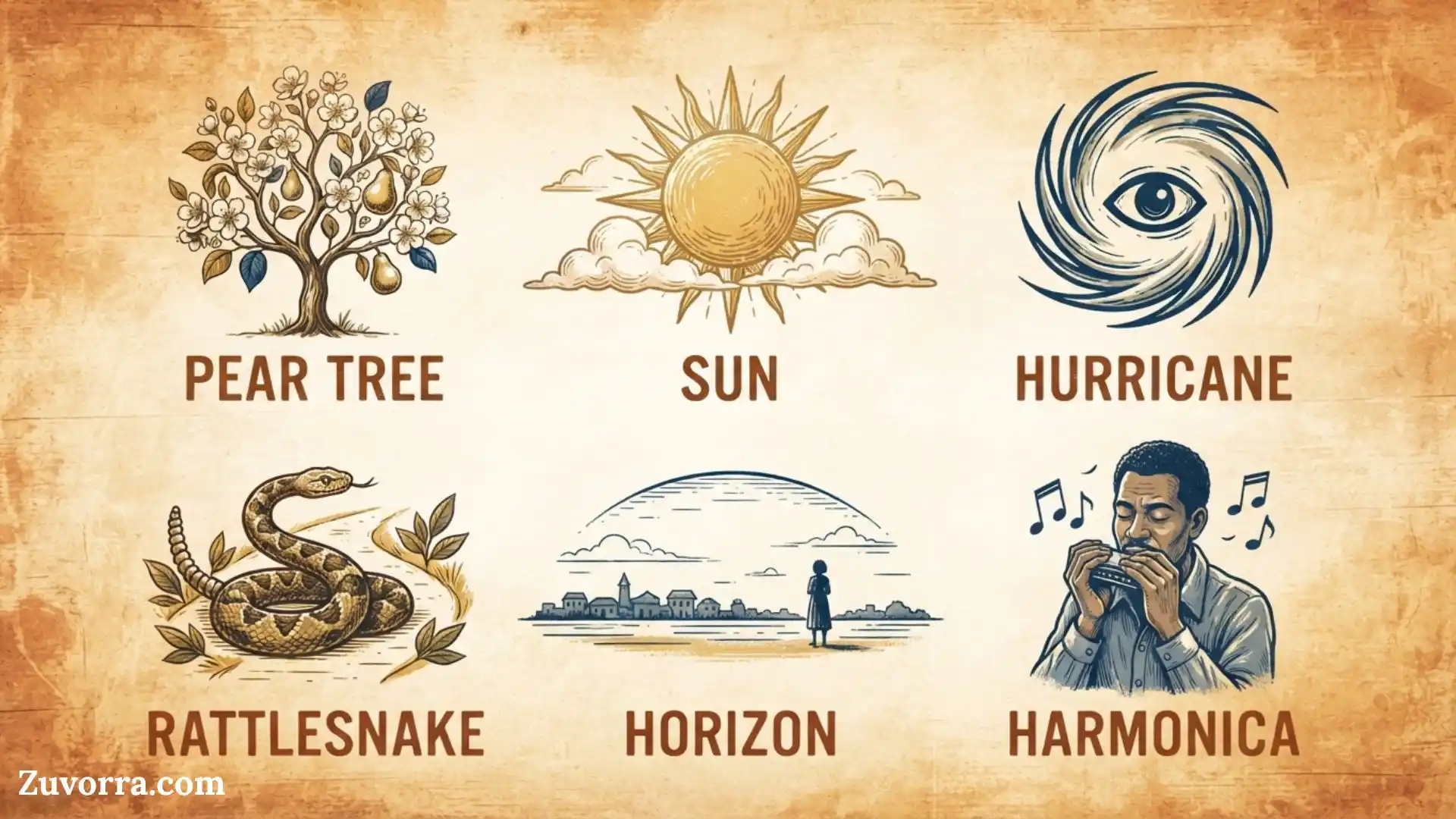
The major Their Eyes Were Watching God symbols reveal Janie Crawford’s search for love, freedom, identity, and a voice of her own. The pear tree represents her ideal vision of love, the horizon symbolizes possibility, her hair expresses independence, the mule reflects oppression, and the hurricane exposes the limits of human power.
These images are more than decorative details. Zora Neale Hurston repeats and transforms them as Janie moves through three marriages, several communities, and different stages of self-discovery.
Understanding the novel’s symbolism helps readers see how nature, gender, race, language, work, and power shape Janie’s life. It also explains why the ending is not simply about loss. It is about a woman who has gained the authority to define her own experience.
Quick Meaning
In Their Eyes Were Watching God, the central symbols trace Janie Crawford’s journey toward selfhood. The pear tree represents ideal love, the horizon represents possibility, hair symbolizes independence, the mule reflects the burden placed on Black women, and the hurricane represents nature’s overwhelming power and human vulnerability.
Symbol Overview Table
| Symbol | Primary Meaning | Connection to Janie | How Its Meaning Develops |
| Pear tree | Love, sexuality, harmony, awakening | Shapes Janie’s first idea of a fulfilling relationship | Changes from a youthful dream into a standard by which she judges love |
| Horizon | Possibility, freedom, an expanded life | Represents the experiences Janie wants to reach | Moves from distant longing to inward wisdom |
| Janie’s hair | Independence, beauty, sexuality, identity | Shows her resistance to control | Becomes especially important when Jody forces her to cover it |
| Mule | Labor, oppression, voicelessness | Mirrors Janie’s treatment within marriage and society | Connects gender oppression with racial and economic burdens |
| Hurricane | Nature, uncertainty, human powerlessness | Tests Janie and Tea Cake’s relationship | Destroys the illusion that people can control every outcome |
| Porch | Community, storytelling, judgment, exclusion | Offers social life but often denies Janie equal participation | Becomes a symbol of both cultural richness and public control |
| Road and gate | Choice, departure, transition | Mark Janie’s movement into new stages of life | Show the risks and possibilities involved in leaving familiar roles |
| Head-rag | Control, restriction, suppressed identity | Jody requires Janie to hide her hair | Represents the policing of female visibility and desire |
| Store | Status, labor, public performance | Gives Janie social importance but limits her voice | Represents the difference between appearing powerful and being free |
| Overalls | Work, equality, unconventional womanhood | Associated with Janie’s life with Tea Cake | Suggest comfort, participation, and freedom from rigid respectability |
| Water | Life, danger, change, renewal | Appears most powerfully during the hurricane | Shows that nature can sustain and destroy without moral distinction |
| Bees and blossoms | Mutuality, desire, creative union | Form Janie’s first image of love | Become a measure of emotional and physical connection |
What Do the Symbols Mean?
The symbols primarily show the difference between the life Janie imagines, the roles society assigns her, and the identity she eventually creates for herself.
At the beginning of the novel, Janie does not yet have clear language for her desires. She understands herself through images. The blooming pear tree gives visible form to her longing for love. The horizon gives shape to her wish for a larger life. Later, the mule helps explain the burden imposed on women like her.
Each major symbol therefore performs two jobs. It reveals Janie’s inner feelings, and it exposes the social forces surrounding her. Hurston uses natural images to express private desire while using objects, clothing, work, and public spaces to reveal social control.
The symbols also change as Janie matures. The horizon initially seems like something another person might offer her. By the end, she no longer treats fulfillment as a distant object controlled by a husband. She carries the meaning of her experiences within herself.
Historical and Literary Origins
Their Eyes Were Watching God was published in 1937 and follows Janie Crawford as she recounts her life from adolescence to mature independence. Much of the novel takes place in Florida, including Eatonville, a historically important Black town, and the agricultural region around Lake Okeechobee.
Hurston’s symbolic style grew from several parts of her background. She was a novelist, folklorist, and anthropologist who studied Black speech, storytelling, music, customs, and oral traditions in the American South and the Caribbean. Her work preserved cultural expression that mainstream American institutions often ignored or distorted.
The novel blends lyrical narration with vernacular dialogue. This combination matters because symbolism appears in both forms. The narrator describes Janie’s inner life through poetic natural images, while characters use metaphors, jokes, folk sayings, exaggeration, and stories in everyday conversation.
Hurston wrote during the broader cultural period associated with the Harlem Renaissance and the New Negro movement. Yet the novel does not function as a simple political statement. It focuses closely on one Black woman’s emotional, social, and spiritual development. Its symbols connect Janie’s personal struggles to wider questions of race, gender, labor, community, and freedom.
The book initially received divided responses, but its reputation grew strongly after Hurston’s work was revived in the 1970s. It is now widely studied for its treatment of voice, identity, folklore, gender, love, and Black cultural life.
Major Symbolism and Interpretation
The Pear Tree: Ideal Love and Sexual Awakening
The pear tree symbolizes Janie’s first vision of love as a natural, mutual, and joyful union.
As a teenager, Janie watches bees move among the blossoms of a blooming pear tree. The scene awakens her awareness of sexuality, intimacy, and emotional harmony. She sees connection as something reciprocal: the bee and blossom participate together in a living process.
This experience becomes her private model for marriage. She does not simply want security or social respect. She wants desire, tenderness, equality, and shared fulfillment.
That ideal creates conflict because her first marriage to Logan Killicks offers protection and property but little emotional closeness. Janie learns that marriage does not automatically produce love. Her pear-tree ideal is beautiful, but it is also incomplete because it comes from observation rather than experience.
The symbol remains important throughout the novel. Janie continues searching for a relationship that resembles the natural harmony she once witnessed. Tea Cake comes closest to fulfilling that hope because he offers companionship, play, conversation, attraction, and shared activity.
However, even their relationship is not perfect. Jealousy, violence, economic risk, illness, and tragedy complicate it. The pear tree therefore represents both a worthy desire and the danger of expecting human love to remain as flawless as an imagined natural scene.
The Horizon: Freedom, Possibility, and Self-Discovery
The horizon represents the life beyond Janie’s present limits.
A horizon can be seen but never permanently reached. As a result, it perfectly expresses desire, possibility, mystery, and movement. Janie repeatedly looks beyond the boundaries others create for her.
When Joe Starks appears, he seems to offer a wider horizon. He speaks of ambition, change, ownership, and a new Black town. Janie leaves Logan because Joe appears connected to a larger future.
Yet Joe soon turns possibility into restriction. He gains public authority while silencing Janie. She becomes part of his image of success rather than an equal participant in it. The horizon he promised becomes another controlled space.
Tea Cake opens a different horizon. Life with him includes risk and hardship, but it also gives Janie access to play, work, music, travel, conversation, and companionship. She participates instead of merely representing her husband’s status.
By the end of the novel, Janie metaphorically draws the horizon inward. The image suggests that she has transformed distant longing into lived knowledge. She no longer needs another person to promise her a larger life. Her horizon has become part of her identity. Literary guides commonly interpret it as the realm of possibility and Janie’s desire for a fuller existence.
Janie’s Hair: Independence, Sexuality, and Personal Power
Janie’s long hair symbolizes her individuality, sensuality, youthfulness, and refusal to fit narrow expectations.
Other characters notice it because it makes her visible. It distinguishes her from the community and challenges conventional images of how a respectable married woman should present herself.
Joe Starks becomes threatened by the attention Janie receives. He orders her to cover her hair while working in the store. The head-rag is not merely practical clothing. It becomes an instrument of control.
By hiding her hair, Joe tries to regulate how other people see Janie and how Janie expresses herself. His jealousy reveals that he treats her beauty as property belonging to him.
After Joe’s death, Janie removes the head covering and lets down her hair. This private act marks a major change. Before presenting the expected public image of a grieving widow, she recognizes her regained freedom.
Hair should not be reduced to sexuality alone. It also represents ownership of the self. Janie’s ability to uncover, arrange, and display it on her own terms reflects her growing authority over her body and identity.
The Mule: The Burden Placed on Black Women
The mule symbolizes labor, exploitation, humiliation, and voiceless suffering.
Janie’s grandmother explains that Black women are treated like the “mule” of the world. Her metaphor connects racial oppression, gender inequality, economic labor, and domestic service. Black women are expected to carry heavy burdens while receiving little protection or recognition.
The abused mule in Eatonville repeats this idea in a visible form. The townspeople joke about it, turning suffering into public entertainment. Janie identifies emotionally with the animal because she understands what it means to be worked, controlled, and discussed by others.
Joe buys the mule and allows it to rest. On the surface, this seems compassionate. Yet his gesture is complicated. He performs his generosity publicly and gains admiration from the town, while continuing to restrict Janie inside their marriage.
This contrast exposes a major irony: Joe recognizes oppression when it appears in an animal, but not when he participates in it at home.
The mule’s death and funeral also show Hurston’s use of folk humor. The scene is comic, but its symbolism remains serious. The community can speak creatively about suffering while still failing to challenge the human systems that produce it.
The Hurricane: Nature’s Power and Human Vulnerability
The hurricane symbolizes forces that no person can fully control.
Before the storm, people on the muck believe they can judge the weather and protect their earnings. Many delay leaving because the danger does not yet seem real. Their confidence collapses when the hurricane arrives.
During the storm, social status, money, gender roles, and personal confidence lose much of their power. Everyone must face the same elemental danger. The characters wait in darkness, watching for some sign of meaning or control.
The storm does not act as a simple punishment. It harms people without dividing the innocent from the guilty. That is why the hurricane should not be read as proof that every tragedy has a clear moral explanation.
Instead, it reveals the limits of human certainty. People make choices, but they live within natural, social, and biological conditions they cannot master.
The hurricane also changes Janie’s relationship with Tea Cake. He saves her during the flood but is bitten by a rabid dog. The rescue leads indirectly to his illness and death. Heroism and tragedy become inseparable.
Through the hurricane, Hurston shows that love can be genuine without protecting people from loss. Human connection matters precisely because life remains uncertain.
Cultural and Social Significance
The symbols reflect Black life in the early twentieth-century American South, but they should not be treated as universal statements about every Black community or every woman’s experience.
Eatonville represents Black political independence, business ownership, community storytelling, and civic ambition. However, it is not free from hierarchy. Men dominate the porch conversations, Joe controls public life, and Janie is expected to support her husband’s status without expressing equal authority.
The muck near Lake Okeechobee offers a different social setting. People work hard, but they also gather for music, dancing, gambling, storytelling, and conversation. Janie participates more openly there than she did as the mayor’s wife.
This contrast complicates simple ideas of status. In Eatonville, Janie has property and public importance but limited freedom. On the muck, she performs agricultural labor but experiences greater social and emotional participation.
The mule carries special cultural weight because it joins racial, gender, and labor history. It represents the expectation that Black women should endure burdens for families, employers, husbands, and communities.
The porch also has a double meaning. It preserves oral culture through jokes, tales, verbal contests, and collective memory. At the same time, it can become a place of gossip, ridicule, exclusion, and public judgment.
Hurston therefore presents community as both sustaining and restrictive. Janie needs human connection, but she also needs enough independence to resist being defined by the crowd.
Religious and Spiritual Meaning
The novel’s spiritual symbolism centers on nature, mortality, fate, and the human search for meaning.
The title becomes most significant during the hurricane. Faced with darkness and danger, the characters look outward as though waiting for divine guidance. Their “watching” suggests dependence, fear, humility, and uncertainty.
God in this context is not presented through a detailed theological argument. Instead, divine power is associated with everything beyond human command: wind, water, death, chance, time, and the unknown.
The title can therefore be read in several ways:
- People look to God because they have lost control.
- They seek meaning when ordinary knowledge fails.
- They hope for rescue but receive no simple guarantee.
- They recognize that human ambition has limits.
- They confront a universe that may not explain itself.
The pear tree also carries spiritual overtones because Janie experiences nature as a source of revelation. It teaches her something about unity, creation, desire, and the life she wants.
Yet nature is not always gentle or sacred in a comforting sense. The same natural world that produces blossoms and love also produces storms, disease, and death.
Hurston’s spiritual vision is therefore balanced. Nature can inspire wonder, but it does not promise safety. Faith can offer a way to face uncertainty, but it does not erase human suffering.
The Symbolism of Voice and Silence
Voice is not a physical symbol, but it functions as one of the novel’s central motifs.
Janie’s development is often measured by whether she can speak, whether others listen, and whether she chooses silence for herself.
During her marriage to Joe, she works in a public store but is denied full participation in public speech. Joe prevents her from addressing the town and discourages her from joining porch conversations. Her silence supports his authority.
Over time, Janie develops the confidence to challenge him. Her public response to his insults damages the image of masculine power he has carefully built. Speech becomes an act of resistance.
However, the novel does not suggest that speaking constantly equals freedom. Janie’s mature silence differs from her earlier forced silence. At the beginning and end, the townspeople speculate about her. She chooses to tell her story to Pheoby rather than perform it for everyone.
That choice matters. Freedom includes the right to speak, but it also includes the right to decide when, how, and to whom one’s story will be told.
Where the Symbols Appear
In the Framing Story
The novel begins after Janie returns to Eatonville. Her overalls, loose hair, and refusal to satisfy the gossiping crowd immediately introduce questions of identity, respectability, judgment, and self-possession.
In Janie’s Marriages
Each marriage changes the meaning of recurring symbols:
- Logan turns marriage into labor and security without love.
- Joe connects ambition with status, ownership, silence, and appearance.
- Tea Cake brings companionship and greater freedom, but not a life without danger or conflict.
In Community Spaces
The porch and store symbolize public storytelling. They preserve culture but also reinforce social rules about gender, reputation, age, class, and acceptable behavior.
In Nature
Trees, blossoms, horizons, wind, water, animals, and changing seasons mirror Janie’s emotional life. Nature is not just background scenery. It provides the language through which she first understands desire and later confronts mortality.
In Clothing
The head-rag, mourning clothes, and overalls mark different roles. Clothing shows how Janie is expected to appear and how she gradually chooses her own presentation.
Common Variations and Connected Motifs
Trees, Blossoms, and Bees
These related images represent growth, fertility, attraction, mutual exchange, and creative energy. Together, they form Janie’s ideal of a balanced relationship.
Roads, Gates, and Travel
These images represent decisions and transitions. Janie repeatedly crosses boundaries when she leaves one stage of life for another.
The Store and the Porch
Both are social spaces, but they differ in function. The store connects commerce and status, while the porch emphasizes performance, storytelling, humor, and public judgment.
Water and Wind
Water may sustain crops and life, but floodwater becomes deadly. Wind can suggest movement and change, yet hurricane winds destroy human plans. Their instability reflects life’s unpredictability.
Clothing and Hair
Both concern visibility. Hair expresses Janie’s individuality, while clothing can signal mourning, labor, respectability, social rank, or freedom from convention.
Light and Darkness
Light often accompanies recognition, desire, and natural beauty. Darkness during the hurricane represents fear, uncertainty, and the inability to see what comes next.
Common Misconceptions
The Pear Tree Does Not Simply Mean Romance
The pear tree represents an ideal of mutual love, sexuality, harmony, and natural fulfillment. It also reveals how a youthful ideal can shape adult expectations.
Tea Cake Is Not a Perfect Pear-Tree Partner
Tea Cake gives Janie companionship and experiences she lacked before, but their relationship includes jealousy, violence, gambling, economic danger, and tragedy. The novel does not present him as flawless.
The Horizon Does Not Mean Escape Alone
Escape is part of its meaning, but the horizon also represents imagination, knowledge, future experience, and the ongoing expansion of identity.
Hair Is Not Only a Beauty Symbol
Janie’s hair relates to beauty and sexuality, but its deeper meaning concerns autonomy. The central issue is who controls its visibility.
Joe’s Treatment of the Mule Does Not Prove He Respects Janie
His public kindness toward the mule contrasts with his private treatment of his wife. The scene exposes his blindness and hypocrisy.
The Hurricane Is Not Clearly Divine Punishment
The storm reveals human vulnerability, but the novel does not identify a single moral reason for every death or injury.
Janie’s Return Does Not Represent Defeat
She returns without Tea Cake, but she brings knowledge, memory, independence, and control over her own story. Her physical return is paired with inward growth.
Interesting Facts About the Novel’s Symbols
- The central love symbol appears before Janie understands marriage.
The pear tree gives her an emotional standard before she has enough experience to know how difficult such harmony may be between people. - The horizon changes direction at the end.
Janie spends much of her life looking toward it, but finally draws it inward. The shift turns an external goal into internal wisdom. - A rescued animal exposes human hypocrisy.
Joe receives praise for helping the mule while denying Janie similar freedom, making the rescue morally ironic. - Clothing reveals social power.
The head-rag and mourning clothes show roles placed on Janie, while overalls represent a less conventional and more active identity. - The porch is both a cultural treasure and a social court.
It protects oral storytelling but also judges anyone who violates community expectations. - Nature has no single moral meaning.
The pear tree inspires love, while the hurricane brings terror. Hurston refuses to divide nature into purely good and evil forces. - Janie’s voice grows before her circumstances fully change.
She begins resisting Joe verbally while still living under his control, showing that inner freedom may develop before external freedom. - The mule symbol links several forms of inequality.
It represents not only hard work but the combined weight of racism, sexism, poverty, and domestic obligation. - The hurricane transforms a familiar setting into an unknown world.
Water erases boundaries, roads, fields, and homes, showing how quickly human order can disappear. - The framing structure turns storytelling into self-definition.
Janie does not merely experience events. By choosing how to narrate them, she gives them meaning. - Public and private identity often conflict.
Janie may appear privileged as the mayor’s wife while privately experiencing loneliness and suppression. - The novel ends with possession, but not material possession.
Janie’s most valuable possession is her integrated experience: love, grief, memory, self-knowledge, and a story she can tell on her own terms.
Related Literary Symbols
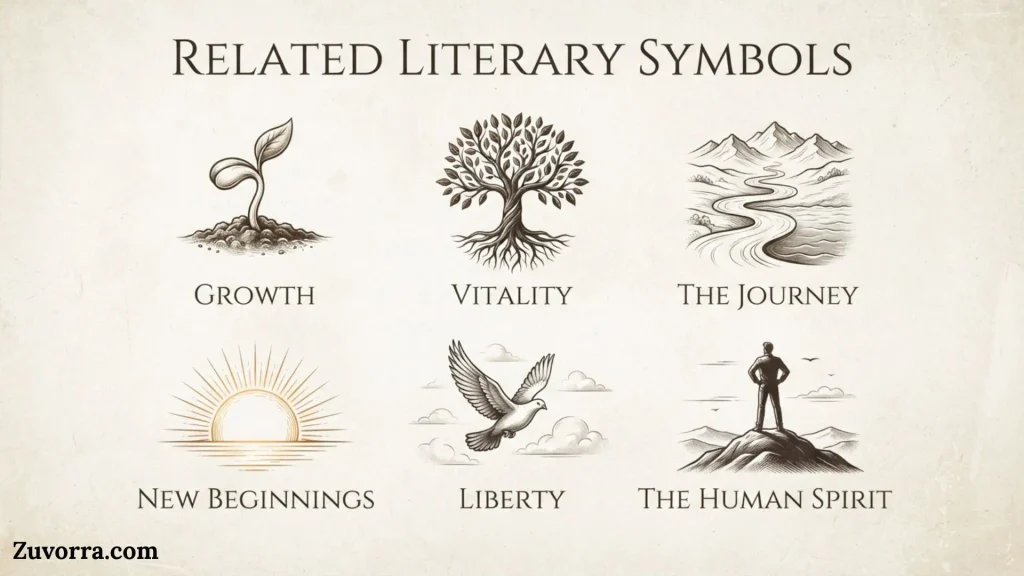
The Sea
Like the horizon and hurricane, the sea often represents freedom, mystery, danger, and forces beyond human control. Unlike the novel’s horizon, however, the sea more often emphasizes depth and instability than distant possibility.
Birds
Birds commonly represent freedom and escape. Janie’s symbolism is more grounded in trees, roads, hair, and horizons, which connect freedom with growth, movement, embodiment, and lived experience.
The Caged Animal
The caged-animal image often represents direct confinement. Hurston’s mule symbol is more specific because it emphasizes forced labor, burden, ownership, and social exhaustion.
Masks
Masks symbolize hidden identity or social performance. Janie’s head-rag and role as the mayor’s wife serve a similar purpose by concealing parts of her personality behind an acceptable public image.
Doors and Gates
These represent thresholds and decisions. In Janie’s story, leaving through a gate or traveling down a road often begins a new stage of self-discovery.
Storms
Storms in literature may symbolize emotional conflict, divine judgment, political disorder, or transformation. Hurston’s hurricane most strongly emphasizes vulnerability, uncertainty, and the indifference of natural power.
Frequently Asked Questions
What are the most important symbols in Their Eyes Were Watching God?
The most important symbols are the pear tree, horizon, Janie’s hair, the mule, and the hurricane. Other significant images include the porch, head-rag, store, road, overalls, bees, blossoms, water, and voice. Together, they trace Janie’s movement from youthful desire and social restriction toward experience, independence, and self-knowledge.
What does the pear tree symbolize?
The pear tree symbolizes Janie’s ideal vision of love as natural, mutual, passionate, and harmonious. Watching bees interact with the blossoms awakens her emotional and sexual consciousness. She later measures her marriages against this image, although experience teaches her that human relationships are more complicated than the perfect natural union she first imagined.
What does the horizon symbolize?
The horizon symbolizes possibility, freedom, dreams, experience, and the life beyond Janie’s present limits. At first, she believes other people may lead her toward it. By the ending, she has gained enough experience to draw the horizon inward, suggesting that fulfillment and wisdom now belong to her rather than remaining distant promises.
Why is Janie’s hair important?
Janie’s hair represents independence, beauty, sexuality, youthfulness, and control over personal identity. Joe forces her to cover it because he dislikes the attention it receives. When Janie removes the head-rag after his death, the action marks her release from his authority and her renewed ownership of her body and appearance.
What does the mule represent?
The mule represents the heavy labor, exploitation, humiliation, and silence imposed on Black women. Janie identifies with the overworked Eatonville mule because she also feels controlled and denied a voice. Joe’s decision to rescue the animal becomes ironic because he fails to recognize the similar restrictions he places on his wife.
What is the meaning of the hurricane?
The hurricane represents nature’s uncontrollable power and the limits of human knowledge. It strips away confidence, wealth, social position, and ordinary routines. It also sets in motion the events that lead to Tea Cake’s death, showing that love and courage cannot guarantee safety in an unpredictable world.
What does the title Their Eyes Were Watching God mean?
The title refers to people facing a crisis beyond their control and looking toward divine power for meaning, guidance, or rescue. During the hurricane, human knowledge becomes inadequate. The title captures fear, dependence, uncertainty, and the recognition that people cannot fully command nature, fate, illness, or death.
What does the porch symbolize?
The porch symbolizes community storytelling, humor, cultural memory, gossip, performance, and public judgment. It gives Eatonville a lively collective voice, yet it often excludes Janie from equal participation. The porch therefore represents both the richness of communal culture and the pressure communities place on individual identity.
Does Tea Cake fulfill Janie’s pear-tree dream?
Tea Cake comes closer than Janie’s earlier husbands because he offers attraction, companionship, play, conversation, and shared experiences. However, he does not create a perfect relationship. Jealousy, violence, financial risk, illness, and tragedy complicate their love. Hurston presents their bond as meaningful and transformative rather than flawless.
What does Janie gain by the end of the novel?
Janie gains self-knowledge, emotional independence, control over her story, and a mature understanding of love and loss. She cannot keep every person or dream she values, but she no longer depends on social approval or a husband’s promises to define her life. Her experience becomes an inner source of strength.
Key Takeaways
- The pear tree symbolizes Janie’s ideal of mutual, passionate, and harmonious love.
- The horizon represents freedom, possibility, experience, and an expanding sense of self.
- Janie’s hair expresses individuality, sexuality, visibility, and bodily autonomy.
- The mule represents the racial, gendered, domestic, and economic burdens placed on Black women.
- The hurricane reveals nature’s power and the limits of human control.
- The porch preserves oral culture while also enabling gossip and social judgment.
- The head-rag shows how Joe attempts to control Janie’s appearance and identity.
- Voice and silence reveal whether Janie is being controlled or choosing for herself.
- Tea Cake expands Janie’s life but does not create a perfect relationship.
- Janie’s return to Eatonville represents completion and self-possession, not failure.
Conclusion
The most important Their Eyes Were Watching God symbols form a map of Janie Crawford’s inner and outer journey. The pear tree gives her an ideal, the horizon calls her toward possibility, the mule reflects the burdens placed upon her, her hair expresses independence, and the hurricane forces her to confront the limits of love and human control.
These symbols evolve because Janie evolves. At first, she looks outward for someone who can deliver the life she imagines. Through disappointment, companionship, danger, grief, and storytelling, she learns that no relationship can replace self-knowledge.
By the final pages, Janie has not escaped pain or solved every mystery. She has gained something more durable: ownership of her experience. The horizon she once pursued now lives within her, transformed into memory, wisdom, and a voice she uses by choice.
References
- Digital Public Library of America. “Their Eyes Were Watching God by Zora Neale Hurston.” Primary Source Sets.
- Library of Congress. “Her Eyes Were Watching Everything: Zora Neale Hurston at the Library of Congress.”
- National Endowment for the Arts. “Their Eyes Were Watching God.” NEA Big Read.
- SparkNotes. “Their Eyes Were Watching God: Symbols.” Used as a secondary reference for established interpretations of the pear tree and horizon.
- The New Yorker. “A Society of One.” Background on Hurston’s literary language, cultural significance, and critical revival.

I’m Rupert Ashbourne, a British author interested in how symbols have shaped human communication throughout history. I examine signs, emblems, markings, and visual representations, explaining their meanings and cultural significance. My aim is to make symbolism approachable while helping readers understand how simple shapes and images can carry surprisingly powerful messages.
Books:
- The Meaning of Symbols
- A History of Signs and Emblems