Laboratory environments are hubs of innovation, discovery, and rigorous experimentation, but they also harbor hidden physical, chemical, and biological dangers. To protect researchers, students, and technicians from harm, standardized visual cues are deployed globally. Understanding lab safety signs and symbols is not merely a regulatory requirement; it is a critical life-saving skill. Whether you are stepping into a high school chemistry lab, a university research facility, or an industrial manufacturing plant, recognizing these color-coded indicators ensures that hazardous situations are identified, handled, and avoided safely.
Safety in a laboratory relies heavily on immediate, universal comprehension. When hazardous materials, high voltages, or biological agents are present, verbal warnings are often insufficient due to noise, distance, or the need for instant recognition. This is where standardized pictograms and visual markers become essential. They bridge language barriers and provide split-second warnings that prevent chemical splashes, biological contamination, fires, and electrical shocks. Encountered on chemical reagent bottles, storage cabinets, personal protective equipment (PPE) stations, and entryway doors, lab safety signs serve as an indispensable line of defense. This guide breaks down the complex system of laboratory hazard communication, equipping you with the comprehensive knowledge required to navigate scientific workspaces safely.
Quick Meaning
Lab safety signs and symbols are standardized visual indicators designed to instantly communicate specific physical, chemical, health, or environmental hazards in a workspace. Utilizing distinct shapes, bold colors, and universally recognized pictograms, they dictate necessary safety precautions, mandatory actions, and emergency equipment locations to prevent workplace accidents and injuries.
Symbol Overview Table
| Symbol Name | Primary Meaning | Category | Origin | Common Usage | Modern Meaning |
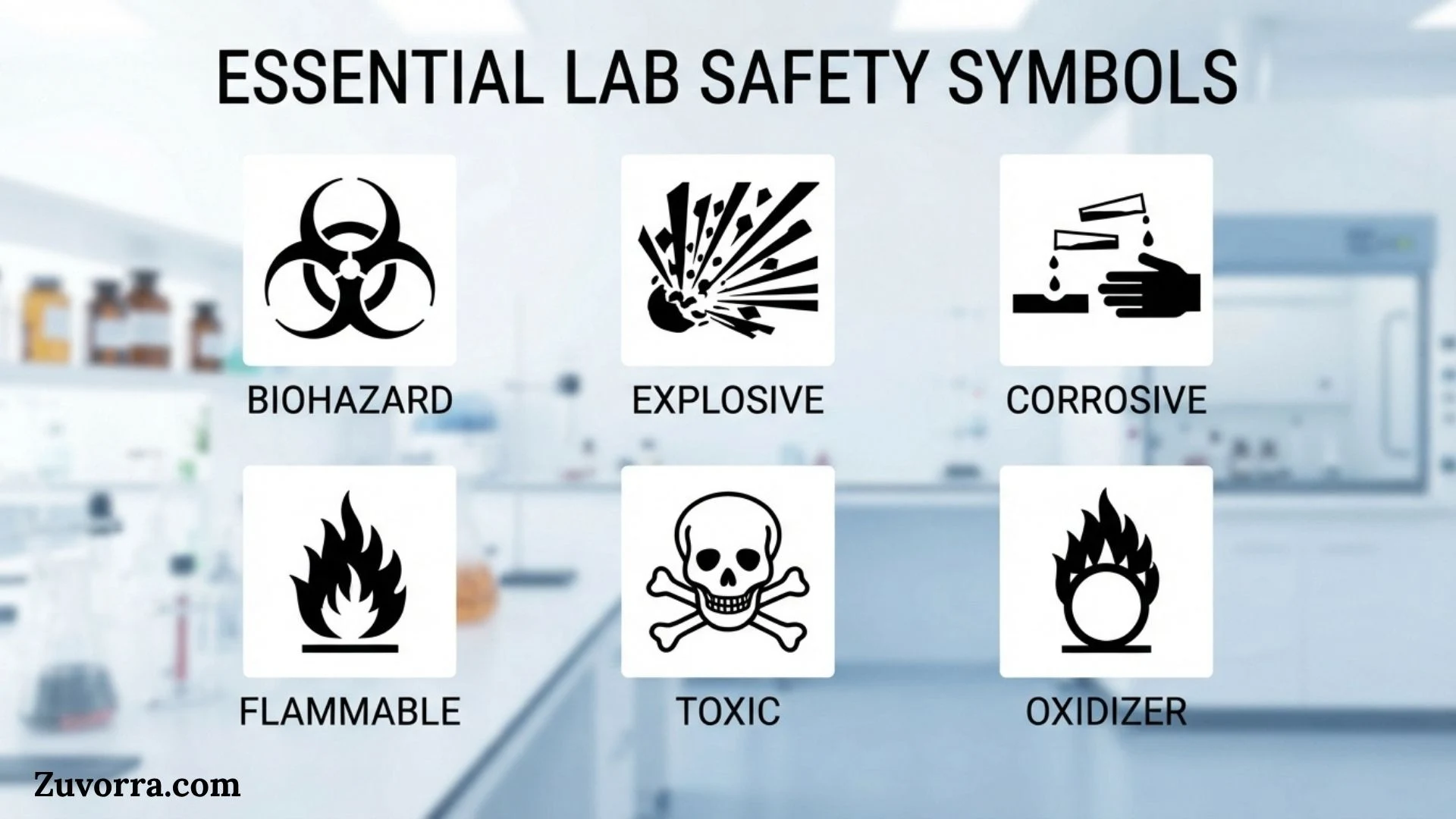
| Flammable | Substance easily ignited | Physical Hazard | International Standards | Chemical storage cabinets, reagent bottles | Fire risk, keep away from open flames and heat sources |
| Biohazard | Risk from biological agents | Biological Hazard | Dow Chemical Company (1966) | Labs handling viruses, bacteria, and blood products | Potential biological infection or contamination risk |
| Corrosive | Destructive to tissue and metals | Chemical Hazard | Globally Harmonized System (GHS) | Strong acids, bases, and etching agents | Causes severe skin burns and eye damage |
| Toxic | Fatal or toxic upon exposure | Health Hazard | International Standards | Poisons, heavy metals, and reactive chemicals | Acute toxicity, risk of poisoning or death |
| Radioactive | Emits ionizing radiation | Physical Hazard | University of California, Berkeley (1946) | X-ray equipment, isotope storage, nuclear labs | Ionizing radiation hazard, exposure risk |
What Does the Lab Safety Sign Mean?
Lab safety symbols function through a carefully calibrated visual grammar. Rather than relying on text alone—which can be affected by language barriers or low-light conditions—these symbols use a combination of geometric shapes and colors to convey urgency and intent.
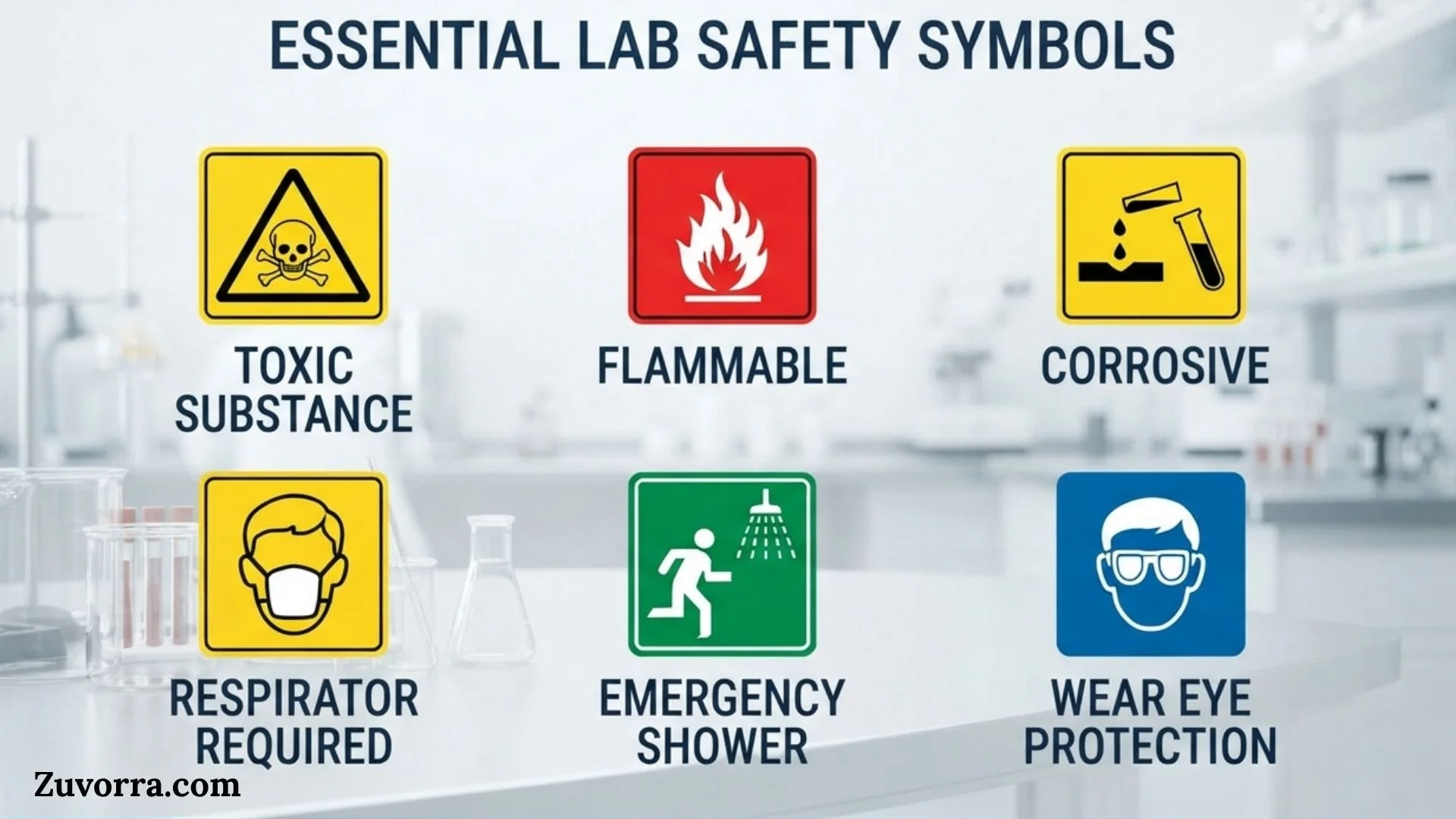
For instance, a yellow or amber background typically denotes a warning or caution regarding a potential hazard. Red circles with a diagonal slash indicate mandatory prohibitions (what you must not do), while blue circles dictate mandatory actions (what PPE you must wear). Green and white signs designate safe conditions, emergency exits, and first-aid stations. By combining a clear pictogram (such as a skull and crossbones or a falling drop of liquid eating through a surface) with standardized color psychology, these signs communicate complex chemical, physical, and biological profiles instantly.
History and Origin
The systematic organization of laboratory safety symbols evolved out of an industrial need for international trade consistency and worker protection during the mid-20th century. Before international harmonization, factories and laboratories used wildly differing warning labels, creating confusion and severe safety risks for workers handling imported chemical goods.
The modern framework draws heavily from organizations such as the International Organization for Standardization (ISO), the American National Standards Institute (ANSI), and the Occupational Safety and Health Administration (OSHA). A major milestone was the establishment of the Globally Harmonized System of Classification and Labelling of Chemicals (GHS) by the United Nations in the late 1990s and early 2000s. GHS unified hazard communication globally, replacing disparate national systems with the familiar diamond-shaped red-bordered symbols used on chemical containers today. Similarly, specialized symbols like the trefoil for radiation (developed in 1946 at UC Berkeley) and the biohazard symbol (designed in 1966 by Charles Baldwin at Dow Chemical) became universally adopted industry standards.
Symbolism and Interpretation
The interpretation of safety symbols requires an understanding of both explicit pictograms and structural context:
- Traditional Meanings: Historically, symbols like the skull and crossbones have represented poison and mortality since maritime and apothecary days, translating directly into modern laboratory settings to denote acute toxicity.
- Modern Interpretations: Today’s symbols are heavily data-driven, linked directly to toxicological testing, environmental impact metrics, and physical reactivity thresholds.
- Positive vs. Negative Symbolism: While hazard symbols carry inherently negative connotations (warning of danger, restriction, or harm), safety instruction symbols (such as blue mandatory eye protection icons) carry proactive, positive reinforcement for safe operational habits.
- Psychological Impact: The use of high-contrast colors (such as safety yellow and signal red) triggers an immediate orienting response in the human brain, capturing visual attention before conscious cognitive processing occurs.
Cultural and Global Significance
While safety symbols are designed to be universally understood across cultures, regional implementation and regulatory bodies vary slightly. For example, North America has historically relied on the NFPA 704 “fire diamond” (the four-colored hazard rating system) alongside OSHA standards, whereas European Union nations strictly enforce GHS pictograms and CLP (Classification, Labelling and Packaging) regulations. Despite these administrative differences, the core visual language—such as the corrosion symbol showing liquid dripping onto hands and metal—remains consistent worldwide, ensuring that a researcher traveling from Tokyo to Toronto immediately recognizes a chemical threat.
Scientific and Technical Classifications
Laboratory safety symbols are scientifically categorized under several strict technical frameworks:
- Physical Hazards: Includes explosives, flammable gases, oxidizing liquids, compressed gases, and substances corrosive to metals. These signs warn of energetic reactivity, pressure, or fire risks.
- Health Hazards: Encompasses acute toxicity, skin corrosion/irritation, serious eye damage, respiratory sensitization, carcinogenicity, and reproductive toxicity.
- Environmental Hazards: Denotes acute and chronic hazards to the aquatic environment, monitored to prevent ecological contamination via laboratory drain disposal.
- Electrical and Mechanical Hazards: Indicates high voltage, moving parts, lasers, and extreme temperatures (cryogenics or high-heat furnaces).
Where the Symbol Is Used
Lab safety symbols appear across a wide spectrum of professional, educational, and industrial environments:
- Chemical Reagent Bottles: Primary container labels displaying GHS diamond pictograms.
- Safety Data Sheets (SDS): Documenting safety profiles using standardized hazard symbols.
- Storage Cabinets: Flammable liquid lockers, acid cabinets, and radioactive isotope safes.
- Laboratory Entryways: NFPA hazard rating diamonds and biohazard containment level placards.
- Personal Protective Equipment (PPE) Stations: Reminding personnel to wear gloves, goggles, or lab coats.
- Fume Hoods and Equipment: Highlighting laser apertures, high-voltage panels, or biohazard waste disposal bins.
Common Variations
Safety signage frequently varies by format depending on its application:
- GHS Diamonds: Square-on-point with a red border, white background, and black pictogram.
- NFPA 704 Rating Diamonds: Four-quadrant diamond assessing health (blue), flammability (red), instability (yellow), and specific hazards (white).
- ISO Geometric Signs: Circular mandatory signs (blue), triangular warning signs (yellow with black borders), and rectangular emergency signs (green).
- Digital Adaptations: Modern electronic lab management software and digital inventory systems integrate these exact symbols into virtual manifests and mobile safety apps.
Common Misconceptions

- Misconception: A non-flammable label means a chemical is completely safe around heat.
- Correction: Non-flammable substances can still act as oxidizers, supporting combustion, or release toxic vapors when heated.
- Misconception: Biohazard symbols only apply to human blood.
- Correction: The symbol covers a wide range of biological agents, including recombinant DNA, pathogenic bacteria, viral vectors, and infected animal tissues.
- Misconception: Hazard symbols are merely advisory suggestions.
- Correction: They represent legally mandated hazard classifications tied to strict regulatory compliance and workplace safety laws.
Interesting Facts
- Origin of the Biohazard Symbol: Created in 1966 by industrial designer Charles Baldwin at Dow Chemical, the biohazard symbol was engineered to be striking, memorable, and completely meaningless so people would learn its specific association.
- The Radiation Trefoil: The classic magenta-on-yellow trefoil symbol was designed in 1946 at the University of California Radiation Laboratory, originally intended to represent radiation being emitted from an atom.
- Color Psychology: Safety yellow was selected by international standards committees because the human eye is more sensitive to yellow-green wavelengths than any other color, making it the most visible hue in low light.
- Universal Language: GHS symbols successfully eliminated dozens of conflicting national warning labels, drastically reducing international shipping accidents involving hazardous chemicals.
- The NFPA Fire Diamond: The famous diamond-shaped rating grid was developed in the 1950s primarily to help firefighters instantly assess the risks posed by burning structures or chemical stores.
- Cryogenic Warnings: Specialized symbols for liquid nitrogen and extreme cold prevent researchers from making the fatal mistake of sealing cryogenic containers, which can lead to explosive pressure ruptures.
- Laser Safety Classifications: Laser hazard signs incorporate roman numerals (Class 1 to Class 4) alongside warning pictograms to denote beam power and retinal damage risks.
- Corrosion Precision: The GHS corrosion pictogram specifically depicts two metal bars being eaten away alongside a bare hand, demonstrating dual damage to inorganic and organic matter.
Related Symbols
- NFPA 704 Fire Diamond: Differs from GHS diamonds by using numerical ratings (0–4) to quantify specific hazard severities rather than simply indicating presence.
- Recycling and Environmental Recovery Symbols: Used for chemical waste segregation, differing from hazard warnings by indicating proper disposal pathways rather than active danger.
- General Warning Exclamation Mark: A versatile GHS symbol used for less severe acute toxicity, skin irritation, or skin sensitization compared to the skull and crossbones.
Frequently Asked Questions
What do the red-bordered diamond symbols mean on chemical bottles?
These are Globally Harmonized System (GHS) hazard pictograms. The red border, white background, and black symbol indicate specific physical, health, or environmental dangers associated with the chemical inside the container.
What is the difference between a toxic hazard and a harmful hazard?
Toxic hazards (often denoted by a skull and crossbones) represent severe, acute, or fatal risks even at low exposure levels. Harmful or irritant hazards (often shown with an exclamation mark) indicate lower-level risks of irritation, temporary illness, or sensitization.
Why are laboratory safety signs color-coded?
Color coding provides instant visual categorization of safety information. Red indicates fire, danger, or prohibition; yellow indicates caution and potential hazards; blue indicates mandatory instructions or PPE requirements; green indicates emergency equipment and safe exits.
Who regulates laboratory safety signs in the workplace?
In the United States, standards are established and enforced by the Occupational Safety and Health Administration (OSHA) and the American National Standards Institute (ANSI), aligning with international frameworks set by the ISO and the United Nations.
What should I do if I see a biohazard symbol in a lab?
A biohazard symbol indicates the presence of infectious biological agents. You should avoid contact with the material, ensure you are wearing appropriate personal protective equipment, and follow institutional biosafety protocols for containment and waste disposal.
Can chemical hazard symbols be ignored if the container is small?
No. Hazard symbols must be maintained on all primary and secondary chemical containers regardless of size, unless the chemical is dispensed and used immediately by the person who prepared it during a single work shift.
What does the corrosion symbol represent?
The corrosion symbol depicts liquid dropping from two test tubes onto a metal bar and a human hand. It signifies that the substance causes severe skin burns, eye damage, and corrodes metals upon contact.
How do NFPA ratings differ from GHS symbols?
While GHS symbols categorize the specific nature of a hazard using pictograms, the NFPA 704 rating system uses a four-part grid with numbers from zero to four to indicate the relative severity of health, flammability, and chemical instability risks for emergency responders.
Key Takeaways
- Standardized Recognition: Lab safety symbols utilize universal shapes, colors, and pictograms to transcend language barriers and provide instant hazard recognition.
- Regulatory Framework: Modern systems rely on the Globally Harmonized System (GHS), OSHA, and ISO standards to maintain consistent safety communication worldwide.
- Color Psychology: Red denotes danger/fire, yellow indicates caution, blue signals mandatory actions, and green points to safety and emergency equipment.
- Comprehensive Protection: Understanding physical, chemical, biological, and health symbols is vital for preventing workplace accidents and ensuring laboratory safety compliance.
Conclusion
Mastering the language of lab safety signs and symbols is a foundational responsibility for anyone operating within scientific and industrial environments. These visual indicators do far more than satisfy regulatory checklists—they serve as silent guardians that prevent catastrophic accidents, chemical exposures, and biological contamination. By respecting these symbols, understanding their specific classifications, and adhering to the protocols they mandate, researchers and technicians ensure a secure culture of safety, allowing scientific discovery to proceed without compromising human well-being.
Also Check These Posts:
Unveiling the Fluid Power: The Profound Depth and History of Symbols of Water
The Ultimate Laundry Care Symbols Chart: Decoding Every Tag and Icon

I’m Felix Everard, a British writer passionate about the fascinating world of symbols and visual communication. I explore traditional, cultural, historical, and modern symbols, focusing on what they represent and why they matter. Through accessible explanations, I hope to help readers recognise the meanings hidden within familiar signs, shapes, and images.
Books:
- The Complete Guide to Symbolism
- Decoding Signs and Symbols