NFL symbols are the visual language of professional American football. The league shield identifies the National Football League, team logos represent local history and identity, field markings organize play, and uniform patches communicate leadership, achievement, or remembrance.
Fans encounter these symbols on helmets, jerseys, football fields, broadcasts, merchandise, video games, apps, and stadium signs. Some have official meanings, while others rely on history, regional culture, wordplay, or modern brand design. Understanding them makes it easier to recognize teams, follow games, interpret standings, and appreciate how football imagery has evolved.
Quick Meaning of NFL Symbols
NFL symbols are logos, marks, colors, signs, patches, gestures, and field graphics used to identify the league, its conferences, teams, rules, achievements, and traditions. The NFL shield represents the league as a whole, while individual team symbols express regional identity, history, mascots, values, or local culture.
NFL Symbols Overview Table
| Symbol or Symbol Group | Primary Meaning | Category | Origin or Context | Common Usage | Modern Significance |
| NFL shield | The National Football League | League emblem | Developed as the league’s official identity | Jerseys, footballs, broadcasts, fields, merchandise | Authority, unity, professional football |
| Eight stars | Eight NFL divisions | Structural symbol | Added to the redesigned shield in 2008 | Upper section of the league logo | League organization |
| Football in the shield | The sport of American football | Sporting symbol | Central feature of the league emblem | NFL shield and licensed products | The game itself |
| AFC logo | American Football Conference | Conference emblem | Created through the AFL-NFL organizational structure | Playoffs, broadcasts, standings | One half of the NFL |
| NFC logo | National Football Conference | Conference emblem | Created during the AFL-NFL merger era | Playoffs, broadcasts, standings | One half of the NFL |
| Team logos | Individual NFL clubs | Franchise identity | Based on mascots, places, history, or names | Helmets, jerseys, fields, merchandise | Loyalty, tradition, local pride |
| Captain’s patch | Team leadership | Uniform insignia | NFL captain recognition system | Upper chest of selected players | Leadership and experience |
| Memorial patch or decal | Remembrance or tribute | Commemorative mark | Created for a person, event, or anniversary | Jerseys and helmets | Respect and historical memory |
| Yard lines and numbers | Field position | Technical marking | Standardized football rules | Playing field | Distance and game organization |
| Hash marks | Ball-placement position | Technical marking | Official field design | Between the sidelines | Controls where plays begin |
| Goalpost | Scoring target | Equipment symbol | Football scoring rules | End zones | Field goals and extra points |
| Penalty flag | Possible rule violation | Officiating symbol | Official enforcement system | Thrown onto the field | Alerts players and viewers to a penalty |
| Challenge flag | Coach requests review | Replay symbol | Instant-replay system | Thrown by a head coach | Review of certain officiating decisions |
| Hand signals | Referee rulings | Gestural symbols | Standardized officiating practice | On-field announcements and broadcasts | Communicates penalties and decisions |
| Playoff letters and marks | Clinched status | Statistical notation | League standings systems | Websites and broadcast graphics | Shows postseason qualification |
NFL currently consists of 32 clubs divided equally between the American Football Conference and National Football Conference. Each conference contains East, North, South, and West divisions, producing the eight-division structure represented by the stars in the modern league shield.
What Do NFL Symbols Mean?
NFL symbols identify people, organizations, locations, rules, and achievements within professional football.
At the broadest level, the NFL shield tells viewers that a game, product, event, or digital service belongs to or is officially associated with the National Football League. Conference emblems separate the AFC from the NFC. Team logos allow viewers to recognize clubs instantly, often without reading a team name.
Other symbols serve practical purposes rather than branding. Field numbers show distance from the goal line. Hash marks identify where the ball should be placed. Officials use hand signals to announce penalties, scoring decisions, timeouts, and changes of possession.
A symbol’s meaning depends on context. A star may refer to the Dallas Cowboys when used alone, but the stars inside the NFL shield represent the league’s eight divisions. A horseshoe may symbolize luck in general culture, but in an NFL setting it usually represents the Indianapolis Colts. The same shape can therefore carry a broad cultural meaning and a precise football meaning at the same time.
History and Origin of NFL Symbols
NFL symbolism developed alongside the league, its franchises, uniforms, broadcasting systems, and commercial identity.
The National Football League traces its organizational history to 1920. Early professional teams did not always use polished, standardized logo systems. Their identities were often communicated through city names, team nicknames, uniform colors, newspaper illustrations, and simple letterforms.
As radio, television, national advertising, licensed merchandise, and stadium entertainment expanded, clear visual identities became more important. Teams increasingly needed emblems that looked recognizable on helmets, scoreboards, trading cards, clothing, and television screens.
The shield became the league’s central institutional symbol. Its red, white, and blue palette connects the organization visually with the United States, while its football shape and bold initials identify the sport and league.
The current shield design debuted in 2008. Its eight stars represent the NFL’s eight divisions. The updated football was styled to resemble the ball displayed on the Vince Lombardi Trophy, and the lettering was modernized for cleaner reproduction.
Team symbolism also evolved as franchises moved, renamed themselves, updated uniforms, or responded to changing cultural expectations. Some clubs kept long-standing visual identities with only minor refinements. Others introduced new logos to mark relocation, ownership changes, stadium openings, anniversaries, or broader rebranding efforts.
The Los Angeles Rams provide an important historical example. Their horn design became the first logo painted on an NFL helmet, helping turn protective equipment into a major surface for team identity.
Symbolism and Interpretation
The NFL shield
A shield traditionally suggests protection, strength, authority, and organized defense. These ideas fit football, a sport built around territory, blocking, physical protection, and coordinated teams.
For the NFL, the shield also represents institutional legitimacy. It distinguishes the league’s official identity from individual club brands, college football, amateur leagues, and unrelated football organizations.
The stars
The modern shield’s eight stars have a direct organizational meaning: they represent the NFL’s eight divisions. Four divisions belong to the AFC and four belong to the NFC.
Stars also carry broader positive associations, including excellence, aspiration, national identity, and championship status. However, those broader interpretations are secondary. Within the current NFL shield, their official practical connection is the divisional structure.
Red, white, and blue
These colors strongly connect the league’s visual identity to the United States. Red often communicates energy, action, urgency, and physical intensity. Blue suggests authority, stability, and trust. White provides contrast and visual clarity.
Color meanings are partly interpretive rather than fixed rules. Their practical purpose is also important: high contrast helps the shield remain recognizable on uniforms, footballs, screens, signs, and small digital icons.
The football
The football identifies the sport immediately. Its placement near the top of the shield gives it visual prominence, almost like a crown or central crest.
It also connects the league mark to the Lombardi Trophy, the championship award presented to the winner of the Super Bowl.
Team animals and human figures
Many NFL franchises use animals, warriors, or legendary figures. These symbols usually communicate traits that teams want associated with competitive football:
- Bears suggest strength and toughness.
- Bengals suggest speed, danger, and agility.
- Broncos suggest energy, freedom, and power.
- Cardinals and Falcons suggest quick movement and sharp vision.
- Eagles suggest height, strength, freedom, and authority.
- Jaguars, Lions, and Panthers suggest predatory power.
- Dolphins suggest speed, intelligence, and movement through water.
- Ravens suggest intelligence, mystery, and literary history.
- Vikings suggest exploration, endurance, and warrior identity.
These associations are symbolic interpretations, not measurements of how a team actually plays.
Positive symbolism
Most football branding emphasizes positive qualities such as:
- Courage
- Strength
- Speed
- Discipline
- Loyalty
- Unity
- Regional pride
- Competitive excellence
- Tradition
- Resilience
Negative or aggressive symbolism
Football logos may also use imagery connected with danger, conquest, weapons, storms, raiding, or predatory animals. These elements create an intimidating competitive identity.
Aggressive symbolism should usually be understood as sports theater rather than a literal endorsement of violence. Teams use it to suggest confidence, toughness, and determination within the controlled setting of competition.
Cultural Significance of NFL Symbols
NFL symbols connect professional football with American geography, industry, history, folklore, and popular culture.
Many franchise names reflect the communities where the teams began or currently play. The Steelers connect Pittsburgh with its steel-producing history. The Packers name developed from Green Bay’s meat-packing connection. The 49ers refer to prospectors associated with the California Gold Rush. The Patriots evoke the revolutionary history of New England.
Other team identities draw from regional animals or landscapes. The Dolphins fit Miami’s coastal setting. The Broncos reflect the American West. The Seahawks use the name of a powerful coastal bird, while the Cardinals use a familiar North American bird.
Some names emerged from public contests, newspaper campaigns, owner decisions, inherited identities, or earlier franchises. The Pro Football Hall of Fame records examples such as the Colts name reflecting horse breeding and racing traditions, and the Minnesota Vikings name connecting with the Scandinavian heritage associated with the region.
Symbols can become more culturally important than their original explanations. The Green Bay “G,” Dallas star, New Orleans fleur-de-lis, Las Vegas Raiders shield, and Pittsburgh’s three-diamond emblem are now closely tied to fan communities, clothing, family traditions, and regional identity.
Football symbolism also travels internationally. The NFL’s official international programs allow clubs to build fan communities in markets outside the United States, giving team logos meaning in places with no direct geographic connection to the franchise’s home city.
Religious or Spiritual Meaning
NFL symbols are primarily sporting and commercial marks, not sacred emblems. However, a few team designs use images that also exist in religious, ceremonial, or historical traditions.
The New Orleans Saints use a fleur-de-lis, a stylized lily with a long history in European heraldry, French identity, architecture, and Christian art. Within the NFL, it mainly represents New Orleans, Louisiana’s French heritage, and the Saints franchise. It should not automatically be interpreted as a religious statement when it appears on a helmet or jersey.
The Dallas Cowboys star may remind viewers of stars used in flags, religion, navigation, or folklore. In its team context, however, it functions as the Cowboys’ franchise identity and reflects Texas’s “Lone Star” association.
The Minnesota Vikings’ imagery refers to historical Norse seafarers and warriors. It should not be treated as a direct representation of modern Norse religious practice.
Context matters. A symbol may have sacred meaning in one setting and a commercial sports meaning in another. NFL usage does not erase older meanings, but it usually narrows the intended interpretation.
Scientific, Technical, and Digital Meanings
NFL symbols also form a technical communication system.
Field numbers and yard lines
Field numbers indicate distance from the nearest goal line. The numbers increase from each goal line toward midfield, where the 50-yard line divides the playing surface.
These markings help players, coaches, officials, broadcasters, and fans track field position.
Hash marks
Hash marks are short lines used to determine where the ball is placed before the next play. NFL hash marks run along the field at standardized positions and create a consistent starting location after a play ends near one side.
Goal lines and end zones
The goal line marks the front boundary of the end zone. Crossing it while legally possessing the ball can produce a touchdown. End-zone markings, logos, and decorations must not interfere with the visibility of official boundary lines and require league approval.
Referee signals
Officials use standardized gestures because stadium noise can make spoken communication difficult. Signals visually explain decisions such as holding, pass interference, false starts, personal fouls, touchdowns, safeties, timeouts, and unsuccessful plays.
The gesture does not replace the rule. It summarizes the ruling so that people across the field and watching remotely can understand it.
Digital standings symbols
NFL standings may use letters or marks to show that a team has clinched a playoff berth, wild-card place, division title, or home-field advantage. Common statistical abbreviations include:
- W: Wins
- L: Losses
- T: Ties
- PCT: Winning percentage
- DIV: Division record
- CONF: Conference record
- PF: Points scored
- PA: Points allowed
- STRK: Current winning or losing streak
Official NFL standings also provide a legend explaining postseason-clinching symbols.
Where NFL Symbols Are Used
NFL symbols appear across nearly every part of the sport.
Helmets
The helmet is one of the most visible locations for team identity. Most clubs display a primary team logo on both sides. Helmet stripes, numbers, wordmarks, memorial decals, manufacturer marks, and American flag decals may also appear.
Jerseys and uniforms
Uniforms may include the NFL shield, team marks, player numbers, nameplates, captain patches, anniversary patches, memorial patches, manufacturer logos, and approved partner marks.
The league regulates commercial branding on player equipment. Only authorized marks may be displayed openly during official activities.
Football fields
Team logos commonly appear at midfield and in end zones. The league shield may appear during special games, postseason events, international games, or league-branded presentations.
Official rules require decorative marks to remain visually separate from essential field boundaries.
Broadcasts and apps
Television networks and digital services use team abbreviations, helmets, logos, colors, arrows, possession indicators, timeout boxes, play clocks, down-and-distance graphics, and penalty notifications.
These elements turn complex game information into a visual system that viewers can understand within seconds.
Merchandise
NFL symbols appear on hats, shirts, jackets, jerseys, mugs, flags, toys, trading cards, video games, collectibles, and stadium products. League and team marks are legally protected trademarks, so official licensing matters when products are manufactured or sold.
Architecture and public spaces
Stadium facades, locker rooms, training centers, team offices, fan zones, museums, restaurants, and public murals often display franchise symbols.
Tattoos and fan art
Fans may use team logos as symbols of loyalty, family history, hometown identity, or memories connected with important games. However, personal artistic use and commercial reproduction are different legal contexts. Selling products with protected logos generally requires authorization.
Common Variations of NFL Symbols
Primary logos
A primary logo is the main visual identity used by a team. It usually appears on helmets, official websites, broadcasts, and core merchandise.
Secondary logos
Secondary marks support the main identity. They may include initials, alternate mascots, regional symbols, simplified shapes, or historic designs.
Wordmarks
A wordmark presents the league or team name in a distinctive typeface. Wordmarks work well on stadium signs, end zones, apparel, and digital headers.
Throwback logos
Throwback symbols revive earlier designs to celebrate franchise history. They may appear during heritage games, anniversary seasons, special uniforms, or historical merchandise.
Anniversary marks
Teams and the league create temporary symbols for major milestones. The NFL used a special design during its 100th season, while clubs regularly introduce marks for franchise anniversaries.
Memorial symbols
Black bands, initials, jersey patches, or helmet decals may honor deceased owners, players, coaches, staff members, or important public figures.
Conference and event logos
The AFC, NFC, Super Bowl, Pro Bowl, NFL Draft, playoffs, international games, and community initiatives each use distinct visual identities.
Simplified digital icons
Small screens require clear shapes. A detailed logo may be reduced to a helmet mark, initial, mascot head, or flat-color emblem for scoreboards, mobile apps, fantasy platforms, and social media profiles.
Common Misconceptions About NFL Symbols
“Every star represents an NFL team”
This is incorrect for the current NFL shield. The eight stars represent the eight divisions, not the league’s 32 individual clubs.
“All team logos are mascots”
Some are mascots, but many are not. The Cowboys use a star, the Packers use a letterform, the Steelers use a symbol based on steel-industry imagery, and the Saints use a fleur-de-lis.
“Every logo has an official hidden meaning”
Many online explanations assign secret meanings to colors, angles, or shapes without evidence. Some design choices have documented origins, while others mainly improve balance, visibility, reproduction, or brand consistency.
“The NFL shield is an emoji”
There is no standard Unicode character for the official NFL shield. Images that resemble it are logos, stickers, custom icons, or platform graphics rather than universal text characters.
“A team symbol always represents the city literally”
Team identities may survive relocation. A logo can preserve a franchise’s earlier history even when the team moves to another region.
“Old logos are no longer meaningful”
Historic marks remain important to collectors and longtime fans. Throwback logos can represent a specific championship era, former city, ownership period, stadium, or generation of players.
“All helmet decals affect gameplay”
Most decals are decorative or commemorative. Functional equipment elements, warning labels, communication identifiers, and approved safety features serve different purposes from team branding.
Interesting Facts About NFL Symbols
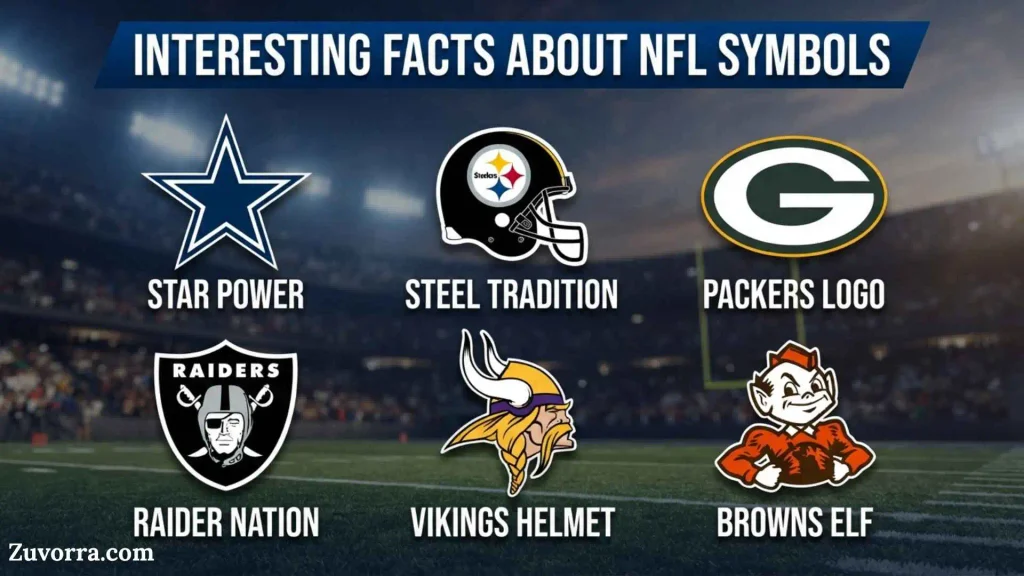
- The modern shield contains eight stars. They represent the league’s eight divisions rather than its 32 teams.
- The shield was modernized in 2008. The redesign simplified the stars, refined the lettering, and updated the football image.
- The Rams pioneered the helmet logo. Their painted horn design helped establish the NFL helmet as a major branding surface.
- Not every club uses the same logo style. NFL identities include animals, letters, objects, historic figures, shields, stars, industrial marks, and regional emblems.
- Franchise nicknames often preserve local history. Team names can reference industries, immigration patterns, historical events, animals, folklore, or public naming contests.
- Field logos require approval. Decorative marks cannot make official lines harder to see or create confusion during play.
- A logo can outlive a city connection. Teams that relocate may keep their nickname, colors, and visual identity to preserve franchise continuity.
- Uniform symbols are regulated. Players cannot freely display any commercial mark they choose during official games.
- Standings use a separate symbolic language. Letters and marks communicate playoff status, division records, conference records, streaks, and point totals.
- Special patches act like visual history records. A jersey may document an anniversary, memorial, award, or franchise milestone without changing the team’s permanent logo.
- NFL symbols now have international reach. Every club participates in the league’s global markets program, extending team identities into countries beyond the United States.
- The same image can hold different meanings. A star, horseshoe, bird, or flower may have religious, cultural, geographic, and sporting interpretations depending on where it appears.
Related Football Symbols
| Related Symbol | Meaning | How It Differs |
| Super Bowl logo | The NFL championship game | Changes for each edition and event identity |
| Vince Lombardi Trophy | League championship | A physical award rather than a franchise logo |
| AFC emblem | American Football Conference | Represents 16 teams in one conference |
| NFC emblem | National Football Conference | Represents the other 16 teams |
| College football logos | Universities and athletic programs | Governed outside the NFL |
| Referee stripes | Officiating authority and neutrality | Identifies game officials, not a team |
| Yellow penalty flag | Possible rule violation | A functional game signal |
| Red challenge flag | Replay-review request | Used by a coach under replay rules |
| Goalpost | Field-goal and extra-point target | Functional equipment rather than branding |
| Captain’s “C” | Player leadership | Assigned to selected team captains |
| Salute to Service marks | Military appreciation initiative | Temporary program branding |
| Crucial Catch marks | Cancer awareness initiative | League community and health campaign identity |
Frequently Asked Questions
What do the eight stars on the NFL logo mean?
The eight stars on the modern NFL shield represent the league’s eight divisions. The AFC has four divisions, and the NFC has four. They do not represent the league’s teams, championships, original founders, or states. The eight-star design became part of the updated shield introduced in 2008.
What does the football inside the NFL shield represent?
The football directly identifies the sport governed and promoted by the league. In the modern shield, its styling also connects visually with the football displayed on the Vince Lombardi Trophy. It serves as both a literal sports symbol and a central unifying element in the league emblem.
Why is the NFL logo shaped like a shield?
A shield creates a strong, official-looking crest and traditionally suggests defense, strength, protection, and authority. Those ideas fit both the physical nature of football and the NFL’s role as the governing organization for its professional league. The shape also works well on uniforms, footballs, fields, and merchandise.
Do all NFL team logos have an official meaning?
Most team logos have a documented connection to a franchise name, city, region, historical theme, mascot, or industry. However, not every color, line, or angle carries a hidden symbolic message. Some design features exist mainly for visibility, balance, reproduction, or visual appeal.
Which NFL team first placed a logo on its helmet?
The Rams are widely credited with introducing the first painted NFL helmet logo through their distinctive horn design. The innovation helped make helmets a central part of team identity and influenced the visual culture of professional football.
What does the “C” patch on an NFL jersey mean?
The “C” identifies a team captain. Stars associated with some captain-patch designs may indicate seasons of recognized captaincy. The patch communicates leadership, experience, and responsibility, but captain-selection practices can vary by team.
Are NFL logos copyrighted or trademarked?
NFL and team names, logos, uniform designs, and related marks are protected intellectual property. Fans may display them in ordinary personal settings, but commercial reproduction usually requires permission or a licensing agreement. Official merchandise is produced through authorized league or team arrangements.
Why do NFL teams wear special helmet decals or patches?
Special decals and patches may honor a deceased person, celebrate an anniversary, recognize an award, support a league initiative, or mark an important historical event. They are usually temporary and do not replace the team’s permanent primary logo.
What do letters beside teams in NFL standings mean?
They show statistical categories or postseason status. W, L, and T mean wins, losses, and ties. DIV and CONF refer to division and conference records. Special letters may indicate that a club has secured a playoff berth, wild-card position, division title, or home-field advantage.
Is there an official NFL emoji?
There is no universal Unicode emoji for the NFL shield. Platforms may offer licensed stickers, custom graphics, team icons, or branded reactions, but these are not standard text characters available in every operating system.
Key Takeaways
- NFL symbols include league, conference, team, field, uniform, officiating, and digital marks.
- The NFL shield represents the league as a unified professional organization.
- Its eight stars represent the eight divisions.
- Team logos express regional history, mascots, industries, places, values, and franchise traditions.
- Field numbers, hash marks, flags, and referee gestures communicate technical game information.
- Symbols can have different meanings inside and outside football.
- Not every design detail has a hidden or officially documented explanation.
- Memorial, anniversary, captain, and program patches add temporary meaning to uniforms.
- NFL and team logos are protected trademarks.
- Context is the best guide to interpreting any football symbol accurately.
Conclusion
NFL symbols do far more than decorate helmets and football fields. They identify the league’s structure, distinguish 32 franchises, communicate rules, record achievements, honor important people, and connect teams with their communities.
The shield, stars, football, team logos, uniform patches, field markings, and referee signals form a complete visual language. Some meanings are official and practical, while others grow from regional history, cultural associations, and fan tradition. By reading these symbols in context, viewers can better understand both the game and the identity surrounding it.
References
- National Football League, “Official Sites of All 32 NFL Teams.”
- NFL Football Operations, “Creating the NFL Schedule.”
- NFL Football Operations, “2026 NFL Rulebook.”
- NFL Football Operations, “Football Terms.”
- NFL Football Operations, “Uniform Inspections.”
- Pro Football Hall of Fame, “Franchise Nicknames.”
- Pro Football Hall of Fame, “NFL Franchise Histories.”
- Pro Football Hall of Fame, “HOF New Artifact Spotlight: LA Rams.”
- NFL.com, “Evolution of Every Team’s Logo and Helmet.”
- United States Patent and Trademark Office, NFL shield trademark description.

I’m Rupert Ashbourne, a British author interested in how symbols have shaped human communication throughout history. I examine signs, emblems, markings, and visual representations, explaining their meanings and cultural significance. My aim is to make symbolism approachable while helping readers understand how simple shapes and images can carry surprisingly powerful messages.
Books:
- The Meaning of Symbols
- A History of Signs and Emblems