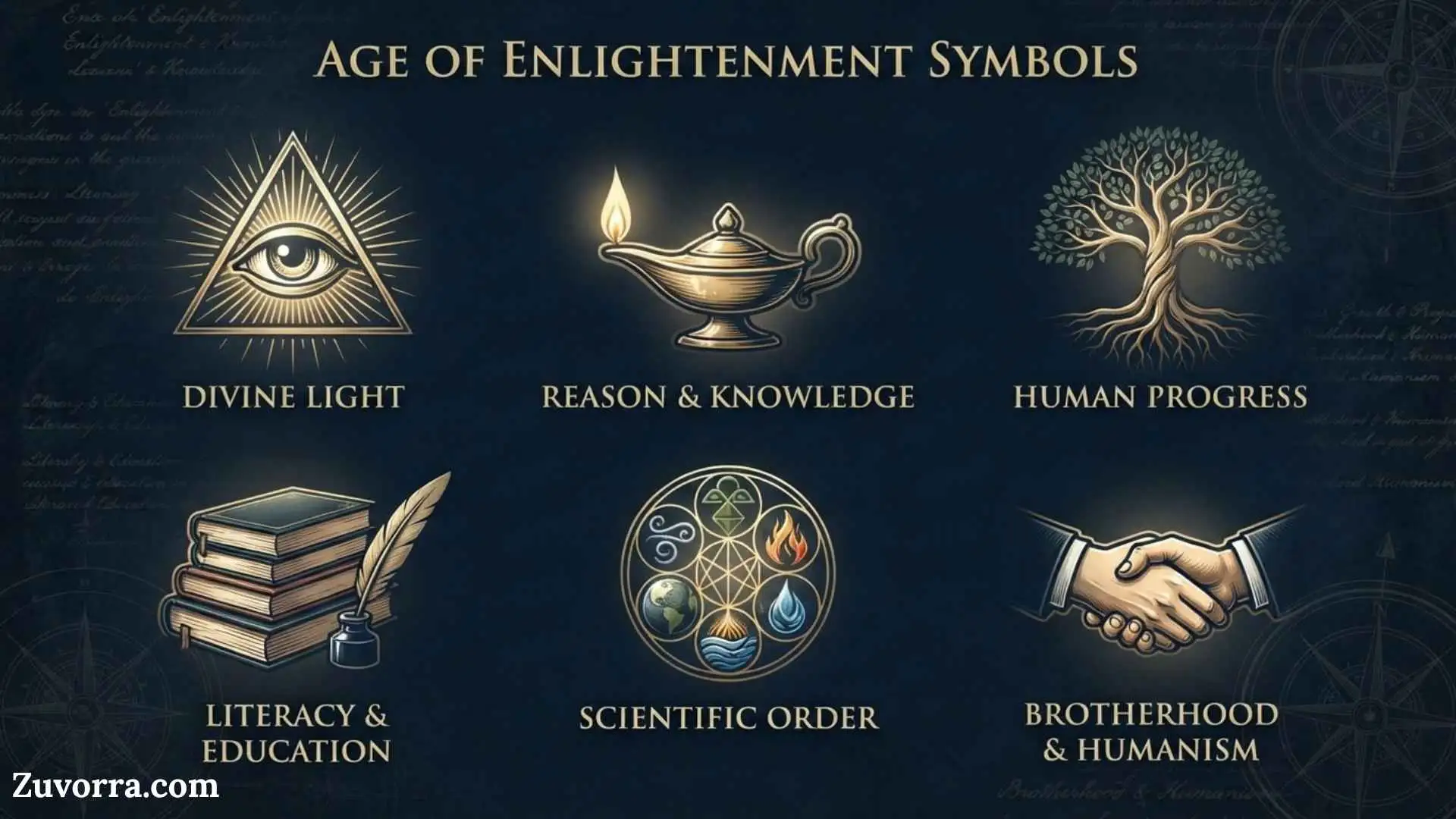
Age of Enlightenment symbols represent humanity’s effort to replace ignorance, superstition, and unquestioned authority with reason, evidence, education, liberty, and open inquiry. The most recognizable symbol is light, often shown as a radiant sun, torch, flame, or rays surrounding Truth. Other important images include an open book, the all-seeing eye, scientific instruments, broken chains, scales, liberty caps, and allegorical figures of Reason.
These symbols appear in eighteenth-century paintings, political prints, encyclopedias, revolutionary emblems, architecture, coins, national seals, university logos, and modern educational imagery. Understanding them reveals how Enlightenment thinkers presented knowledge not merely as information, but as a force capable of transforming individuals and society.
Quick Meaning
Age of Enlightenment symbols express the triumph of reason, knowledge, scientific investigation, liberty, and human progress over ignorance and oppression. Light is the central metaphor: darkness represents error or intellectual restriction, while a torch, sun, flame, or radiant Truth represents discovery, education, and freedom of thought.
Age of Enlightenment Symbols Overview
| Symbol | Primary Meaning | Historical Context | Common Enlightenment Usage | Modern Meaning |
| Light or sun rays | Knowledge defeating ignorance | European intellectual culture of the 1600s and 1700s | Surrounding Truth, Reason, or scientific discovery | Education, clarity, progress |
| Torch or flame | Reason carried into darkness | Classical imagery revived by Enlightenment artists | Held by Reason, Liberty, or Philosophy | Learning, freedom, discovery |
| Unveiled Truth | Knowledge revealed through inquiry | Allegorical art and the Encyclopédie | A female figure whose veil is removed | Transparency and intellectual honesty |
| Open book | Accessible knowledge and literacy | Growth of print culture and encyclopedias | Books, manuscripts, libraries, reference works | Education and public information |
| Eye of Providence | Divine oversight, order, or watchfulness | Christian and Renaissance symbolism adapted in the eighteenth century | Seals, architecture, political emblems | Providence, vigilance, sometimes reason |
| Scientific instruments | Observation and measurement | Scientific Revolution and Enlightenment | Telescopes, globes, compasses, microscopes | Empirical science and technology |
| Scales | Justice and rational law | Classical legal symbolism | Political reform, natural rights, fair government | Equality before the law |
| Broken chains | Freedom from oppression | Abolitionist and revolutionary imagery | Liberation from tyranny, slavery, or inherited privilege | Emancipation and civil rights |
| Liberty cap | Political freedom | Ancient Roman imagery revived in Atlantic revolutions | American and French revolutionary art | Republican liberty |
| Tree of knowledge | Organized and connected learning | Francis Bacon and the Encyclopédie | Classification of memory, reason, and imagination | Knowledge systems and intellectual growth |
| Rising sun | A new political or intellectual era | Revolutionary and republican imagery | New nations, constitutions, and social progress | Hope and renewal |
| Beehive | Productive, cooperative society | Eighteenth-century moral and civic imagery | Industry, social order, shared labor | Community and diligence |
What Do Age of Enlightenment Symbols Mean?
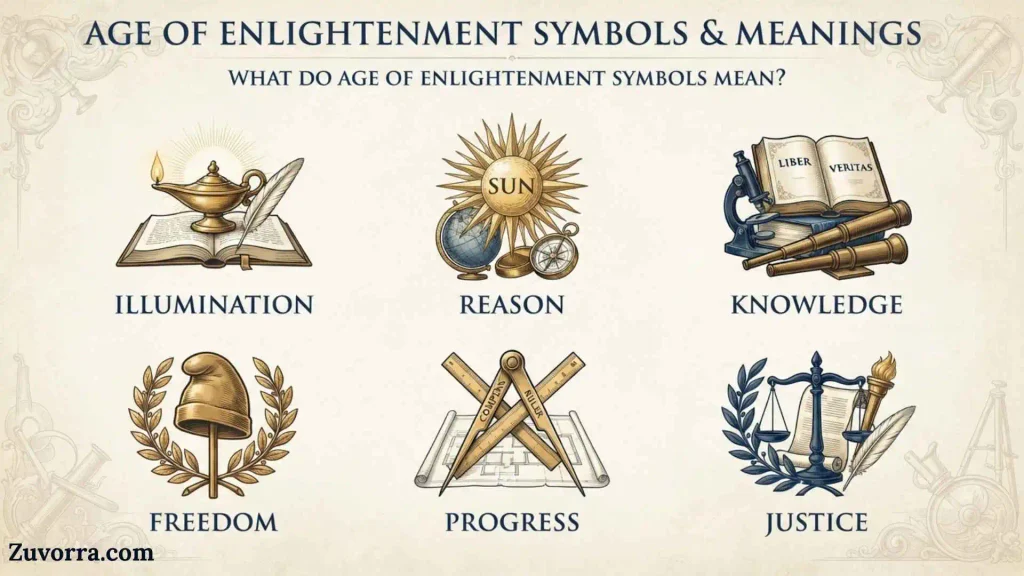
Age of Enlightenment symbols communicate a broad intellectual message: people can understand the world through reason, observation, discussion, and education.
The Enlightenment was not a single organization with one official emblem. It was a diverse intellectual movement that developed across Europe and the Atlantic world during the seventeenth and eighteenth centuries. Its thinkers disagreed about politics, religion, economics, and human nature. Nevertheless, their visual language repeatedly emphasized several connected ideals:
- Reason should test inherited claims.
- Knowledge should be organized and shared.
- Observation should guide science.
- Government should answer to rational principles.
- Individuals possess rights that rulers should respect.
- Education can improve society.
- Intellectual progress requires freedom of inquiry.
The word enlightenment itself creates the movement’s most important symbol. To enlighten is to bring light where darkness existed. In this metaphor, light means understanding, while darkness represents ignorance, confusion, censorship, fear, or blind obedience.
This symbolism did not always imply hostility toward religion. Some Enlightenment thinkers were Christians, some supported deism, and others questioned organized religious authority. Light could therefore represent human reason, divine truth, scientific discovery, or a combination of these ideas.
History and Origin of Enlightenment Symbolism
Enlightenment symbols did not appear suddenly in the eighteenth century. Artists and writers adapted older religious, classical, scientific, and political images for new purposes.
Light as an Ancient Symbol of Knowledge
Light had represented truth long before the Enlightenment. Ancient Greek philosophers connected sight and illumination with understanding. Jewish and Christian texts used light to symbolize creation, revelation, wisdom, and divine presence. Renaissance artists later surrounded sacred and allegorical figures with glowing halos or rays.
Enlightenment writers retained this familiar contrast between light and darkness but gave it a stronger intellectual and social meaning. Light increasingly represented rational investigation, public education, criticism, and the spread of useful knowledge.
Classical Figures and Republican Ideals
Eighteenth-century artists drew heavily from ancient Greece and Rome. Allegorical female figures represented abstract ideas such as Truth, Liberty, Justice, Philosophy, Nature, and Wisdom. Their clothing, posture, and objects helped viewers identify them.
A figure carrying scales signified Justice. A woman holding a liberty cap represented political freedom. Minerva, the Roman goddess associated with wisdom, could stand for disciplined intelligence, science, or civic learning.
Classical imagery gave new political ideas an appearance of dignity and historical authority. It also allowed artists to communicate complex arguments through familiar visual forms.
The Scientific Revolution
The Enlightenment inherited scientific methods and discoveries associated with figures such as Francis Bacon, Galileo Galilei, René Descartes, Robert Boyle, and Isaac Newton. Telescopes, globes, compasses, prisms, mathematical diagrams, and experimental equipment consequently became symbols of disciplined observation.
These instruments mattered because they showed that knowledge could arise from testing, calculation, and repeatable evidence rather than tradition alone. A telescope symbolized more than astronomy; it represented the extension of human perception through technology.
Print Culture and the Open Book
Printing helped create a wider reading public. Newspapers, pamphlets, journals, dictionaries, philosophical works, and scientific reports allowed ideas to travel across national borders.
The book therefore became a central Enlightenment image. A closed book could suggest stored authority, but an open book implied accessible learning. Books shown beside globes or scientific tools linked literacy with discovery and public improvement.
The Encyclopédie Frontispiece
One of the clearest visual summaries of Enlightenment symbolism appears in the frontispiece of Denis Diderot and Jean le Rond d’Alembert’s Encyclopédie.
The image places Truth near the top, surrounded by brilliant light. Reason and Philosophy remove her veil, while Imagination prepares to adorn her. Below them appear figures representing the arts, sciences, and practical trades. The composition presents knowledge as an organized human effort in which reflection, creativity, craft, and observation all contribute to revealing truth.
This image is especially important because it corrects a common oversimplification. Enlightenment thought did not value reason while completely rejecting art or imagination. In the frontispiece, Reason reveals Truth, but Imagination also has a place within the system of knowledge.
Major Symbols and Their Interpretations
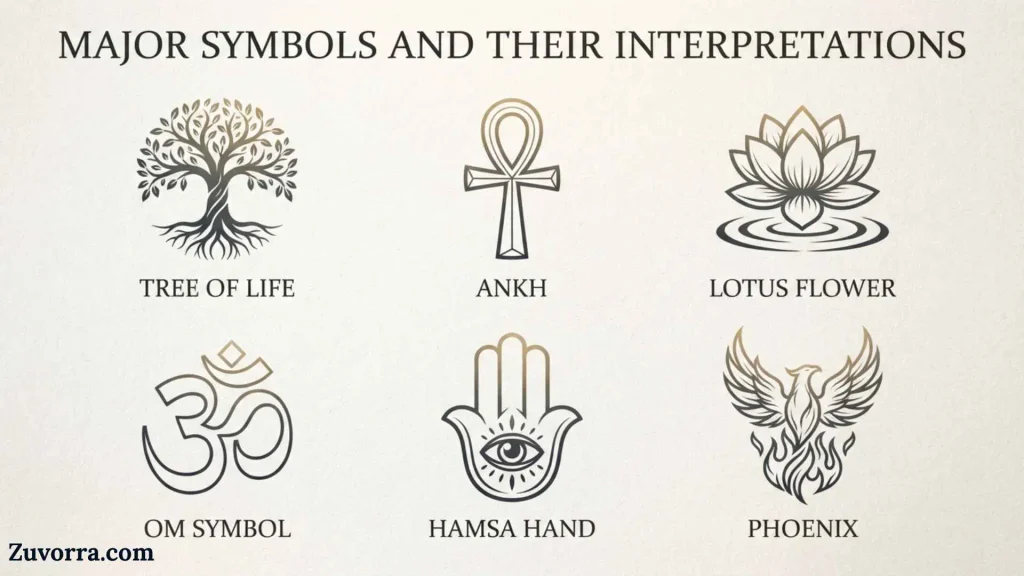
Light and Radiant Sun
Light is the clearest symbol of the Enlightenment. Rays breaking through clouds suggest truth overcoming confusion. A radiant sun may represent universal knowledge because sunlight reaches everyone rather than remaining confined to a privileged group.
Its positive meanings include clarity, hope, education, openness, and progress. Its negative side appears when a person or institution claims to possess the only “light” and dismisses all disagreement. Enlightenment symbolism supports inquiry, not intellectual arrogance.
Torch and Flame
The torch represents knowledge that can be carried, shared, and passed from one generation to another. Unlike the distant sun, a torch involves human action. Someone must light it, protect it, and bring it into dark places.
The torch may belong to Reason, Liberty, Science, or Education. Modern schools, universities, libraries, and civic institutions still use torch emblems to communicate learning and public service.
Unveiled Truth
Truth often appears as a female figure surrounded by light. A veil covers what cannot yet be seen clearly. Reason or Philosophy removes it through examination.
The image suggests that truth is not reached through passive acceptance. It must be uncovered by comparing evidence, questioning appearances, and correcting mistakes.
Modern viewers should avoid reading the image as a promise that every mystery has a simple answer. Enlightenment inquiry also involved recognizing uncertainty and the limits of human knowledge.
Open Book and Encyclopedia
The open book represents literacy, accumulated knowledge, and the public circulation of ideas. In Enlightenment imagery, it may also symbolize resistance to censorship.
The encyclopedia has an additional meaning: knowledge is connected. Diderot and d’Alembert did not treat individual subjects as isolated facts. Their project attempted to show relationships among philosophy, history, poetry, science, art, and skilled labor.
Tree of Knowledge
The tree organizes knowledge through branches. Its trunk represents a shared foundation, while its limbs show specialized fields.
The Encyclopédie classified knowledge through three major human faculties: memory, reason, and imagination. These corresponded broadly to history, philosophy, and poetry or the arts. The model drew partly from Francis Bacon’s earlier classification of learning.
The tree remains useful as a modern symbol because it combines unity and diversity. Knowledge grows outward, but its branches remain connected.
Scientific Instruments
A compass, telescope, microscope, globe, or measuring device represents empirical investigation. Such objects communicate that reliable knowledge requires methods.
The compass can also suggest intellectual boundaries and precision. The telescope expands vision toward distant objects. The microscope reveals structures hidden from ordinary sight. The globe places human societies within a shared natural world.
Scales of Justice
Scales symbolize impartial judgment, proportion, and equality before the law. Enlightenment political thought challenged the idea that legal rights should depend entirely on birth, estate, or inherited privilege.
Scales do not mean that every person receives an identical outcome. Their central idea is that laws should be weighed rationally and applied according to publicly defensible standards.
Broken Chains
Broken chains represent release from political tyranny, enslavement, censorship, inherited status, or intellectual restriction.
This symbol became especially powerful in revolutionary and abolitionist movements. Yet it also exposes the limits of eighteenth-century reform. Some people who defended liberty tolerated colonial domination, slavery, or the exclusion of women from political power. The broken chain therefore symbolizes both an ideal and an unfinished historical struggle.
Liberty Cap
The liberty cap, often called a Phrygian cap, became associated with freedom through interpretations of ancient Roman manumission customs. During the American and French Revolutions, it appeared on poles, prints, clothing, and personifications of Liberty.
The Library of Congress identifies the cap as an established emblem of revolutionary freedom in both American and French visual culture.
Although closely connected with Enlightenment political ideals, it belongs more precisely to the revolutionary symbolism that developed from those ideals.
Eye of Providence
The Eye of Providence usually shows an eye within a triangle, surrounded by rays. Its older meaning concerns divine watchfulness and providential care rather than secular rationalism.
It became associated with the Enlightenment partly because eighteenth-century political and Masonic imagery used geometric order, radiant light, and watchful vision. On the reverse of the Great Seal of the United States, the eye appears above an unfinished pyramid. The National Archives explains the accompanying motto Annuit Coeptis in relation to divine favor, while Novus Ordo Seclorum announces the beginning of a new era.
The eye should therefore not be labeled simply as “the Enlightenment symbol.” Its meaning depends on context.
Cultural Significance
France
French Enlightenment symbolism strongly emphasized Reason, Philosophy, Nature, Truth, and the classification of knowledge. The Encyclopédie offered the period’s most elaborate visual program.
During the French Revolution, these intellectual symbols merged with political emblems such as the liberty cap, tricolor cockade, fasces, broken chains, and female personifications of Liberty or the Republic. Revolutionary symbols could be more militant than earlier philosophical imagery.
Britain and Scotland
British and Scottish Enlightenment culture often favored images of scientific instruments, libraries, learned societies, commerce, and improvement. Thinkers such as David Hume, Adam Smith, Joseph Priestley, and members of scientific associations helped associate inquiry with sociability and public debate.
Coffeehouses, salons, clubs, lecture halls, and laboratories became symbolic spaces even when they were not formal emblems. They represented knowledge created through conversation and exchange.
The American Colonies and United States
American revolutionary imagery combined Enlightenment natural-rights arguments with classical republican symbolism. Liberty figures, rising suns, eagles, unfinished structures, Roman mottos, and balanced scales appeared in seals, prints, architecture, and political documents.
The rising sun on George Washington’s chair at the Constitutional Convention became associated with the hopeful beginning of a new political order. The Great Seal’s unfinished pyramid likewise suggests strength combined with an ongoing national project.
Germany and Central Europe
German Enlightenment thought, often called the Aufklärung, placed strong emphasis on independent judgment, education, and the public use of reason.
Immanuel Kant’s famous explanation of enlightenment focused on humanity’s emergence from self-imposed intellectual dependence. This idea is often symbolized by a person stepping from darkness into light, although that exact image was not Kant’s official emblem.
Wider Global Interpretation
The historical Enlightenment was centered largely in Europe and the Atlantic world, but its language of reason, rights, and reform later traveled widely.
These ideas were adapted, contested, and criticized in Latin America, the Caribbean, Africa, Asia, and the Middle East. Local thinkers did not simply copy European models. They combined them with existing legal, religious, philosophical, and anticolonial traditions.
For this reason, Enlightenment symbols may represent emancipation in one context and European cultural dominance in another.
Religious and Spiritual Meaning
Enlightenment symbolism did not have one religious meaning. The period included orthodox believers, religious reformers, deists, skeptics, and critics of organized religion.
Light could symbolize divine revelation as easily as human reason. The Eye of Providence referred primarily to God’s oversight. Geometric forms could suggest a rationally ordered creation. Nature itself sometimes appeared as a readable book whose laws revealed the wisdom of its creator.
Some thinkers argued that reason supported religious belief. Others used reason to criticize miracles, clerical power, intolerance, or doctrines that could not be publicly examined.
The most accurate interpretation is therefore not “religion versus reason.” Enlightenment symbolism reflects an ongoing debate about how revelation, nature, conscience, evidence, and institutional authority should relate to one another.
Scientific and Technical Meaning
Enlightenment symbols have no special Unicode category or fixed technical definition. Their scientific significance comes from the tools and practices they depict.
A telescope represents extended observation. A compass represents measurement and geometry. A prism recalls the study of light. A globe reflects astronomy, geography, navigation, and a growing awareness of global interconnection.
Diagrams and taxonomic trees also carry technical importance. They turn complex information into visible systems. Modern flowcharts, knowledge graphs, classification trees, library catalogs, and digital databases continue this Enlightenment ambition to organize relationships among ideas.
Where Enlightenment Symbols Are Used
Today, these symbols appear in:
- University seals and educational logos
- Library emblems and reading programs
- Government buildings and courtrooms
- Political monuments and constitutional imagery
- Museum exhibitions about science or revolution
- Historical novels, documentaries, and textbooks
- Freemasonry and fraternal organizations
- Coins, banknotes, stamps, and national seals
- Tattoos representing knowledge or freedom
- Technology logos using rays, bulbs, books, or eyes
- Scientific societies and research institutions
Context determines meaning. A torch on a school crest usually represents education. A torch beside broken chains may suggest liberation. An eye inside a church points more directly toward divine providence.
Common Variations and Similar Designs
Enlightenment imagery changes according to its purpose.
A radiant woman may represent Truth, Reason, Liberty, Wisdom, or the Republic. Objects identify her role: scales suggest Justice, a mirror may suggest Truth, and a cap on a pole suggests Liberty.
A sunburst may represent intellectual illumination, divine glory, political renewal, or national rebirth. A single flame usually emphasizes continuing knowledge rather than universal illumination.
The Eye of Providence differs from the modern eye icon used for visibility, surveillance, or awareness. The liberty cap differs from an ordinary soft hat because its historical setting and association with a pole establish its political meaning.
Common Misconceptions
There Was One Official Enlightenment Symbol
No central body selected an official emblem. “Age of Enlightenment symbols” refers to a family of related images used across books, prints, institutions, scientific culture, and revolutionary politics.
The Eye of Providence Means Only the Illuminati
The eye existed in Christian art and European visual culture before modern conspiracy theories. In eighteenth-century settings, it generally signified divine providence, oversight, or order. Its exact meaning depends on the surrounding design.
Every Revolutionary Symbol Is an Enlightenment Symbol
The Enlightenment influenced the American, French, Haitian, and other revolutionary movements, but intellectual history and revolutionary history are not identical. Guillotines, barricades, and military emblems belong to specific political events, not to Enlightenment philosophy as a whole.
Enlightenment Thinkers Rejected All Religion
Some criticized religious institutions or traditional doctrines, but many remained religious. Deism, natural theology, religious toleration, and reformist Christianity all formed part of Enlightenment debate.
Light Always Represents Unquestionable Truth
Light represents the pursuit or revelation of knowledge, not permission to declare oneself infallible. The strongest Enlightenment tradition includes criticism, revision, and evidence-based doubt.
Enlightenment Ideals Were Applied Equally
They were not. Racial slavery, colonialism, unequal property systems, and the political exclusion of women continued during the period. Later reformers used the Enlightenment’s language of universal rights to challenge these contradictions.
Interesting Facts About Enlightenment Symbols
- The movement’s name is itself a metaphor. “Enlightenment” turns intellectual understanding into an image of light entering darkness.
- The Encyclopédie celebrated manual skill as well as philosophy. Its imagery and illustrated volumes gave artisans, tools, and technical processes an important place within human knowledge.
- Truth was commonly personified as a woman. Her veil suggested that reality may be hidden and must be uncovered through disciplined inquiry.
- Imagination was not excluded from knowledge. In the Encyclopédie frontispiece, Imagination stands near Reason and Truth, showing that creativity had a recognized intellectual role.
- Scientific tools became moral symbols. A compass or telescope could represent careful thinking, accuracy, and intellectual humility, not only a particular branch of science.
- The liberty cap crossed the Atlantic. It appeared in both American and French revolutionary imagery, demonstrating how political symbols traveled between movements.
- The rising sun expressed unfinished hope. Rather than representing a completed achievement, it often signified the uncertain beginning of a new political era.
- Broken chains can criticize the Enlightenment itself. The symbol celebrates freedom while reminding viewers that many eighteenth-century societies denied freedom to enslaved and colonized people.
- Trees became early information architecture. The tree of knowledge visually organized branches of study much as modern websites and knowledge graphs organize connected topics.
- Classical imagery made radical ideas look ancient. Reformers used Roman clothing, goddesses, columns, and Latin mottos to give new political systems historical dignity.
- Light retained religious meaning. Even in scientific or political art, rays could still suggest divine truth or providential guidance.
- Modern lightbulb icons continue the tradition. The familiar symbol for an idea converts understanding into illumination, preserving the same metaphor in digital communication.
Related Symbols
| Related Symbol | Connection | Main Difference |
| Lightbulb | Represents ideas and discovery | Modern technological adaptation |
| Lamp of learning | Represents education and study | More closely tied to schools and scholarship |
| Owl of Athena | Represents wisdom | Rooted in ancient Greek mythology |
| Eye of Providence | Represents divine oversight or order | Primarily religious rather than purely rational |
| Liberty Bell | Represents political liberty | Specifically linked to American history |
| Phrygian cap | Represents republican freedom | More revolutionary and political |
| Scales of justice | Represents rational and fair law | Focused on legal judgment |
| Tree of life | Represents creation and interconnected existence | Usually spiritual or cosmological |
| Tree of knowledge | Represents organized learning | Intellectual and classificatory |
| Broken chains | Represents liberation | Emphasizes oppression and emancipation |
| Compass and square | Represents order, measurement, and moral conduct | Strongly associated with Freemasonry |
| Rising sun | Represents renewal and a new era | Can be national, spiritual, or political |
Frequently Asked Questions
What is the main symbol of the Age of Enlightenment?
Light is the main symbol because the movement described knowledge as illumination. Sun rays, torches, flames, and glowing figures all communicate the idea that reason and education can overcome ignorance. No organization officially adopted light as a universal emblem, but it dominates eighteenth-century Enlightenment language and art.
Why is a torch associated with the Enlightenment?
A torch represents knowledge that people actively carry into darkness. It differs from sunlight because it emphasizes human responsibility. Teachers, philosophers, scientists, and reformers “carry the torch” by preserving discoveries, sharing ideas, and helping others understand subjects that were previously hidden or restricted.
What does the unveiled woman symbolize?
The unveiled woman usually represents Truth. A veil suggests that truth is hidden by ignorance, error, prejudice, or appearance. When Reason and Philosophy remove it, the scene presents knowledge as the result of investigation. Details around the figure determine whether she represents Truth, Nature, Liberty, or another concept.
Is the Eye of Providence an Enlightenment symbol?
It can appear within eighteenth-century Enlightenment-era imagery, but its primary historical meaning is divine providence. Rays, geometry, and watchful vision allowed it to fit designs concerned with order and new political institutions. It should not be interpreted as a purely secular symbol of reason in every context.
What did the open book mean during the Enlightenment?
The open book represented accessible knowledge, literacy, publication, and intellectual exchange. It also reflected the expansion of encyclopedias, journals, pamphlets, and public debate. Unlike secret or restricted knowledge, an open book suggests that learning can be examined, discussed, corrected, and shared with a wider audience.
Why were scientific instruments used as symbols?
Scientific instruments showed that knowledge requires observation and measurement. Telescopes extended sight, microscopes revealed hidden structures, and compasses supported precision. In allegorical art, these tools communicated a larger principle: claims about the natural world should be tested through evidence rather than accepted solely because of tradition.
Did the Enlightenment have a flag?
No single flag represented the entire Enlightenment. The movement crossed national, religious, and political boundaries and had no central authority. Later revolutions inspired by Enlightenment ideas developed flags, cockades, seals, and national emblems, but those symbols belonged to particular governments or political movements.
What colors represent the Enlightenment?
Gold, yellow, and white commonly suggest light, truth, and intellectual clarity. Blue can represent reason, order, or the heavens, while red may signify liberty, courage, or revolution. These associations are flexible rather than official. The figures, objects, inscriptions, and historical setting matter more than color alone.
Are Enlightenment symbols appropriate for tattoos?
They can represent education, critical thinking, freedom, or personal growth. A torch, open book, sunburst, broken chain, or tree of knowledge offers a relatively clear meaning. Anyone choosing a historical emblem should study its wider associations first, especially symbols connected with religion, Freemasonry, nationalism, or revolution.
How can I identify an Enlightenment symbol in art?
Look for radiant light, allegorical figures, books, scientific tools, classical clothing, temples, scales, liberty caps, globes, or broken chains. Then examine the date, title, inscription, and surrounding figures. A symbol becomes reliably “Enlightenment” through context, not merely because one familiar object appears.
Key Takeaways
- Light is the central metaphor of the Age of Enlightenment.
- Torches and flames represent reason, education, and shared knowledge.
- Unveiled Truth symbolizes discovery through critical inquiry.
- Open books and encyclopedias represent public access to learning.
- Scientific instruments express observation, evidence, and measurement.
- Scales, liberty caps, and broken chains reflect legal and political reform.
- The Eye of Providence primarily represents divine oversight, though it appears in Enlightenment-era designs.
- Revolutionary symbolism overlaps with Enlightenment thought but is not identical to it.
- Enlightenment symbols express ideals that eighteenth-century societies often applied inconsistently.
- Context is essential because many of these images have religious, classical, scientific, and political meanings.
Conclusion
Age of Enlightenment symbols turn abstract ideas into a clear visual language. Light reveals truth. A torch carries knowledge forward. An open book makes learning available. Scientific instruments test the world, while scales, liberty caps, and broken chains express hopes for justice and freedom.
These images endure because the questions behind them remain relevant. How should people distinguish truth from error? Who should control knowledge? What makes a law just? Can education improve society? The symbols do not provide final answers, but they preserve the Enlightenment conviction that careful inquiry, open discussion, and intellectual freedom are essential to human progress.
References
- British Museum. “Frontispiece” from Diderot’s Encyclopédie, with the historical description of Truth, Reason, and Imagination.
- Library of Congress. Resources on liberty caps, allegorical figures, revolutionary fashion, maps, and American political symbolism.
- MIT Libraries. “Introduction to the Encyclopédie,” explaining the frontispiece and its figures of Truth, Reason, Philosophy, arts, sciences, and trades.
- National Archives. Historical information about the Great Seal of the United States, the Eye of Providence, the unfinished pyramid, and its Latin mottos.
- Stanford Encyclopedia of Philosophy. Entries on reason and the Enlightenment idea of moral and intellectual progress.
- University of Michigan, Encyclopédie of Diderot & d’Alembert Collaborative Translation Project. Explanation of the Encyclopédie frontispiece.

I’m Jasper Huxley, a British writer fascinated by the symbols that communicate ideas without words. I explore their meanings, origins, cultural connections, and everyday uses. From ancient markings to contemporary signs, I enjoy uncovering the stories behind visual language and presenting symbolism in a clear, engaging way for curious readers worldwide.
Books:
- The Hidden Language of Symbols
- Symbols, Signs and Their Meanings