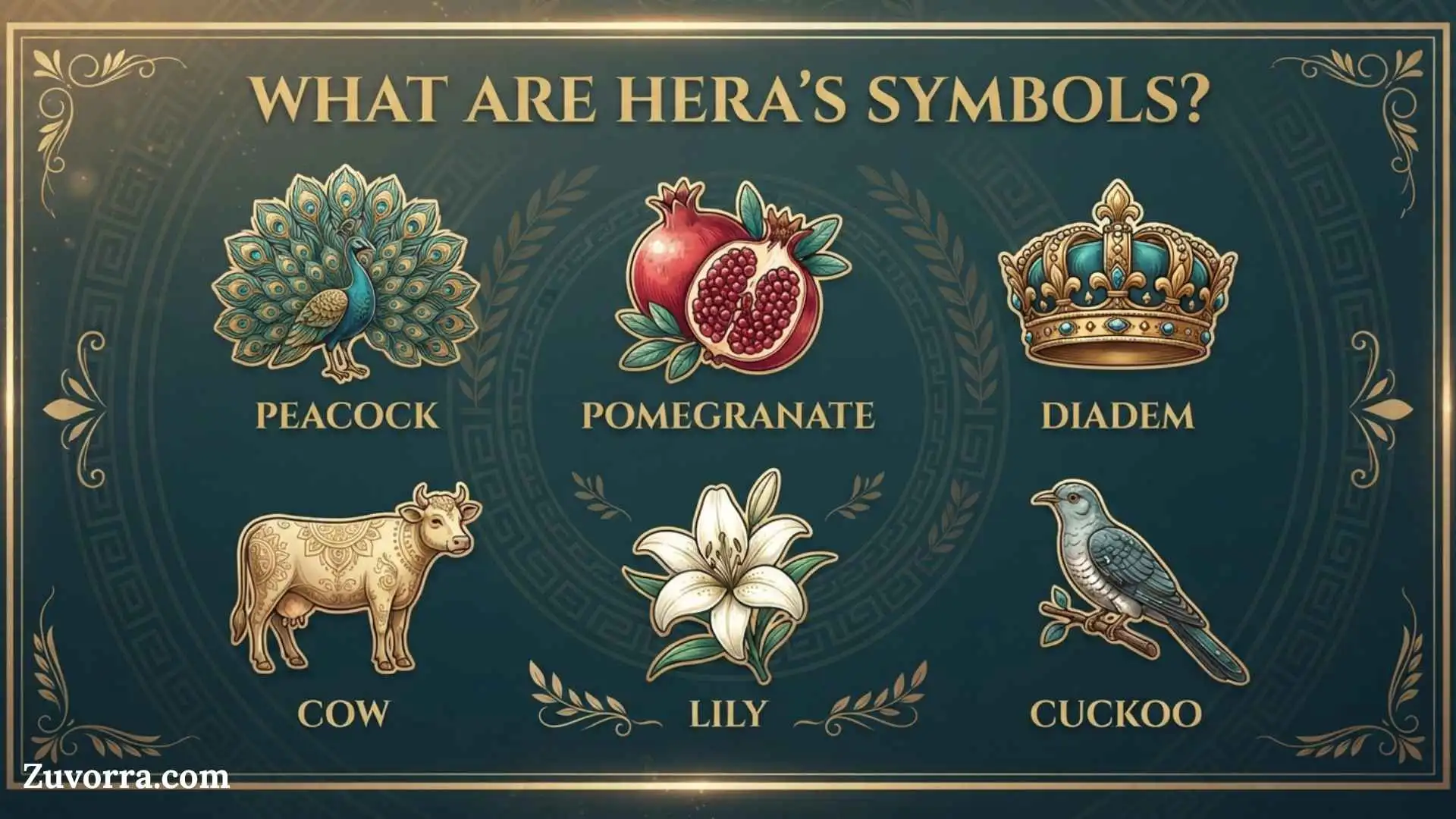
Hera’s main symbols are the peacock, cow, cuckoo, pomegranate, crown, scepter, throne, and lotus-tipped staff. Each reflects part of her identity as the ancient Greek goddess of marriage, women, royal authority, and legitimate rule.
These symbols matter because they reveal a more complete picture of Hera than the familiar stories about her anger toward Zeus’s lovers. In ancient temples, pottery, statues, coins, literature, and later Roman art, her animals and royal objects identified her as the queen of the Olympian gods.
Understanding what Hera’s symbols mean also helps explain ancient Greek ideas about marriage, fertility, sovereignty, family order, and the responsibilities of a queen.
Quick Meaning
Hera’s symbols represent queenship, marriage, fertility, protection, dignity, and watchfulness. The crown and scepter show her royal authority. The pomegranate represents fertility and marital union. The cow suggests nurturing motherhood, while the cuckoo recalls Zeus’s courtship. The peacock became her best-known emblem of majesty and vigilance.
Hera’s Symbols Overview
| Symbol or Attribute | Primary Meaning | Category | Ancient Connection | Common Modern Interpretation |
| Peacock | Majesty, beauty, watchfulness | Sacred bird | Linked with Hera and the story of Argus Panoptes | Pride, dignity, vigilance |
| Cow or heifer | Motherhood, fertility, regal beauty | Sacred animal | Hera is called “ox-eyed” in Homeric poetry | Nurturing power and abundance |
| Cuckoo | Courtship and marriage | Sacred bird | Zeus approached Hera in the form of a cuckoo | Love, persuasion, seasonal renewal |
| Pomegranate | Fertility, marriage, abundance | Sacred plant and fruit | Held by Hera’s cult statue at Argos | Commitment, fertility, life cycles |
| Crown or diadem | Queenship and legitimacy | Royal object | Hera appears crowned as queen of the gods | Leadership, dignity, authority |
| Scepter | Divine government and command | Royal object | Held by Hera in temple sculpture and art | Power, lawful rule, responsibility |
| Throne | Established sovereignty | Royal object | Hera is frequently portrayed seated as queen | Stable authority and status |
| Lotus-tipped staff | Divine authority and flourishing life | Ceremonial object | Appears in Greek artistic representations | Renewal, feminine power, sacred rule |
| Lion | Strength and royal power | Sacred animal | Sometimes associated with Hera’s cult and imagery | Courage, protection, sovereignty |
| Veil | Marriage and respectable status | Clothing attribute | Worn by married women and divine brides | Commitment, modesty, sacred boundaries |
Hera does not have a Unicode character or official emoji. Modern writers may use the peacock emoji, crown emoji, cow emoji, or pomegranate emoji as informal visual equivalents, but none officially represents the goddess.
What Do Hera’s Symbols Mean?
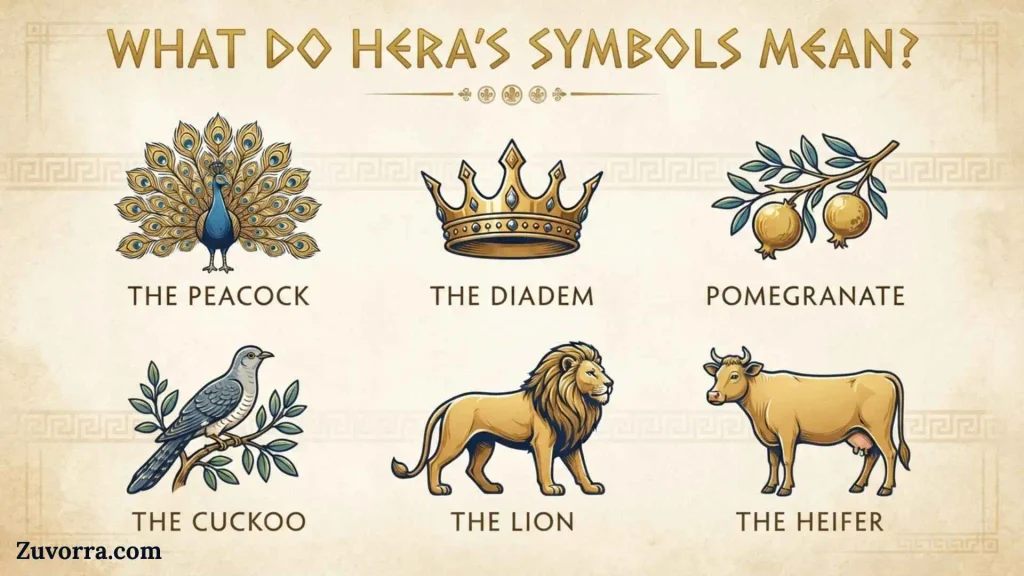
Hera’s symbols express her position as both a marriage goddess and a ruling queen. Unlike Athena, who often carries weapons, or Zeus, who holds the thunderbolt, Hera is usually identified through animals, fruit, royal clothing, and ceremonial objects.
Her symbols can be grouped into three main themes.
Marriage and Fertility
The pomegranate, cuckoo, veil, cow, and certain plants connect Hera with marriage, fertility, birth, and the continuation of the family. These symbols reflect the importance of lawful marriage in ancient Greek religious and civic life.
Hera did not simply represent romantic love. Aphrodite governed sexual desire and attraction, while Hera protected the formal bond of marriage. Her authority concerned vows, household legitimacy, lawful heirs, and the recognized place of a wife within the family.
Queenship and Authority
The crown, scepter, throne, and staff communicate Hera’s royal status. She is not merely Zeus’s wife. She is Hera Basileia, or Hera the Queen, an Olympian ruler with her own temples, rituals, festivals, and worshippers.
Ancient artists often showed her seated, crowned, and holding a scepter. This visual language would have been immediately recognizable. A throne indicated established sovereignty, while a scepter signaled the right to command.
Watchfulness and Dignity
The peacock, especially in later Greek and Roman tradition, represents watchfulness, beauty, and royal splendor. Its tail appears covered with eye-like markings, making it a natural emblem of observation.
Modern interpretations often connect those “eyes” with Hera’s awareness of Zeus’s infidelity. That reading is understandable, but ancient meanings were broader. The bird also displayed magnificence, immortality, divine glory, and the impressive dignity expected of a queen.
History and Origin of Hera’s Symbols
Hera’s symbolism developed over many centuries rather than emerging as one fixed system. Some of her attributes, such as the cow and crown, appear deeply rooted in early Greek religion. Others, especially the peacock, became more prominent as Greek and Roman myths evolved.
Hera was one of the most important goddesses in the ancient Greek world. Her major cult centers included Argos in the Peloponnese and the island of Samos, where monumental sanctuaries called Heraia were built in her honor. Olympia also had an ancient temple dedicated to her.
Hera in Early Greek Tradition
In Homer’s Iliad, Hera is repeatedly called “ox-eyed” or “cow-eyed.” The Greek epithet, commonly transliterated as boōpis, may praise her large, impressive eyes while also reflecting her association with cattle.
Cattle carried great economic and religious value in the ancient Mediterranean. A cow could suggest wealth, nourishment, motherhood, sacrifice, and fertility. The image therefore suited a major goddess who protected marriage and the family.
The cuckoo also belonged to early traditions surrounding Hera. In one myth, Zeus transformed himself into a cold or distressed cuckoo. Hera took the bird into her clothing to warm it, allowing Zeus to reveal himself and pursue her. Different surviving versions handle the encounter differently, so it should not be treated as a simple modern romance.
The Argive Cult Statue
One of the clearest ancient descriptions of Hera’s attributes comes from Pausanias, a Greek traveler and writer of the second century CE. He described a monumental gold-and-ivory statue of Hera at the Heraion of Argos.
According to his account, the sculptor Polycleitus represented Hera seated on a throne. She wore a crown decorated with the Graces and Seasons, carried a pomegranate in one hand, and held a scepter in the other. Pausanias added that a cuckoo sat upon the scepter.
This single image brings together four central ideas:
- The throne establishes Hera as a ruler.
- The crown confirms her divine queenship.
- The scepter expresses lawful authority.
- The pomegranate connects her rule with marriage, fertility, and sacred mystery.
Pausanias refused to explain the pomegranate fully because its meaning belonged to a protected religious tradition. This caution is important. Modern interpretations can suggest fertility, abundance, and marriage, but they cannot reconstruct every secret meaning known to ancient worshippers.
The Rise of the Peacock
The peacock is now Hera’s most recognizable animal, yet the cow and cuckoo are equally important in older Greek literature and cult imagery.
Later mythology connected the peacock with Argus Panoptes, the many-eyed guardian assigned by Hera to watch Io. After Hermes killed Argus, one tradition says Hera preserved his eyes in the peacock’s tail.
The story gave the bird a powerful narrative link to vigilance, memory, and divine honor. Its spectacular feathers also made it an ideal royal emblem. By the Greco-Roman period, the peacock was strongly associated with Hera and her Roman counterpart, Juno.
Symbolism and Interpretation
Hera’s symbols contain both positive and difficult meanings because the goddess herself had many roles. She could protect marriage and childbirth, defend cities, oppose enemies, punish oath-breaking, and act harshly in myth.
Traditional Meanings
Traditionally, Hera’s symbols communicate:
- Lawful marriage
- Legitimate succession
- Female dignity
- Fertility and childbirth
- Protection of the household
- Royal command
- Divine order
- Loyalty to sacred vows
These meanings come primarily from Hera’s religious functions and artistic attributes, not simply from modern personality-based readings of her myths.
Positive Symbolism
In a positive sense, Hera’s crown and throne represent leadership that is stable rather than impulsive. Her cow represents care and nourishment. The pomegranate suggests fruitfulness and continuity. The peacock embodies beauty that cannot be ignored.
Together, these images portray a goddess who protects institutions that hold society together: marriage, family, inheritance, household order, and legitimate government.
Negative Symbolism
Hera’s myths also give her symbols darker associations. Watchfulness can become suspicion. Commitment can become confinement. Authority can become control. Pride can become vanity, and the defense of marriage can turn into anger against innocent people.
These negative readings are interpretations rather than fixed ancient definitions. Ancient worshippers did not reduce Hera to jealousy. That narrow portrayal overlooks her importance as a powerful civic and religious goddess.
Psychological Interpretation
In modern psychological readings, Hera may represent the desire for recognized partnership, loyalty, status, and permanence. Her symbols can express the emotional need to have one’s commitments respected.
The crown may represent self-respect. The scepter can symbolize personal authority. The pomegranate may suggest the creative or reproductive potential of a long-term union. The peacock’s eyes can represent alertness after betrayal.
Such interpretations can be useful, but they belong to modern psychology and symbolic reflection. They should not be presented as beliefs shared by all ancient Greeks.
Cultural Significance
Hera’s symbols changed according to location, period, artistic style, and religious setting. Ancient Greek religion had no single centralized authority that dictated one official meaning for every symbol.
Argos and the Peloponnese
Hera held special importance in Argos and the wider region of Argolis. The Argive Heraion stood between major ancient communities and served as an important religious center.
At Argos, the enthroned, crowned Hera emphasized political authority and divine protection. The pomegranate and scepter seen in her cult statue joined fertility with sovereignty.
Samos
The Heraion of Samos was among the most significant sanctuaries in the Greek world. The site developed over centuries and became known for monumental temple architecture and a rich collection of offerings.
Samian tradition closely connected Hera with the island. Worship there emphasized her divine marriage, sacred presence, and protective power. Specialized objects such as so-called Hera cups have been found in connection with Samian cult activity.
Olympia
At Olympia, Hera had an ancient temple near the sanctuary of Zeus. Her presence there shows that she was not merely an accessory to Zeus. She received worship in her own right.
The Heraia, a footrace festival associated with girls and women, was also connected with her worship at Olympia. The festival reinforced Hera’s relationship with female life stages, communal identity, and religious participation.
Roman Culture
The Romans identified Hera with Juno, although Juno had her own Italian history and functions. Under Roman influence, the peacock became especially prominent as an emblem of divine queenship.
Juno could protect marriage, women, the Roman state, and public life. As Juno Regina, or Juno the Queen, her royal symbolism closely matched Hera’s crown, scepter, and throne.
The comparison is useful, but Hera and Juno should not be treated as completely identical. Roman religion adapted Greek stories while preserving distinct Roman titles, rituals, and civic meanings.
Religious and Spiritual Meaning
In ancient Greek religion, Hera’s symbols were connected to worship, sacrifice, festivals, marriage rites, and temple images. They were not merely decorative illustrations.
Marriage as a Sacred Institution
Hera protected the formal and sacred dimension of marriage. Brides, wives, and families could honor her when seeking a stable union, fertility, protection, or social legitimacy.
The veil and pomegranate fit this religious setting. The veil marked the change in a woman’s social and marital status, while the many-seeded fruit naturally suggested abundance and fertility.
Sacred Sovereignty
The crown and scepter communicated more than wealth. They showed that Hera possessed divine rank. In temple art, these objects made her authority visible to worshippers.
The scepter also implied order. Hera’s power concerned the enforcement of proper relationships, lawful bonds, and recognized social structures.
Modern Hellenic and Neopagan Practice
Some modern Hellenic polytheists honor Hera as a living deity connected with marriage, family, queenship, and personal dignity. Peacock feathers, pomegranates, crowns, flowers, or images of cows may appear in modern devotional settings.
Practices differ widely. There is no universal modern ritual code, and contemporary spiritual meanings should not automatically be projected backward onto antiquity.
Is There a Scientific or Technical Meaning?
Hera’s mythological symbols do not have a standard scientific, mathematical, medical, or engineering meaning.
The name HERA, however, appears in modern technical contexts as an acronym. For example, the Hydrogen Epoch of Reionization Array is a radio telescope project used to study the early universe. This scientific use is unrelated to the Greek goddess’s peacock, pomegranate, crown, or other symbols.
Likewise, no official astronomical glyph universally represents Hera. The goddess should not be confused with the asteroid 103 Hera, scientific acronyms, brands, or fictional organizations that happen to use her name.
Where Hera’s Symbols Are Used
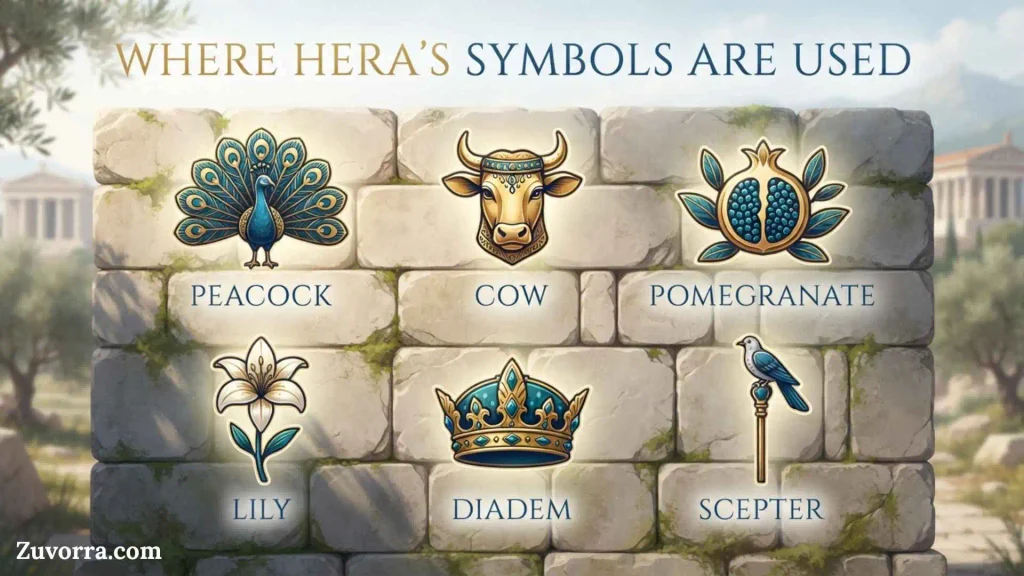
Hera’s symbols appear in both historical and modern settings.
Ancient Art and Sculpture
Greek vase painters and sculptors often identified Hera through her crown, veil, scepter, throne, or cuckoo. Temple statues presented her as dignified and mature rather than armed or physically active.
Coins and Civic Images
Cities connected with Hera sometimes placed her head, crown, or cult image on coins. These images expressed local devotion and civic identity as well as religious belief.
Literature and Drama
Homeric poetry identifies Hera through epithets such as “ox-eyed” and portrays her as a queen among the gods. Later poets and mythographers expanded stories involving the cuckoo, Io, Argus, and the peacock.
Renaissance and Neoclassical Art
European artists frequently portrayed Juno or Hera with a peacock. In these works, the bird serves as a quick visual label, just as an eagle may identify Zeus or a trident may identify Poseidon.
Jewelry and Fashion
Peacock feathers, pomegranate designs, crowns, and scepters can be used in jewelry inspired by Hera. Their intended meaning may include dignity, marriage, feminine authority, fertility, or classical beauty.
Tattoos
A Hera-inspired tattoo may combine:
- A peacock with a crown
- A pomegranate and wedding band
- A scepter wrapped in flowers
- A cow or heifer with Greek ornament
- Hera’s name written in Greek as Ἥρα
- A throne framed by peacock feathers
Tattoo meanings are personal. A peacock tattoo does not automatically refer to Hera, and a pomegranate is also associated with Persephone, fertility traditions, and other cultures.
Weddings and Ceremonial Design
Modern wedding planners sometimes use peacock feathers, pomegranates, or Greek-style crowns in Hera-themed ceremonies. Such use is inspired by mythology rather than a direct continuation of one universal ancient wedding custom.
Common Variations and Similar Images
Hera’s appearance changes across Greek, Roman, Renaissance, and modern art.
Crown, Polos, or Diadem
Hera may wear a simple band-like diadem, an ornate crown, or a tall cylindrical headdress called a polos. All indicate elevated status, though their exact shapes depend on the period and artistic tradition.
Scepter and Lotus Staff
Some representations show a plain royal scepter. Others show a staff topped with a flower, lotus form, or cuckoo. These are related attributes rather than entirely separate identities.
Peacock or Cuckoo
The peacock dominates modern imagery, but the cuckoo is more closely tied to myths about Zeus’s courtship. An artwork featuring a crowned woman with a cuckoo may therefore represent Hera even without a peacock.
Cow and “Ox-Eyed” Imagery
Hera is rarely shown simply as a cow in classical art. Her bovine connection more often appears through sacred cattle, sacrifices, cult associations, and Homer’s “ox-eyed” epithet.
Hera and Juno
A crowned goddess with a peacock in Roman or European art is often labeled Juno. In a Greek mythological context, the same figure may be called Hera. The visual vocabulary overlaps because Roman artists and writers identified the two goddesses with each other.
Common Misconceptions About Hera’s Symbols
“The Peacock Was Always Hera’s Only Main Symbol”
The peacock is famous today, but ancient evidence also places great importance on the cow, cuckoo, crown, scepter, throne, and pomegranate. Earlier Greek poetry often emphasizes bovine imagery rather than the peacock.
“Every Eye on the Peacock Tail Literally Belonged to Argus”
That claim comes from a mythological explanation of the feather pattern. It is not a biological belief or a detail found in every ancient version of the story.
“The Pomegranate Has One Fixed Meaning”
The pomegranate can suggest fertility, abundance, marriage, blood, death, rebirth, and sacred mystery. Its meaning depends on the deity and context. With Persephone it often relates to the Underworld; with Hera it is closely connected to marriage, fertility, and divine ritual.
“Hera Was Only the Goddess of Jealousy”
Jealousy was not her formal divine domain. Hera was worshipped as a goddess of marriage, women, family, royal authority, and childbirth-related protection. Her revenge stories belong to mythology, but they do not define the full scope of her religion.
“Hera and Juno Are Exactly the Same”
The Romans identified Juno with Hera, but Juno retained distinct Roman roles, titles, festivals, and political importance. They are corresponding deities, not perfectly interchangeable figures in every historical context.
“A Peacock Feather Always Means Hera”
Peacock imagery also appears in Christian art, South Asian traditions, Persian design, fashion, national symbolism, and general decorative art. Context determines whether it refers to Hera.
10 Interesting Facts About Hera’s Symbols
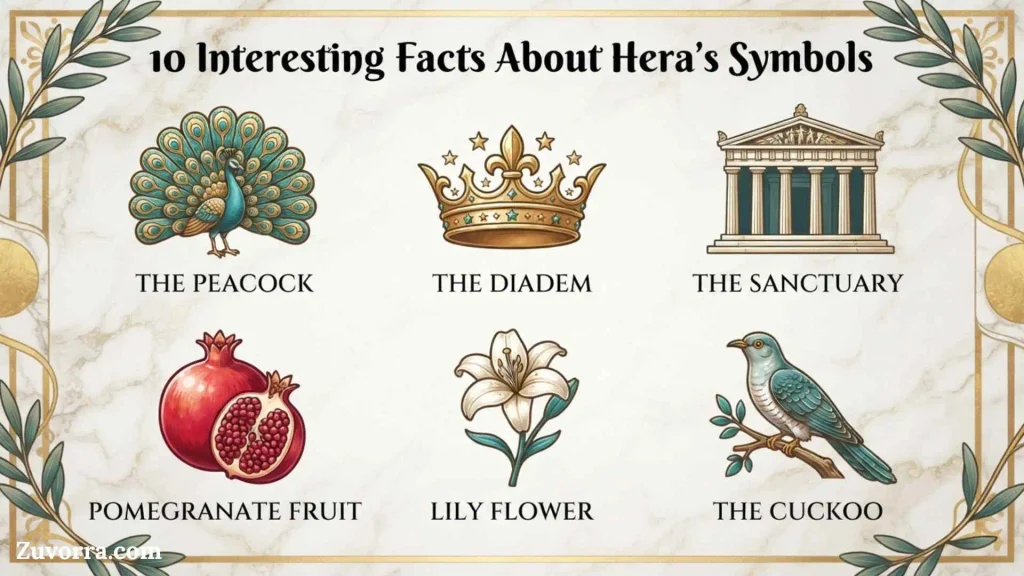
1. The Pomegranate’s Meaning Was Considered Secret
Pausanias described the pomegranate in Hera’s hand but refused to reveal its sacred explanation. His silence suggests that the fruit carried ritual meaning beyond the simple modern label of “fertility.”
2. Hera’s Scepter Included a Cuckoo
The cuckoo was not merely a bird associated with Hera in storytelling. Ancient descriptions place it directly on her royal scepter, joining the story of her courtship with her authority as queen.
3. The Peacock May Be More Familiar Than It Was in Early Greek Poetry
Modern illustrations almost always give Hera a peacock. Homer, however, identifies her more strongly through queenship and the “ox-eyed” epithet. This shows how divine symbolism can change in popularity over time.
4. Her Crown Could Depict Other Divine Figures
The crown of the famous Argive cult statue included the Graces and the Seasons. This decoration connected Hera’s rule with beauty, social harmony, order, and the recurring pattern of time.
5. The Cow Symbol Was a Compliment
Calling Hera “ox-eyed” was not an insult. Large, calm, impressive eyes were admired, and cattle represented wealth and value. The epithet communicated beauty and grandeur within its ancient poetic setting.
6. Hera’s Symbols Combine Domestic and Political Power
The pomegranate and veil concern marriage and fertility, while the crown and scepter concern government. Hera’s image therefore joins household order with public sovereignty.
7. Her Symbols Help Identify Unlabeled Art
Ancient artworks do not always include written names. A mature crowned goddess seated on a throne with a scepter, pomegranate, cuckoo, or peacock can often be identified as Hera or Juno.
8. The Peacock’s Eyes Represent Preservation as Well as Surveillance
In the Argus story, the eyes can be understood as a memorial. Hera does not merely watch through them; she preserves the image of a loyal servant after his death.
9. Hera’s Throne Is a Symbol in Its Own Right
The throne shows that her authority is established and institutional. She does not need to display a weapon to prove her status. Her seated posture communicates command, permanence, and ceremonial dignity.
10. No Single Ancient List Was Universally Binding
Different cities honored Hera through different titles, objects, rituals, and local stories. Modern lists combine evidence from literature, cult practice, sculpture, pottery, and later Roman tradition.
Related Symbols and Deities
| Related Symbol or Deity | Connection to Hera | Main Difference |
| Zeus’s eagle and thunderbolt | Represents Hera’s husband and co-ruler | Zeus’s symbols emphasize sky power and force |
| Aphrodite’s dove and shell | Connected with love and attraction | Aphrodite governs desire rather than lawful marriage |
| Demeter’s grain and torch | Connected with fertility and motherhood | Demeter centers on agriculture and the mother-daughter bond |
| Persephone’s pomegranate | Shares the same fruit symbol | Persephone’s fruit mainly marks her bond with the Underworld |
| Athena’s owl and helmet | Represents another powerful Olympian goddess | Athena symbolizes wisdom, strategy, and civic defense |
| Artemis’s deer and bow | Connected with women and childbirth | Artemis remains unmarried and protects wilderness |
| Juno’s peacock | Roman counterpart of Hera’s bird | Juno has additional Roman civic and state functions |
| Royal crown | Shared by queens and ruling deities | Hera’s crown specifically identifies divine female sovereignty |
Frequently Asked Questions
What is Hera’s most famous symbol?
The peacock is Hera’s best-known symbol today. Its impressive tail represents majesty, beauty, watchfulness, and divine glory. Later mythology connected its eye-like markings with Argus Panoptes, Hera’s many-eyed guardian. In earlier Greek traditions, however, the cow and cuckoo were also highly important.
Why is the peacock Hera’s symbol?
The peacock became associated with Hera because of its royal appearance and the myth of Argus. After Hermes killed the many-eyed guardian, Hera reportedly placed or preserved his eyes in the peacock’s tail. The bird therefore came to suggest vigilance, remembrance, splendor, and the dignity of a divine queen.
Why is the cow associated with Hera?
The cow represents fertility, nourishment, motherhood, wealth, and impressive beauty. Homer frequently calls Hera “ox-eyed,” an admiring poetic description of her large, stately eyes. The animal also suited a goddess concerned with women, marriage, family continuity, and the prosperity of the household.
What does Hera’s pomegranate symbolize?
Hera’s pomegranate most commonly symbolizes fertility, abundance, marriage, and the continuation of family life. Her famous cult statue at Argos held one in its hand. Because its deeper ritual story was considered sacred, historians avoid claiming that it had only one universal ancient meaning.
What does Hera’s crown represent?
Hera’s crown represents divine queenship, legitimate authority, status, and dignity. It distinguishes her as the queen of Olympus rather than merely the wife of Zeus. In some works she wears a diadem; in others she wears a tall polos or an elaborate royal crown.
Why is the cuckoo sacred to Hera?
The cuckoo recalls a myth in which Zeus approached Hera after taking the bird’s form. It therefore became connected with their courtship and marriage. A cuckoo also appeared on the scepter of Hera’s renowned Argive statue, showing that the bird had both mythological and ceremonial importance.
Is the lotus one of Hera’s symbols?
A lotus-tipped staff appears among Hera’s artistic attributes. It may communicate sacred authority, flowering life, fertility, or ceremonial elegance. However, its precise meaning is less certain than those of her crown and scepter, so modern explanations should avoid treating one interpretation as proven fact.
Does Hera have a symbol for marriage?
The pomegranate, veil, cuckoo, and wedding-related crown can all symbolize Hera’s connection with marriage. Of these, the pomegranate most clearly combines fertility with marital continuity, while the veil reflects the recognized status of a married woman in ancient Greek society.
Is Hera’s symbol a peacock feather or the whole bird?
Both forms can represent her. Ancient and later art commonly shows the whole peacock beside Hera or pulling her chariot. Modern jewelry, tattoos, and illustrations often use a single feather because its eye pattern is easier to recognize and adapt into a compact design.
What symbol should be used to represent Hera today?
The peacock is the clearest choice for immediate recognition. A crown and pomegranate offer a more historically balanced design because they emphasize her queenship, marriage, and fertility. For a fuller emblem, combine a crowned peacock with a pomegranate or scepter.
Key Takeaways
- Hera’s principal symbols are the peacock, cow, cuckoo, pomegranate, crown, scepter, throne, and lotus staff.
- The crown, throne, and scepter represent queenship, legitimacy, and divine authority.
- The pomegranate signifies fertility, marriage, abundance, and sacred mystery.
- The cow reflects motherhood, nourishment, wealth, and Hera’s “ox-eyed” Homeric epithet.
- The cuckoo is connected with Zeus’s approach to Hera and appeared on her scepter.
- The peacock symbolizes royal splendor, vigilance, remembrance, and beauty.
- Hera’s symbols developed across different regions and historical periods.
- Ancient religious meanings should be distinguished from modern spiritual and psychological interpretations.
- Hera was not officially the goddess of jealousy. She governed marriage, women, family, and royal order.
- Roman Juno shares many of Hera’s attributes but also has distinct Roman functions.
Conclusion
The answer to what are Hera’s symbols goes far beyond the peacock alone. Her crown, throne, and scepter reveal a sovereign queen. Her pomegranate, cow, veil, and cuckoo connect her with marriage, fertility, family continuity, and sacred union. The peacock adds majesty, vigilance, and unforgettable visual beauty.
Together, these emblems show Hera as ancient worshippers could understand her: not simply as a jealous wife in myth, but as a powerful goddess who protected marriage, embodied legitimate queenship, and helped preserve the social and divine order of the Greek world.
References
- Encyclopaedia Britannica. “Hera.” General overview of Hera’s identity, mythology, and religious functions.
- Homer. Iliad. Scaife Viewer and Perseus Digital Library editions, including references to “ox-eyed Hera.”
- National Archaeological Museum, Athens. “A Cuckoo Bird for Goddess Hera.” Archaeological evidence concerning Hera’s cuckoo attribute.
- Pausanias. Description of Greece, Book 2. Description of the Argive Heraion and Polycleitus’s cult statue of Hera.
- The British Museum. Collection record for the Samian “Hera Cup” and its cult context.
- Theoi Project. “Hera” and “Hera Cult.” Compiled translations of ancient literary sources concerning Hera’s attributes, animals, plants, and sanctuaries.
- University of Warwick, Department of Classics and Ancient History. “Sanctuary of Hera, Argos.” Archaeological and literary information about the Argive Heraion.
- World History Encyclopedia. “Hera.” Overview of Hera’s mythology, worship, family relationships, and cultural role.

I’m Rupert Ashbourne, a British author interested in how symbols have shaped human communication throughout history. I examine signs, emblems, markings, and visual representations, explaining their meanings and cultural significance. My aim is to make symbolism approachable while helping readers understand how simple shapes and images can carry surprisingly powerful messages.
Books:
- The Meaning of Symbols
- A History of Signs and Emblems