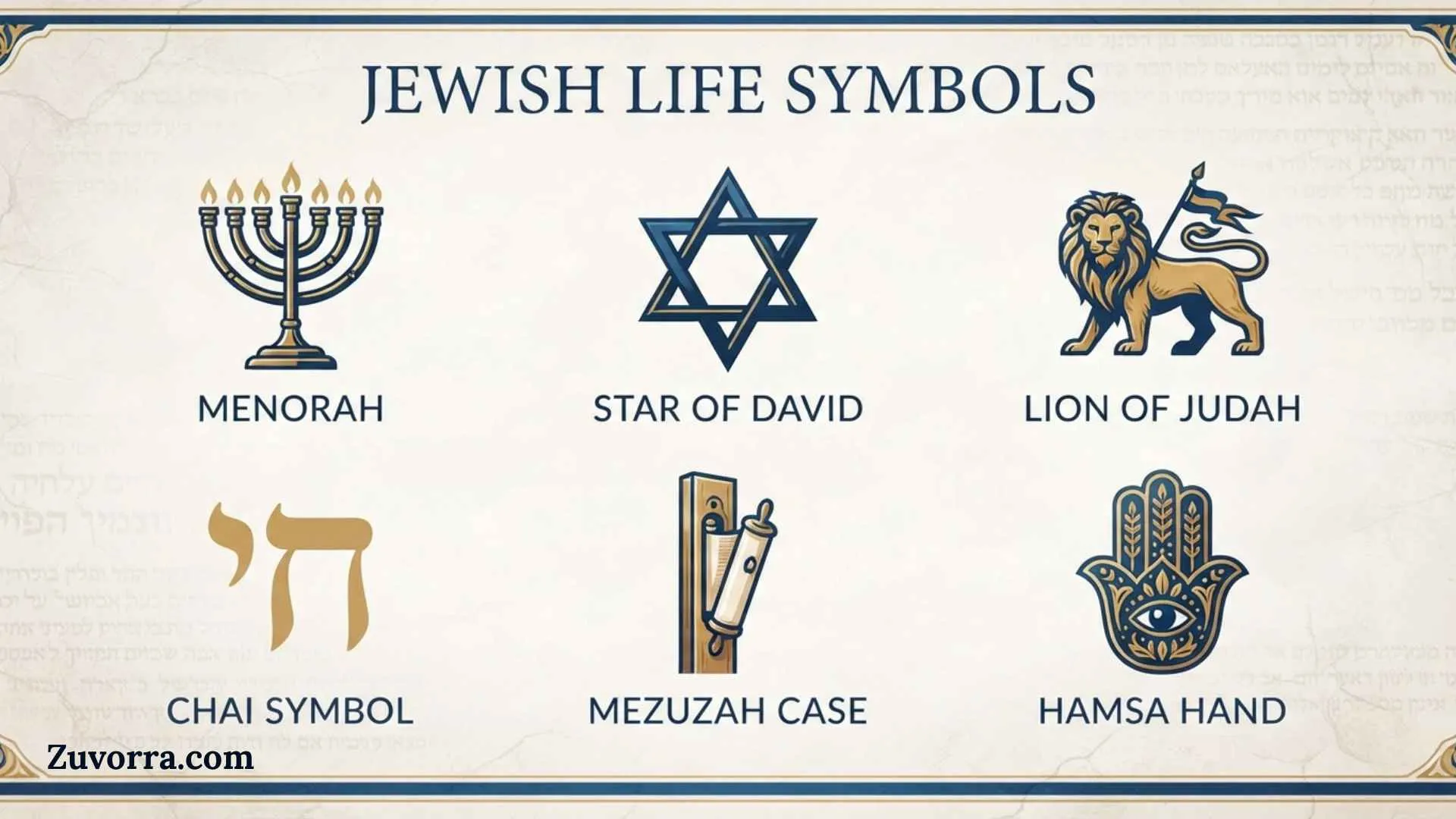
Jew symbols, more respectfully called Jewish symbols, represent faith, identity, memory, community, and the long history of the Jewish people. The best-known examples include the Star of David, menorah, chai, mezuzah, hamsa, Torah scroll, shofar, and Hebrew letters.
You may see these symbols in synagogues, Jewish homes, museums, cemeteries, holiday decorations, jewelry, tattoos, books, artwork, national emblems, and digital communication. However, they do not all have the same purpose. Some come directly from the Torah, while others developed through art, folklore, mysticism, community life, or modern Jewish history.
Quick Meaning
Jewish symbols express religious beliefs, cultural identity, sacred memory, protection, life, learning, and belonging. The Star of David commonly represents Judaism and Jewish identity, while the menorah recalls the ancient Temple. Other symbols, such as chai, mezuzah, Torah scrolls, and shofars, carry specific meanings rooted in Hebrew language, scripture, worship, and tradition.
Jewish Symbols Overview Table
| Symbol | Hebrew Name | Primary Meaning | Historical Source | Common Modern Use |
| Star of David | Magen David | Jewish identity, community, Israel | Medieval and early modern Jewish use | Synagogues, jewelry, flags, memorials |
| Seven-branched menorah | Menorah | Divine light, wisdom, Temple worship | Hebrew Bible and ancient Israel | Religious art, State of Israel emblem |
| Hanukkah lamp | Hanukkiah | Religious freedom and rededication | Second Temple period tradition | Hanukkah observance |
| Chai | חי | Life | Hebrew language and Jewish tradition | Necklaces, gifts, donations |
| Mezuzah | מזוזה | Covenant, remembrance, sacred home | Deuteronomy 6:9 and 11:20 | Jewish doorposts |
| Torah scroll | Sefer Torah | Divine teaching and sacred law | Biblical and rabbinic tradition | Synagogue worship |
| Hamsa | חמסה | Protection and blessing | Middle Eastern and North African traditions | Jewelry, wall art, amulets |
| Shofar | שופר | Awakening, repentance, remembrance | Hebrew Bible | Rosh Hashanah and Yom Kippur |
| Lion of Judah | Aryeh Yehudah | Strength, royalty, tribe of Judah | Genesis and biblical tradition | Art, heraldry, Jewish identity |
| Pomegranate | Rimon | Fruitfulness, beauty, sacred abundance | Biblical imagery | Judaica, synagogue decoration |
| Dove | Yonah | Peace, hope, renewal | Biblical narratives | Art, memorials, peace imagery |
| Hebrew letters | Otiyot Ivriyot | Language, scripture, sacred meaning | Ancient Hebrew writing | Prayer books, jewelry, art |
What Do Jewish Symbols Mean?
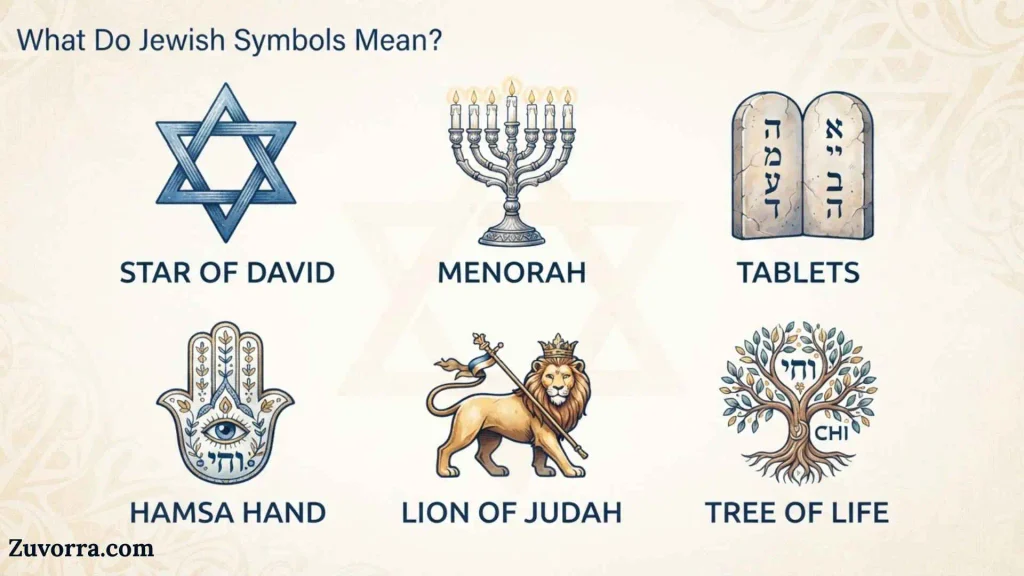
Jewish symbols communicate ideas that words alone may not fully express. They connect religious practice with family memory, historical experience, shared language, and community identity.
A symbol may serve several roles at once. A Star of David necklace can express religious commitment, cultural heritage, solidarity with other Jews, or connection to Israel. A mezuzah is both a religious object and a visible sign that a household follows Jewish tradition. A menorah can refer to the ancient Temple, spiritual light, Jewish continuity, or the modern State of Israel.
Meaning also depends on context. A symbol displayed in a synagogue may have a sacred or ceremonial purpose. The same image on a T-shirt may function mainly as cultural identification. On a Holocaust memorial, the Star of David may symbolize persecution, mourning, survival, or resistance.
For this reason, no single interpretation applies to every Jewish person. Judaism includes many religious movements, ethnic communities, languages, geographic backgrounds, and levels of observance.
History and Origin of Jewish Symbols
Jewish symbolism developed over thousands of years. Its earliest forms appear in the Hebrew Bible, ancient Israelite religious practice, archaeological objects, coins, inscriptions, synagogue mosaics, manuscripts, and household traditions.
Biblical and Ancient Israelite Origins
Several major symbols come directly from biblical texts. The seven-branched menorah was described as a sacred lampstand used in the Tabernacle and later associated with the Temple in Jerusalem. The shofar appears as a ceremonial instrument connected with proclamation, worship, warning, and sacred occasions.
The Torah also commands the placement of divine words on the doorposts of Jewish homes. This command became the basis of the mezuzah, which contains a handwritten parchment scroll with passages from Deuteronomy.
Plants and animals also carried symbolic meaning. The pomegranate appeared in descriptions of priestly clothing and Temple decoration. Lions represented strength, kingship, and the league of Judah. Olive branches, vines, palms, and dates reflected the land, peace, prosperity, and sacred abundance.
Late Antiquity and the Jewish Diaspora
After the destruction of the Second Temple by Rome in 70 CE, Jewish communities lived across the Middle East, North Africa, Europe, and later many other parts of the world. Symbols helped preserve shared identity across distant regions.
The menorah appeared frequently in ancient Jewish art, tombs, synagogue mosaics, lamps, seals, and inscriptions. It was more clearly associated with Judaism in antiquity than the Star of David, which became a widespread Jewish emblem much later.
Jewish communities also adopted artistic forms from surrounding cultures. Geometric shapes, hands, eyes, animals, crowns, and floral patterns sometimes entered Jewish art while receiving new local meanings.
Medieval and Early Modern Development
The six-pointed hexagram existed in several civilizations before becoming strongly associated with Jews. It appeared in decorative, magical, Islamic, Christian, and Jewish settings. Therefore, its basic shape was not originally exclusive to Judaism.
The Hebrew name Magen David, meaning “Shield of David,” eventually became connected with the hexagram. Its use as an official community emblem spread especially through European Jewish communities, including Prague. The National Library of Israel notes that the phrase “Shield of David” appeared earlier as a title for God rather than as the name of a geometric symbol.
By the 19th century, the Star of David had become an increasingly recognized public symbol of Jewish communal identity.
Modern Jewish History
The Zionist movement adopted the Star of David as a national Jewish emblem, and it later appeared on the flag of the State of Israel. Today, the star represents Judaism, Jewish peoplehood, Israel, or some combination of these ideas, depending on the context.
The symbol also carries painful Holocaust associations. Nazi authorities forced many Jews to wear identifying badges, often in the form of a yellow Star of David, as a method of humiliation, segregation, and persecution. In September 1941, Jews over the age of six in designated territories of the German Reich were ordered to wear such a badge publicly.
After the Holocaust, Jewish communities reclaimed the star as a sign of survival, remembrance, dignity, and continuity.
Major Jewish Symbols and Their Interpretations
Star of David
The Star of David consists of two overlapping triangles that form a six-pointed star, or hexagram. Its Hebrew name is Magen David, meaning “Shield of David.”
Today, it is the most widely recognized symbol of Jewish identity. It appears on synagogues, gravestones, necklaces, community centers, memorials, ceremonial objects, and the flag of Israel.
Many spiritual interpretations have been proposed. Some connect the six points with the six directions of space: north, south, east, west, above, and below, with the center representing divine presence. Others see the triangles as a meeting of heaven and earth.
These interpretations can be meaningful, but historians have not found one universally accepted ancient explanation. The Star of David became a common Jewish emblem relatively late compared with the menorah.
Menorah
The traditional menorah is a seven-branched lampstand associated with the Tabernacle and the ancient Temple in Jerusalem. It symbolizes sacred light, divine wisdom, holiness, and the enduring presence of Jewish faith.
The menorah is one of the oldest distinctively Jewish symbols. A representation of the Temple menorah appears on the Arch of Titus in Rome, which depicts objects taken after the Roman destruction of Jerusalem.
A version inspired by that ancient relief became part of the official emblem of the State of Israel. The Knesset describes it as a symbol of national renewal and the enduring nature of the Jewish people.
The menorah should not be confused with the hanukkiah, the nine-branched lamp used during Hanukkah.
Hanukkiah
A hanukkiah has nine branches: eight for the eight nights of Hanukkah and one additional light, called the shamash, used to light the others.
It commemorates the rededication of the Second Temple following the Maccabean revolt and the rabbinic tradition of a small amount of consecrated oil lasting for eight days.
The hanukkiah symbolizes religious dedication, perseverance, freedom of worship, and light in times of darkness.
Chai
Chai, written חי, is the Hebrew word for “life.” It combines the Hebrew letters chet and yod.
Through Hebrew letter-number values, or gematria, chet has a value of eight and yod has a value of ten. Together they equal 18. For this reason, 18 is considered a meaningful number in many Jewish communities.
People may give charitable donations, wedding gifts, or bar and bat mitzvah gifts in multiples of 18 as a symbolic wish for life and blessing. Chai also appears on pendants and decorative objects.
Mezuzah
A mezuzah is a parchment scroll placed inside a protective case and attached to the doorpost of a qualifying Jewish home or room.
The scroll contains passages from Deuteronomy, including the Shema, Judaism’s central declaration of God’s unity. Its purpose is to fulfill the biblical command to place these words on the doorposts and gates.
The mezuzah symbolizes covenant, awareness of God, the sacred character of the home, and the responsibility to live according to Jewish teachings. It should not be reduced to a lucky charm. Traditional explanations describe it primarily as a commandment and reminder, not merely as a protective object.
Torah Scroll
The Sefer Torah, or Torah scroll, contains the Five Books of Moses handwritten in Hebrew on parchment by a trained scribe.
It represents divine teaching, law, moral responsibility, memory, study, and the covenant between God and the Jewish people. During synagogue services, Torah scrolls are removed from the ark, carried through the congregation, read publicly, and treated with deep respect.
Images of tablets often symbolize the Ten Commandments, while scrolls generally represent the Torah as a whole.
Shofar
The shofar is traditionally made from a ram’s horn. It is sounded during Rosh Hashanah and at the conclusion of Yom Kippur in many Jewish communities.
Its sound symbolizes spiritual awakening, repentance, divine judgment, remembrance, and the call to examine one’s actions. It is not used mainly as a musical instrument. Its sharp, uneven notes are meant to interrupt routine and demand attention.
The ram’s horn may also recall the binding of Isaac, in which a ram was offered in place of Isaac.
Hamsa
The hamsa is a hand-shaped symbol found in Jewish, Muslim, Christian, Middle Eastern, and North African traditions. Its name relates to the number five.
In Jewish settings, it may be called the Hand of Miriam, referring to Miriam, the sister of Moses and Aaron. It often symbolizes protection, blessing, strength, good fortune, and resistance to the evil eye.
Scholars debate its exact origin, and it should not be described as exclusively Jewish. It became an important motif in Jewish folk art and is often seen on jewelry, wall hangings, key chains, and ceremonial objects.
Lion of Judah
The Lion of Judah comes from the biblical association between a lion and the league of Judah. It represents courage, royalty, leadership, strength, and the Davidic line.
It appears in Jewish art, synagogue decoration, manuscripts, seals, and heraldic designs. The symbol has also been adopted by other religious and national traditions, so its meaning changes according to context.
Pomegranate
The pomegranate is a recurring image in biblical descriptions, Jewish art, and the landscape of the Land of Israel.
Its many seeds have made it a symbol of fruitfulness, abundance, beauty, learning, community, and good deeds. A popular tradition says that a pomegranate contains 613 seeds, corresponding to the 613 commandments. Real pomegranates do not consistently contain exactly 613 seeds, so the statement should be understood as symbolic folklore rather than a botanical fact.
Dove and Olive Branch
The dove is associated with peace, hope, and renewal, especially through the story of Noah. A dove returned to the ark carrying an olive leaf, signaling that the floodwaters were receding.
In modern Jewish and Israeli imagery, the dove and olive branch often represent peace, reconciliation, and hope for a safer future. Neither image belongs only to Judaism, but both hold recognizable biblical meaning.
Cultural Significance Across Jewish Communities
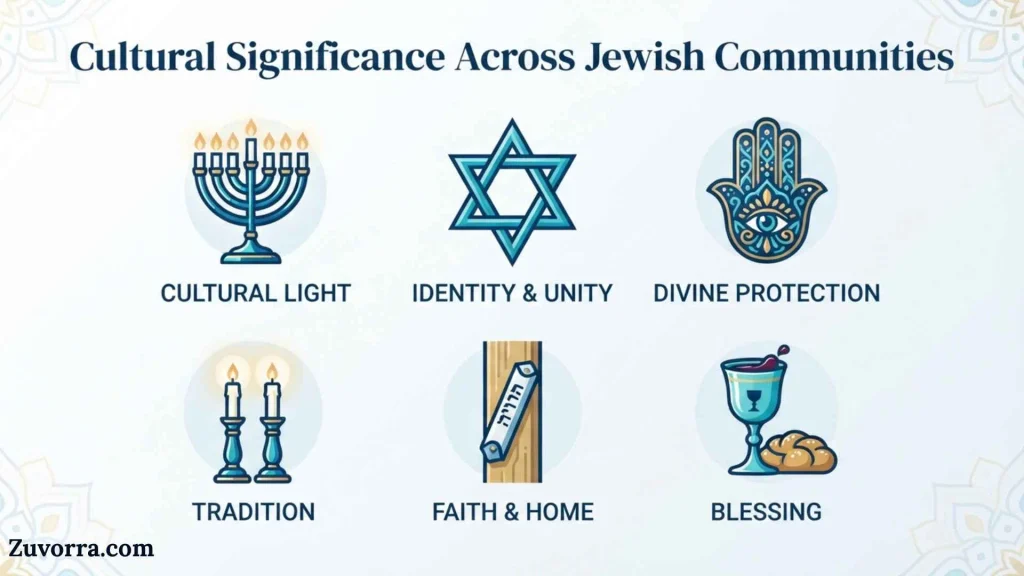
Jewish symbols are interpreted through many cultural traditions rather than one uniform style.
Ashkenazi Jewish communities developed artistic customs shaped by Central and Eastern Europe. Sephardi communities carried traditions from the Iberian Peninsula, the Mediterranean, North Africa, and the Ottoman world. Mizrahi Jewish communities preserved symbolism influenced by long histories in the Middle East and North Africa. Ethiopian, Yemenite, Persian, Indian, Bukharan, and other Jewish communities also developed distinctive designs.
A hamsa may appear more frequently in some Middle Eastern and North African Jewish households than in communities where it was not historically common. Decorative Torah cases vary between regions. Some communities use upright wooden or metal cases, while others dress Torah scrolls in embroidered fabric mantles.
Symbols may also express Jewish identity without indicating religious observance. A secular Jew may wear a Star of David as a sign of ancestry or solidarity. An observant Jew may place more emphasis on ritual objects such as a mezuzah, tefillin, or Torah scroll.
Religious and Spiritual Meaning
Jewish religious symbolism usually centers on covenant, commandments, sacred time, learning, remembrance, ethical conduct, and the relationship between humanity and God.
Unlike traditions centered on sacred images of divine beings, Judaism has often been cautious about religious images, especially those that could be treated as idols. Jewish visual culture therefore frequently emphasizes letters, ritual objects, architecture, plants, animals, geometric forms, and biblical scenes.
Hebrew writing can itself carry spiritual significance. The letter shin, for example, often appears on mezuzah cases because it begins the divine name Shaddai. Crowns may represent Torah, divine kingship, or the “crown of a good name.” Light commonly represents wisdom, holiness, and spiritual awareness.
Interpretations differ among Orthodox, Conservative, Reform, Reconstructionist, secular, mystical, and other Jewish perspectives. Folk beliefs should not automatically be treated as universal Jewish doctrine.
Scientific, Mathematical, and Digital Meanings
Most Jewish symbols do not have formal scientific meanings. However, their forms may overlap with mathematical or digital systems.
The Star of David is a hexagram composed of two equilateral triangles. In geometry, it can be analyzed through symmetry, polygons, angles, and intersecting lines. A mathematical hexagram is not automatically religious.
Hebrew letters have Unicode values for digital text. For example:
- Chai is written with ח and י.
- The Star of David has a Unicode character:, officially called “Star of David.”
- The menorah has an which represents a Hanukkah menorah rather than the seven-branched Temple menorah.
Digital symbols may appear differently across phones, fonts, and platforms. An emoji can communicate a general Jewish or Hanukkah theme, but it cannot express every historical or religious meaning associated with the original object.
Where Jewish Symbols Are Used
Jewish symbols appear in both sacred and everyday settings:
- Synagogues: Torah arks, curtains, stained glass, menorahs, Hebrew inscriptions, and Stars of David.
- Homes: Mezuzahs, Shabbat candlesticks, hamsas, blessings, holiday objects, and family heirlooms.
- Jewelry: Star of David, chai, hamsa, Hebrew names, and miniature Torah designs.
- Cemeteries: Stars, menorahs, priestly hands, pitchers, Hebrew letters, and biblical quotations.
- Jewish holidays: Hanukkiahs, shofars, lulav and etrog sets, matzah imagery, and Purim masks.
- National imagery: The Star of David appears on Israel’s flag, while the menorah appears on its state emblem.
- Museums and memorials: Symbols may represent Jewish life, persecution, loss, survival, and remembrance.
- Art and literature: Artists use Jewish symbols to explore faith, exile, identity, family, antisemitism, and cultural continuity.
- Tattoos: Some people choose Jewish imagery as personal expression, although traditional Jewish law generally discourages tattooing.
- Digital media: Symbols appear in social profiles, educational graphics, holiday greetings, and community announcements.
Common Variations and Similar Designs
Seven-Branch Menorah vs. Nine-Branch Hanukkiah
The seven-branched menorah represents the ancient Temple and Jewish continuity. The nine-branched hanukkiah is specifically used for Hanukkah.
Star of David vs. General Hexagram
Every Star of David is a hexagram, but not every hexagram is Jewish. Similar six-pointed forms appear in architecture, decorative art, alchemy, South Asian traditions, Islamic art, and other cultural systems.
Hamsa With or Without an Eye
Some hamsas contain an eye symbol linked with protection from the evil eye. Others contain Hebrew letters, fish, pomegranates, flowers, or prayers. The fingers may point upward or downward, depending on the design tradition.
Priestly Hands
Two hands with fingers divided into sections may represent the priestly blessing given by descendants of Aaron, known as Kohanim. This hand arrangement also inspired the Vulcan salute popularized by actor Leonard Nimoy, who drew on a Jewish blessing he had witnessed.
Pitcher and Basin
A pitcher may appear on Jewish gravestones to identify a Levite or a person from a Levitical family. It refers to the traditional role of Levites in washing the hands of priests before the priestly blessing.
Common Misconceptions
“The Star of David Has Always Been Judaism’s Main Symbol”
The star is now the most recognizable Jewish emblem, but the menorah has a much older and more distinctly Jewish history. The hexagram became widely accepted as a Jewish community symbol much later.
“All Jewish Symbols Come Directly From the Torah”
Some do, including the mezuzah command and the menorah tradition. Others developed through later religious practice, art, community custom, folklore, migration, and interaction with neighboring cultures.
“A Hamsa Is Exclusively Jewish”
The hamsa belongs to a wider Middle Eastern and North African symbolic tradition. Jewish communities adapted it and gave it distinct Jewish names, inscriptions, and associations.
“A Mezuzah Is Simply a Good-Luck Charm”
A mezuzah is primarily a sacred scroll and religious commandment. Its meaning centers on covenant, memory, divine unity, and the creation of a Jewish home.
“The Menorah Emoji Shows the Temple Menorah”
The 🕎 emoji usually represents the nine-branched Hanukkah lamp. The ancient Temple menorah had seven branches.
“Every Person Wearing a Jewish Symbol Is Religiously Observant”
A symbol may express religion, ethnicity, family history, cultural pride, solidarity, remembrance, or connection to Israel. The wearer’s purpose cannot be assumed from appearance alone.
Interesting Facts About Jewish Symbols
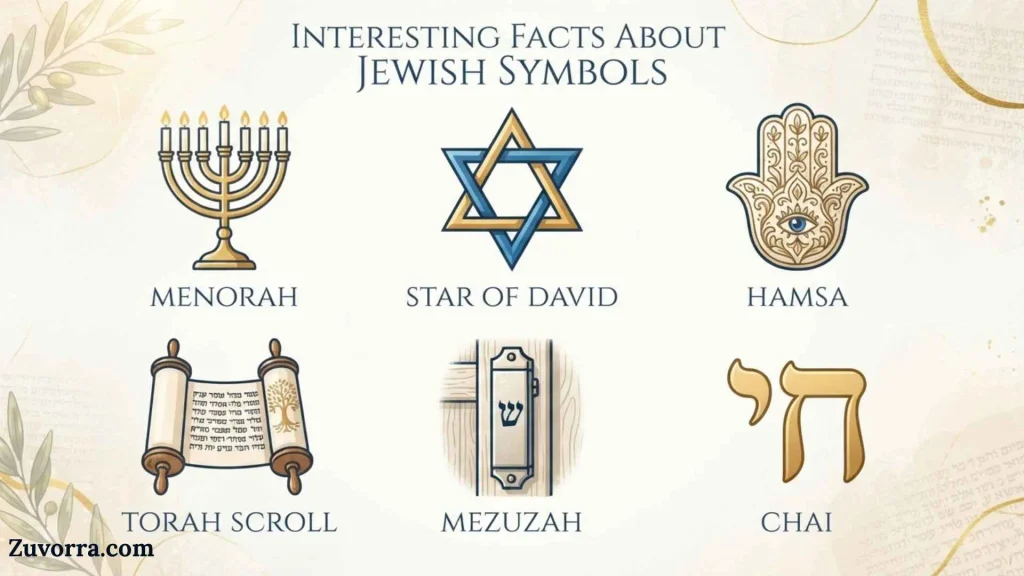
- The menorah is older as a Jewish emblem than the Star of David. Archaeological and literary evidence connects the menorah with ancient Jewish worship and identity.
- The Star of David was not originally exclusive to Judaism. The hexagram appeared in several cultures before Jewish communities widely adopted it.
- Chai connects language with numbers. Its Hebrew letters total 18 in gematria, explaining why gifts and donations are often given in multiples of 18.
- The mezuzah case is not the sacred core. The handwritten parchment inside fulfills the religious commandment; the outer case mainly protects it.
- Hanukkah lamps can have many designs. They may be made from silver, brass, stone, glass, ceramic, or modern recycled materials, provided the lights meet applicable ritual requirements.
- Jewish gravestones can reveal family tradition. Priestly hands may indicate Kohanim, while a pitcher can suggest Levitical ancestry.
- The yellow star represents both oppression and survival. Nazis used it to degrade and isolate Jews, but later generations reclaimed the Star of David as an emblem of dignity and endurance.
- A famous Danish Holocaust story is not historically accurate. King Christian X did not wear a yellow star, and Danish Jews were not ordered to wear such identification.
- The hamsa crosses religious boundaries. Jewish, Muslim, Christian, and regional folk traditions have all used hand-shaped protective imagery.
- Hebrew letters frequently become visual art. Calligraphy allows artists to combine language, prayer, identity, and abstract design without creating human or divine images.
- The pomegranate’s 613-seed claim is symbolic. It connects the fruit with the traditional number of Torah commandments, not with a fixed botanical seed count.
- The menorah became Israel’s state emblem. Its design was linked to the menorah shown on the Arch of Titus, transforming an image of Roman conquest into one of Jewish renewal.
Related Symbols
Tablets of the Ten Commandments
The two tablets represent revelation, law, covenant, and moral responsibility. They are often placed above synagogue Torah arks.
Tree of Life
The Tree of Life, or Etz Chaim, may symbolize the Torah, wisdom, creation, spiritual growth, and the interconnected structure of Kabbalistic teachings.
Crown
A crown can represent divine sovereignty, Torah, priesthood, kingship, or an honorable life. On Torah ornaments, it often refers to the “crown of Torah.”
Lulav and Etrog
These ritual objects are used during Sukkot. Together they symbolize gratitude, harvest, divine provision, unity, and the connection between worship and the natural world.
Kiddush Cup
The cup used for blessing wine represents sanctification, joy, celebration, Shabbat, holidays, weddings, and the separation of sacred time from ordinary time.
Tallit
The Jewish prayer shawl symbolizes prayer, commandments, humility, and spiritual responsibility. Its fringes, called tzitzit, serve as reminders of the commandments.
Frequently Asked Questions
What is the main symbol of Judaism?
The Star of David is the most widely recognized modern symbol of Judaism and Jewish identity. However, the seven-branched menorah is older and has stronger roots in ancient Israelite worship. Which symbol is considered “main” depends on whether the context is modern identity, biblical history, religious practice, or the State of Israel.
What does the Star of David symbolize?
The Star of David commonly symbolizes Judaism, Jewish peoplehood, community, heritage, and connection to Israel. It has also become a symbol of Holocaust memory and Jewish survival. Many spiritual meanings have been proposed, but historians have not identified one ancient interpretation accepted by all Jewish traditions.
What is the difference between a menorah and a hanukkiah?
A traditional menorah has seven branches and refers to the sacred lampstand associated with the ancient Temple. A hanukkiah has nine branches and is used during Hanukkah. Eight lights mark the festival’s eight nights, while the ninth light, called the shamash, lights the others.
Is the hamsa a Jewish symbol?
The hamsa is used in Jewish culture, particularly among communities with Middle Eastern and North African roots, but it is not exclusively Jewish. It also appears in Muslim, Christian, and regional folk traditions. Jewish versions may feature Hebrew prayers, Stars of David, fish, pomegranates, or references to Miriam.
Why is the number 18 important in Judaism?
The Hebrew letters that form the word chai, meaning “life,” have a combined numerical value of 18. As a result, 18 became associated with life and blessing. Jewish charitable donations and gifts are often given in multiples of 18 as a symbolic wish for health, goodness, and long life.
What does a mezuzah protect?
In Jewish practice, a mezuzah marks a home as a place guided by faith, covenant, and awareness of God. Some traditions also associate it with divine protection. However, it is not simply a magical object. Its central purpose is to fulfill a biblical commandment and keep sacred teachings present in everyday life.
Is it respectful for a non-Jew to wear a Jewish symbol?
Respect depends on intention, context, and presentation. Wearing a symbol to honor Jewish family, support a community, or appreciate its meaning may be acceptable. Using sacred objects as costumes, fashion trends, or stereotypes can be disrespectful. Learning the symbol’s history and avoiding false claims about one’s identity are wise practices.
Are Jewish symbols religious or cultural?
They can be religious, cultural, ethnic, historical, national, or personal. A Torah scroll has a sacred ritual function, while a Star of David necklace may express cultural identity. The same person may understand a symbol through several meanings at once, including faith, ancestry, family memory, and solidarity.
Why do Jewish symbols appear on gravestones?
Jewish gravestone symbols can communicate identity, family lineage, religious role, personal name, or admired qualities. Priestly hands may indicate a Kohen, a pitcher may indicate a Levite, and a menorah may appear on the grave of a woman or symbolize Jewish faith and sacred light.
Is the Star of David the same as the Seal of Solomon?
The names have overlapped in some historical magical, artistic, Jewish, Islamic, and European traditions, but they are not always used in the same way. “Star of David” usually means the modern Jewish hexagram. “Seal of Solomon” can refer to a hexagram, pentagram, or other magical emblem associated with King Solomon.
Key Takeaways
- “Jew symbols” are more naturally and respectfully described as Jewish symbols.
- The Star of David is the best-known modern emblem of Jewish identity.
- The seven-branched menorah has older roots in ancient Jewish worship.
- A hanukkiah has nine branches and is used only for Hanukkah.
- Chai means “life” and is connected with the number 18.
- A mezuzah is a sacred parchment and commandment, not merely decoration.
- The hamsa is shared across several Middle Eastern and North African traditions.
- Jewish symbolism varies among regions, communities, and levels of religious observance.
- Historical context matters because the same symbol can express faith, persecution, memory, survival, or national identity.
- Not every geometric shape resembling a Jewish emblem has a Jewish meaning.
Conclusion
Jew symbols reveal how a community can preserve faith, identity, memory, and hope across thousands of years. Some, such as the menorah, shofar, and mezuzah, come from ancient scripture and worship. Others, including the Star of David and hamsa, gained their present meanings through centuries of cultural development.
Understanding Jewish symbols requires more than recognizing their shapes. Their true significance comes from the prayers, historical experiences, family traditions, sacred texts, and communities connected with them. Whether seen on a synagogue, necklace, doorway, memorial, flag, or work of art, these symbols continue to tell stories of life, learning, responsibility, resilience, and belonging.
References
- United States Holocaust Memorial Museum, Jewish Badge: During the Nazi Era and related Holocaust Encyclopedia resources.
- United States Holocaust Memorial Museum, King Christian X of Denmark.
- The Knesset, information on the Temple menorah and the emblem of the State of Israel.
- National Library of Israel, The Story of the Star of David.
- My Jewish Learning, resources on the Star of David, mezuzah, hamsa, chai, and Jewish amulets.

I’m Felix Everard, a British writer passionate about the fascinating world of symbols and visual communication. I explore traditional, cultural, historical, and modern symbols, focusing on what they represent and why they matter. Through accessible explanations, I hope to help readers recognise the meanings hidden within familiar signs, shapes, and images.
Books:
- The Complete Guide to Symbolism
- Decoding Signs and Symbols