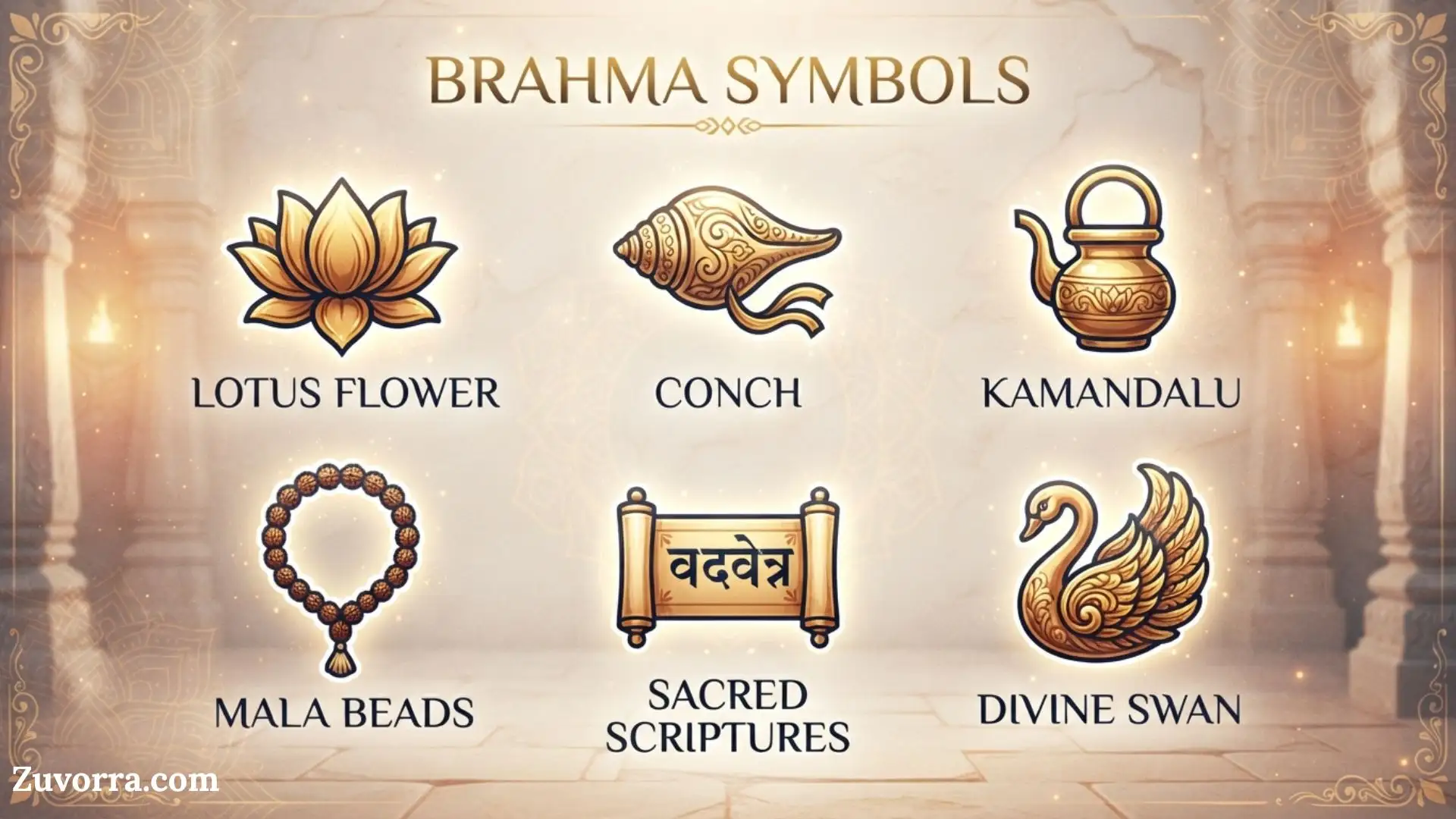
Brahma symbols represent divine creation, sacred knowledge, cosmic order, time, and the unfolding of the universe in Hindu tradition. Rather than having one universal emblem, Brahma is recognized through a group of visual attributes, especially his four faces, four arms, the Vedas, prayer beads, water vessel, lotus seat, and hamsa mount.
These symbols appear in Hindu temple sculpture, devotional paintings, manuscripts, statues, jewelry, spiritual artwork, and Southeast Asian religious sites. Each feature helps explain Brahma’s role as a creator deity while connecting him with wisdom, ritual, language, direction, and cyclical time. Understanding the symbols also prevents a common mistake: confusing the god Brahma with Brahman, the ultimate reality described in Hindu philosophy.
Quick Meaning of Brahma Symbols
Brahma symbols primarily signify creation, divine intelligence, sacred knowledge, cosmic balance, and the fourfold structure of existence. His four faces commonly connect him with the four Vedas and four directions, while his book, rosary, water pot, lotus, and hamsa represent learning, time, creative potential, purity, and spiritual discernment.
Brahma Symbol Overview
| Feature | Meaning |
| Central figure | Brahma, the Hindu creator deity |
| Primary symbolism | Creation, knowledge, order, time, and sacred speech |
| Religious tradition | Hinduism |
| Cultural origin | Indian religious and artistic traditions |
| Main iconographic features | Four faces, four arms, beard, crown, and red or golden complexion |
| Sacred objects | Vedas or book, rosary, water vessel, lotus, and ritual spoon |
| Mount or vehicle | Hamsa, usually represented as a swan or goose |
| Sacred seat | Lotus |
| Associated goddess | Saraswati, goddess of learning, speech, music, and knowledge |
| Divine grouping | Trimurti with Vishnu and Shiva |
| Common usage | Temples, sculpture, painting, manuscripts, devotional art, and tattoos |
| Unicode symbol | No official Unicode character represents Brahma |
| Emoji equivalent | No exact emoji equivalent |
| Related symbols | Om, lotus, hamsa, Vedas, kalasha, mala, Saraswati, Vishnu, and Shiva |
What Do Brahma Symbols Mean?
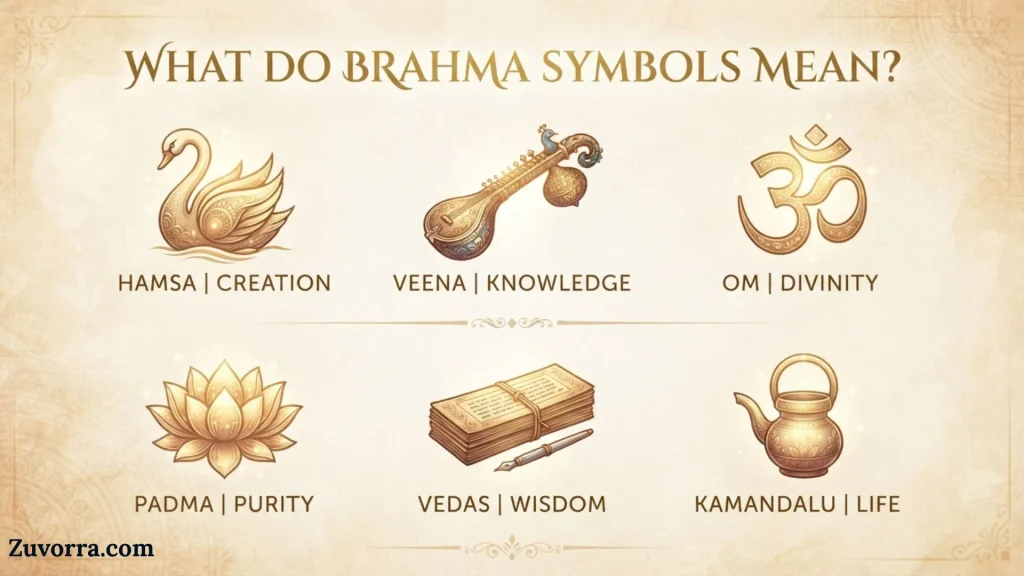
Brahma symbols explain the nature and process of creation. They do not simply identify a divine figure. Together, they form a visual language that communicates how the ordered universe emerges through knowledge, intention, sacred sound, ritual, time, and purified awareness.
Brahma is commonly described as the creator within the Trimurti, a theological grouping that associates Brahma with creation, Vishnu with preservation, and Shiva with dissolution or transformation. This structure should not be treated as a simple hierarchy followed identically by every Hindu tradition. Hindu theology contains many schools, texts, and regional practices, and different communities understand divine relationships in different ways.
The most recognizable Brahma symbols are:
- Four faces: expansive knowledge and awareness of the four directions
- Four arms: divine power operating beyond ordinary human limits
- The Vedas or book: revealed knowledge, language, learning, and sacred law
- Prayer beads: time, meditation, repetition, and the cycles of existence
- Water vessel: creative potential, ritual purity, and the source of life
- Lotus: emergence, purity, spiritual unfolding, and cosmic birth
- Hamsa: wisdom, discrimination, purity, and spiritual movement
- Beard: antiquity, maturity, and the wisdom of a primordial creator
Because Brahma has no single equivalent of Shiva’s trident or Vishnu’s discus, viewers usually identify him through a combination of several attributes.
History and Origin of Brahma’s Iconography
Brahma’s symbolism developed gradually from early Indian ideas about cosmic creation, sacrifice, sacred speech, and the ordering of existence. His later identity is connected with concepts associated with Prajapati, a creator figure in Vedic literature, although the relationship between these figures changed across texts and historical periods.
The familiar image of Brahma as a multiheaded, multiarmed deity took shape within the wider development of Hindu sacred art. Indian artists used multiple heads and limbs not to portray physical abnormality but to express powers that exceed ordinary human limits. A divine figure could perceive several directions, perform multiple cosmic functions, or hold several sacred objects at once.
By the early medieval period, Brahma appeared in temple programs across India. He could be shown independently, as part of the Trimurti, beside Vishnu or Shiva, or within larger creation narratives. In some Shaiva temples of Tamil Nadu, sculptures of Brahma occupy a northern wall niche as part of a planned group of deities.
Brahma’s iconography also traveled beyond India as Hindu and Buddhist ideas spread through trade, pilgrimage, royal patronage, and cultural exchange. Images related to Brahma appeared in Cambodia, Thailand, Indonesia, Nepal, Tibet, Central Asia, and other regions. Local artists adapted clothing, facial style, crowns, mounts, gestures, and ritual meanings while preserving recognizable features such as multiple faces.
Museum collections show considerable variation. One British Museum painting depicts Brahma with three visible heads and four arms, carrying a water pot and book while making gestures of protection and generosity. Another shows four-headed Brahma with Saraswati, seated upon the hamsa and holding a water vessel and book. These works demonstrate that sacred iconography follows recognizable patterns without becoming completely uniform.
Major Brahma Symbols and Their Interpretations
Four Faces
Brahma’s four faces are his most recognizable symbol. They commonly represent the four Vedas: Rigveda, Samaveda, Yajurveda, and Atharvaveda. Because the faces look toward different directions, they also suggest complete awareness of the ordered world.
Only three faces may be visible in a frontal painting or sculpture. The fourth is understood to face backward. This artistic convention should not be mistaken for a three-headed form. The Metropolitan Museum of Art, for example, describes a Kashmiri image in which three of Brahma’s heads are visible and the fourth is assumed.
The faces may also be interpreted more broadly as symbols of:
- Four cardinal directions
- Four Vedas
- Four stages of life
- Four social functions in traditional Hindu thought
- Four ages or yugas
- Four dimensions of the manifest world
Not every interpretation appears in every scripture or artistic tradition. The Vedas and cardinal directions are the most widely repeated associations.
Four Arms
Brahma’s four arms symbolize supernatural ability and the many forces involved in creation. Hindu artists frequently use multiple arms to show that a deity possesses powers beyond normal human capability.
The arms also allow Brahma to carry several attributes at once. Their exact arrangement varies by region, period, text, and artistic school. A book, rosary, water vessel, lotus, ritual spoon, or gesture may replace another object without changing the figure’s basic identity.
The Vedas or Sacred Book
A book in Brahma’s hand represents sacred knowledge, language, wisdom, and the intellectual principles through which an ordered universe becomes understandable. The object is often identified with the Vedas, although some artworks portray it more generally as a manuscript.
This symbol emphasizes that creation is not presented as meaningless production. It is associated with structure, names, categories, ritual formulas, and intelligible order. The book therefore connects Brahma with both cosmology and learning.
The British Museum identifies the book, or pustaka, as one of Brahma’s regular attributes in several devotional paintings.
Prayer Beads or Mala
The mala represents meditation, spiritual discipline, sacred recitation, and the passage of time. Each bead can mark a repeated mantra, making the rosary a symbol of focused consciousness and ordered repetition.
In Brahma’s iconography, the mala can also suggest cosmic cycles. Hindu cosmology often views creation and dissolution as recurring processes rather than a single event with no repetition. The beads form a circle or sequence, visually echoing this cyclical understanding.
A Metropolitan Museum painting portrays Brahma holding a text, rosary, and flower while receiving a Vedic fire offering.
Kamandalu or Water Vessel
The kamandalu is a portable water pot traditionally associated with ascetics, sages, and ritual purity. In Brahma’s hand, it symbolizes primordial water, creative potential, purification, and the life-giving source from which ordered existence can emerge.
Water has a special place in many creation accounts because it is formless yet capable of supporting life. The vessel gives that potential a boundary. Symbolically, it shows creative energy being gathered, directed, and prepared for sacred use.
The object may look like a rounded pot, flask, or handled vessel. Museum descriptions sometimes call it a kamandalu, kalasha, or simply a water pot, depending on its form.
Lotus
The lotus symbolizes purity, emergence, divine birth, and the unfolding of creation. It grows from muddy water yet opens as a clean and beautiful flower, making it a powerful image of spiritual possibility.
Brahma may sit directly on a lotus. In many Vaishnava images, he appears on a lotus growing from the navel of the reclining Vishnu. This arrangement expresses a theological relationship in which creation unfolds through Vishnu’s cosmic presence.
A British Museum painting of Ranganatha, a reclining form of Vishnu, includes four-headed Brahma seated on a lotus emerging behind the central divine figure.
Hamsa: The Swan or Goose
The hamsa is Brahma’s vahana, or divine vehicle. It may be translated or depicted as a swan, goose, or related waterbird. In religious symbolism, it represents purity, knowledge, spiritual freedom, and the ability to distinguish truth from error.
A traditional interpretation credits the hamsa with separating milk from water. Whether understood literally, poetically, or philosophically, the image became a metaphor for viveka, the power of discernment.
The hamsa is not merely transportation. A deity’s mount often reflects a power, quality, or domain associated with that deity. Brahma’s bird therefore reinforces the idea that true creation requires intelligence and discrimination.
Beard and Mature Appearance
Brahma is often portrayed with a beard, giving him the appearance of an ancient sage, teacher, or patriarch. The beard symbolizes maturity, antiquity, authority, and accumulated knowledge.
This feature is common but not compulsory. Some paintings show Brahma as youthful and clean-shaven. The British Museum describes one such image as unusual because Brahma appears with dark hair and without his typical beard and mustache.
Red or Golden Complexion
Artists may give Brahma a red, pink, golden, or light complexion. Red can suggest creative energy, activity, sacred fire, and the dynamic quality traditionally called rajas. Gold can suggest divine radiance, purity, authority, and the brilliance of knowledge.
Colors in sacred art may vary according to regional style and available materials. A color should therefore be interpreted alongside the deity’s other attributes rather than treated as an independent universal code.
Abhaya and Varada Mudras
Brahma may form sacred hand gestures instead of holding objects.
- Abhaya mudra: the raised open palm conveys protection, reassurance, and freedom from fear.
- Varada mudra: the lowered open hand signifies generosity, grace, blessing, or the granting of wishes.
British Museum paintings show Brahma using both gestures while holding a book and water vessel in his upper hands.
Positive, Negative, and Psychological Interpretations
Most Brahma symbols carry positive meanings. They celebrate intelligence, learning, creativity, disciplined thought, sacred order, and the potential to bring something new into existence.
From a psychological perspective, the four faces can represent the ability to examine a problem from several viewpoints. The book suggests knowledge before action. The rosary suggests patience and repetition, while the water vessel represents unrealized potential waiting to take form.
These psychological readings are modern interpretations, not formal replacements for traditional Hindu meanings. They can help viewers relate sacred imagery to creativity, education, leadership, and personal development, but they should be presented respectfully.
Brahma’s image can also carry cautionary themes in mythology. Some stories concern pride, false testimony, uncontrolled desire, or conflicts among deities. In Shaiva traditions, the loss of Brahma’s fifth head is sometimes interpreted as a lesson about ego and the limits of self-importance. The British Museum notes the Tantric story in which Bhairava decapitates Brahma, expressing the superiority of a particular sacred path within that context.
The negative symbolism belongs to specific narratives. It does not mean that Brahma himself is generally a symbol of evil, deception, or bad luck.
Cultural Significance Across Regions
India
In India, Brahma’s symbols occur in temple carvings, paintings, manuscripts, household images, and larger scenes involving Vishnu, Shiva, Saraswati, or other deities. His independent worship is less prominent than the worship of Vishnu, Shiva, Devi, Ganesha, and several regional deities, yet his image remains important in Hindu cosmology and art.
The Brahma Temple at Pushkar, Rajasthan, is the best-known center associated with his worship. Brahma also appears in temple niches and narrative panels throughout India, even where he is not the principal deity.
Nepal and the Himalayan Region
Himalayan art may place Brahma within complex arrangements of Hindu and Buddhist figures. Artists often retain his multiple heads while adapting crowns, jewelry, facial forms, and composition to local traditions.
Kashmiri sculpture developed distinctive multi-faced forms. The Metropolitan Museum’s Brahmanical Triad presents Brahma, Shiva, and Vishnu with multiple faces in a regional visualization of divine complexity.
Cambodia and Indonesia
Brahma entered the sacred art of Southeast Asia through the transmission of Hindu religious literature, royal rituals, Sanskrit culture, and temple architecture. He appears in sculptures and reliefs connected with major Hindu narratives.
At sites influenced by Hindu cosmology, multi-faced divine imagery may also relate to kingship, sacred geography, or Mount Meru. However, not every four-faced monument represents Brahma. Context, inscriptions, attributes, and scholarly analysis are necessary for identification.
Thailand
In Thailand, Brahma is commonly known as Phra Phrom. Four-faced shrines associated with blessing, success, protection, and prosperity are visible in public and commercial spaces. The Erawan Shrine in Bangkok is a famous modern example.
Thai representations often show four faces and multiple arms holding symbolic objects. Local devotional practice has developed within a cultural environment shaped by both Hindu and Buddhist traditions.
Buddhist Traditions
Buddhist texts and art also include brahma beings and figures such as Brahma Sahampati. These should not always be treated as identical to the Hindu creator deity. In Buddhist cosmology, brahmas are exalted beings who still exist within conditioned realms rather than eternal creators of everything.
Buddhist art may show Brahma honoring the Buddha, witnessing important events, or encouraging the teaching of the Dharma. A British Museum relief, for example, depicts the Buddha flanked by Brahma and Indra.
Religious and Spiritual Meaning
Spiritually, Brahma’s symbols teach that genuine creation requires wisdom, order, attention, and ethical responsibility. The deity’s image combines creative force with the tools of a scholar, sage, and ritual specialist.
The symbolism can be read as a sequence:
- The water vessel holds possibility.
- The rosary introduces time and disciplined repetition.
- The Vedas provide knowledge and sacred order.
- The four faces perceive the whole field of creation.
- The lotus shows existence unfolding from spiritual depth.
- The hamsa distinguishes truth from confusion.
This sequence offers a useful interpretation of why Brahma’s image includes intellectual and contemplative symbols rather than weapons. His function is associated with producing, naming, organizing, and transmitting, not primarily with combat.
Brahma and Brahman Are Different
Brahma and Brahman are not interchangeable terms.
Brahma is a personal deity represented in stories and sacred art. He has recognizable features, relationships, attributes, and functions.
Brahman is the ultimate reality or foundational principle discussed in Hindu philosophy, especially in the Upanishads and Vedanta. Brahman is not normally represented as a four-faced god.
The words are related historically and linguistically, but they refer to different concepts. Brahmin, the term for a member of the traditional priestly class, is also distinct.
Is There a Scientific or Technical Brahma Symbol?
There is no standardized mathematical, scientific, electrical, medical, or digital symbol specifically assigned to Brahma. No official Unicode character or emoji represents the deity.
People may use nearby visual substitutes, such as:
- A lotus emoji for spiritual unfolding
- A swan emoji for the hamsa
- A book emoji for sacred knowledge
- Prayer beads for meditation
- The Om symbol for Hindu spirituality
These substitutes do not specifically mean Brahma. Om, for example, represents sacred sound and ultimate reality in several Hindu traditions. It should not be labeled as Brahma’s personal emblem without additional context.
Where Brahma Symbols Are Used
Temple Architecture
Brahma appears in wall niches, entrance carvings, ceilings, lintels, narrative reliefs, and groups of deities. His multiple faces allow worshippers and art historians to distinguish him from nearby figures.
Paintings and Manuscripts
Indian miniature paintings show Brahma in creation stories, Trimurti scenes, encounters with other deities, and images with Saraswati. Artists may overlap three visible faces to imply the hidden fourth.
Statues and Home Shrines
Statues often combine four faces, four arms, a book, rosary, water pot, and lotus. Before purchasing or displaying one, viewers should identify the objects carefully because damaged or simplified statues can be confused with other multiheaded figures.
Jewelry and Tattoos
Modern designs may use a four-faced head, lotus, hamsa, or sacred manuscript. A respectful design should avoid placing a deity’s face on body areas or objects regarded as impure within the wearer’s cultural setting.
Logos and Educational Art
Schools, meditation groups, publishers, and cultural organizations sometimes use the book, lotus, or hamsa to suggest knowledge and creativity. Such logos may draw inspiration from Brahma without representing the deity directly.
Literature and Popular Culture
Writers use Brahma as a symbol of cosmic creation, ancient wisdom, or intellectual power. Popular retellings sometimes simplify Hindu theology, so readers should separate creative fiction from scriptural or historical claims.
Common Variations of Brahma’s Image
Three Visible Faces
A frontal artwork usually shows three faces because the fourth faces backward. This is the most common visual solution for representing a four-headed deity on a flat surface.
Four Fully Visible Faces
Some statues arrange the heads in four directions, allowing viewers to walk around the figure. This form strongly emphasizes omnidirectional awareness.
A Fifth Head
Some myths describe Brahma as originally having five heads. Shaiva traditions tell how Shiva or Bhairava removed one. Images with five heads require careful identification because several Hindu deities may have five-faced forms.
Different Hand Attributes
Brahma may hold a book, mala, lotus, spoon, water pot, grass, flower, or other ritual object. The selection depends on artistic manuals, region, sectarian setting, and narrative.
Standing or Seated Forms
He may sit cross-legged on a lotus, ride the hamsa, sit on a throne, or stand on a pedestal. His identity rests more on the combination of faces and attributes than on one required posture.
Common Misconceptions
“Brahma is the supreme god for every Hindu”
Hinduism has no single theological structure accepted identically by all practitioners. Brahma is important as a creator deity, but Vaishnava, Shaiva, Shakta, Smarta, and other traditions understand divine supremacy differently.
“Brahma and Brahman are the same”
Brahma is a deity. Brahman is ultimate reality in major Hindu philosophical traditions. Confusing the terms can distort both iconography and theology.
“Every four-faced statue depicts Brahma”
Other Hindu, Buddhist, and regional figures can have multiple faces. Identification requires objects, gestures, mount, location, inscription, and artistic context.
“Brahma has only three heads”
Most two-dimensional images show only three because the fourth faces away from the viewer.
“The hamsa is always a swan”
The Sanskrit term may be represented or translated as a swan, goose, or related waterbird. Its symbolic function matters more than exact modern zoological classification.
“Brahma symbols are mainly good-luck charms”
Their primary meanings concern creation, knowledge, sacred order, ritual, and discernment. Some communities may seek blessings through Brahma devotion, but reducing the symbols to luck removes their religious depth.
How to Identify a Brahma Image
Use this quick decision guide:
Does the figure have four faces or three visible faces with a fourth implied?
↓
Yes: Look for a book, rosary, water pot, lotus, or hamsa.
↓
Several attributes are present: The figure is likely Brahma.
↓
Few or none are present: Check the temple location, inscription, accompanying deities, crown, gestures, and regional style before deciding.
A multi-faced figure holding weapons may represent another deity. A four-faced shrine in Thailand may represent Phra Phrom, the Thai form associated with Brahma, while a Buddhist image may depict a brahma being in a different theological role.
Interesting Facts About Brahma Symbols
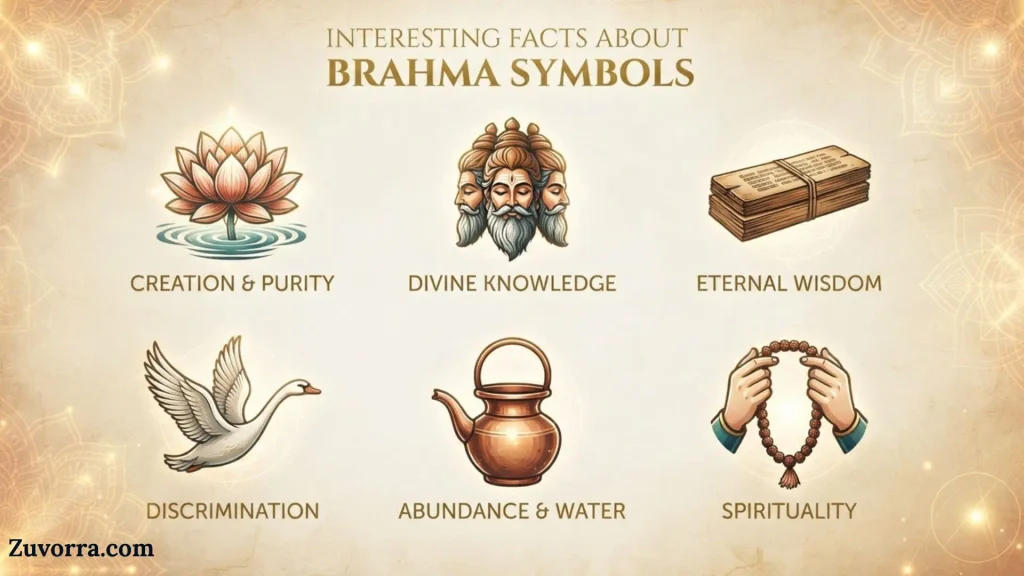
- Three heads usually mean four: Artists often show three faces while asking the viewer to imagine the fourth behind the head.
- His objects are mostly peaceful: Books, beads, water vessels, and flowers emphasize wisdom and ritual rather than warfare.
- The hamsa represents judgment: Its legendary ability to separate milk from water became a metaphor for distinguishing truth from illusion.
- Brahma can appear within Vishnu imagery: In Vaishnava art, he may sit on a lotus growing from Vishnu’s navel, symbolizing creation emerging from a deeper cosmic source.
- His beard is meaningful but optional: It communicates primordial wisdom, yet regional artists sometimes depict him as young and clean-shaven.
- Four faces do more than multiply vision: They connect spatial completeness with sacred knowledge, especially the four directions and four Vedas.
- His imagery crossed religious boundaries: Brahma-related figures appear in Hindu and Buddhist art, although their theological roles are not always identical.
- There is no official Brahma emoji: Digital users must combine symbols such as a lotus, book, swan, or prayer beads to suggest his attributes.
- Brahma may appear in Shaiva temples: Even when Shiva is the principal deity, Brahma can occupy an important architectural niche within the temple’s sacred program.
- Thai four-faced shrines are modern living traditions: They show how ancient Indian iconography can gain new local meanings while remaining recognizable.
- His water pot links asceticism with creation: An object carried by wandering sages becomes a container of life-giving and ritual potential.
- Multiple arms function like a visual sentence: Each object contributes another idea, allowing one image to communicate knowledge, time, purity, creation, and blessing simultaneously.
Related Symbols
Om
Om represents sacred sound, spiritual reality, and the vibration associated with cosmic existence. Unlike Brahma’s iconography, it is a written and spoken sacred syllable rather than the personal emblem of one deity.
Saraswati
Saraswati’s symbols include the veena, book, rosary, white clothing, lotus, and hamsa. She shares themes of learning and sacred speech with Brahma but represents knowledge, music, eloquence, and the arts in her own right.
Vishnu’s Lotus
The lotus associated with Vishnu can support Brahma in creation scenes. It expresses purity and cosmic emergence but belongs to a different iconographic system when held by Vishnu.
Shiva’s Trident
The trident symbolizes Shiva’s transformative power and several threefold structures. It differs from Brahma’s scholarly and ritual attributes.
Kalasha
The kalasha is a sacred water vessel representing abundance, life, fertility, and divine presence. Brahma’s kamandalu carries related water symbolism but often has a more ascetic form.
Hamsa
The hamsa can appear independently as a symbol of purity and discernment. It is also associated with Saraswati and with spiritually realized teachers described by titles such as paramahamsa.
Trimurti
Trimurti imagery places Brahma, Vishnu, and Shiva together to express creation, preservation, and dissolution. This is a theological composition rather than one personal Brahma symbol.
Frequently Asked Questions
What is the main symbol of Brahma?
Brahma does not have one exclusive emblem comparable to Shiva’s trident. His four faces are his strongest identifying feature. A complete image commonly adds four arms, a sacred book, rosary, water vessel, lotus, and hamsa. Together, these attributes symbolize creation, knowledge, time, purity, and discernment.
What do Brahma’s four heads represent?
The four heads most commonly represent the four Vedas and the four cardinal directions. They express complete knowledge and awareness extending throughout the ordered universe. Other interpretations connect them with four ages, stages of life, or dimensions of existence, although these associations vary among texts and teachers.
Why is only three-faced Brahma shown in paintings?
A flat picture can show the front and two side faces clearly, but the fourth faces backward. Artists therefore present three visible faces and leave the fourth implied. This convention allows Brahma to remain four-headed without forcing an unnatural arrangement into a two-dimensional composition.
What does Brahma hold in his hands?
Brahma commonly holds a book or Vedic manuscript, a mala, a kamandalu, and a lotus or ritual implement. He may also form abhaya and varada mudras. The exact arrangement changes between regions and periods, so no single set of hand attributes appears in every image.
Why does Brahma ride a swan?
The hamsa, often translated as a swan or goose, symbolizes purity, spiritual freedom, wisdom, and discrimination. Its traditional ability to separate milk from water represents the power to distinguish truth from error. This makes it a fitting vehicle for a deity associated with knowledge and ordered creation.
Is the lotus a Brahma symbol?
Yes, the lotus is one of Brahma’s major symbols, but it is not exclusive to him. It represents purity, divine emergence, spiritual awakening, and creation unfolding from hidden potential. Brahma may sit on a lotus or appear upon one growing from Vishnu in Vaishnava creation imagery.
Why are there so few temples dedicated to Brahma?
Several Hindu narratives explain Brahma’s limited independent worship through curses, disputes, or theological developments. Historically, traditions centered on Vishnu, Shiva, and the Goddess gained stronger institutional followings. Even so, Brahma remains visible in temple art, cosmological stories, rituals, and sacred architectural programs.
Is Brahma the same as the Buddhist Brahma?
Not exactly. Buddhist traditions include brahma beings and named figures such as Brahma Sahampati, but they exist within Buddhist cosmology and are not eternal creators. Some Buddhist images borrow visual language from Hindu art, so the figures may resemble one another while serving different theological purposes.
Can Brahma symbols be used in tattoos?
They can, but the design should be researched and treated respectfully. Consider the placement, exact attributes, regional style, and religious meaning. A lotus or hamsa offers a subtler reference, while a full deity portrait carries greater sacred weight and should not be treated as a decorative fantasy figure.
Does Brahma have an official written symbol?
No standardized written character, Unicode sign, or emoji specifically represents Brahma. Om is sometimes used beside his image, but Om has a much broader sacred meaning and should not be described as his exclusive sign. Brahma is best represented through his established iconographic attributes.
Key Takeaways
- Brahma symbols primarily represent creation, knowledge, sacred order, time, and discernment.
- His four faces commonly symbolize the four Vedas and four cardinal directions.
- The book represents sacred knowledge, while the mala represents meditation and cosmic cycles.
- The water vessel suggests creative potential, purity, and the source of life.
- The lotus signifies divine emergence and spiritual unfolding.
- The hamsa represents wisdom and the ability to distinguish truth from error.
- Brahma and Brahman are different concepts and should not be confused.
- Not every four-faced image represents Brahma; attributes and context matter.
- Brahma’s iconography appears across India and throughout parts of Southeast and Central Asia.
- No official Unicode symbol or emoji represents Brahma.
Conclusion
Brahma symbols form a carefully structured visual language of creation. His four faces expand awareness in every direction, his book preserves sacred knowledge, his rosary measures disciplined time, his water vessel contains creative possibility, and his lotus reveals life unfolding from spiritual depth. The hamsa completes the image by representing the wisdom needed to separate truth from confusion.
Seen together, these symbols present creation as more than the production of physical things. They describe a process guided by knowledge, order, reflection, language, and discernment. Whether encountered in an Indian temple, a Thai shrine, a museum sculpture, a manuscript, or modern spiritual art, Brahma symbols invite viewers to recognize the intelligence and responsibility involved in bringing anything meaningful into existence.
References
- The Metropolitan Museum of Art. “The Brahmanical Triad: Brahma, Shiva, Vishnu.”
- The Metropolitan Museum of Art. “Gods to Be Worshipped in the Evening.”
- The Metropolitan Museum of Art. “Folio from a Ragamala Series.”
- The British Museum. Collection records for paintings of Brahma, Brahma and Saraswati, and Ranganatha.
- Smarthistory. “Three Hindu Gods.”
- Smarthistory. “Hinduism and Buddhism, an Introduction.”
- Encyclopaedia Britannica. Reference material on Brahma and Hindu religious traditions.
- Flood, Gavin. An Introduction to Hinduism. Cambridge University Press.
- Kramrisch, Stella. The Hindu Temple. Motilal Banarsidass.
- Rao, T. A. Gopinatha. Elements of Hindu Iconography.
I’m Rupert Ashbourne, a British author interested in how symbols have shaped human communication throughout history. I examine signs, emblems, markings, and visual representations, explaining their meanings and cultural significance. My aim is to make symbolism approachable while helping readers understand how simple shapes and images can carry surprisingly powerful messages.
Books:
- The Meaning of Symbols
- A History of Signs and Emblems