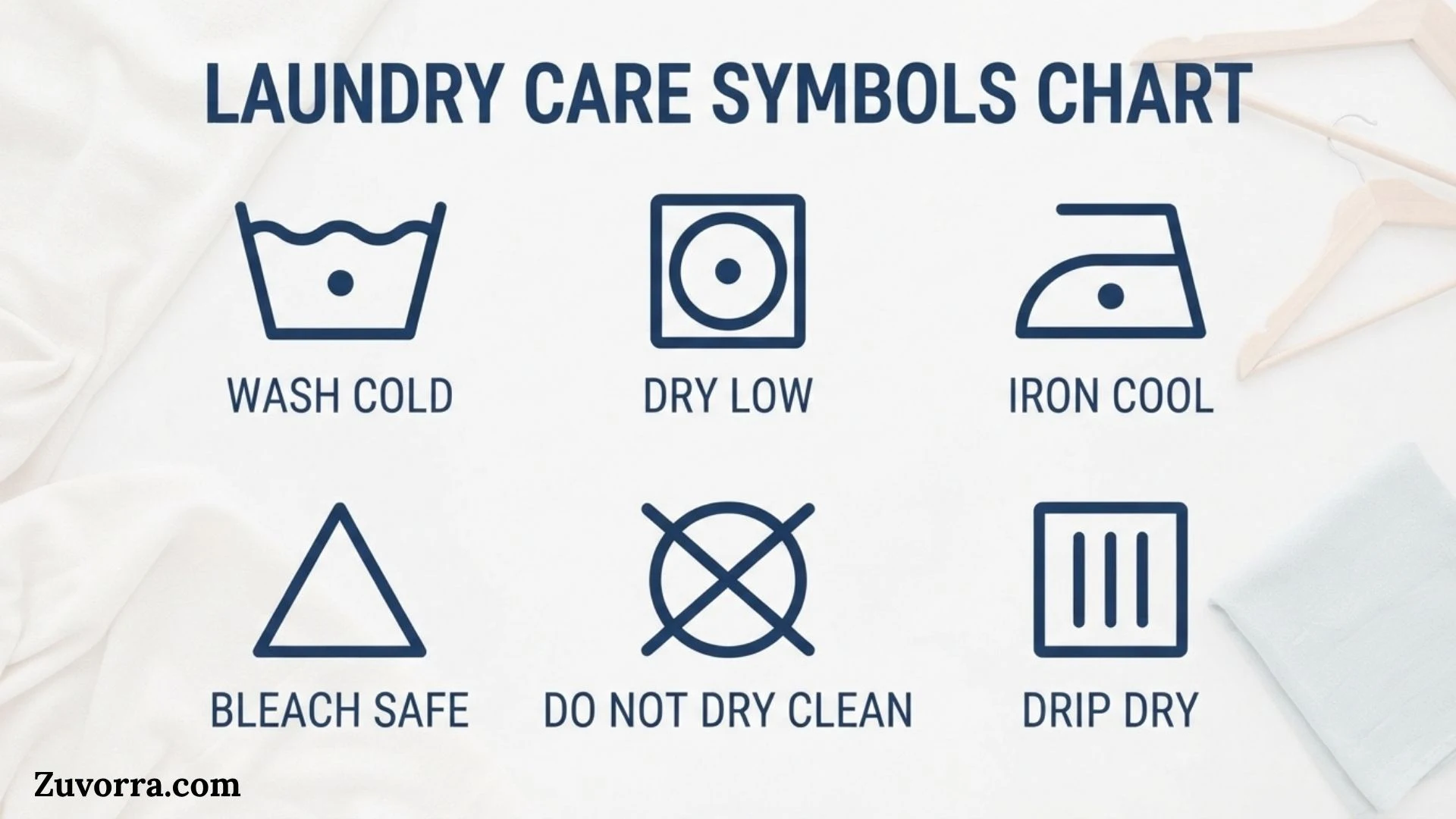
Decoding the tiny, cryptic icons printed on clothing labels can feel like trying to read an ancient hieroglyphic script. These miniature graphics dictate whether a garment will emerge from the wash cycle pristine or completely ruined.
Understanding a laundry care symbols chart is essential for extending the lifespan of your wardrobe, preventing accidental shrinkage, and protecting delicate fabrics like silk, wool, and technical synthetics.
Encountered on sewn-in textile tags worldwide, these universal pictograms bridge language barriers to provide standardized washing, bleaching, drying, ironing, and professional cleaning instructions.
Quick Meaning
A laundry care symbols chart is a standardized system of geometric icons—washing tubs, triangles, circles, squares, and irons—that communicate safe textile maintenance procedures. These symbols dictate water temperature, mechanical agitation intensity, chemical usage restrictions, thermal drying limits, and professional dry-cleaning parameters to prevent garment damage.
Symbol Overview Table
| Symbol Name | Primary Meaning | Category | Origin | Common Usage | Modern Meaning | Related Symbols |
| Washing Tub | Machine or hand laundering process | Washing | International Organization for Standardization (ISO) | Apparel care labels | Water temperature and agitation limits | Hand wash icon, Do not wash |
| Triangle | Bleaching capabilities and restrictions | Bleaching | ISO 3758 standard | Garment inner tags | Permissible bleach agents and safety | Chlorine bleach, Non-chlorine bleach |
| Square | Drying procedures and heat levels | Drying | Textile standardization bodies | Textile care labels | Tumble drying, line drying, flat drying | Tumble dry, Line dry |
| Iron | Ironing and pressing temperature limits | Ironing | Global textile labeling | Woven clothing tags | Maximum soleplate temperature | Steam iron, No steam |
| Circle | Professional laundering and dry cleaning | Dry Cleaning | Commercial textile care | Retail garment tags | Dry cleaning solvents and wet cleaning | P symbol, F symbol |
What Does the Symbol Mean?

Laundry care symbols are universal visual instructions designed to communicate how a textile product can be cleaned safely without causing structural damage, fiber degradation, color bleeding, or dimensional shrinkage.
The system relies on five fundamental shapes that represent the core stages of garment care:
- The Washing Tub: Indicates whether a garment can be submerged in water, the maximum safe water temperature (often indicated by dots or numbers), and the required mechanical action level (standard, gentle, or very gentle).
- The Triangle: Specifies rules regarding bleaching agents. An empty triangle permits any bleach, a striped triangle restricts to oxygen-based (non-chlorine) bleach, and a crossed-out triangle prohibits all bleaching agents.
- The Square: Governs drying methods. Inside the square, lines or dots dictate whether to tumble dry on high, medium, or low heat, or use non-mechanical methods like line drying, flat drying, or drip drying.
- The Iron: Outlines safe ironing parameters. Dots within the iron symbol specify maximum temperature thresholds, typically low (110°C), medium (150°C), and high (200°C), while a cross through the iron forbids ironing entirely.
- The Circle: Reserved for professional dry cleaners and commercial laundries. Letters inside the circle (such as P, F, or W) inform professionals which chemical solvents or wet-cleaning techniques are safe to use.
History and Origin
The standardization of clothing care instructions emerged out of a post-World War II global economy characterized by a massive influx of synthetic fibers like nylon, polyester, and acrylic. Traditional laundering techniques—which relied exclusively on boiling water, harsh lye soaps, and manual scrubbing—frequently destroyed these delicate new materials.
In the 1960s, the International Organization for Standardization (ISO) developed the ISO 3758 standard to create a unified visual language for textile care. Concurrently, regional systems developed, such as the ASTM International standards in North America and Ginetex (International Association for Textile Care Labeling) in Europe. Over the decades, these organizations harmonized their frameworks to ensure that a consumer in Tokyo, Paris, or New York could interpret the same garment tag without language friction. The evolution transitioned from text-heavy instruction tags to minimalist, intuitive pictograms capable of fitting on small fabric labels.
Symbolism and Interpretation
In the context of textile maintenance, these symbols function as a prescriptive visual code rather than esoteric symbolism. However, their design follows universal semiotic principles:
- Enclosure (The Tub, Square, Circle): Represents the containment environment where the treatment takes place.
- Modification (Dots, Lines, and Crosses): Act as modifiers of intensity. A single dot consistently signifies low intensity or cool temperatures, two dots represent medium settings, and three dots denote high thresholds.
- Prohibition (The X Overlay): A universal cross-out or “X” serves as an immediate, negative injunctive signifier, universally understood across cultures to mean “Do not perform this action.”
Cultural Significance
While laundry care symbols are strictly technical, their interpretation varies slightly by geographic region due to historical standardization bodies:
- Europe (Ginetex System): Heavily emphasizes the ISO 3758 standard, using precise dot systems inside the wash tub and precise iron temperature thresholds.
- North America (ASTM / FTC System): Historically incorporated a mix of written words (“Tumble Dry Low”) alongside symbols, though globalization has driven widespread adoption of the pure ISO pictogram system.
- Japan (JIS L 0219): Historically utilized a distinct set of Japanese Industrial Standards icons that included unique descriptive symbols for wringing and pressing, though Japan transitioned to align closely with the international ISO standard to facilitate global apparel trade.
Scientific or Technical Meaning
The parameters behind laundry care symbols are rooted in textile chemistry, polymer science, and thermodynamics:
- Thermal Thresholds: Natural fibers like cotton and linen tolerate high thermal energy because of strong hydrogen bonding in cellulose. Synthetic fibers like polyester and acetate have low glass transition temperatures; excessive heat from tumble dryers or irons causes polymer chains to soften, deform, or melt permanently.
- Mechanical Action: Agitation in washing machines places shear stress on yarns. Delicates instructions reduce drum rotation speed and spin cycles to prevent fiber fatigue and seam slippage.
- Chemical Reactivity: Chlorine bleach ($NaClO$) acts as a powerful oxidizing agent that breaks chromophores in stains but also attacks peptide bonds in protein fibers like wool and silk, causing fiber dissolution.
Where the Symbol Is Used
Laundry care symbols appear primarily in functional and commercial contexts:
- Apparel Inner Tags: Sewn into the side seams or collar bands of shirts, trousers, dresses, and outerwear.
- Home Textiles: Printed on labels attached to bed linens, duvets, curtains, towels, and upholstery fabrics.
- Commercial Laundry Guides: Displayed in industrial laundromats, hotel housekeeping departments, and professional dry-cleaning facilities.
- Digital Retail Platforms: Integrated into e-commerce product pages as part of product care and material composition guides.
Common Variations
Care label symbols feature several standard modifiers that alter their baseline instructions:
- Single Underline: Indicates a gentle washing machine cycle requiring reduced mechanical action (e.g., synthetics or permanent press cycles).
- Double Underline: Denotes a very gentle or wool-specific cycle with minimal agitation.
- Hand Wash Icon (Tub with a Hand): Specifies that machine washing is prohibited; the garment must be laundered manually at temperatures not exceeding 40°C.
- Crossed-Out Symbols: Any core icon overlaid with an “X” explicitly forbids that specific treatment (e.g., a crossed-out tub means do not wash in water; a crossed-out circle means do not dry clean).
Common Misconceptions
- Misconception: The dots inside the washing tub represent water temperature in degrees Celsius.
- Fact: The dots represent relative heat levels (one dot for cold/30°C, two dots for warm/40°C–50°C, three dots for hot/60°C+), though some modern charts incorporate exact numerical Celsius values alongside or inside the tub.
- Misconception: A crossed-out iron means the garment can never be pressed.
- Fact: It means the garment cannot be ironed with a hot soleplate; often, steaming or low-temperature pressing without steam may still be permissible depending on the fiber content.
- Misconception: All synthetic fabrics can be tumble-dried on high heat if they feel dry.
- Fact: Synthetics are prone to heat-set wrinkling and fiber glazing; drying them above recommended temperatures permanently damages the fabric texture.
Interesting Facts

- Global Universality: The ISO 3758 standard allows clothing manufacturers to sell garments globally without printing multi-language text labels for washing instructions.
- The Origin of the Tub: The washing tub icon was designed to mimic an open top-loading wash basin with water sloshing inside.
- The Triangle’s Evolution: The bleaching triangle originally resembled a chemical Erlenmeyer flask before being simplified into a geometric triangle in the late 20th century.
- Professional Secrets: The letters inside dry-cleaning circles (P, F, W) instruct the cleaner on specific hydrocarbon or wet-cleaning solvents, protecting rubberized coatings and bonded seams from dissolving.
- Woolmark Influence: The iconic Woolmark logo heavily influenced international standards for labeling pure wool products with strict hand-wash and flat-dry requirements.
- Smart Labels: Modern textile engineering is introducing NFC-enabled and QR-coded care tags that link smartphones directly to digital laundry care guides.
- The Drip-Dry Line: A vertical line inside a square indicates line drying, while a horizontal line specifies flat drying to prevent stretch distortion in heavy knit sweaters.
- Temperature Scaling: Standard washing dot codes scale from one dot ($30^\circ\text{C}$) up to six dots ($95^\circ\text{C}$ for heavy cottons and linens).
Related Symbols
- Dry Cleaning Circle: Focuses exclusively on solvent-based professional cleaning rather than water laundering.
- Bleach Triangle: Governs chemical oxidizing agents used for stain removal and whitening.
- Tumble Drying Square: Manages thermal and mechanical moisture extraction processes.
- Ironing Icon: Regulates conductive thermal application via heated metal soleplates.
Frequently Asked Questions
What do the dots inside the laundry care symbols mean?
The dots indicate temperature thresholds and heat intensity levels. One dot signifies low heat or cold water settings, two dots represent medium warmth, and three or more dots designate high heat tolerances. This system prevents thermal damage to sensitive fibers.
What does a wash tub symbol with a hand inside mean?
The hand inside the washing tub indicates that the garment cannot withstand machine agitation. It must be washed strictly by hand in a basin with mild detergent at a low temperature, avoiding harsh wringing or twisting.
What is the difference between a square with one horizontal line and a square with vertical lines?
A square with a single horizontal line indicates that the garment must be dried flat to prevent stretching and distortion, common in heavy wool sweaters. Vertical lines indicate traditional vertical line drying on a clothesline.
Can I use chlorine bleach if the triangle has a cross through it?
No. A crossed-out triangle prohibits all forms of bleaching. Using chlorine or oxygen bleach on such a garment will permanently damage the fabric structure, weaken the yarn, and cause severe discoloration.
What do the letters P and F mean inside the dry cleaning circle?
The letters P and F are instructions for professional dry cleaners. P indicates that the garment can be cleaned with perchloroethylene and specific hydrocarbons, while F designates milder hydrocarbon solvents required for sensitive prints or trims.
Why do some wash tubs feature an underline?
An underline beneath the washing tub indicates a reduced mechanical agitation cycle, such as a permanent press or synthetic cycle. A double underline signifies a delicate or wool cycle with minimal spinning and movement.
What happens if I ignore laundry care symbols?
Ignoring care symbols often results in catastrophic garment failure, including severe shrinkage from thermal felting, color bleeding from excessive water temperatures, fabric stiffening, seam distortion, or complete fiber degradation.
Are laundry care symbols legally required on clothing?
In many jurisdictions, such as the United States regulated by the Federal Trade Commission (FTC) and the European Union, clear and accurate care instructions—whether symbolic or written—are legally required to be permanently attached to apparel.
Key Takeaways
- Standardized Language: Laundry care symbols use five core shapes—tubs, triangles, squares, irons, and circles—to communicate universal washing rules.
- Intensity Dots: Dots inside symbols scale from low to high heat and agitation levels.
- Prohibition Signs: An overlay “X” strictly forbids a specific maintenance action.
- Fabric Protection: Adhering to these symbols prevents shrinkage, color loss, and structural fiber damage.
Conclusion
Mastering a laundry care symbols chart transforms everyday garment maintenance from guesswork into an exact science. By understanding the precise language of washing tubs, bleaching triangles, drying squares, and ironing icons, you can protect your wardrobe investment, maintain fabric integrity, and ensure your clothing lasts for years to come.

I’m Jasper Huxley, a British writer fascinated by the symbols that communicate ideas without words. I explore their meanings, origins, cultural connections, and everyday uses. From ancient markings to contemporary signs, I enjoy uncovering the stories behind visual language and presenting symbolism in a clear, engaging way for curious readers worldwide.
Books:
- The Hidden Language of Symbols
- Symbols, Signs and Their Meanings
One thought on “The Ultimate Laundry Care Symbols Chart: Decoding Every Tag and Icon”