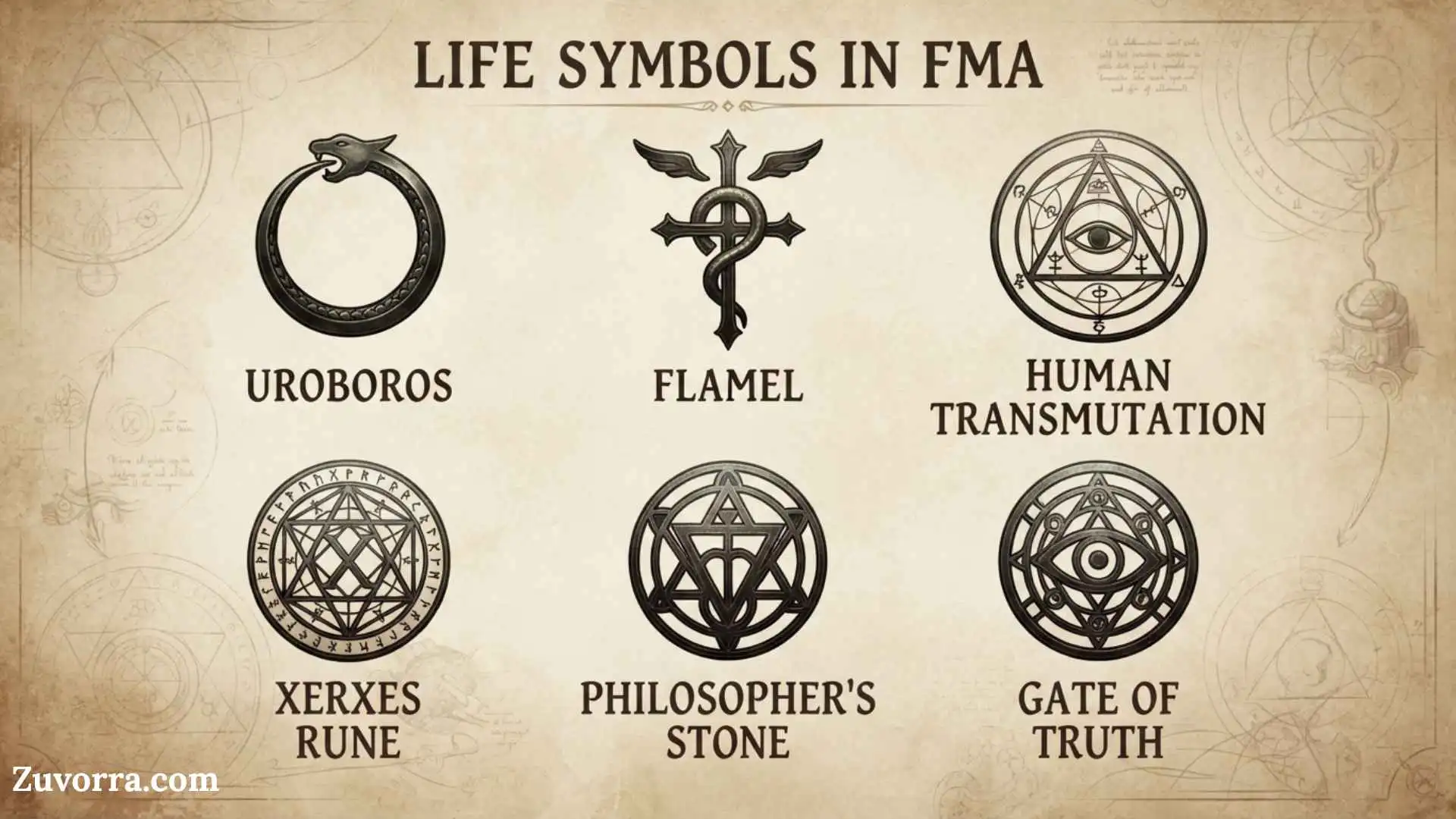
Fullmetal Alchemist symbols represent transformation, sacrifice, mortality, identity, forbidden knowledge, and the moral cost of power. The most important designs include transmutation circles, the Homunculi’s Ouroboros, Edward Elric’s Flamel emblem, the Gate of Truth, blood seals, the Philosopher’s Stone, and the Amestrian nationwide transmutation circle.
Readers encounter these symbols on Edward’s coat, Alphonse’s armor, military uniforms, character tattoos, laboratory walls, manga covers, and major ritual scenes. Some draw from historical alchemy, mythology, religion, geometry, and medicine, while others were created specifically for Hiromu Arakawa’s fictional world.
Quick Meaning
Fullmetal Alchemist symbols show that knowledge and power always carry consequences. Circles suggest controlled transformation, the Ouroboros represents artificial immortality and repetition, the Flamel emblem reflects healing and renewal, and the Gate represents ultimate truth. Together, these images support the story’s central question: what should a person sacrifice to gain what they desire?
Fullmetal Alchemist Symbol Overview
| Symbol | Primary Meaning | Origin or Inspiration | Common Use in the Series | Modern Fan Meaning |
| Transmutation circle | Transformation through structured knowledge | Historical alchemical diagrams, geometry, magical circles | Activating alchemy | Skill, balance, equivalent exchange |
| Ouroboros | Eternity, self-consumption, false immortality | Ancient Egyptian and Greco-Egyptian symbolism | Mark of the Homunculi | Villainy, immortality, cyclical destruction |
| Flamel emblem | Healing, renewal, mastery, sacrifice | Serpent, cross, crown, wings, alchemical imagery | Edward’s coat and Alphonse’s armor | Brotherhood, resilience, Elric identity |
| Gate of Truth | Ultimate knowledge and human limitation | Religious gates, mystical diagrams, “Tree of Life” imagery | Human transmutation and Truth | Forbidden knowledge, judgment, self-discovery |
| Blood seal | A soul bound to matter | Fictional alchemy and ritual sealing traditions | Anchors Alphonse’s soul to armor | Loyalty, fragile identity, survival |
| Philosopher’s Stone | Power created from human life | European and Islamic alchemical traditions | Bypasses normal alchemical limits | Corruption, sacrifice, concentrated suffering |
| State Alchemist emblem | Military authority and controlled science | Heraldry and institutional insignia | Silver watch and certification | Duty, compromise, state power |
| Nationwide circle | Mass sacrifice and political control | Geometric ritual design | Father’s plan for Amestris | Systemic exploitation and hidden power |
| Scar’s arm tattoos | Destruction and reconstruction | Ishvalan alkahestry and alchemical notation | Combat and counter-transmutation | Revenge transformed into restoration |
| Flame Alchemy circle | Controlled combustion | Elemental symbolism and technical diagrams | Roy Mustang’s gloves | Precision, ambition, destructive responsibility |
Fullmetal Alchemist was created by Hiromu Arakawa and began serialization in 2001. Its premise presents alchemy as a power positioned between magic, art, and science, governed by rules but repeatedly abused by governments and individuals.
What Do Fullmetal Alchemist Symbols Mean?
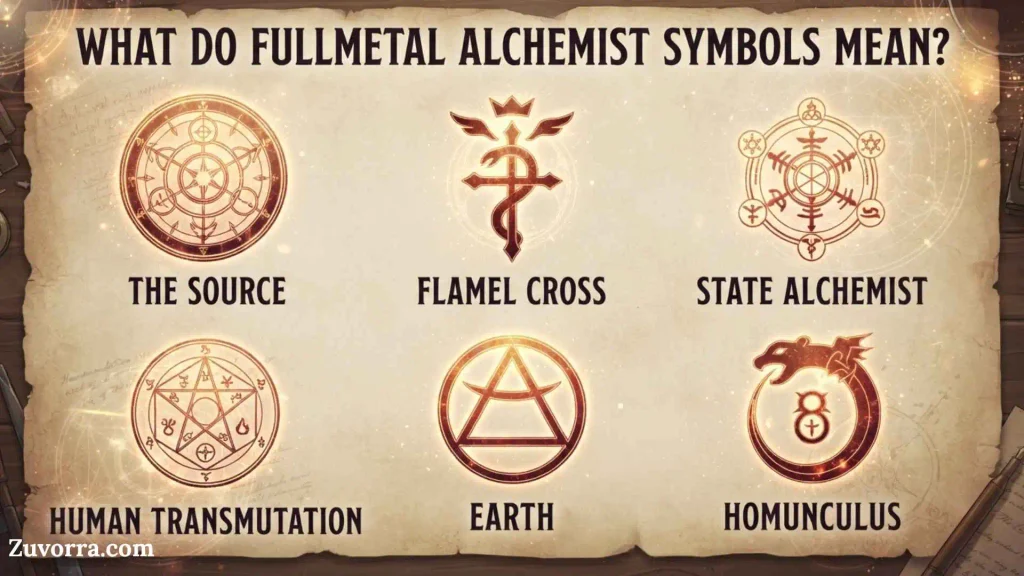
The symbols function as a visual language for the series’ ethical and philosophical ideas. They are not decorative additions. A circle, tattoo, seal, or insignia often reveals how a character understands life, power, death, and responsibility.
Alchemy in the story works by analyzing matter, breaking it down, and reconstructing it. The transmutation circle represents that organized process. Its lines and inscriptions act like a fictional formula, directing energy toward a specific result.
However, the same visual order can hide moral disorder. A perfect circle may power a healing technique, a weapon, or a human sacrifice. The design itself is neutral; the intention and cost determine its meaning.
This distinction appears throughout the narrative:
- Edward uses alchemy to repair and protect, but his first major experiment destroys his body.
- Roy Mustang’s flame circle gives him remarkable control over fire, yet connects him to wartime violence.
- The Homunculi wear an ancient sign of continuity, although their lives depend on stolen human souls.
- Father builds a massive geometric system beneath an entire nation, turning a civilization into ritual material.
The symbols therefore communicate one of the story’s strongest lessons: technical knowledge does not guarantee wisdom.
History and Origin of the Symbols
The visual world of Fullmetal Alchemist combines fictional designs with recognizable elements from historical alchemy, Western esotericism, mythology, religious art, chemistry, medicine, heraldry, and geometry.
Historical alchemy was not one single practice. It developed through Greco-Egyptian writings, Islamic scholarship, European workshops, medicine, metallurgy, philosophy, and spiritual speculation. Early modern alchemists studied substances and laboratory processes while also using allegories, planetary signs, animals, religious images, and coded diagrams.
Arakawa adapts that symbolic tradition rather than reproducing a complete historical system. Her fictional alchemists use clean circles, triangles, arrays, text, and elemental marks that look scholarly and mysterious. The visual style makes alchemy seem rule-based, even when its exact mechanics remain imaginary.
The Influence of Historical Alchemy
Several major ideas have clear historical parallels:
- The Philosopher’s Stone: Historical alchemists associated it with transmuting base metals, perfecting matter, creating gold, or producing an elixir of life.
- The Ouroboros: A serpent eating its own tail appears in ancient and alchemical traditions as an image of unity, renewal, eternity, and matter transforming itself.
- Geometric diagrams: Historical occult and alchemical texts often combined shapes, planetary signs, Latin phrases, and allegorical figures.
- Transformation: Both historical alchemy and the series treat transformation as physical and philosophical.
- The union of opposites: Alchemical art frequently joins male and female, sun and moon, sulfur and mercury, or body and spirit.
The Metropolitan Museum of Art notes that alchemy joined practical experimentation with theories about matter, medicine, religion, and philosophy. That mixture helps explain why the symbols in Fullmetal Alchemist can look scientific, magical, and spiritual at the same time.
Fictional Development Within the Story
Inside the fictional history, different regions develop distinct methods.
Amestrian alchemy relies heavily on tectonic energy and circular arrays. Xingese alkahestry emphasizes the “Dragon’s Pulse,” medicine, and the flow of energy through the land. Ishvalan knowledge develops under different religious and cultural conditions.
These systems show that symbols do not have one universal meaning. Their design changes according to geography, education, politics, and purpose.
Major Symbols and Their Interpretations
Transmutation Circles
A transmutation circle means that transformation must follow structure. The outer circle contains and directs energy, while the shapes, inscriptions, and signs inside define the operation.
The circle also represents wholeness and continuity. Because it has no visible beginning or end, it fits a world where matter continually changes form.
Most alchemists require an array to perform transmutations. Those who have passed through the Gate can use their own bodies as part of the circuit by bringing their hands together. This ability does not mean they have escaped alchemy’s laws. It means they paid a severe price for knowledge.
Positive meaning: discipline, learning, balance, creativity, restoration.
Negative meaning: control, experimentation without consent, weaponized science, or the illusion that everything can be reduced to a formula.
The Ouroboros
The Homunculi’s red tattoo depicts an Ouroboros, a serpent or dragon consuming its own tail. Historically, the image has represented eternity, unity, endless return, death and rebirth, and a self-contained universe.
In the series, the emblem becomes ironic. The Homunculi seek superiority and extended life, but they remain trapped within Father’s ambitions. Their apparent immortality depends on finite energy stored in Philosopher’s Stones.
The creature eating itself also mirrors the way their system consumes human beings to preserve itself. What appears eternal is actually self-destructive.
Each tattoo’s placement further individualizes the design. The marks appear on different parts of the Homunculi’s bodies, linking shared origin with separate identities.
The Flamel Emblem
The red emblem on Edward’s coat and Alphonse’s armor is commonly called the Flamel. It contains a cross-like vertical form, a coiled serpent, wings, and a crown.
The design resembles several historical motifs, including serpent staffs, cruciform emblems, crowned alchemical figures, and images associated in popular culture with Nicolas Flamel. However, the exact composite should be understood primarily as a symbol within the franchise rather than a standard historical alchemical sign with one universally documented definition.
Within the story, it is connected to the Elric brothers and their teacher, Izumi Curtis. Its serpent can suggest renewal, medicine, danger, and knowledge. Wings imply transcendence or spiritual movement. The crown suggests mastery, completion, or the elevated goal of the alchemical work.
The emblem’s deepest meaning comes from context: the Elrics have suffered, but they continue moving forward. It becomes a sign of endurance rather than effortless power.
The Gate of Truth
The Gate represents ultimate knowledge and the boundary separating human understanding from total truth.
Its surface contains branching designs that resemble mystical trees, anatomical figures, religious diagrams, or maps of existence. The exact artwork varies among characters and adaptations, which suggests that the Gate reflects the individual standing before it.
Behind the Gate lies overwhelming knowledge. Passing through it grants extraordinary understanding of alchemy, but Truth takes a physical toll in return.
The Gate therefore symbolizes:
- Knowledge that cannot be gained safely
- The limits of human control
- Judgment without human emotion
- A confrontation with the self
- The relationship between body, mind, soul, and truth
Its message is not simply “knowledge is dangerous.” The deeper warning is that knowledge pursued without humility can turn people into objects, costs, or ingredients.
The Eye of Truth
An eye appears within Gate imagery and during forbidden transmutations. Across many cultures, eyes can signify awareness, surveillance, divinity, judgment, or inner knowledge.
In Fullmetal Alchemist, the eye suggests that Truth sees through pride and self-deception. Characters may hide motives from other people, but they cannot hide the true nature of their exchange.
It should not automatically be labeled an “Eye of Providence” or tied to one specific religion. The resemblance supports broad themes of observation and judgment, but the series does not establish a simple one-to-one identity.
The Blood Seal
Alphonse’s blood seal is a small but essential symbol. Edward draws it in blood inside the armor to bind Alphonse’s soul to the metal body.
Blood represents life, kinship, sacrifice, and identity. The seal preserves Alphonse, yet it also shows how fragile his condition is. Damage to the armor can be repaired, but destruction of the seal could end the bond.
The seal also expresses brotherhood. Edward’s blood literally anchors his brother to the world. It is both an alchemical mechanism and a visible reminder of Edward’s responsibility.
The Philosopher’s Stone
The Philosopher’s Stone represents power detached from visible cost. It lets alchemists appear to bypass equivalent exchange because the required energy has already been taken from human lives.
Historical alchemy associated the legendary stone with perfected matter, gold-making, healing, spiritual completion, or an elixir of life. In the series, that hopeful object becomes a moral horror.
Its red color evokes blood, life, danger, and concentrated vitality. Every use raises a difficult question: does a good goal justify using power created through murder?
The Stone’s true symbolism is not unlimited possibility. It is hidden payment.
The Nationwide Transmutation Circle
The circle beneath Amestris transforms geography into a weapon. Cities, conflicts, railways, tunnels, and borders become parts of a vast design built over generations.
This symbol expands the ethics of alchemy from individual choices to political systems. Ordinary citizens may not recognize the pattern because they see only their local surroundings. The audience gains meaning by viewing the entire map.
It represents systemic exploitation: a nation can look orderly while being shaped toward a concealed purpose. It also shows how war and expansion can serve goals that soldiers and civilians do not understand.
Scar’s Arm Tattoos
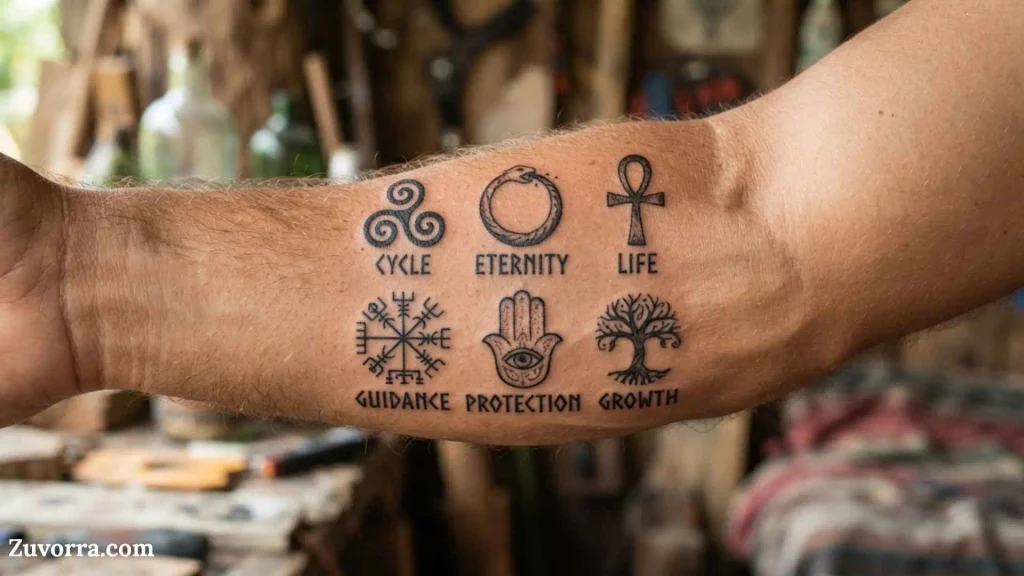
Scar’s tattooed arms contain alchemical and alkahestric knowledge inherited from his brother. One arm specializes in decomposition, while the completed system can also support reconstruction.
At first, Scar uses only destruction. His incomplete practice reflects his grief and desire for revenge. As his understanding changes, the paired functions gain new meaning.
The tattoos symbolize knowledge carried in the body, cultural survival, brotherly inheritance, and the choice between repeating violence and rebuilding after it.
Flame Alchemy Symbols
Roy Mustang’s gloves bear transmutation arrays designed for flame alchemy. The symbols help him alter oxygen concentration and ignite gases through sparks produced by ignition cloth.
This fictional process gives his alchemy a technical appearance, but it should not be treated as a real method of creating controlled explosions.
Symbolically, fire suits Mustang because it can warm, illuminate, purify, or destroy. His ambition to reform the state remains inseparable from the devastation he caused under military orders.
Cultural and Religious Significance
The symbols combine Japanese storytelling with imagery drawn from several global traditions. This cross-cultural design helped the series communicate complex themes to audiences without depending on one religious system.
Serpents can represent medicine, renewal, danger, wisdom, temptation, or immortality. Crosses may indicate suffering, death, protection, direction, or sacrifice. Gates often separate sacred and ordinary spaces. Eyes suggest judgment and awareness. Circles imply unity and completion.
These associations enrich the story, but viewers should avoid claiming that every image has a fixed Christian, Jewish, Egyptian, Greek, or occult meaning. Arakawa uses visual borrowing creatively. Similarity does not always prove direct theological equivalence.
The Ishvalan storyline also separates faith from fanaticism. Ishvalan religion shapes community identity and ethical debates, yet characters interpret its teachings differently. Scar’s journey demonstrates that a sacred tradition can be used to justify vengeance or to guide restoration.
Scientific and Technical Meaning
The series presents alchemy as a controlled system, but it is fictional. Real chemistry does not use transmutation circles, clap-activated reactions, souls as energy sources, or symbolic arrays to rearrange matter.
Some scientific ideas do support the story’s atmosphere:
- Matter has structure and composition.
- Chemical reactions rearrange atoms.
- Energy must be accounted for.
- Materials cannot be created freely from nothing under ordinary conditions.
- Human bodies contain measurable elements and compounds.
- Scientific work can produce both healing tools and weapons.
The rule of equivalent exchange resembles conservation principles, but it is a philosophical and narrative law rather than an exact statement of physics. The story uses it to make moral consequences visible.
Where the Symbols Are Used
Fans encounter these designs across several forms of media and merchandise:
- Manga panels and cover illustrations
- Fullmetal Alchemist and Fullmetal Alchemist: Brotherhood
- Films, games, art books, and promotional artwork
- Edward Elric cosplay coats
- Alphonse armor replicas
- Jewelry, pins, posters, and clothing
- Tattoos inspired by the Flamel or Ouroboros
- Fan art and convention displays
VIZ’s official art collection gathers color artwork produced by Arakawa from 2001 through 2017, showing how central emblems, uniforms, circles, and character designs are to the franchise’s visual identity.
Anyone considering a permanent tattoo should study the complete symbol and its story context. The Ouroboros, Flamel, Gate, and blood seal carry very different associations.
Common Variations and Similar Symbols
| Design | Common Variation | How It Differs |
| Transmutation circle | Character-specific array | Internal marks change according to the technique |
| Ouroboros | Serpent or dragon biting its tail | FMA adds a distinctive triangular and wing-like composition |
| Flamel | Simplified red linework | Often loses the crown, wings, or serpent details |
| Gate | Different door illustrations | Reflects character, adaptation, or visual interpretation |
| Blood seal | Circular seal with written marks | Functions as a soul anchor, not a general transmutation array |
| Flame array | Glove-based circle | Designed for Mustang’s specialized combat alchemy |
| Scar’s tattoos | Separate arm patterns | Each side represents a different stage of transmutation |
The Flamel is sometimes confused with the caduceus. The caduceus traditionally shows two serpents around a winged staff and is linked to Hermes. The Rod of Asclepius has one serpent and is associated with healing. Edward’s emblem is a different composite design, even though it shares visual features with serpent-staff traditions.
Common Misconceptions
Every symbol is an authentic alchemical sign
Many designs use real historical motifs, but the arrays and composite emblems were adapted or invented for the fictional setting.
Equivalent exchange is a law of chemistry
It resembles conservation concepts, but it also functions as a moral belief that the story later challenges and complicates.
The Flamel is an Ouroboros
The Flamel contains a serpent, but it does not show that serpent forming a closed loop by eating its tail. The Homunculi’s emblem is the true Ouroboros design.
The Gate belongs to one specific religion
Its imagery resembles mystical and religious diagrams, but its narrative role combines many ideas: truth, judgment, selfhood, knowledge, and limitation.
Philosopher’s Stones provide free energy
They only seem to erase the cost of transmutation. Their power comes from lives already sacrificed.
All alchemy in the series works the same way
Amestrian alchemy, Xingese alkahestry, specialized arrays, human transmutation, and Philosopher’s Stones rely on different methods or energy relationships.
Interesting Facts About Fullmetal Alchemist Symbols
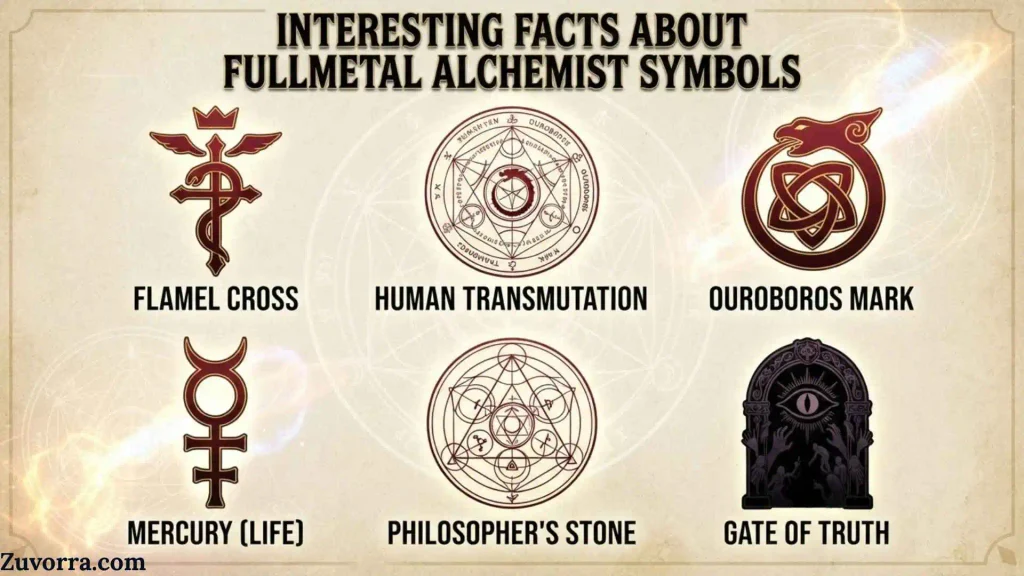
- The symbols often reveal plot information before dialogue does. A tattoo, map, or circle may expose a character’s origin or a hidden ritual long before the full explanation appears.
- The Homunculi share one emblem but wear it in different places. This balances their common creation with their individual personalities.
- Edward becomes a living transmutation circuit. Clapping replaces the need to draw a circle because his encounter with the Gate changes his knowledge.
- Alphonse’s most important mark is hidden. His blood seal sits inside the armor, emphasizing that his true identity cannot be judged from his outer body.
- The national map functions like a diagram. Geography, warfare, and politics become parts of one symbolic machine.
- Scar’s tattoos preserve knowledge after its creator dies. The body becomes a book, inheritance, weapon, and cultural archive.
- Red connects several forms of dangerous power. Blood seals, Philosopher’s Stones, the Ouroboros, and Edward’s coat all use red in different but related ways.
- Circles can represent both freedom and confinement. They allow controlled creation, yet characters also become trapped inside cycles of revenge, ambition, and sacrifice.
- The Gate’s imagery is personal. Its changing appearance supports the idea that every person confronts truth through a different self.
- Alchemy’s symbols make invisible costs visible. Human lives, political violence, memory, guilt, and bodily loss are transformed into marks the audience can recognize.
Related Symbols
- Rod of Asclepius: A single serpent around a staff, traditionally associated with healing.
- Caduceus: Two serpents and wings linked to Hermes, trade, mediation, and communication.
- Ouroboros: A tail-eating serpent representing continuity, unity, or cyclical renewal.
- Philosopher’s Stone symbol: Historical alchemical diagrams vary; no single design covers every tradition.
- Tree of Life: A branching sacred or philosophical structure that can symbolize creation and connected existence.
- Magic circle: A ritual boundary used in various occult and fictional traditions.
- Pentagram: A five-pointed star with many historical meanings; it is not automatically evil.
- Alchemical element signs: Marks representing substances, metals, planets, or processes in historical manuscripts.
Frequently Asked Questions
What is the main Fullmetal Alchemist symbol?
There is no single official emblem representing every theme, but Edward’s red Flamel is the most recognizable character symbol. The transmutation circle is the most important symbol of alchemy itself, while the Ouroboros identifies the Homunculi and represents artificial immortality, repetition, and self-consuming ambition.
What does the symbol on Edward Elric’s coat mean?
Edward’s coat bears the Flamel, a crowned, winged, serpent-cross design. Within the story, it connects Edward and Alphonse to their teacher and alchemical training. Fans commonly interpret it as a sign of healing, transformation, sacrifice, resilience, and the brothers’ determination to restore what they lost.
Is the Fullmetal Alchemist Flamel a real symbol?
The design borrows features from historical serpent, cross, wing, crown, and alchemical imagery, but the exact emblem should not be treated as a standard universal symbol from historical alchemy. Its best-supported meaning comes from its use in the manga and anime rather than a single ancient source.
What does the Homunculus tattoo mean?
The Homunculi carry an Ouroboros, a serpent or dragon eating its own tail. Historically, this image can represent eternity and cyclical renewal. In the series, it also symbolizes false immortality, shared origin, endless repetition, and a system that consumes human life to maintain itself.
Why can Edward transmute without a circle?
Edward can perform alchemy by clapping because he passed through the Gate of Truth and gained direct alchemical knowledge. His joined hands and body complete the circuit that a drawn array would normally provide. The ability is not free; it results from the physical price of forbidden human transmutation.
What does Alphonse’s blood seal represent?
The seal binds Alphonse’s soul to his armor. Practically, it keeps him alive without a human body. Symbolically, it represents identity, brotherhood, sacrifice, and fragility. Edward’s blood serves as the link, making the mark a literal expression of the bond and responsibility between the brothers.
Is the Gate of Truth based on the Kabbalistic Tree of Life?
Some viewers note visual similarities between Gate designs and mystical trees or diagrams associated with Kabbalah and other traditions. However, the Gate should not be reduced to one source. In the story, it combines ideas of ultimate knowledge, judgment, individuality, forbidden ambition, and human limitation.
Are transmutation circles scientifically accurate?
No. Their geometric and technical appearance makes the fictional system feel logical, but real chemical reactions do not require symbolic circles. The series draws inspiration from chemistry, conservation, historical alchemy, and ritual diagrams while creating its own rules for storytelling.
What is the meaning of the Philosopher’s Stone?
The Stone represents extraordinary power built from concealed sacrifice. It lets an alchemist avoid paying an immediate personal cost because human souls already supply the energy. Its symbolism challenges the idea of a harmless shortcut and asks whether any achievement can justify treating people as fuel.
Which Fullmetal Alchemist symbol is best for a tattoo?
Choose according to the meaning you want. The Flamel suits resilience and brotherhood, the Ouroboros fits cycles and darker themes, a transmutation circle represents learning and transformation, and the blood seal expresses identity and loyalty. Verify the exact design before using permanent body art.
Key Takeaways
- Fullmetal Alchemist symbols turn ideas about knowledge, sacrifice, identity, and power into recognizable images.
- Transmutation circles represent structured change, but their morality depends on how they are used.
- The Ouroboros symbolizes eternity while exposing the Homunculi’s false and self-consuming immortality.
- Edward’s Flamel emblem combines serpent, cross, wing, and crown imagery into a symbol of endurance and transformation.
- The Gate of Truth represents forbidden knowledge, judgment, self-confrontation, and human limits.
- Alphonse’s blood seal shows that identity may survive outside the natural body, but only through a fragile bond.
- The Philosopher’s Stone does not remove equivalent exchange; it hides the lives already paid.
- Many designs borrow from real traditions, but the series adapts them into an original fictional system.
- Religious similarities should be discussed carefully rather than treated as proof of one fixed interpretation.
- The symbols matter because they reveal the human consequences hidden beneath technical power.
Conclusion
Fullmetal Alchemist symbols give visual form to the series’ deepest questions. The circles, seals, tattoos, gates, stones, and emblems all concern transformation, but none promise change without consequence.
The Flamel reflects perseverance. The Ouroboros reveals the danger of endless self-preservation. The Gate confronts people with truths they cannot control. The blood seal preserves a life while exposing its vulnerability. The Philosopher’s Stone turns a dream of perfection into a record of human suffering.
Together, these symbols explain why Fullmetal Alchemist remains more than a story about magical science. It is a study of what people value, what they are willing to sacrifice, and how they respond after learning that some losses cannot be reversed.
References
- Arakawa, Hiromu. Fullmetal Alchemist. VIZ Media. The official series description identifies Arakawa as the creator and presents alchemy as a power between magic, art, and science.
- VIZ Media. The Complete Art of Fullmetal Alchemist. A collection of Arakawa’s color artwork from 2001 to 2017, including an interview and illustration discussion.
- The Metropolitan Museum of Art. “Alchemy, Science, and Innovations in the Decorative Arts.” Overview of alchemy’s relationship with experimental knowledge, medicine, Hermetic writings, philosophy, and material processes.
- The Metropolitan Museum of Art. Bartholomeus Spranger: Splendor and Eroticism in Imperial Prague. Discussion of alchemical allegory, the Philosopher’s Stone, spiritual knowledge, and the union of opposites.
- Encyclopaedia Britannica. “Caduceus.” Historical background on the winged staff associated with Hermes and its distinction from related serpent symbols.
- Newman, William R., Seymour H. Mauskopf, and Matthew Daniel Eddy. “Chemical Knowledge in the Early Modern World.” Referenced in historical overviews of alchemy and early chemical thought.
I’m Felix Everard, a British writer passionate about the fascinating world of symbols and visual communication. I explore traditional, cultural, historical, and modern symbols, focusing on what they represent and why they matter. Through accessible explanations, I hope to help readers recognise the meanings hidden within familiar signs, shapes, and images.
Books:
- The Complete Guide to Symbolism
- Decoding Signs and Symbols