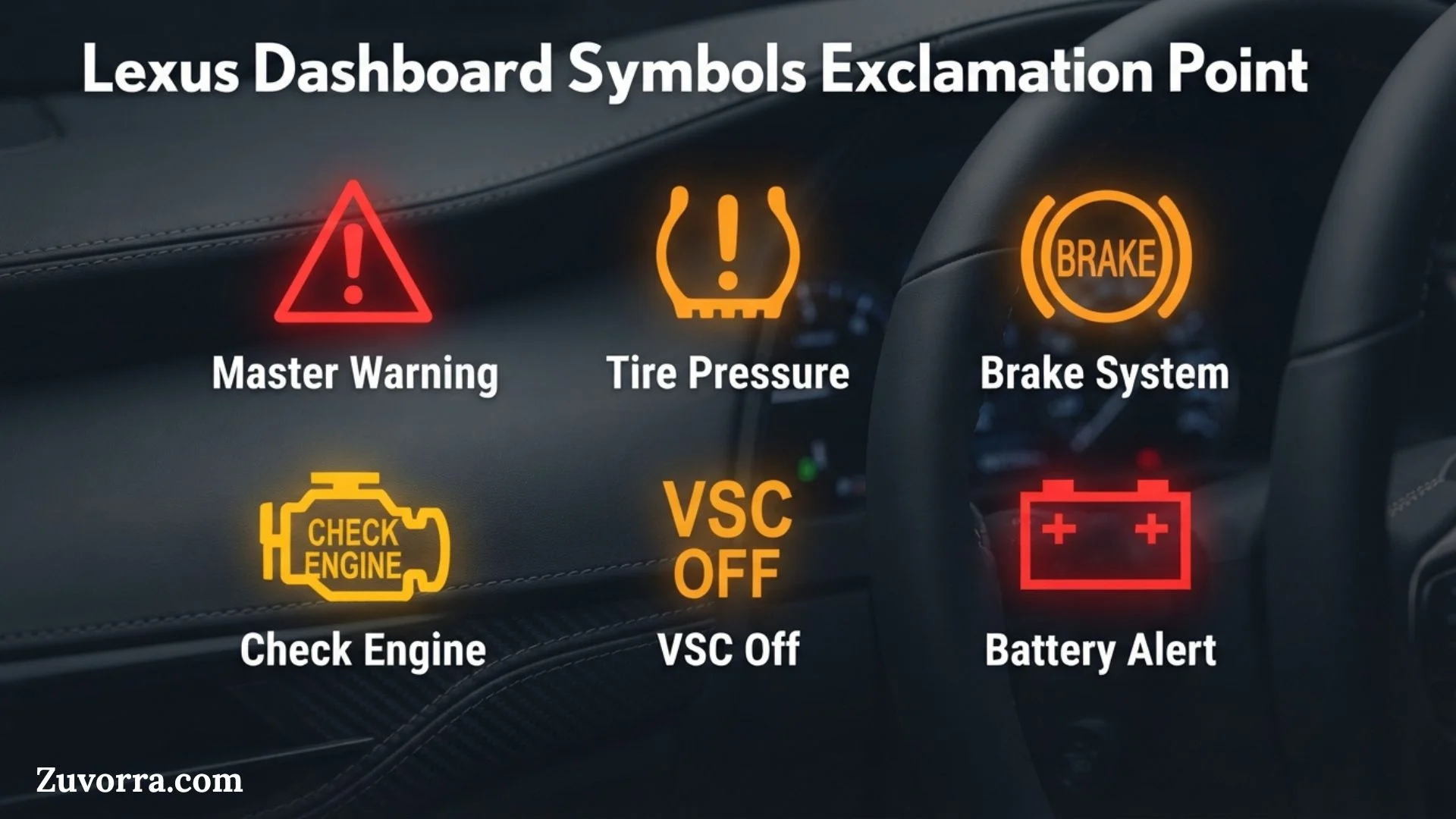
A Lexus dashboard symbol with an exclamation point is a warning that requires your attention, but its exact meaning depends on the shape surrounding the mark. A horseshoe-shaped tire symbol usually means low tire pressure. A triangle commonly serves as the master warning light. A red circle may signal a brake-system problem, while a steering-wheel symbol can indicate an electric power-steering fault.
Recognizing the surrounding shape and warning-light color is essential. One exclamation-point light may require a simple tire-pressure adjustment, while another may mean you should stop driving immediately.
This guide explains the major Lexus dashboard symbols with an exclamation point, why they appear, what their colors mean, and what you should do next.
Quick Meaning
A Lexus dashboard exclamation point is a general alert rather than one single warning. Check the symbol’s surrounding shape: a tire outline means low tire pressure, a triangle means another warning needs review, a circle usually relates to the brakes, and a steering wheel may indicate a power-steering problem.
Lexus Exclamation-Point Symbol Overview
| Symbol appearance | Common Lexus meaning | Typical color | Usual urgency |
| Horseshoe or tire shape with ! | Low tire pressure or TPMS malfunction | Amber | Check soon |
| Triangle with ! | Master warning light | Amber or red | Read the displayed message |
| Circle with ! or BRAKE | Brake warning | Red or amber | Potentially urgent |
| Steering wheel with ! | Electric power-steering warning | Amber or red | Steering assistance may be reduced |
| Car or system graphic with ! | Vehicle-system warning | Amber | Meaning varies by model |
| Message display with warning icon | Additional details about a detected condition | Amber or red | Follow the displayed instruction |
These symbols are technical safety indicators, not decorative or cultural symbols. Their designs follow common automotive conventions, although exact colors, wording, and graphics vary by Lexus model, model year, country, and equipment package.
What Does the Lexus Dashboard Exclamation Point Mean?
The exclamation point means that the vehicle has detected a condition the driver should review. It does not identify the affected system by itself. The icon surrounding it provides the important context.
For example:
- An exclamation point inside a tire outline points to tire pressure.
- An exclamation point inside a triangle is a general or master warning.
- An exclamation point inside a circle often concerns the braking system.
- An exclamation point beside a steering wheel relates to steering assistance.
The information display may also show a written message such as:
- “Low Tire Pressure”
- “Check Tire Pressure”
- “Brake System Malfunction”
- “Parking Brake Malfunction”
- “Visit Your Dealer”
- “Steering Power Low”
- “Master Warning”
Read that message before assuming what the symbol means. Modern Lexus vehicles combine warning icons with multi-information display messages because one graphic can represent several related conditions.
How Warning Light Colors Change the Meaning
Color communicates urgency. The same general symbol can require a different response depending on whether it appears in amber or red.
Red Exclamation-Point Warning
A red warning usually identifies a serious or potentially unsafe condition. It may involve:
- Low brake fluid
- A braking-system malfunction
- A parking-brake problem
- Severely reduced steering assistance
- Another condition requiring the vehicle to be stopped
When a red symbol remains illuminated, move to a safe location as soon as road conditions allow. Do not continue driving merely because the vehicle still seems to operate normally.
Amber or Yellow Exclamation-Point Warning
An amber warning usually means the vehicle needs attention soon, but an immediate roadside stop may not always be necessary.
Common amber alerts include:
- Low tire pressure
- A tire-pressure monitoring system fault
- A master warning with a noncritical message
- Reduced operation of a driver-assistance feature
- An electronic parking-brake warning
- An electric power-steering issue
Amber does not mean “safe to ignore.” It means you should identify and correct the condition promptly.
Flashing Versus Steady Light
A flashing symbol often communicates something different from a steady one.
For example, a steady tire-pressure light normally indicates significant underinflation. A light that flashes for roughly a minute and then stays on generally points to a TPMS malfunction rather than ordinary low pressure. Federal guidance explains that this flashing-then-steady pattern warns that the monitoring system is not functioning properly.
1. Tire Pressure Warning Light
The most common Lexus dashboard exclamation point is the tire-pressure warning light. It resembles a cutaway tire or rounded horseshoe with tread along the bottom and an exclamation point in the center.
Primary Meaning
A steady tire-pressure warning light means that one or more tires may be significantly underinflated.
The Tire Pressure Monitoring System, commonly shortened to TPMS, uses sensors to monitor tire inflation. When the detected pressure falls below an established threshold, the system illuminates the dashboard warning.
NHTSA describes the standard symbol as a tire cross-section with an exclamation mark. It advises drivers to inspect the tires and check their pressure as soon as possible when the light appears.
What to Do
- Reduce speed and avoid sudden steering or hard braking.
- Pull over safely if the vehicle feels unstable.
- Inspect all tires for visible damage, bulges, nails, or a flat appearance.
- Check pressure with an accurate tire gauge.
- Inflate each tire to the cold pressure listed on the driver-side doorjamb label.
- Recheck the warning after driving briefly.
Use the pressure shown on the vehicle’s Tire and Loading Information label, not the maximum pressure printed on the tire sidewall. The doorjamb figure is the vehicle manufacturer’s recommended cold inflation pressure.
Why the Light May Appear in Cold Weather
Air pressure falls as outside temperature decreases. A tire that was only slightly low may cross the warning threshold overnight, causing the light to appear during a cold morning.
The warning may disappear after the tires warm during driving, but that does not mean the pressure is correct. Check the tires while they are cold and adjust them to the door-label specification.
What a Flashing Tire Symbol Means
When the tire symbol flashes for about 60 to 90 seconds and then remains illuminated, the TPMS itself may have a fault.
Possible causes include:
- A failed wheel sensor
- A sensor battery reaching the end of its life
- Replacement wheels without compatible sensors
- Incorrectly programmed sensor IDs
- A damaged sensor after tire service
- A communication problem
- Use of certain temporary spare tires
A malfunctioning TPMS may not warn you accurately about future pressure loss, so check tire pressure manually and arrange an inspection.
Can You Drive With the Tire-Pressure Light On?
You may be able to drive a short distance after confirming that no tire is dangerously low or damaged. However, continuing at highway speed without checking can be unsafe.
Underinflation can increase heat buildup, reduce handling, worsen braking response, accelerate shoulder wear, and raise the risk of tire failure. NHTSA notes that TPMS activates only after a tire becomes significantly underinflated, so it does not replace routine manual checks.
2. Triangle With an Exclamation Point
A triangle containing an exclamation point is commonly called the master warning light. It tells you that the Lexus has detected a condition explained elsewhere, usually in the multi-information display.
Primary Meaning
The triangle does not identify one specific component. Instead, it directs your attention to a warning message, buzzer, or another illuminated symbol.
Depending on the Lexus model, it may accompany messages related to:
- An open door, hood, or trunk
- Low fuel
- Low washer fluid
- A smart-key condition
- A parking-brake issue
- A driver-assistance system
- A hybrid-system warning
- An engine, transmission, or electronic fault
- A required maintenance message
- An improperly shifted gear position
What to Do
Look at the information display immediately. It often gives a direct instruction, such as:
- “Depress Brake Pedal”
- “Shift to P Before Exiting Vehicle”
- “Check Rear Seat”
- “Parking Brake Unavailable”
- “System Malfunction Visit Your Dealer”
- “Stop in a Safe Place”
Follow the message rather than reacting to the triangle alone.
Is the Master Warning Light Always Serious?
No. Some master warnings involve simple conditions, while others identify faults that can affect safe operation.
For example, a warning about an electronic key may be less urgent than a message telling you to stop the vehicle. The color, accompanying buzzer, displayed wording, and vehicle behavior determine the correct response.
Why It May Stay On
The triangle may remain illuminated until:
- The triggering condition is corrected
- The message is acknowledged
- The vehicle is restarted
- A malfunction is repaired
- The system completes a successful self-check
Do not erase or dismiss the message without understanding it.
3. Brake Warning Light With an Exclamation Point
A red circle containing an exclamation point, often surrounded by curved brackets, is generally associated with the braking system. Some Lexus dashboards display the word “BRAKE” instead of, or alongside, the symbol.
Possible Meanings
Depending on the model and operating condition, it may indicate:
- The parking brake is engaged
- Brake fluid is low
- A brake-system malfunction exists
- An electronic parking-brake fault has occurred
- The regenerative and hydraulic braking systems require inspection
- Brake assistance may be reduced
A light that appears briefly when starting the vehicle may be part of a normal system check. A light that stays on after the parking brake is fully released needs attention.
What to Do if the Red Brake Light Remains On
- Confirm that the parking brake is fully released.
- Notice whether the brake pedal feels unusually soft, hard, low, or spongy.
- Listen for a warning buzzer.
- Check whether ABS or stability-control lights are also illuminated.
- Pull over safely if braking feels abnormal.
- Arrange professional inspection or towing when instructed by the owner’s manual.
Do not continue driving with a red brake warning accompanied by weak braking, fluid leakage, unusual noises, or a “Stop Vehicle” message.
Red Brake Light Versus Amber ABS Light
The red brake warning and amber ABS warning are not interchangeable.
The red light may signal a basic braking-system condition, such as low fluid or a hydraulic fault. The ABS light means the anti-lock braking feature may be unavailable. Normal braking might remain, but wheel-lock prevention during hard braking may not operate.
When both lights appear together, the vehicle may have a more serious brake-control problem. Stop safely and follow the model-specific manual.
4. Steering Wheel With an Exclamation Point
A steering-wheel icon with an exclamation point commonly indicates an electric power-steering warning.
Primary Meaning
The Electric Power Steering system, or EPS, may have detected overheating, low voltage, sensor trouble, or another malfunction. Steering assistance can become weaker, making the wheel noticeably harder to turn.
The mechanical steering connection normally remains, but greater physical effort may be required, especially at low speed.
Common Causes
Potential causes include:
- Weak 12-volt battery voltage
- Charging-system trouble
- Repeated steering while stationary
- Holding the steering at full lock
- Overheated steering-assist motor
- Wiring or sensor faults
- A control-module malfunction
In some cases, repeated parking maneuvers cause the electric motor to heat up. The system may temporarily reduce assistance to protect itself.
What to Do
If steering still feels normal, drive cautiously to a safe place and restart the vehicle. If the light disappears and steering returns to normal, temporary overheating or low voltage may have caused the warning.
Seek assistance immediately when:
- The steering becomes very heavy
- The light is red
- A stop-driving message appears
- The charging-system light is also on
- The vehicle pulls or responds unpredictably
Never assume a steering warning is harmless because it appeared only once. Intermittent faults can return.
5. Electronic Parking-Brake Warning
Some Lexus models use an exclamation point with a parking-brake icon, the letter “P,” or a written message to report an electronic parking-brake problem.
What It May Mean
The warning can indicate that:
- The parking brake did not engage
- The parking brake did not release
- The actuator overheated
- Battery voltage is too low
- The system detected a malfunction
- Automatic parking-brake operation is unavailable
You may also see messages such as “Parking Brake Unavailable” or “Parking Brake Malfunction.”
Safe Response
Park on level ground when possible, shift into Park, and avoid relying on the electronic parking brake until the warning is resolved. On a slope, the vehicle may need wheel chocks or professional assistance.
Do not attempt repeated activation if the system makes grinding noises, refuses to release, or reports an actuator fault.
History and Technical Origin of the Exclamation-Point Design

The automotive exclamation point evolved from a broader visual-language principle: a familiar punctuation mark can communicate attention without requiring a long written message.
The exclamation mark itself has been used in European writing for centuries to express emphasis, surprise, or urgency. Instrument designers later adapted it as a compact warning element because drivers can recognize its purpose quickly.
As vehicle dashboards became more complex, manufacturers combined the mark with system-specific outlines:
- A tire shape identifies inflation pressure.
- A circle and brackets suggest the brake assembly.
- A triangle creates a broad caution sign.
- A steering wheel identifies steering assistance.
This combination of a general alert mark and a system outline helps drivers recognize both urgency and category.
The low-tire-pressure icon became especially standardized as governments introduced TPMS requirements. In the United States, passenger vehicles, light trucks, and vans from model year 2008 onward are required to have tire-pressure monitoring systems.
Symbolism and Interpretation
In automotive use, the exclamation point symbolizes attention, caution, and the need for a decision.
Positive Interpretation
The light can be viewed positively because it provides early warning. It may allow a driver to correct a low tire, brake issue, or electronic fault before it develops into a more dangerous failure.
Modern warning systems serve three useful purposes:
- Detection of a developing condition
- Communication through a recognized visual symbol
- Direction toward a corrective action
Negative Interpretation
The symbol can also represent risk, reduced system performance, or an unresolved malfunction. Its negative meaning becomes stronger when the light is red, flashes, sounds a buzzer, or appears with a stop-driving message.
Psychological Interpretation
Drivers often react to all exclamation marks as though they mean the same thing. This can lead to two opposite mistakes:
- Panic over a minor warning
- Ignoring a serious warning because a previous one was harmless
The safer approach is to identify the surrounding shape, observe the color, read the display message, and notice how the vehicle behaves.
Cultural and Regional Significance
Automotive warning symbols are designed to cross language barriers. A driver may not understand a written warning in another language, but a tire outline or brake-circle graphic remains recognizable.
Regional differences still exist. A vehicle sold in one market may use:
- A symbol instead of an English word
- Different warning colors
- Different display wording
- Kilopascals instead of PSI
- “Tyre” rather than “tire”
- Market-specific safety equipment
Lexus models also differ by year and trim. A newer digital instrument cluster may display a detailed illustration and written instruction, while an older model may show only a small warning lamp.
For that reason, the owner’s manual for the exact vehicle identification, model year, and market remains the final authority.
Scientific and Technical Meaning
The exclamation-point warning is the visible output of an electronic diagnostic process.
Sensors monitor operating conditions such as:
- Tire pressure
- Brake-fluid level
- Wheel speed
- Steering torque
- Battery voltage
- Parking-brake actuator position
- Control-module communication
A control unit compares sensor data with programmed operating limits. When a reading falls outside the accepted range, the system stores a diagnostic condition and activates a lamp, message, or buzzer.
TPMS Technology
A direct TPMS uses pressure sensors mounted in or near each wheel. Those sensors transmit data to a receiver and control module.
A low-pressure warning and a system-malfunction warning are different:
- Steady light: pressure may be low.
- Flashing, then steady: the monitoring system may be faulty.
Brake-System Monitoring
Brake warnings may draw information from fluid-level sensors, parking-brake switches, actuator position sensors, wheel-speed sensors, hydraulic controls, and electronic brake-control modules.
Because several subsystems work together, one fault may illuminate multiple lights.
Electric Power-Steering Monitoring
EPS systems use steering-angle, torque, motor-current, temperature, and voltage data. If the system detects excessive heat or an electrical problem, it may reduce assistance and display the steering warning.
Where the Symbol Is Used
Lexus exclamation-point warnings may appear in several locations:
- Instrument cluster
- Digital gauge display
- Head-up display
- Multi-information display
- Center touchscreen
- Vehicle-status menu
- Lexus mobile-app notifications
- Owner’s manual diagrams
- Service diagnostic reports
The symbol may also appear with an audible chime. A chime increases urgency and helps ensure that the driver notices the visual warning.
Common Variations
Tire Outline With Exclamation Point
This is the standard low-tire-pressure or TPMS symbol. It resembles a flattened horseshoe with tread along the bottom.
Amber Triangle With Exclamation Point
This is generally a master caution or master warning. Read the related message.
Red Triangle With Exclamation Point
On models that use a red triangle, the condition may require immediate action. Follow the display instructions.
Circle With Exclamation Point
This usually relates to the brake system or parking brake. Curved brackets may appear around the circle.
Steering Wheel With Exclamation Point
This points to an electric power-steering warning or reduced steering assistance.
Exclamation Point Beside a Vehicle Graphic
This may indicate a driver-assistance, parking-support, safety, or general vehicle-system issue. The exact meaning depends on the accompanying message.
Quick Decision Guide
Which shape surrounds the exclamation point?
Tire or horseshoe shape
↓
Check all tire pressures and inspect for damage.
Triangle
↓
Read the multi-information display and follow its instruction.
Red circle or BRAKE warning
↓
Release the parking brake. If the light remains on, stop safely and inspect the braking system.
Steering wheel
↓
Expect reduced steering assistance. Stop if steering becomes heavy or unpredictable.
Symbol is flashing
↓
Treat it as a possible system malfunction and consult the model-specific manual.
Vehicle feels unsafe, displays “Stop,” or shows multiple red lights
↓
Pull over safely, turn on the hazard lights, and arrange professional assistance.
Common Misconceptions
“Every Exclamation Point Means Low Tire Pressure”
Low tire pressure is common, but the surrounding icon may identify the brakes, steering, master warning system, or parking brake.
“An Amber Light Can Be Ignored”
Amber usually means “check soon,” not “ignore.” Delayed attention can allow a manageable condition to become expensive or unsafe.
“The Pressure on the Tire Sidewall Is the Correct Setting”
The sidewall usually shows a maximum-related tire specification, not the vehicle’s recommended everyday cold pressure. Use the driver-side doorjamb label.
“If the TPMS Light Turns Off, the Tire Is Fine”
A marginally low tire may warm up and rise above the warning threshold. The light can go out even though pressure still needs adjustment.
“The Master Warning Triangle Identifies One Specific Failure”
The triangle is a general attention indicator. The displayed text explains the actual condition.
“A Red Brake Light Only Means the Parking Brake Is On”
It may mean that, but it can also indicate low brake fluid or a brake-system fault. If it stays on after the parking brake is released, investigate immediately.
“Resetting the Warning Fixes the Problem”
A reset clears or recalibrates an indicator. It does not repair a leak, failed sensor, electrical defect, or brake malfunction.
Interesting Facts
- The outer shape matters more than the punctuation mark. The exclamation point communicates urgency, while the tire, triangle, circle, or steering wheel identifies the affected system.
- TPMS is a backup, not a pressure gauge. The system may not warn until a tire is already significantly underinflated, so monthly manual checks remain important.
- Cold weather can reveal borderline inflation. Pressure that seemed adequate in warm weather may trigger the warning after a sharp temperature drop.
- A flashing tire light usually changes the diagnosis. Instead of low pressure alone, flashing followed by steady illumination commonly indicates a TPMS malfunction.
- Digital displays add context. Newer Lexus clusters can pair the warning with the affected wheel, a pressure value, or a written instruction.
- More than one warning may share a single cause. Low battery voltage can sometimes affect steering, parking-brake, stability-control, and other electronic systems at the same time.
- The spare tire may be treated differently. Depending on the model, the spare may not have a monitored sensor, or installing it may trigger a warning.
- Tire sealants can affect sensors. Some emergency sealants may contaminate or damage TPMS components, depending on their formulation and use.
- The brake symbol is intentionally red. Brake failure can directly affect the driver’s ability to stop, so the system uses a high-priority color.
- Warning lights perform a startup check. Several lamps briefly illuminate when the vehicle starts. A lamp that turns off afterward may simply have completed its self-test.
- Sensor replacement may require registration. Installing new TPMS sensors may not be enough; their identification codes may also need to be registered with the vehicle.
- Different Lexus models may describe the same fault differently. One may display a short icon, while another shows a complete sentence with recommended action.
Related Lexus Dashboard Symbols
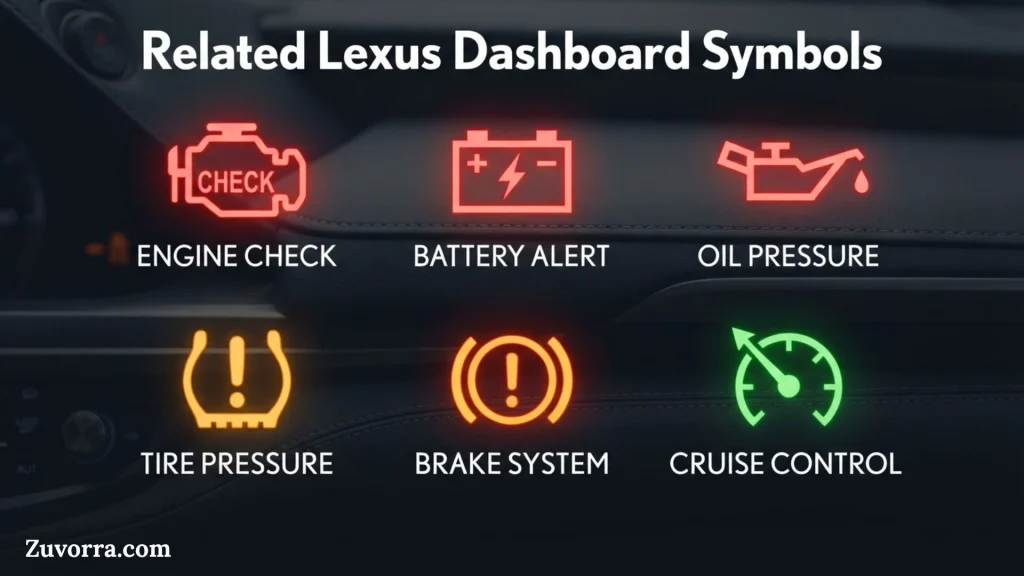
ABS Warning Light
The amber ABS symbol means the anti-lock braking system may be unavailable. It differs from the red brake warning, which may involve the basic braking system.
Slip Indicator
A vehicle with wavy lines indicates traction or stability-control activity. Flashing during wheel slip can be normal; steady illumination may indicate a fault or disabled system.
Check Engine Light
The engine-shaped lamp relates to the engine, emissions system, or powertrain controls. It does not normally use an exclamation point.
Battery or Charging-System Light
The battery icon warns of a charging-system problem. Low system voltage may also trigger other electronic warnings.
Engine Oil-Pressure Light
The oil-can symbol indicates low engine oil pressure, not merely a reminder to change the oil. A red oil-pressure warning requires an immediate safe stop.
Hybrid-System Warning
On hybrid Lexus vehicles, a warning triangle or message may relate to the hybrid drive, high-voltage system, cooling system, or control electronics.
Maintenance Required Light
This is a service reminder based on mileage or maintenance programming. It is different from a malfunction warning.
Frequently Asked Questions
Why is there an exclamation point on my Lexus dashboard?
The vehicle has detected a condition that needs attention. Identify the shape surrounding the mark and read the multi-information display. A tire outline means low pressure, a triangle is a master warning, a circle commonly relates to the brakes, and a steering-wheel icon points to steering assistance.
What does the yellow horseshoe with an exclamation point mean?
It is the tire-pressure monitoring warning. At least one tire may be significantly underinflated. Inspect the tires for damage and measure their cold pressure with a gauge. Inflate them to the specification printed on the driver-side doorjamb label, not the maximum figure on the tire sidewall.
Why is my tire-pressure light on when the tires look normal?
A tire can be significantly underinflated without appearing visibly flat. Temperature changes may also lower pressure enough to trigger the system. Check every tire with an accurate gauge. A slow puncture, valve leak, sensor fault, or recent wheel change may also explain the warning.
What does a flashing tire-pressure light mean on a Lexus?
A flashing light that later stays illuminated usually indicates a TPMS malfunction. The vehicle may not be receiving valid information from one or more wheel sensors. Check pressures manually and have the sensors, batteries, wheel equipment, and programming inspected.
Can I drive with the triangle and exclamation point on?
That depends on the accompanying message. A master warning triangle may identify a minor condition or a serious malfunction. Read the display immediately. If it says to stop, if the triangle is red, or if the vehicle behaves abnormally, pull over safely and seek assistance.
What does a red circle with an exclamation point mean?
It normally relates to the brake system or parking brake. Make sure the parking brake is fully released. If the light remains on, the brake fluid may be low or a brake-system fault may exist. Stop driving if braking feels unusual or a stop warning appears.
Why did the steering-wheel exclamation light come on?
The electric power-steering system may have overheated or detected low voltage, a sensor fault, or another malfunction. Steering may require more effort. Stop safely if the wheel becomes heavy, jerky, or difficult to control, especially when the symbol is red.
How do I reset a Lexus tire-pressure warning?
First set every tire to the correct cold pressure and repair any leaks. Some models clear the light automatically after driving, while others require initialization through a button or vehicle-setting menu. Follow the exact procedure in your model’s owner’s manual.
Why did several Lexus warning lights appear at once?
Multiple lights can share a cause, such as low 12-volt battery voltage, a charging fault, damaged wiring, wheel-speed sensor trouble, or communication loss between control modules. Do not assume every system failed separately. Read all messages and arrange diagnosis if the lights remain on.
When should I call for roadside assistance?
Call for assistance when a red warning remains on, the display says to stop, a tire is visibly flat or damaged, braking feels abnormal, steering becomes difficult, fluid is leaking, or the vehicle handles unpredictably. Avoid driving when safe control cannot be confirmed.
Key Takeaways
- A Lexus exclamation point has no single universal meaning.
- The surrounding shape identifies the affected system.
- A tire outline usually means low pressure or a TPMS fault.
- A triangle is a master warning that requires you to read the display.
- A red circle commonly indicates a brake or parking-brake warning.
- A steering-wheel icon can mean reduced electric steering assistance.
- Red warnings deserve immediate attention.
- Amber warnings should be checked promptly.
- Flashing and steady lights may communicate different faults.
- The driver-side doorjamb label provides the correct cold tire pressure.
- Never reset a warning before correcting its cause.
- Consult the owner’s manual for your exact Lexus model and year.
Conclusion
A Lexus dashboard symbol with an exclamation point is designed to make you pause, identify the affected system, and respond before the condition becomes more serious. The icon’s shape, color, flashing pattern, accompanying message, and changes in vehicle behavior reveal its true meaning.
A tire-shaped warning often calls for a pressure check. A triangle directs you to another message. A brake circle may require an immediate stop, while a steering-wheel warning can mean steering assistance is limited.
Understanding these differences turns a confusing dashboard light into a useful safety message. When uncertainty remains, follow the exact Lexus owner’s manual and have the vehicle inspected rather than guessing.
References
- Lexus, Manuals & Resources, owner-information and dashboard-warning resources.
- National Highway Traffic Safety Administration, TireWise: Tire Safety and Tire Pressure Monitoring Systems.
- Lexus Newsroom, Six Tips for Avoiding Pothole Damage While Driving, tire-pressure and underinflation guidance.
- Lexus Newsroom, 2016 Lexus GS F Performance Sedan, tire-pressure monitoring and individual tire-pressure display information.

I’m Felix Everard, a British writer passionate about the fascinating world of symbols and visual communication. I explore traditional, cultural, historical, and modern symbols, focusing on what they represent and why they matter. Through accessible explanations, I hope to help readers recognise the meanings hidden within familiar signs, shapes, and images.
Books:
- The Complete Guide to Symbolism
- Decoding Signs and Symbols