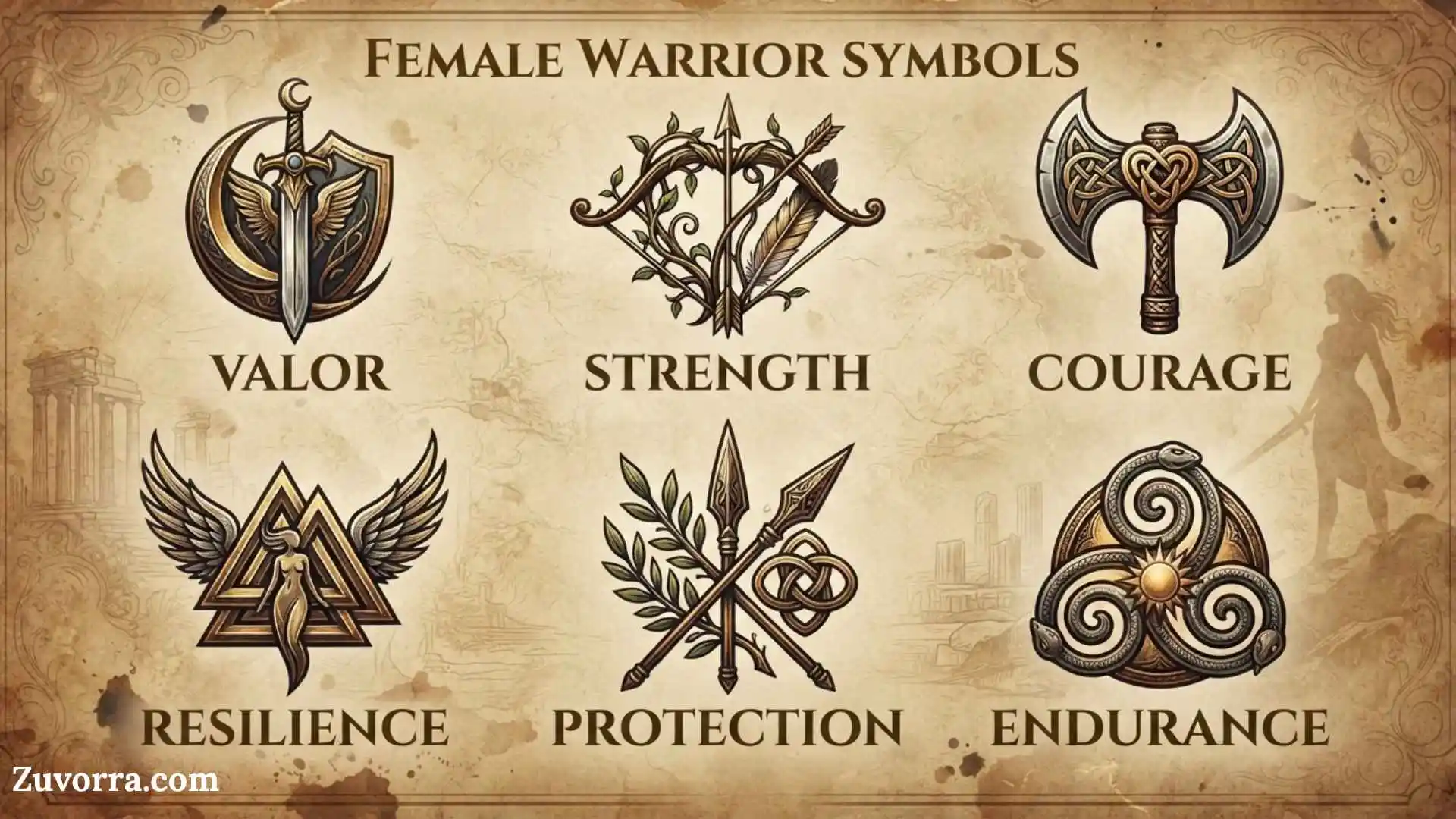
Female warrior symbols represent courage, protection, strategic power, resistance, justice, and the strength to defend others. There is no single universal emblem for a female warrior. Instead, cultures have expressed this idea through warrior goddesses, legendary heroines, weapons, animals, armor, and sacred objects.
You may encounter female warrior symbols in ancient sculpture, religious art, mythology, military history, novels, movies, jewelry, tattoos, and modern logos. Understanding their origins matters because a helmeted goddess, a Valkyrie, a lion-riding deity, and a crossed sword design do not carry exactly the same message. Each reflects a different culture’s ideas about courage, duty, femininity, and power.
Quick Meaning
Female warrior symbols generally represent bravery, protection, independence, leadership, disciplined strength, and resistance against injustice. Common examples include Athena’s helmet and shield, Durga’s lion and weapons, Valkyrie wings, the Amazon bow, crossed swords, armor, shields, spears, and powerful animals such as lions, wolves, and falcons.
Female Warrior Symbol Overview
| Symbol or Figure | Primary Meaning | Cultural Origin | Common Attributes | Modern Interpretation |
| Athena | Wisdom and strategic warfare | Ancient Greece | Helmet, spear, shield, aegis, owl | Intelligent leadership and controlled strength |
| Durga | Divine protection and victory over evil | Hindu traditions of South Asia | Lion or tiger, multiple arms, sacred weapons | Fearlessness, protection, righteous power |
| Valkyrie | Courage, destiny, and honored warriors | Norse tradition | Armor, spear, horse, winged imagery | Bold independence and heroic purpose |
| Amazon warrior | Female independence and martial ability | Ancient Greek literature and art | Bow, spear, shield, horse | Defiance of gender limits |
| Shield | Defense, boundaries, and guardianship | Many cultures | Round or oval protective armor | Emotional strength and protection |
| Sword | Justice, decisive action, and authority | Many cultures | Single blade or crossed blades | Courage and readiness to act |
| Spear | Focus, defense, and forward movement | Ancient global traditions | Long shaft and pointed head | Determination and direct purpose |
| Bow and arrow | Precision, patience, and skill | Many cultures | Drawn bow, arrow, quiver | Focused ambition and self-reliance |
| Lion or lioness | Courage, command, and protective ferocity | Africa, Asia, Europe, Middle East | Mane, claws, crown, solar imagery | Confidence and powerful guardianship |
| Armor or helmet | Preparedness and resilience | Many military traditions | Helmet, breastplate, greaves | Survival, discipline, and inner protection |
| Flame | Unbroken spirit and transformation | Global symbolic traditions | Torch, fire, glowing ember | Passion, rebellion, and renewal |
| Wings | Freedom, elevation, and divine mission | Religious and mythological art | Feathered wings or winged helmet | Liberation and fearless aspiration |
No single Unicode character officially means “female warrior.” People sometimes combine symbols such as but these combinations are modern visual shorthand rather than ancient emblems.
What Do Female Warrior Symbols Mean?
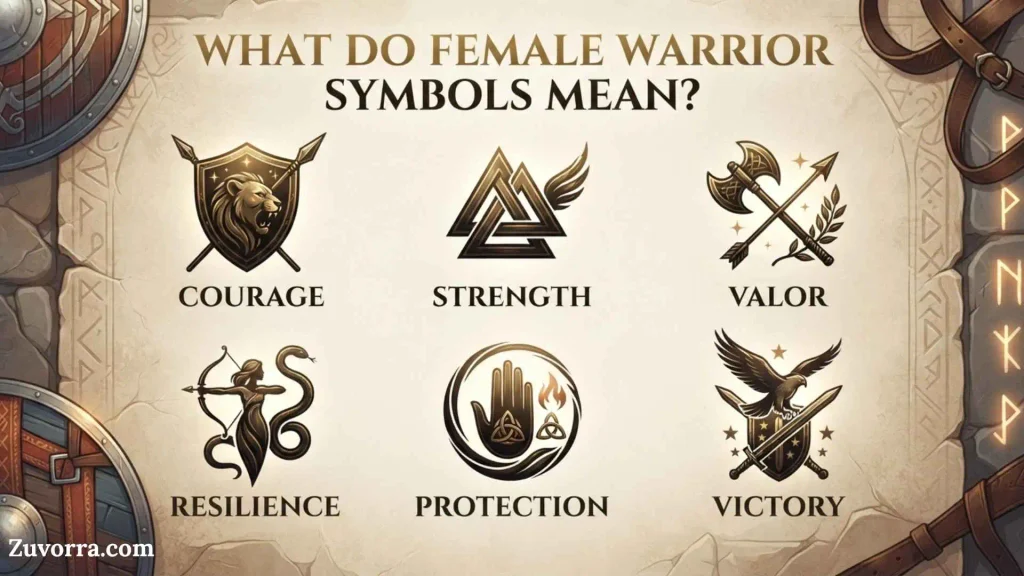
Female warrior symbols express the power to confront danger while protecting a person, community, belief, or moral principle. Their meaning is not limited to physical combat. They may also represent emotional endurance, intellectual strength, political resistance, spiritual protection, or the courage to overcome hardship.
The “warrior” element usually suggests:
- Readiness to face a challenge
- Discipline rather than uncontrolled aggression
- Protection of vulnerable people
- Loyalty to a cause or community
- Courage under pressure
- The ability to recover after defeat
The “female” element can add ideas such as creation, guardianship, intuition, motherhood, sovereignty, or independence. These associations vary widely, however. It would be inaccurate to claim that all cultures define feminine power in the same way.
In some traditions, female warriors defend cosmic order. In others, they protect a city, family, homeland, or personal freedom. Modern wearers often choose these symbols to express resilience after trauma, confidence in leadership, or resistance to restrictive expectations.
History and Origin of Female Warrior Imagery
Female warrior imagery did not begin with one civilization. It developed independently in mythology, religion, historical memory, oral tradition, and visual art.
Warrior Goddesses in the Ancient World
Ancient societies often represented war through divine figures. Some goddesses embodied strategy and civic defense, while others represented destructive force, royal authority, hunting, or protection.
Athena became one of the best-known armed goddesses of ancient Greece. Artists commonly portrayed her with a helmet, spear, shield, and the protective aegis. A Greek votive figure dated to the sixth or fifth century BCE shows an armed goddess with a helmet, shield, and spear, demonstrating how established this visual language was in antiquity.
Athena’s military character differed from uncontrolled bloodlust. She represented strategic warfare, sound judgment, skilled planning, and defense of the city. Her owl added wisdom, while her olive tree and handicraft associations showed that her identity extended beyond combat.
South Asian traditions developed another powerful model through Durga. In the Devi Mahatmya, Durga appears as a weapon-bearing warrior who fights demons threatening the stability of the universe. British Museum materials describe her as a lion-riding deity armed for a cosmic struggle.
Her many arms do not simply make her look more dangerous. They visually communicate extraordinary divine capacity. Her weapons, often received from different gods, show concentrated sacred power directed toward restoring order.
Legendary Female Fighters
Greek writers described the Amazons as a people of martial women skilled with bows, spears, horses, and shields. Whether every ancient story reflected historical reality is debated, but Amazon imagery became an enduring symbol of female military independence.
Norse literature presented Valkyries as supernatural female figures connected with battle, fate, and the selection of fallen warriors. Later European art increasingly portrayed them as armored women on horseback, sometimes adding wings or winged helmets. That familiar winged appearance is largely an artistic development rather than a single fixed description from early Norse sources.
Historical women also became symbolic figures. Boudica came to represent resistance to occupation, Joan of Arc became associated with faith and national courage, and figures such as Tomoe Gozen entered cultural memory as examples of female martial ability. Their later representations often blend documented history with legend.
Development Through Art and Literature
During the Renaissance and later European periods, artists frequently depicted Minerva, the Roman counterpart of Athena, with military attributes. One work in the Metropolitan Museum of Art associates Minerva with a helmet, shield, spear, and owl, combining armed authority with wisdom.
Nineteenth-century Romanticism strengthened the image of the heroic warrior woman. Painters, poets, and composers transformed mythological figures into symbols of nationalism, sacrifice, freedom, and destiny.
In the twentieth and twenty-first centuries, comics, fantasy novels, games, films, and television broadened the archetype. The female warrior could now be a soldier, revolutionary, survivor, superhero, archer, commander, or defender of a fictional world.
Symbolism and Interpretation
Courage
Courage is the most direct interpretation. Weapons, armor, and upright posture suggest a willingness to face danger. This does not always mean fearlessness. A warrior symbol can represent action taken despite fear.
Protection
The shield, fortress, lioness, and guardian goddess emphasize defense. These symbols are often chosen by mothers, caregivers, veterans, activists, and people who see strength as the ability to protect rather than dominate.
Strategic Intelligence
Athena’s symbols connect warrior strength with intelligence. Her spear may suggest decisive action, but the owl and aegis show planning, awareness, and controlled judgment. The combination communicates, “Think clearly before you strike.”
Independence
Amazon imagery, solitary archers, and female sword bearers often signify personal freedom. In modern contexts, they can reject the assumption that courage, authority, or physical power belongs only to men.
Justice and Resistance
A raised sword, broken chain, torch, or armored woman can represent resistance to oppression. Such designs appear in political art, protest imagery, fictional rebellion narratives, and personal tattoos.
Psychological Meaning
From a psychological perspective, the female warrior can function as an archetype of the protected self. A person may identify with it while developing boundaries, recovering confidence, or confronting a difficult period.
This is an interpretation rather than a scientific diagnosis. Symbols do not have fixed psychological effects, and their meaning depends on the individual’s experiences.
Negative Interpretations
Warrior imagery can also suggest aggression, vengeance, domination, or emotional defensiveness. A downward sword may communicate peace after conflict, while a raised or bloodied sword may imply attack.
Context changes the meaning. The same armored figure may appear heroic in one work and threatening in another.
Cultural Significance
Ancient Greece and Rome
Athena and Minerva represented armed wisdom, civic protection, craftsmanship, and state authority. Athena’s aegis, often bearing the head of Medusa, served as a protective object. The Metropolitan Museum notes that Medusa’s face commonly functioned as an apotropaic image intended to repel harmful forces.
The meaning is therefore layered. Athena’s armor signals warfare, while the aegis adds supernatural protection and deterrence.
South Asia
Durga represents divine power directed against chaos and wrongdoing. She is commonly shown riding a lion or tiger and carrying several weapons. The British Museum describes her as the conqueror of demonic asuras and notes her close association with Durga Puja.
For practicing Hindus, Durga is not merely a decorative “warrior woman.” She is a sacred deity. Using her image in fashion, tattoos, or commercial branding requires cultural and religious sensitivity.
Northern Europe
Valkyrie imagery combines war, destiny, death, honor, and passage to the afterlife. Modern culture often reduces Valkyries to generic Viking shield-maidens, but the two concepts are not identical. Valkyries are supernatural figures, while shield-maidens are presented as mortal women who fight.
East Asia
Female martial figures appear in Chinese and Japanese history, theater, folklore, and literature. Mulan often symbolizes family duty, adaptability, courage, and service. Japanese representations of women warriors may use the naginata, armor, banners, family crests, or cherry blossoms.
The cherry blossom does not inherently mean “female warrior.” When paired with armor or a blade, however, it may suggest beauty, mortality, discipline, and the brief nature of life.
Africa and the African Diaspora
African female warrior symbolism is diverse and should not be treated as one tradition. Modern imagery may reference women soldiers, queens, royal guards, ancestral power, shields, spears, or specific historical communities.
The women soldiers of Dahomey, for example, have inspired contemporary art and popular culture. Responsible representation should distinguish historical institutions from fictionalized “Amazon” imagery imposed by outsiders.
Indigenous Cultures
Indigenous nations have distinct spiritual, artistic, and military traditions. A feather, animal, geometric design, or weapon cannot be assigned one universal Indigenous meaning.
Sacred patterns, clan symbols, regalia, and ceremonial objects may have restricted uses. People should avoid copying them for tattoos or branding without understanding the specific nation, community, and cultural protocol.
Religious and Spiritual Meaning
Female warrior symbols often represent sacred protection, the defeat of chaos, moral courage, and the defense of cosmic or social order.
Durga’s battle against Mahishasura symbolizes the victory of divine power over forces that disturb dharma and universal balance. Her calm expression amid battle is significant. It suggests mastery, not panic.
Athena’s sacred role included guarding Athens and granting success in worthy ventures. A Metropolitan Museum relief depicts her in a sanctuary context wearing a helmet and aegis, showing that her military attributes also belonged to worship and civic devotion.
Joan of Arc imagery carries Christian associations with faith, obedience, sacrifice, and courage. However, Joan herself is a historical saint, not an interchangeable symbol for every spiritual warrior tradition.
Modern spiritual users sometimes describe the warrior woman as an image of inner strength or protective energy. Such language reflects contemporary personal spirituality and should not be confused with the formal beliefs of older religions.
Is There a Scientific or Technical Meaning?
There is no official scientific, mathematical, medical, or engineering symbol for “female warrior.”
The female sign, ♀, originated as an astronomical and alchemical symbol associated with Venus and later became widely used to represent the female sex or gender. Crossed swords, ⚔, indicate combat or battle in modern iconography. Combining ♀ and ⚔ can communicate “female fighter,” but the combination has no standardized technical definition.
In digital design, meaning comes from composition:
- ♀ + shield: female protection or advocacy
- ♀ + sword: female courage or militancy
- Helmet + laurel: victory and leadership
- Bow + moon: independent huntress imagery
- Lioness + crown: feminine authority and command
Designers should test these combinations because audiences may interpret them differently across cultures.
Where Female Warrior Symbols Are Used
Tattoos
Tattoos may feature Athena, Durga, Valkyries, Amazons, swords, shields, bows, lionesses, ravens, or armored women. People often choose them to mark survival, independence, military service, motherhood, or personal transformation.
Jewelry
Sword pendants, shield charms, spear shapes, winged helmets, and goddess medallions communicate strength in a compact form. Sacred deity images deserve respectful placement and handling.
Literature and Film
Female warriors appear in epics, fantasy, historical fiction, superhero stories, and dystopian narratives. Their weapons often reveal personality. A shield suggests guardianship, a bow suggests patience, and a sword suggests direct confrontation.
Logos and Organizations
Sports teams, fitness brands, advocacy groups, martial arts schools, and gaming communities use warrior women to suggest discipline, confidence, endurance, or competitive strength.
Art and Architecture
Athena and Minerva appear in civic buildings, monuments, universities, libraries, government art, and military memorials. In these settings, they frequently symbolize disciplined reason, defense, learning, and public authority.
Common Variations and Their Meanings
| Variation | Typical Interpretation |
| Armored woman with shield | Defender, guardian, survivor |
| Woman holding a raised sword | Readiness, resistance, active justice |
| Woman with lowered sword | Victory, restraint, peace after struggle |
| Female archer | Precision, patience, independence |
| Winged warrior | Freedom, destiny, divine mission |
| Lion-riding goddess | Sacred courage and command over destructive power |
| Woman with wolf | Loyalty, instinct, endurance |
| Crowned warrior queen | Sovereignty and leadership |
| Broken sword | End of conflict, loss, or rejected violence |
| Sword with flowers | Strength balanced by compassion or beauty |
| Warrior with moon imagery | Intuition, cycles, mystery, or feminine spirituality |
| Helmet with owl | Strategy, vigilance, and wisdom |
A Simple Guide to Choosing a Symbol
What quality do you want to express?
↓
Protection
Choose a shield, lioness, armor, or guardian figure.
↓
Strategic strength
Choose Athena, an owl with a helmet, or a spear-and-shield design.
↓
Spiritual victory over evil
Study Durga’s religious meaning and use her image respectfully.
↓
Freedom and independence
Choose an Amazon archer, winged warrior, horse, or broken chain.
↓
Resilience after hardship
Choose repaired armor, a lowered sword, a flame, or a warrior rising.
↓
Justice and direct action
Choose a balanced sword, upright spear, or warrior holding scales.
Before selecting a culturally specific image, learn its original meaning and decide whether a universal symbol would express your idea more respectfully.
Common Misconceptions
There Is One Ancient Female Warrior Symbol
No universal emblem exists. “Female warrior symbols” is a modern umbrella term covering many figures and objects from unrelated traditions.
Every Armed Goddess Means the Same Thing
Athena, Durga, Bellona, Sekhmet, and other powerful goddesses have distinct religions, stories, attributes, and functions. They should not be blended into a generic warrior-goddess identity.
Valkyries and Shield-Maidens Are Identical
Valkyries are supernatural beings connected with battle fate and the dead. Shield-maidens are portrayed as mortal women warriors. Modern art often combines their visual features.
Medusa Is Simply a Warrior Symbol
Medusa was not traditionally a female warrior in the same sense as Athena. Her severed head became a protective image on shields, armor, buildings, and objects. Modern interpretations may recast her as a symbol of survival or resistance, but that is not her only historical meaning.
A Sword Always Means Violence
A sword may represent justice, truth, authority, sacrifice, defense, or the ability to make difficult decisions. Its position and surrounding imagery matter.
All Warrior Imagery Is Empowering
Some symbols may be connected to conquest, death, religious conflict, nationalism, or commercial stereotypes. Research is essential before using unfamiliar imagery.
Interesting Facts About Female Warrior Symbols
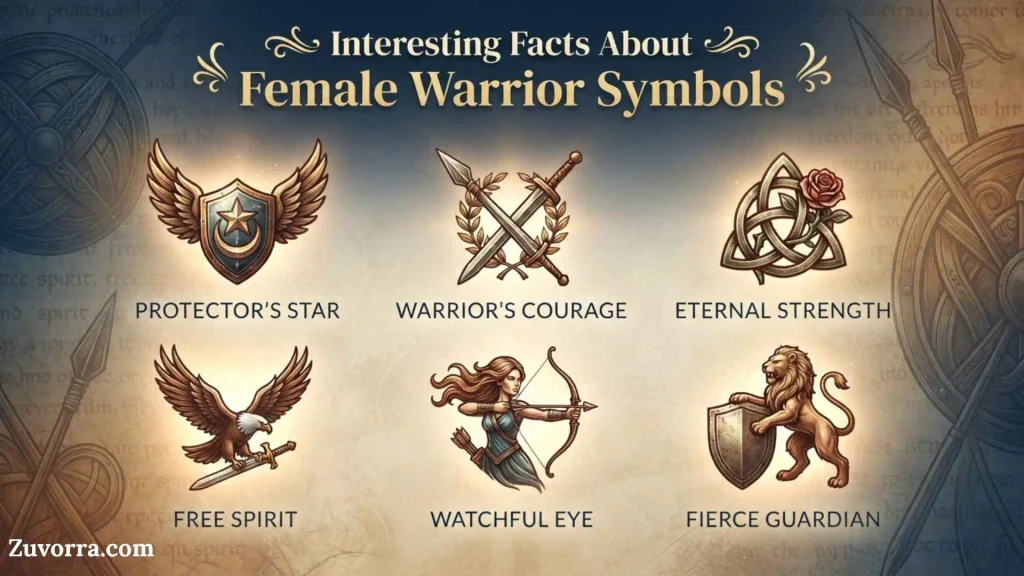
- Athena’s protection was both physical and intellectual. Her helmet and shield represent defense, while her owl connects military power with wisdom.
- Durga’s many weapons express united divine power. They show that her victory comes through multiple sacred abilities rather than ordinary physical force.
- A lion can symbolize controlled power. When a goddess rides a lion, the image may suggest mastery over dangerous force instead of simple aggression.
- The familiar winged Valkyrie is partly a modern artistic convention. Opera, painting, costume design, and film helped popularize the winged-helmet appearance.
- Flowers can change the meaning of weapons. A sword wrapped in roses may symbolize strength with love, while a blade surrounded by thorns may suggest painful resilience.
- Weapon position acts like visual grammar. A raised weapon implies action, a guarded weapon suggests readiness, and a lowered weapon can imply restraint or completed struggle.
- The shield often communicates boundaries. In modern personal symbolism, it can represent emotional self-protection as much as defense in battle.
- Female archers often symbolize self-command. Drawing a bow requires patience, controlled tension, focus, and correct timing.
- Medusa’s face once appeared on protective objects. Her frightening gaze was used to repel danger, making the image defensive as well as fearsome.
- Warrior women do not always reject femininity. Many artworks intentionally combine armor with jewelry, flowing fabric, motherhood, beauty, or sacred grace.
- Historical and mythological figures frequently overlap in popular memory. Films and novels may turn real women into archetypes, sometimes simplifying complex lives.
- Modern symbols are often hybrids. A tattoo may combine a Greek helmet, Norse wings, Japanese flowers, and a modern feminist sign, even though those elements did not historically belong together.
Related Symbols
Athena’s Owl
The owl emphasizes intelligence, vigilance, and strategic awareness. It differs from a sword because it represents perception rather than direct action.
The Aegis
Athena’s aegis is a protective garment or shield-like attribute commonly bearing the Gorgon’s head. It represents divine defense and fearsome deterrence.
Lioness
The lioness symbolizes protective ferocity, cooperation, hunting skill, and maternal defense. It is less militaristic than crossed swords.
Valkyrie Wings
Wings suggest supernatural purpose, freedom, transcendence, and movement between worlds. They differ from ordinary armor because they emphasize destiny rather than defense.
Bow and Arrow
The bow represents patience and preparation. The arrow represents direction and committed action once released.
Broken Chain
A broken chain symbolizes liberation from oppression, fear, control, or limiting expectations. It focuses on freedom rather than combat.
Torch or Flame
A torch represents knowledge, hope, revolution, transformation, and an unconquered spirit. It may suit people who want strength imagery without a weapon.
Crown
A crown adds sovereignty, self-rule, victory, or command. Paired with a warrior, it creates the image of a warrior queen rather than a soldier.
Frequently Asked Questions
What is the main symbol of a female warrior?
There is no official universal symbol. A woman carrying a shield and sword is the clearest general image. Athena represents strategic strength, Durga represents sacred protection and victory over evil, while Valkyries and Amazons express destiny, courage, independence, or martial ability within their own traditions.
What symbol represents a strong warrior woman?
A shield paired with a spear or sword is a widely understood choice. It represents protection, readiness, courage, and leadership without belonging exclusively to one religion. A lioness, armored woman, female archer, or flame can also express strength with less emphasis on physical combat.
Which goddess is the best-known female warrior symbol?
Athena and Durga are among the best-known, but their meanings differ. Athena represents wisdom, strategy, skilled warfare, and civic defense. Durga represents divine power, protection, and the defeat of forces that threaten cosmic order. Neither should be treated as a generic decorative figure.
What does a female warrior tattoo mean?
A female warrior tattoo may express survival, protection, self-respect, military service, independence, leadership, or victory over hardship. Its exact meaning depends on the figure, weapon, posture, animals, flowers, and cultural references included in the design.
What symbolizes a woman who never gives up?
A standing warrior with damaged but intact armor strongly communicates perseverance. Other choices include a flame, phoenix, lioness, unbroken spear, repaired shield, or woman rising after battle. These designs focus on endurance rather than domination.
Can a sword symbolize feminine strength?
Yes. A sword can represent justice, truth, authority, boundaries, decisive action, and the courage to confront difficulty. Adding flowers, a moon, a female sign, or a protective shield may create a more specific design, although none of those combinations has one fixed historical definition.
Is Athena a symbol of female empowerment?
Athena is often interpreted that way today because she combines intelligence, authority, military skill, craftsmanship, and independence. Historically, however, she belonged to ancient Greek religion and civic identity. Modern empowerment is a valid contemporary interpretation, but it should not replace her original cultural context.
Is Durga appropriate as a tattoo?
Durga is a sacred Hindu goddess rather than a general symbol of female toughness. Anyone considering her image should understand its religious importance, avoid disrespectful placement, and consult knowledgeable Hindu sources or community members. A universal lioness, shield, or warrior silhouette may be more appropriate when religious devotion is not intended.
What does a warrior woman with a lion mean?
The combination usually suggests courage, command, guardianship, and mastery of immense power. In a Hindu context, a goddess riding a lion may specifically represent Durga and carry sacred meaning. Outside that context, a lioness beside a warrior may symbolize leadership or protective ferocity.
What is a good nonviolent female warrior symbol?
A shield, owl, torch, laurel wreath, lioness, wings, or repaired armor can represent warrior strength without glorifying attack. These symbols emphasize protection, wisdom, resilience, freedom, victory, and moral courage rather than the act of harming an enemy.
Key Takeaways
- No single symbol universally represents every female warrior.
- Common meanings include courage, protection, leadership, independence, justice, and resilience.
- Athena symbolizes strategic intelligence and civic defense.
- Durga represents sacred protection and victory over forces that disturb cosmic order.
- Valkyries symbolize battle, destiny, honor, and the passage of selected warriors.
- Swords, shields, bows, spears, armor, flames, and lionesses offer broader alternatives.
- The posture and position of a weapon can change a design’s meaning.
- Sacred and Indigenous symbols require cultural research and respectful use.
- Modern interpretations may differ from historical or religious meanings.
- A universal emblem is often safer when no connection to a specific tradition is intended.
Conclusion
Female warrior symbols reveal that strength has never had only one form. It can appear as Athena’s careful strategy, Durga’s sacred defense, a Valkyrie’s connection with destiny, an Amazon’s independence, or a simple shield held against danger.
The most meaningful design is not always the most aggressive one. A lowered sword may show restraint. A shield may represent healthy boundaries. A lioness may express fierce protection, while a bow may symbolize patience and exact purpose.
By studying the history and cultural setting behind female warrior symbols, readers can choose imagery that reflects courage without erasing its original meaning. The result is a symbol that communicates not only power, but also responsibility, wisdom, and respect.
References
- The British Museum. “Durgā.” Collection biography and iconographic description of Durga, her lion vehicle, weapons, victory over asuras, and association with Durga Puja.
- The British Museum. Tantra: Enlightenment to Revolution. Exhibition guide discussing Durga as a weapon-wielding, lion-riding warrior in the Devi Mahatmya.
- The Metropolitan Museum of Art. “Marble Fragment of a Votive Relief with Athena.” Description of Athena’s helmet, aegis, sanctuary setting, and protective role.
- The Metropolitan Museum of Art. “Marble Head and Torso of Athena.” Description of Athena’s helmet and Gorgon-bearing aegis.
- The Metropolitan Museum of Art. “Medusa in Ancient Greek Art.” Examination of Medusa’s head as an apotropaic image used to repel danger.
- The Metropolitan Museum of Art. “Lead Figure of a Warrior with a Helmet, Shield, and Spear.” Greek votive warrior-goddess figure dated to the sixth or fifth century BCE.

I’m Jasper Huxley, a British writer fascinated by the symbols that communicate ideas without words. I explore their meanings, origins, cultural connections, and everyday uses. From ancient markings to contemporary signs, I enjoy uncovering the stories behind visual language and presenting symbolism in a clear, engaging way for curious readers worldwide.
Books:
- The Hidden Language of Symbols
- Symbols, Signs and Their Meanings