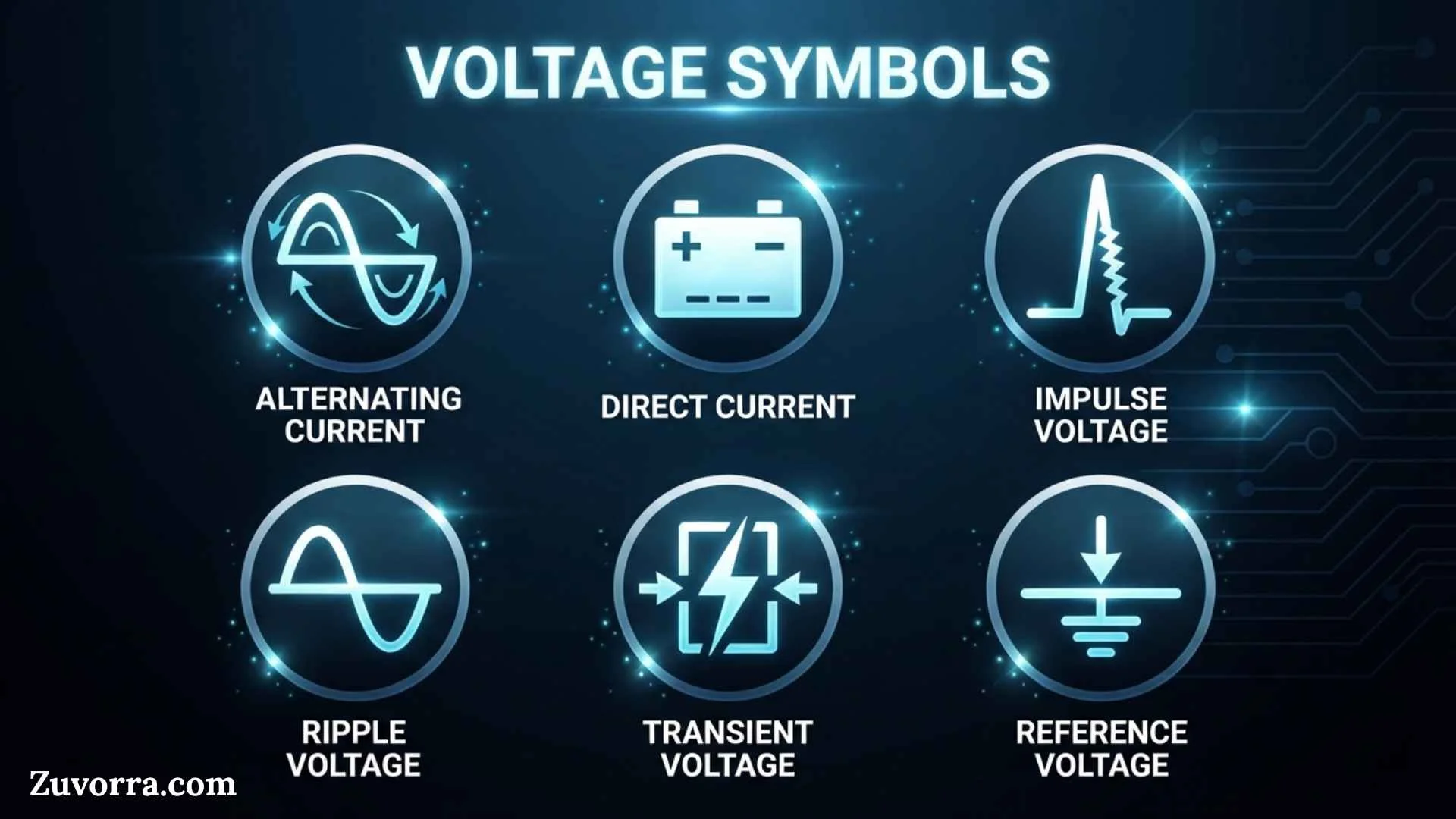
Voltage symbols identify electrical potential difference, show how voltage behaves, and warn people about energized equipment. You may see them in circuit diagrams, multimeters, electrical formulas, appliance labels, batteries, power supplies, vehicles, and high-voltage warning signs.
The most important distinction is simple: V usually represents the unit volt, while U, V, or E may represent the voltage quantity, depending on the standard and context. Other markings, such as V~, V⎓, +, −, and the lightning-bolt triangle, describe alternating voltage, direct voltage, polarity, or electrical danger.
Quick Meaning
Voltage symbols are letters, lines, polarity marks, and safety icons used to represent electrical potential difference. V is the SI symbol for the volt. U commonly represents voltage in international technical standards, while V often represents voltage in English-language formulas. Symbols such as V~, V⎓, +, and − identify voltage type and polarity.
Voltage Symbol Overview Table
| Symbol or Marking | Primary Meaning | Category | Common Usage |
| V | Volt, the SI unit of voltage | Unit symbol | Ratings, measurements, equipment labels |
| U | Electric potential difference or voltage | Quantity symbol | IEC documents, European engineering |
| V or v | Voltage as a quantity | Quantity symbol | Textbooks, formulas, circuit analysis |
| E or ℰ | Electromotive force | Quantity symbol | Batteries, generators, source equations |
| ΔV | Change or difference in electric potential | Mathematical notation | Physics and circuit calculations |
| V~ | Alternating voltage | Instrument marking | Multimeters and test equipment |
| V⎓ | Direct voltage | Instrument marking | Multimeters, power supplies, batteries |
| + / − | Positive and negative polarity | Polarity symbols | Batteries, DC connectors, circuit diagrams |
| VCC | Positive supply voltage associated with collectors | Circuit label | Bipolar-transistor and digital circuits |
| VDD | Positive drain-related supply voltage | Circuit label | MOSFET and CMOS circuits |
| VSS | Source-related reference or negative supply | Circuit label | CMOS and digital circuits |
| VEE | Emitter-related negative supply voltage | Circuit label | Bipolar-transistor circuits |
| ⚡ | Electricity, electrical energy, or shock hazard | General warning icon | Informal graphics and interfaces |
| Lightning bolt in a triangle | Dangerous or high voltage | Safety symbol | Enclosures, substations, industrial equipment |
What Do Voltage Symbols Mean?
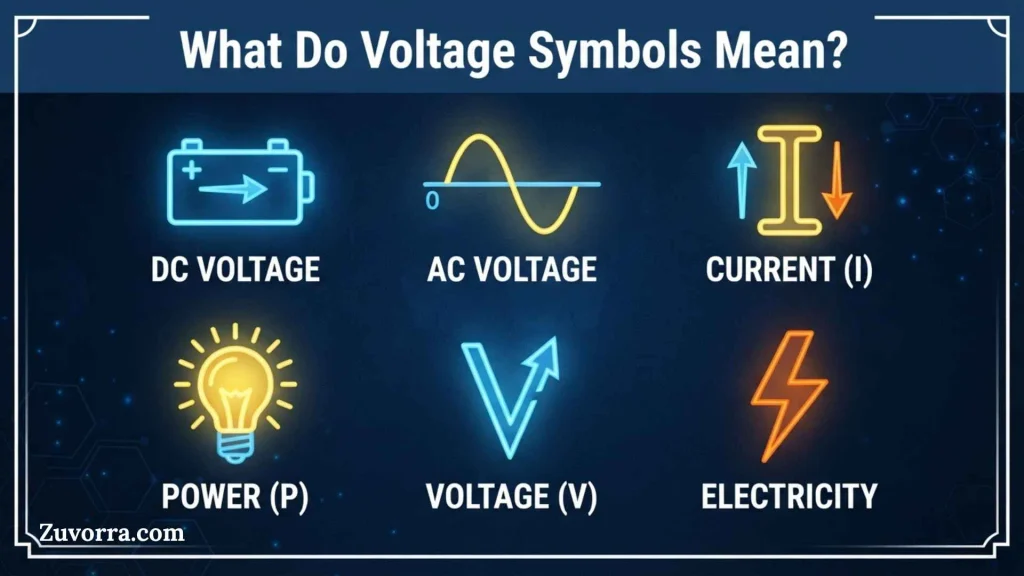
Voltage symbols describe either the electrical quantity being measured, the unit used to express it, or the type and direction of the voltage.
Voltage is the difference in electric potential between two points. It tells you how much energy is available per unit of electric charge. In the International System of Units, one volt equals one joule per coulomb. The volt can also be expressed as one watt per ampere.
A voltage reading never exists at only one isolated point. It is always measured between two points, even when one point is treated as a circuit reference or ground.
For example:
- A 1.5 V battery has about 1.5 volts between its positive and negative terminals.
- A meter reading of 12 V means the selected test points differ in potential by 12 volts.
- A label marked “230 V~” describes a nominal 230-volt alternating-voltage input.
- A power adapter marked “12 V⎓” provides approximately 12 volts of direct voltage.
The Difference Between V as a Quantity and V as a Unit
The letter V can have two jobs:
- It can be the unit symbol for the volt.
- It can represent the quantity voltage in a formula.
Context and typography usually make the meaning clear.
In:
V = 12 V
the first V means the voltage quantity, while the second V means volts. In formal technical writing, quantity symbols are normally italicized, while unit symbols remain upright. Therefore, the expression may appear as V = 12 V.
International standards often avoid this visual duplication by using U for the quantity:
U = 12 V
IEC guidance specifically gives V as the symbol for the unit volt and U as a symbol for the quantity electric tension or voltage.
History and Origin of Voltage Symbols
Modern voltage notation developed from discoveries in electricity, the creation of standardized measurement units, and the need for engineers in different countries to communicate clearly.
Alessandro Volta and the Volt
The volt is named after Italian physicist Alessandro Volta, whose work on electricity led to the development of the voltaic pile around 1800. The pile was an early source of continuous electric current and helped scientists study electrical circuits more systematically.
Like other SI units named after people, the written unit name volt begins with a lowercase letter, while its symbol V is capitalized. NIST notes that unit names behave like ordinary lowercase nouns, but symbols derived from scientists’ names use capital letters.
Correct:
- 12 volts
- 12 V
- a 5-volt supply
Incorrect:
- 12 Volts in ordinary sentence text
- 12 v as the formal SI unit symbol
- 12 V. with a period unless it ends a sentence
Development of the Electrical Definition
Electrical units were refined as scientists connected potential difference with current, resistance, power, and energy. An established practical description defines one volt through the potential difference associated with one ampere and one watt of power. The International Committee for Weights and Measures formalized this relationship in its historical resolutions.
Today, the volt is an SI derived unit:
1 V = 1 W/A = 1 J/C
It can also be written in SI base units as:
1 V = 1 kg·m²·s⁻³·A⁻¹
The BIPM and NIST publish the recognized SI definitions and notation.
Why U and V Both Became Common
English-language education often uses V as the variable for voltage because it is intuitive. However, this creates possible confusion because V is also the unit symbol.
International electrotechnical practice commonly uses U for electric potential difference. IEC 80000-6 provides standardized names, symbols, and definitions for electromagnetic quantities and units.
As a result, both of these equations may be correct:
- V = IR
- U = RI
They express the same physical relationship but follow different notation traditions.
Symbolism and Interpretation
Voltage symbols are mainly technical rather than cultural, but their visual forms still communicate ideas such as energy, force, direction, difference, and danger.
Difference and Electrical “Pressure”
Voltage is often compared with pressure in a water system. The comparison is imperfect, but it helps beginners understand why a potential difference can drive current through a conductive path.
In this interpretation:
- Voltage represents the available electrical push.
- Current represents the movement of charge.
- Resistance limits that movement.
This is why voltage is sometimes informally called electrical pressure. In precise physics, however, voltage means electric potential difference, not a mechanical pushing force.
Positive Symbolism
In advertising, technology, and popular design, a lightning bolt or voltage motif may suggest:
- Energy
- Speed
- Power
- Excitement
- Innovation
- Rapid action
- High performance
Technology companies, sports brands, battery products, and electric-vehicle services often use bolt-like graphics because people quickly associate them with electricity.
Negative or Cautionary Meaning
The same imagery may indicate:
- Electric shock
- Dangerous equipment
- High-energy circuits
- Arc-flash risk
- Fire or equipment damage
- Restricted access
A lightning bolt on a brand logo is decorative. A lightning bolt inside a recognized warning shape on electrical equipment may communicate a serious hazard. The setting determines the meaning.
Psychological Interpretation
Sharp angles and zigzag lines create a sense of motion and intensity. A lightning-bolt shape appears sudden and unstable, so viewers often interpret it as energetic, urgent, or dangerous.
This is a design interpretation rather than an electrical definition. Technical voltage symbols should always be read according to standards, instrument labels, and circuit documentation.
Cultural and Regional Significance
Voltage itself has no ancient cultural symbol system. Its notation belongs to modern science and engineering. Regional differences mainly come from technical education and standardization practices.
North American Usage
In the United States and Canada, V is widely used as both the symbol for voltage in equations and the symbol for volts after a number.
A textbook may write:
V = IR
A product label may write:
120 V
The reader determines the meaning from its position.
European and IEC-Based Usage
European engineering documents frequently use U for voltage:
U = RI
This approach aligns with IEC notation and helps separate the quantity symbol from the unit symbol V.
German, Dutch, French, Scandinavian, and other European technical materials may therefore use U where an American textbook would use V.
International Equipment Labels
Products sold across countries often depend on standardized graphical markings rather than long written explanations. This is why multimeters and power supplies use compact combinations such as:
- V~
- V⎓
- mV
- kV
- and −
These markings reduce language barriers, but users still need to understand measurement categories, safe meter settings, and equipment limits.
Scientific and Technical Meaning
Voltage symbols play several distinct roles in physics, electrical engineering, electronics, power systems, and measurement.
Voltage in Physics
Electric potential difference between two points can be written as:
ΔV = ΔE/q
where:
- ΔV is the potential difference
- ΔE is the change in electric potential energy
- q is electric charge
This equation shows why one volt equals one joule per coulomb.
The delta symbol Δ means “change in” or “difference between.” Therefore, ΔV is especially useful when comparing the potential at two locations.
Voltage in Ohm’s Law
Ohm’s law relates voltage, current, and resistance:
V = IR
or, in IEC-style quantity notation:
U = RI
where:
- V or U = voltage
- I = electric current
- R = resistance
For example, if a 10-ohm resistor carries 2 amperes:
V = 2 A × 10 Ω = 20 V
NIST uses the familiar form I = V/R when explaining the relationship among current, voltage, and resistance.
E for Electromotive Force
The symbol E, e, or script ℰ may represent electromotive force, commonly shortened to emf.
Despite its name, electromotive force is not a mechanical force. It is energy supplied per unit charge by a source such as:
- A battery
- A generator
- A solar cell
- A thermocouple
Both electromotive force and potential difference are measured in volts, but they describe slightly different concepts. EMF refers to energy supplied by a source, while terminal voltage is the measured potential difference between terminals.
A real battery may have an emf of 1.5 V but a slightly lower terminal voltage while delivering current because of internal resistance.
Direct-Voltage Symbol
The direct-voltage marking commonly combines a solid horizontal line with a dashed or broken line beneath it:
V⎓
It indicates a voltage whose polarity does not periodically reverse. Batteries, USB power, many electronic circuits, and DC power adapters use direct voltage.
The symbol should not be confused with a decorative equals sign. On a meter, it identifies the DC-voltage measurement mode.
Alternating-Voltage Symbol
The tilde or sine-wave-like mark indicates alternating voltage:
V~
Alternating voltage changes magnitude and reverses polarity over time. Household electrical supplies and power distribution systems commonly use AC.
On a multimeter:
- Select V~ for an AC outlet.
- Select V⎓ for a battery or DC adapter.
Using the wrong mode may produce an incorrect or misleading reading.
Instantaneous, Average, Peak, and RMS Voltage
Engineers add subscripts or formatting to show which voltage value they mean:
| Symbol | Meaning |
| v(t) | Instantaneous voltage as a function of time |
| Vavg | Average voltage |
| Vrms | Root-mean-square voltage |
| Vpeak or Vp | Peak voltage |
| Vpp | Peak-to-peak voltage |
| Vmax | Maximum voltage |
| Vmin | Minimum voltage |
| Vnom | Nominal voltage |
| Vrated | Rated voltage |
For a pure sine wave:
Vrms = Vpeak/√2
This matters because an AC supply labeled 120 V or 230 V usually states an RMS value, not its instantaneous peak.
Subscripted Circuit Voltages
Subscripts identify the two points between which voltage is measured.
Examples include:
- VAB: voltage at point A relative to point B
- VBE: base-to-emitter voltage
- VCE: collector-to-emitter voltage
- VGS: gate-to-source voltage
- VDS: drain-to-source voltage
- VIN: input voltage
- VOUT: output voltage
- VBAT: battery voltage
- VREF: reference voltage
The order matters:
VAB = VA − VB
Therefore:
VBA = −VAB
Supply-Rail Symbols
Electronic schematics use labels such as VCC, VDD, VSS, and VEE.
Historically:
- VCC related to collector supply in behavior-transistor circuits.
- VEE related to emitter supply.
- VDD related to drain supply in field-effect transistor circuits.
- VSS related to source supply.
Modern designers often use these labels more broadly. VCC or VDD may simply identify a positive supply rail, while VSS may identify the reference or ground rail. Always check the schematic rather than assuming an exact voltage.
Metric Prefixes Used with V
The volt symbol combines with SI prefixes:
| Symbol | Name | Value |
| µV | Microvolt | 0.000001 V |
| mV | Millivolt | 0.001 V |
| V | Volt | 1 V |
| kV | Kilovolt | 1,000 V |
| MV | Megavolt | 1,000,000 V |
| GV | Gigavolt | 1,000,000,000 V |
Capitalization matters. mV means millivolts, while MV means megavolts, a difference of one billion times.
Where Voltage Symbols Are Used
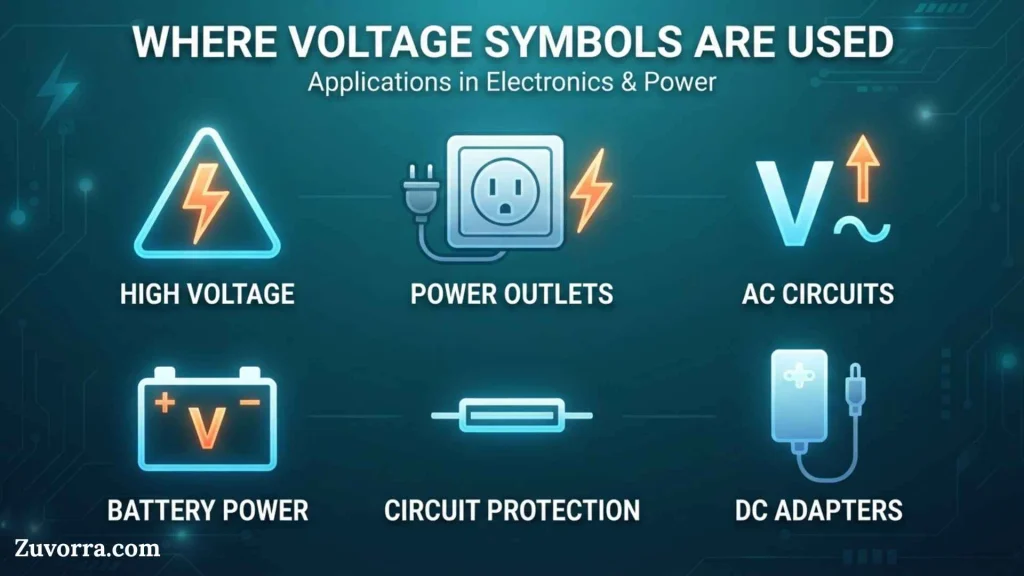
Voltage notation appears anywhere electrical energy must be measured, controlled, documented, or treated safely.
Circuit Diagrams
Schematics label supply rails, component voltage drops, test points, signal levels, and polarity. Arrows or plus-and-minus marks may define the reference direction for a voltage.
Multimeters
Digital and analog meters use V~, V⎓, mV, and range values. Some models automatically detect AC or DC, while others require manual selection.
Before measuring, the user must also confirm:
- The leads are in the correct sockets.
- The meter is rated for the circuit.
- The selected mode is appropriate.
- The probe insulation is undamaged.
Batteries and Power Adapters
Batteries show nominal voltage and terminal polarity. Adapters normally list input and output values, such as:
Input: 100–240 V~, 50/60 Hz
Output: 12 V⎓, 2 A
A DC barrel connector may also show a polarity diagram indicating whether the center pin is positive or negative.
Appliances and Electronics
Equipment labels show rated input voltage, frequency, current, and power. Supplying the wrong voltage can cause failure, overheating, or fire.
Automotive Systems
Vehicles use labels such as 12 V, 24 V, HV, V-BAT, and warning icons. Electric and hybrid vehicles contain high-voltage systems that require specialized isolation procedures and protective equipment.
Power Networks
Power engineering uses terms such as low voltage, medium voltage, high voltage, nominal voltage, phase-to-phase voltage, and phase-to-neutral voltage. Exact classifications depend on the governing standard and application.
IEC 60038 specifies standardized supply-system voltage values used as preferred nominal and reference values for system and equipment design.
Laboratories and Technical Documents
Scientists and engineers use voltage symbols in equations, graphs, data sheets, test reports, oscilloscope displays, and simulation software.
Common Variations and Similar Symbols
V Versus U
Both may represent voltage as a quantity.
- Use U when following IEC-oriented notation.
- Use V when following a textbook, company, or regional style that defines V as voltage.
- Use V after a number for the SI unit volt.
E Versus V
E often means electromotive force or electric field, depending on context. V commonly means voltage or electric potential. Definitions near the formula should settle the meaning.
V~ Versus V⎓
- V~ means alternating voltage.
- V⎓ means direct voltage.
These markings identify different meter functions and should not be interchanged.
Lightning Bolt Versus Official Warning Symbol
A plain lightning bolt can be a decorative energy icon. A lightning bolt inside a safety-warning shape may indicate dangerous voltage or shock risk.
Never decide that equipment is safe merely because a particular icon is absent. Follow the label, manual, lockout procedure, and local safety rules.
Ground Is Not the Same as Zero Voltage Everywhere
Ground symbols identify a reference, protective-earth connection, chassis connection, or signal return, depending on the design.
Different ground symbols can have different functions. Two points marked “ground” are not automatically interchangeable in every system, especially in isolated, high-frequency, automotive, or industrial circuits.
A Quick Decision Guide
Are you reading a number followed by V?
↓
It means volts, the unit of measurement.
Are you reading a formula where V or U stands alone?
↓
It probably represents the voltage quantity.
Is the symbol V~?
↓
It refers to alternating voltage.
Is the symbol V⎓?
↓
It refers to direct voltage.
Do you see E or ℰ near a battery or generator?
↓
It likely means electromotive force.
Do you see + and − at two terminals?
↓
They indicate polarity or the chosen voltage reference.
Do you see a lightning bolt in a warning sign?
↓
Treat it as an electrical-hazard warning and follow the equipment’s safety instructions.
Common Misconceptions
“V Always Means Voltage”
Not always. After a number, V is the unit symbol for volts. In a formula, it may represent voltage. In other contexts, a letter V may have no electrical meaning at all.
“U and V Represent Different Electrical Quantities”
They often represent the same quantity. U is common in IEC-based notation, while V is widespread in English-language instruction and circuit analysis.
“Voltage Flows Through a Wire”
Current flows. Voltage is a difference in electric potential between points. People sometimes say voltage “travels” or “flows,” but that wording is not technically precise.
“A Zero-Volt Reading Means the Circuit Is Safe”
A zero reading may result from the wrong meter setting, poor probe contact, a damaged meter, an incorrect reference point, or an open conductor. Safe isolation requires an approved procedure, not a single casual reading.
“DC Voltage Is Always Safe”
No. Direct voltage can cause shock, burns, arcing, fire, and equipment damage. Hazard depends on voltage, available current, energy, exposure path, environment, and other conditions.
“The Plus Terminal Always Has Positive Voltage”
Voltage is relative. A terminal is positive only in relation to another chosen point. A circuit node may be positive relative to one reference and negative relative to another.
“VCC, VDD, and VSS Have Fixed Values”
These labels identify supply rails, not universal voltages. VCC could be 3.3 V, 5 V, 12 V, or another design value.
Interesting Facts About Voltage Symbols
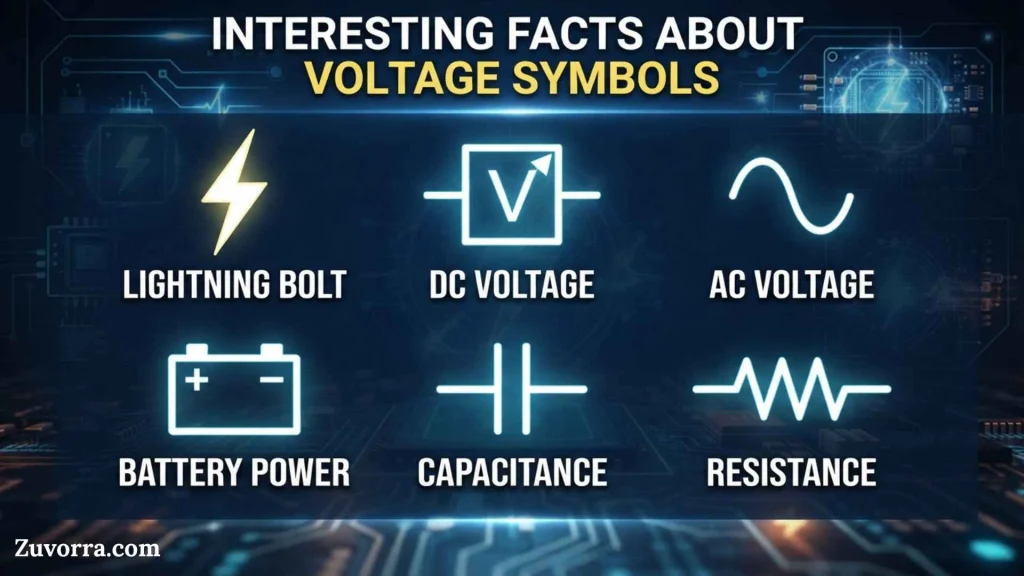
- The same letter can represent both a quantity and its unit.
V may mean voltage in an equation or volt after a number, which is why typography and context matter. - U reduces ambiguity.
IEC-based notation often uses U for the quantity so that V remains clearly reserved for the unit volt. - The volt’s name and symbol follow different capitalization rules.
Write “volt” in lowercase but “V” in uppercase because the unit honors Alessandro Volta. - Voltage is always relational.
A node labeled 5 V is really 5 V relative to a defined reference point. - Reversing measurement leads changes the sign.
A 9 V battery may read +9 V in one probe orientation and −9 V when the probes are reversed. - The tilde carries practical meaning.
On a meter, the wavy mark identifies AC measurement, not uncertainty or approximation. - One symbol can hide different voltage values.
An AC waveform has instantaneous, peak, peak-to-peak, average, and RMS voltage values. - Capitalization can change a value dramatically.
A millivolt and a megavolt use similar-looking symbols, mV and MV, but differ by a factor of one billion. - EMF is measured in volts even though it is not a force.
The historical name remains, but electromotive force describes energy supplied per unit charge. - Supply labels preserve transistor history.
VCC, VEE, VDD, and VSS originated from transistor-terminal names and continued into modern circuit design. - A lightning bolt is not a voltage measurement symbol.
It is usually an energy or hazard icon, while V, U, and E perform the mathematical work. - Standards make international diagrams readable.
IEC quantity and unit conventions help engineers interpret technical documents across languages and regions.
Related Electrical Symbols
| Symbol | Meaning | Difference from Voltage Symbols |
| A | Ampere | Measures electric current |
| I | Current quantity | Represents charge flow in equations |
| Ω | Ohm | Unit of electrical resistance |
| R | Resistance quantity | Describes opposition to current |
| W | Watt | Unit of power |
| P | Power quantity | Rate of energy transfer |
| C | Coulomb | Unit of electric charge |
| Q or q | Electric charge | Represents an amount of charge |
| F | Farad | Unit of capacitance |
| C | Capacitance quantity | Stores charge per volt |
| Hz | Hertz | Unit of frequency |
| ⏚ and ground variants | Ground or reference connections | Identify reference, earth, chassis, or return paths |
| + / − | Polarity | Defines relative positive and negative points |
| ~ | Alternating behavior | Shows periodic reversal or an AC function |
| ⎓ | Direct behavior | Shows a steady-polarity DC function |
Frequently Asked Questions
What is the main symbol for voltage?
The answer depends on context. V is widely used for voltage in formulas, especially in English-language textbooks. U is common in IEC-oriented engineering notation. The official SI unit symbol for the volt is always uppercase V, placed after the numerical value, as in 24 V.
Why is voltage represented by U in some diagrams?
IEC-based technical notation commonly uses U for electric potential difference. This prevents confusion between the voltage quantity and the volt unit, since both might otherwise use V. Therefore, an engineer may write U = 12 V, where U is the quantity and V is the unit.
What does V~ mean on a multimeter?
V~ identifies the alternating-voltage measurement mode. It is used for signals whose polarity and magnitude vary periodically, including many household electrical supplies. The meter must also have a suitable voltage and measurement-category rating for the circuit being tested.
What does V⎓ mean on a multimeter?
V⎓ indicates direct-voltage measurement. The symbol usually contains one solid horizontal line and one dashed line. Use this mode for batteries, many power adapters, automotive circuits, USB supplies, and other sources whose polarity normally remains fixed.
What does ΔV mean?
ΔV means a change or difference in electric potential. The Greek capital letter delta indicates a difference between two values. In physics, ΔV may equal the change in electric potential energy divided by charge. In a circuit, it may describe the voltage drop across a component.
Is E another symbol for voltage?
E may represent electromotive force, especially when describing a battery, generator, or other source. It can also represent electric field strength in other equations. Because E has several technical meanings, readers should check the variable definitions and surrounding context.
What do plus and minus signs mean beside a voltage?
The signs define polarity or the reference direction of the voltage. A positive result means the first marked point is at a higher potential than the second. Reversing the points reverses the sign, even though the magnitude may remain unchanged.
What is the symbol for high voltage?
High voltage is often indicated by words, the abbreviation HV, or a standardized warning sign containing a lightning-bolt graphic. The exact sign depends on the equipment and applicable safety standard. A decorative bolt alone should not be treated as a complete technical classification.
Should there be a space between the number and V?
Yes. Standard SI style places a space between the numerical value and the unit symbol: 12 V, not 12V. In a compound adjective written in words, a form such as “a 12-volt battery” is acceptable.
Are voltage and electric potential the same?
They are closely related but not always used identically. Electric potential describes potential energy per unit charge at a point relative to a reference. Voltage usually describes the difference in electric potential between two points. Both are measured in volts.
Key Takeaways
- V is the official SI symbol for the volt.
- U and V can both represent voltage as a quantity.
- E or ℰ commonly represents electromotive force.
- V~ identifies alternating voltage.
- V⎓ identifies direct voltage.
- + and − establish polarity or a measurement reference.
- Voltage is measured between two points, not at an isolated point.
- Subscripts such as VBE and VGS identify the exact terminals involved.
- VCC, VDD, VSS, and VEE label supply rails rather than fixed voltage values.
- A lightning-bolt warning may indicate shock danger, not merely electrical energy.
- Correct capitalization and spacing are essential: write 12 V, 5 mV, and 2 kV.
- Always interpret symbols within the circuit, instrument, standard, and safety context.
Conclusion
Voltage symbols form a compact language for describing electrical potential, polarity, waveform type, supply rails, measurements, and hazards. The uppercase V represents the volt, while U, V, E, and ΔV may describe related electrical quantities in equations and diagrams.
Understanding the difference between V~, V⎓, polarity marks, subscripted voltages, and safety warnings makes circuit diagrams easier to read and test equipment safer to use. No voltage symbol should be interpreted in isolation. Its exact meaning comes from the surrounding formula, label, schematic, instrument mode, and technical standard.
References
- Bureau International des Poids et Mesures. The International System of Units (SI Brochure), 9th Edition. Defines the volt, symbol V, as the SI derived unit of electric potential difference.
- International Electrotechnical Commission. IEC 80000-6:2022, Quantities and Units, Part 6: Electromagnetism. Covers names, symbols, and definitions for electromagnetic quantities and units.
- International Electrotechnical Commission. ISO/IEC Directives, Part 2. Provides examples distinguishing V as the unit symbol for volt and U as a quantity symbol for voltage.
- National Institute of Standards and Technology. SI Units: Electric Current. Explains the volt, ampere, ohm, and SI capitalization conventions.
- National Institute of Standards and Technology. Quantity Calculus, Fundamental Constants, and SI Units. Expresses the volt in SI base units.
- International Electrotechnical Commission. IEC 60038:2009, IEC Standard Voltages. Specifies preferred nominal voltage values for electrical supply systems.

I’m Jasper Huxley, a British writer fascinated by the symbols that communicate ideas without words. I explore their meanings, origins, cultural connections, and everyday uses. From ancient markings to contemporary signs, I enjoy uncovering the stories behind visual language and presenting symbolism in a clear, engaging way for curious readers worldwide.
Books:
- The Hidden Language of Symbols
- Symbols, Signs and Their Meanings