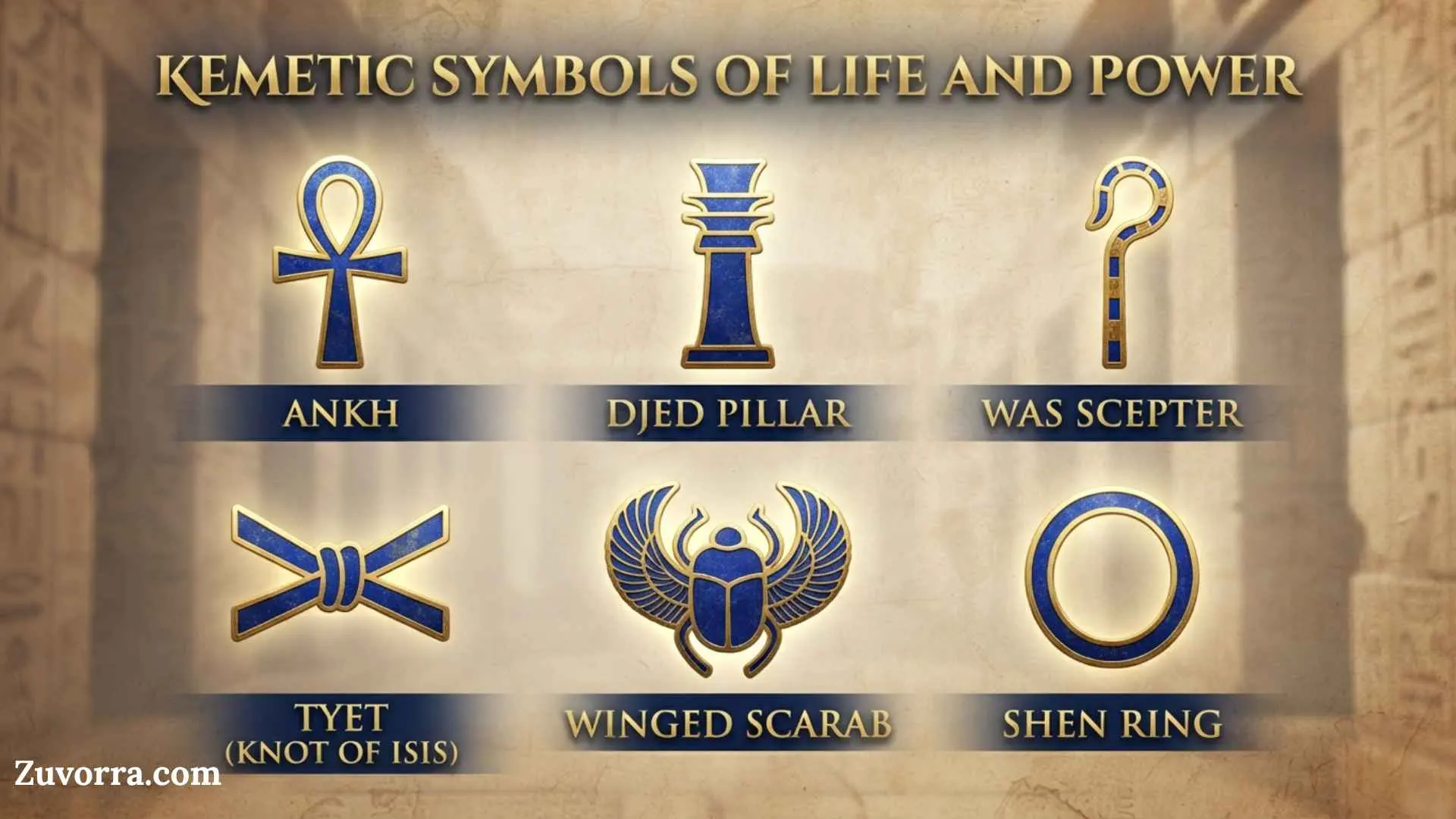
Kemetic symbols are sacred signs, images, hieroglyphs, and ritual objects associated with Kemet, the ancient Egyptian name for Egypt. They express ideas such as life, divine authority, protection, rebirth, truth, stability, and the balance of the universe. You may encounter them on temple walls, coffins, papyri, statues, jewelry, tattoos, clothing, and modern spiritual artwork.
These symbols were not merely decorations. Ancient Egyptians used visual forms to communicate religious beliefs, royal power, natural cycles, and hopes for the afterlife. Understanding their original context helps separate historically supported meanings from modern interpretations.
Quick Meaning
Kemetic symbols represent the religious, social, and cosmic ideas of ancient Egypt. Common examples include the ankh for life, the wedjat eye for healing and protection, the djed pillar for stability, the was scepter for power, the scarab for renewal, and the feather of Ma’at for truth and cosmic order.
Kemetic Symbols Overview Table
| Symbol | Primary Meaning | Historical Association | Common Ancient Use | Modern Meaning |
| Ankh | Life and continued existence | Gods, kings, and the afterlife | Temple reliefs, amulets, funerary art | Life, spirituality, African heritage |
| Eye of Horus | Healing, protection, and restoration | Horus and the restored divine eye | Amulets, coffins, jewelry | Protection and spiritual awareness |
| Eye of Ra | Solar power and divine defense | Ra and powerful solar goddesses | Royal and religious imagery | Strength, vigilance, feminine power |
| Djed pillar | Stability and endurance | Osiris and resurrection | Amulets, pillars, funerary rites | Inner strength and resilience |
| Was scepter | Power, dominion, and authority | Gods and pharaohs | Temple scenes and divine imagery | Leadership and spiritual authority |
| Scarab | Renewal and transformation | Khepri and the rising sun | Seals, amulets, heart scarabs | Rebirth and personal growth |
| Feather of Ma’at | Truth, justice, and order | Ma’at and the judgment of the dead | Funerary texts and divine scenes | Integrity, balance, and fairness |
| Shen ring | Eternity and divine protection | Royal and divine guardianship | Jewelry, amulets, temple art | Wholeness and everlasting protection |
| Tyet knot | Protection and regenerative power | Isis | Funerary amulets | Feminine protection and healing |
| Lotus | Creation, rebirth, and sunlight | Creation traditions and solar gods | Art, architecture, vessels | Awakening, purity, and renewal |
| Sesen | Life emerging from darkness | Solar creation and rebirth | Temple decoration and funerary art | Enlightenment and spiritual growth |
| Crook and flail | Kingship and responsibility | Osiris and the pharaoh | Royal regalia and funerary images | Leadership, discipline, and care |
What Do Kemetic Symbols Mean?
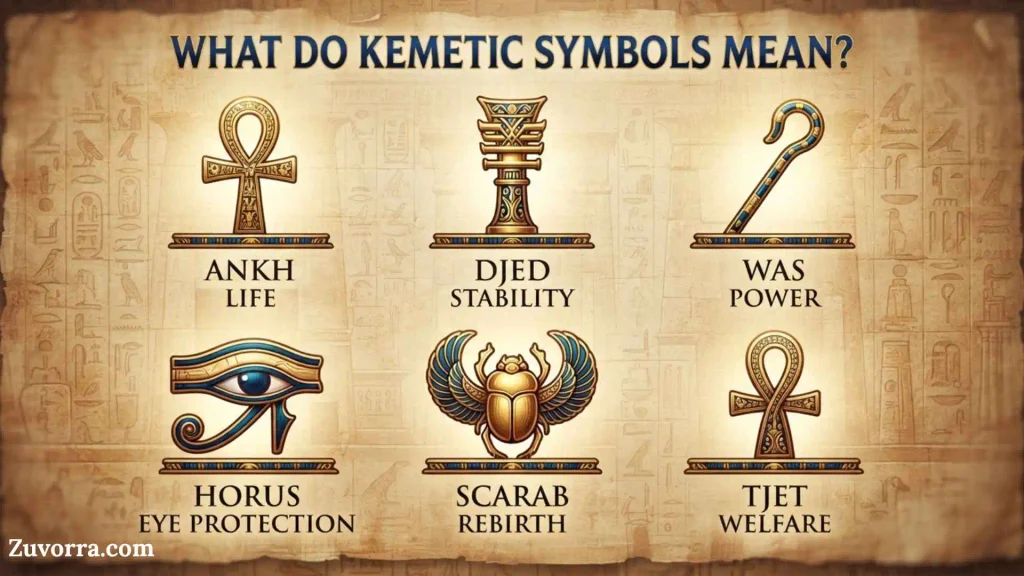
Kemetic symbols communicate the ancient Egyptian understanding of existence. Rather than separating religion, nature, government, and daily life into independent areas, Egyptians often treated them as parts of one connected cosmic system.
A symbol could therefore carry several meanings at once. The ankh represented the word “life,” but it could also suggest divine breath, continued existence, and the gift of life from a deity to a ruler. The scarab represented transformation, yet it also referred to the daily rebirth of the sun.
Many signs had both linguistic and visual functions. A hieroglyph could spell a word, determine its category, represent a sound, or act as a sacred image. When used as an amulet, the same sign could be worn or placed with the dead to provide protection.
This layered approach explains why Kemetic symbolism cannot always be reduced to one-word definitions. Meaning depended on the symbol’s location, material, color, surrounding inscription, associated deity, and ritual purpose.
History and Origin of Kemetic Symbols
Kemetic symbolism developed from the visual and religious traditions of the Nile Valley. The word Kemet, commonly translated as “the Black Land,” referred to Egypt’s fertile dark soil, in contrast with the surrounding desert, or “Red Land.”
Some early symbolic forms appeared during Egypt’s Predynastic Period, before political unification around 3100 BCE. Animals, plants, celestial bodies, royal objects, and geometric signs were used on pottery, palettes, ceremonial objects, and tomb goods.
As hieroglyphic writing developed, images gained formal linguistic functions. Birds, eyes, snakes, thrones, tools, plants, and human figures could serve as sounds, words, or conceptual markers. Their religious associations also grew through myths, temple traditions, and funerary practices.
During the Old Kingdom, symbols became closely tied to kingship and the divine order. Pyramid complexes, tomb inscriptions, and royal regalia presented the pharaoh as the guardian of Ma’at, the proper balance of society and the cosmos.
In the Middle and New Kingdoms, protective amulets became increasingly common. Ankhs, scarabs, djed pillars, wedjat eyes, and other forms appeared on the bodies of both living people and the dead. Funerary texts instructed the deceased on how to move safely through the afterlife.
Symbols continued to evolve during the Late, Ptolemaic, and Roman periods. Greek and Roman artists adopted Egyptian forms, while Egyptian religious traditions absorbed selected outside influences. The ankh, Isis knot, scarab, and other images spread throughout the Mediterranean world.
Modern interest in Kemetic symbols grew through archaeology, museum collections, African diasporic movements, Pan-African thought, popular culture, and contemporary Kemetic religious traditions.
Major Kemetic Symbols and Their Interpretations
The Ankh: Life and Continued Existence
The ankh is one of the most recognized ancient Egyptian symbols. Its hieroglyphic value means “life.” In temple scenes, deities often hold an ankh or extend it toward a king’s nose, suggesting the gift or breath of life.
The symbol also appeared in combinations expressing wishes for life, prosperity, and health. Its looped form inspired later titles such as the “key of life,” although scholars do not agree on exactly what physical object originally inspired its shape.
Today, the ankh may represent eternal life, African cultural identity, spiritual awakening, or the connection between earthly and divine existence. Historically, however, its clearest meaning was life itself.
The Eye of Horus: Healing and Restoration
The Eye of Horus, called the wedjat, symbolizes wholeness, healing, protection, and restoration. It comes from myths in which Horus loses or damages an eye during his struggle with Seth. The eye is later restored, becoming a model of healing after injury.
Wedjat-eye amulets were worn by the living and placed with the dead. The symbol could protect the body, support health, and help restore the deceased in the afterlife.
Although modern art sometimes treats every Egyptian eye as interchangeable, the Eye of Horus traditionally differs from the Eye of Ra. The former emphasizes healing and completeness, while the latter often expresses fierce solar power. The British Museum describes the wedjat as a sign associated with good health.
The Eye of Ra: Solar Power and Defense
The Eye of Ra represents the active, protective, and sometimes destructive force of the sun god Ra. It was often personified as a goddess, including Hathor, Sekhmet, Bastet, or Wadjet, depending on the myth and location.
In religious stories, the Eye could leave Ra, search for his enemies, punish rebellion, or return to restore divine order. It therefore combined protection with danger.
Modern interpretations often connect the Eye of Ra with confidence, watchfulness, feminine power, and defense. These ideas reflect genuine themes, but the historical symbol belonged to a complex group of solar myths rather than a single fixed design.
The Djed Pillar: Stability and Resurrection
The djed pillar means stability, endurance, and lasting strength. It became strongly associated with Osiris, the god connected with kingship, death, regeneration, and the afterlife.
Later Egyptian traditions sometimes interpreted the djed as the backbone of Osiris. Raising the djed was an important ritual act that symbolized the restoration of order, royal authority, and renewed life.
Djed amulets were commonly placed on mummies. Their purpose was not simply decorative; they helped express the hope that the deceased would remain strong, stable, and capable of resurrection.
The Was Scepter: Authority and Dominion
The was scepter is a long staff with a forked base and a stylized animal head at the top. It represents authority, dominion, strength, and divine power.
Gods often hold the was scepter together with the ankh. This combination visually joins life with authority. Pharaohs could also be shown receiving or exercising the kind of power represented by the staff.
The exact identity of the animal behind its head remains debated. Because the was appears in many divine and royal scenes, its meaning should be understood mainly through context rather than attempts to identify one specific creature.
The Scarab: Renewal and Transformation
The scarab beetle symbolized rebirth, transformation, creation, and the rising sun. Its association came from the behavior of dung beetles, which roll balls across the ground. Egyptians compared this movement with the sun’s daily journey across the sky.
The god Khepri, whose name relates to becoming or coming into existence, was often shown as a scarab or a scarab-headed figure. He represented the morning sun and the repeated renewal of creation.
Scarab amulets served as seals, personal objects, protective charms, and funerary items. Large heart scarabs were sometimes placed on the chest of a mummy to support the deceased during judgment.
The Feather of Ma’at: Truth and Cosmic Order
The ostrich feather of Ma’at represents truth, justice, balance, right conduct, and cosmic order. Ma’at was both a goddess and the principle that kept the world functioning properly.
In funerary imagery, the deceased person’s heart was weighed against the feather of Ma’at. A balanced result showed that the person had lived in accordance with truth and order. A heavy or morally burdened heart risked destruction by Ammit.
The feather therefore represents more than legal justice. It expresses harmony between personal conduct, society, nature, kingship, and the divine world.
The Shen Ring: Eternity and Protection
The shen ring is a circular loop with a straight line or tied base. Its circular form represents encircling protection, continuity, and eternity.
Gods, goddesses, and sacred animals may hold or guard a shen ring. When elongated into a cartouche, the enclosure surrounded a royal name and helped protect the identity of the king.
The shen remains closely related to modern ideas of wholeness and endless life. Unlike a simple decorative circle, however, its ancient use emphasized protection through sacred enclosure.
The Tyet Knot: The Protection of Isis
The tyet, sometimes called the Isis knot or girdle of Isis, resembles an ankh with its side arms lowered. It represents the protective and regenerative powers of the goddess Isis.
Red tyet amulets were placed with the dead, especially from the New Kingdom onward. The color could suggest the blood, power, or protective energy of Isis, although modern descriptions sometimes state these associations too literally.
The British Museum identifies examples of red tyet amulets intended to grant the goddess’s protection.
The Lotus: Creation and Rebirth
The lotus, especially the blue water lily of the Nile region, represents creation, rebirth, beauty, and the return of light.
Because the flower opens in daylight and closes at night, Egyptians associated it with the sun’s cycle. Creation traditions sometimes described a lotus rising from the primeval waters, with a solar deity emerging from it.
Lotus imagery appears on columns, furniture, vessels, jewelry, paintings, and ceremonial objects. In modern symbolism, it often represents spiritual awakening, although ancient uses also included pleasure, fragrance, abundance, and regeneration.
The Crook and Flail: The Duties of Kingship
The crook and flail are royal emblems commonly shown crossed over the chest of Osiris and the pharaoh.
The crook suggests guidance, protection, and pastoral care. The flail’s exact original function remains debated, but in royal imagery it became a sign of authority, productivity, and disciplined rule.
Together, they communicate an important Kemetic principle: leadership involves both care and control. A ruler was expected to protect the people while maintaining order.
Cultural Significance of Kemetic Symbols
Kemetic symbols belonged to a specifically ancient Egyptian cultural setting, but their influence extended far beyond Egypt.
In Nubia and Kush, Egyptian religious images interacted with local traditions through trade, diplomacy, political expansion, and periods of Nubian rule over Egypt. Symbols such as the ankh, uraeus, sun disk, and royal crowns appeared in distinct Nubian contexts rather than functioning as simple copies.
Greek and Roman societies adopted Egyptian gods and images, especially those connected with Isis, Serapis, Horus, and the afterlife. Egyptian-style temples and objects appeared throughout the Mediterranean.
In modern African and African diasporic culture, the ankh and other Kemetic symbols may express cultural continuity, Black identity, ancestral respect, or resistance to Eurocentric accounts of history. These uses are modern developments, even when they draw inspiration from ancient meanings.
Contemporary Kemetic religious communities use some ancient symbols in worship, personal devotion, altar design, jewelry, and ethical teaching. Practices differ among groups, so no single modern interpretation represents all Kemetic practitioners.
Religious and Spiritual Meaning
Kemetic symbols played active roles in ancient Egyptian religion. Egyptians often believed that a correctly made image, spoken name, written spell, or ritual object could participate in the reality it represented.
This belief explains why symbols appeared in temples and tombs with great care. An image of food could help provide offerings. A protective eye could defend the body. A djed could support stability. An ankh could communicate life.
Ancient Egyptian religion also included heka, a sacred power often translated as magic. Heka was not viewed simply as stage magic or superstition. It was a force through which gods, priests, physicians, spells, and ritual objects could affect the world.
Amulets were worn to invoke protection, healing, fertility, strength, or divine assistance. Their effectiveness depended on material, shape, color, inscription, ritual preparation, and placement. Ankhs, scarabs, djed pillars, tyet knots, and wedjat eyes were among the best-known amuletic forms.
Language, Writing, and Technical Meaning
Kemetic symbols also belonged to one of the world’s major ancient writing systems: Egyptian hieroglyphs.
A hieroglyph could function in several ways:
- Phonogram: representing one or more sounds
- Logogram: representing an entire word
- Determinative: clarifying the category or meaning of a word
- Sacred image: carrying religious or protective significance
The ankh sign, for example, could write the Egyptian word for life. Other signs represented ideas such as stability, power, beauty, place, divinity, or movement.
Reading hieroglyphs requires more than matching images with modern definitions. Signs must be understood through grammar, direction, sound values, and context. Figures usually face toward the beginning of an inscription, helping readers determine the correct direction.
Some Egyptian hieroglyphs now have Unicode characters for digital use. However, ordinary computer fonts and mobile devices may not display them consistently. There is no single emoji that accurately represents the full group of Kemetic symbols.
Where Kemetic Symbols Are Used
Temples and Monuments
Temple walls used symbolic scenes to show offerings, royal ceremonies, divine relationships, victories, and the maintenance of Ma’at. Columns shaped like lotus or papyrus plants transformed architecture into a model of creation.
Tombs and Coffins
Funerary symbols protected the dead and helped guide them through the afterlife. Coffins, mummy wrappings, tomb paintings, and papyri included eyes, scarabs, protective gods, knots, pillars, and spells.
Jewelry and Amulets
People wore symbols made from gold, stone, faience, glass, wood, and other materials. Jewelry could display devotion, social status, protection, or hopes for health and prosperity.
Books and Museum Collections
Modern books, exhibitions, and educational materials use Kemetic symbols to explain Egyptian writing, mythology, religion, and art. Museums preserve thousands of amulets and inscribed objects.
Tattoos and Fashion
The ankh, Eye of Horus, scarab, lotus, and Ma’at feather are popular tattoo and fashion designs. Before using one, it is wise to research its original meaning and avoid mixing unrelated symbols without understanding them.
Logos and Popular Culture
Kemetic designs appear in music, movies, games, beauty products, jewelry brands, and spiritual businesses. These adaptations may simplify or change the original meanings, so commercial use should not be treated as historical evidence.
Common Variations and Similar Designs
Kemetic symbols often vary because ancient artists worked across more than three thousand years of Egyptian history.
The Eye of Horus may face left or right depending on the object and context. The Eye of Ra may look visually similar, which leads to frequent confusion.
Ankhs may be plain, decorated, combined with the was and djed, or shown in the hands of gods. Modern designs sometimes add wings, gemstones, snakes, or geometric patterns that were not part of the original sign.
Scarabs range from naturalistic beetles to highly stylized amulets. Their undersides may contain royal names, prayers, decorative patterns, or administrative seals.
The tyet resembles the ankh but has downward-curving arms. The djed can appear alone or combined with eyes, arms, crowns, or other divine features.
Common Misconceptions About Kemetic Symbols
“Kemetic” Means One Specific Symbol
Kemetic does not name a single sign. It refers broadly to things connected with Kemet, including ancient Egyptian religion, culture, language, philosophy, and modern revival traditions.
Every Egyptian Eye Is the Eye of Horus
Egyptian eye symbols can represent Horus, Ra, protective goddesses, royal power, or ordinary human eyes. Context matters more than appearance alone.
The Ankh Has One Proven Physical Origin
Many theories connect the ankh’s shape with a sandal strap, knot, womb, mirror, or union of masculine and feminine principles. No single explanation has been conclusively proven.
Scarabs Were Worshiped as Ordinary Insects
The scarab was sacred because its behavior represented solar movement, creation, and renewal. Egyptians did not simply worship every beetle as a god.
All Modern Meanings Are Ancient
Ideas such as “manifestation,” “third-eye activation,” or specific energy frequencies may appear in modern spiritual discussions, but they should not automatically be presented as ancient Egyptian teachings.
Symbols Had Identical Meanings Everywhere
Meanings changed across cities, dynasties, temples, and historical periods. A sign could also gain a different meaning when combined with another deity or object.
How to Choose the Right Kemetic Symbol
Use this simple guide:
Do you want a symbol of life or continued existence?
Choose the ankh.
Do you want protection, healing, or restored wholeness?
Choose the Eye of Horus.
Do you want strength and stability during change?
Choose the djed pillar.
Do you want transformation and new beginnings?
Choose the scarab.
Do you value truth, justice, and balanced conduct?
Choose the feather of Ma’at.
Do you want a symbol of authority or leadership?
Choose the was scepter or the crook and flail.
Do you want protection associated with Isis?
Choose the tyet knot.
This guide reflects traditional themes, but personal use should remain respectful of the symbols’ cultural and religious history.
Interesting Facts About Kemetic Symbols
- Many symbols were also words. The ankh did not merely represent life visually; it could write the word “life” in hieroglyphic texts.
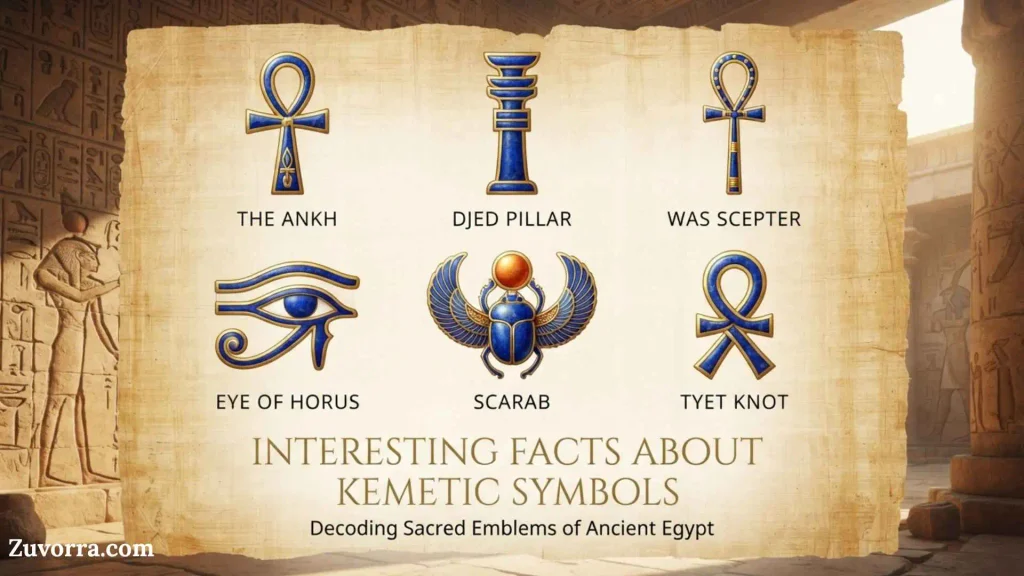
- Symbols could be combined into visual statements. The ankh, djed, and was were often grouped to communicate life, stability, and power.
- Color affected meaning. Green could suggest vegetation, renewal, and life, while red could represent vitality, danger, desert forces, or powerful protection depending on context.
- Amulet placement mattered. A symbol positioned near the heart, throat, spine, or wound could serve a different ritual purpose than the same symbol worn as ordinary jewelry.
- The Book of the Dead was not one standardized book. It is the modern name for a large collection of funerary compositions selected and arranged in different ways for different individuals.
- The djed had its own ritual ceremony. Raising the djed publicly represented restored stability and the renewal of royal and divine order.
- Royal names were protected symbolically. The cartouche developed from the idea of an encircling shen ring around the king’s name.
- The scarab could work as a seal. Many scarab-shaped objects carried names or designs on their flat undersides and were used to stamp clay.
- Images could be ritually activated. Temple and funerary ceremonies treated sacred images as more than artistic representations.
- Modern Kemetic symbolism has several contexts. A symbol may be used historically, religiously, artistically, politically, culturally, or commercially, and those uses should not be confused.
Related Kemetic Symbols
Uraeus
The upright cobra represents royal authority, divine protection, and the fiery power of goddesses such as Wadjet. It commonly appears on crowns and royal foreheads.
Sistrum
The sistrum is a sacred musical instrument associated especially with Hathor. Its sound was used in ritual and could symbolize joy, protection, and divine presence.
Papyrus
Papyrus represents growth, fertility, Lower Egypt, and the marshland environment. Bundled papyrus plants also appeared in architectural columns.
Sema-Tawy
The Sema-Tawy symbolizes the unification of Upper and Lower Egypt. It often shows papyrus and lotus plants tied around a central sign.
Solar Disk
The sun disk represents solar divinity and may be associated with Ra, Aten, Horus, Hathor, or other deities depending on the surrounding image.
Ka Symbol
The ka sign looks like two raised arms. It represents the ka, an aspect of a person’s vital essence that required offerings after death.
Ba Bird
The ba was often shown as a human-headed bird. It represented an aspect of personality or mobility that could move between the tomb, earthly world, and divine realm.
Ouroboros
The snake biting its own tail appears in Egyptian funerary imagery and later traditions. It expresses enclosure, cyclic time, regeneration, or the boundaries of the cosmos.
Frequently Asked Questions
What are Kemetic symbols?
Kemetic symbols are visual signs connected with ancient Egyptian language, religion, kingship, mythology, and funerary practice. The term includes hieroglyphs, divine emblems, sacred animals, ritual objects, crowns, plants, and amulets. Their meanings often overlap, so each symbol should be interpreted through its historical and artistic context.
What is the most important Kemetic symbol?
There was no single most important symbol for every period or purpose. The ankh is the most widely recognized because it means life. However, the djed, Eye of Horus, scarab, Ma’at feather, was scepter, and royal crowns were equally important within particular religious or political settings.
Is the ankh a Kemetic symbol?
Yes. The ankh is an ancient Egyptian hieroglyph meaning life. It appears in temple scenes, funerary art, royal inscriptions, amulets, and divine imagery. Modern Kemetic practitioners and African diasporic communities also use it, although contemporary meanings may extend beyond its ancient linguistic and religious functions.
What Kemetic symbol represents protection?
The Eye of Horus is one of the clearest protective symbols. It represents healing, restoration, health, and wholeness. The uraeus, tyet knot, shen ring, protective deities, and certain scarabs also served protective roles. The most suitable symbol depends on whether the desired focus is health, royal defense, divine guardianship, or funerary protection.
What symbol represents truth in Kemet?
The feather of Ma’at represents truth, justice, proper conduct, balance, and cosmic order. Ma’at was both a goddess and a principle that governed human behavior, kingship, nature, and divine relationships. The heart-weighing scene used her feather as the standard against which the deceased was judged.
Are the Eye of Horus and Eye of Ra the same?
No. They can look similar, but their mythological roles differ. The Eye of Horus usually represents healing, restoration, and protection after injury. The Eye of Ra represents the active power of the sun and may act as a fierce goddess who protects Ra and destroys threats to divine order.
Can anyone wear Kemetic symbols?
Anyone can study or respectfully wear them, but knowledge matters. Learn the symbol’s original name, historical meaning, and religious setting before using it. Avoid presenting modern claims as proven ancient teachings. Respect is especially important when symbols are used in tattoos, sacred jewelry, branding, or commercial products.
What Kemetic symbol represents rebirth?
The scarab is strongly associated with rebirth, transformation, and the rising sun. The lotus also represents renewal because it opens with daylight and emerges from water. The djed expresses resurrection and restored stability, especially through its connection with Osiris. Each symbol presents a different aspect of renewal.
Are Kemetic symbols still used today?
Yes. They appear in contemporary Kemetic religion, African-centered spirituality, jewelry, tattoos, visual art, museums, education, fashion, films, and branding. Their modern uses may express heritage, identity, protection, personal growth, or spiritual belief. These interpretations should still be distinguished from meanings directly documented in ancient sources.
Do Kemetic symbols have Unicode characters?
Some Egyptian hieroglyphs are encoded in Unicode, allowing them to appear digitally when supported by the correct font and software. Display quality varies across devices. Familiar symbols such as the ankh may also appear in specialized fonts, but most do not have direct emoji equivalents with historically precise meanings.
Key Takeaways
- Kemetic symbols come from the religious, linguistic, artistic, and political traditions of ancient Egypt.
- The ankh represents life, while the Eye of Horus symbolizes healing and protection.
- The djed stands for stability, and the scarab represents transformation and renewal.
- The feather of Ma’at expresses truth, justice, balance, and cosmic order.
- Symbols could function as hieroglyphs, amulets, sacred images, or royal emblems.
- Their meaning depended on context, color, material, location, deity, and historical period.
- Modern interpretations may be meaningful, but they should not be confused with verified ancient beliefs.
- Respectful use begins with learning a symbol’s original cultural and religious setting.
Conclusion
Kemetic symbols preserve an ancient Egyptian vision of a universe shaped by life, balance, divine power, death, renewal, and moral responsibility. The ankh, djed, scarab, wedjat eye, Ma’at feather, and related signs were not isolated decorations. They formed a visual language connecting people with gods, kingship, nature, and the afterlife.
Their continuing appeal comes from their ability to express complex ideas through memorable forms. By studying Kemetic symbols in context, modern readers can appreciate both their historical depth and their continuing cultural importance without replacing evidence with speculation.
References
- British Museum. Life in Ancient Egypt educational resources and Egyptian collection records.
- British Museum. Collection record for a red jasper tyet or Isis-knot amulet.
- Metropolitan Museum of Art. Egyptian Art collection and educational essays.
- National Park Service. “Ankh: Egyptian Symbol of Life.”
- University College London, Digital Egypt for Universities. Resources on hieroglyphs, Egyptian religion, funerary literature, and material culture.
- Unicode Consortium. Egyptian Hieroglyphs character block documentation.
- Wilkinson, Richard H. Reading Egyptian Art: A Hieroglyphic Guide to Ancient Egyptian Painting and Sculpture.
- Wilkinson, Richard H. Symbol and Magic in Egyptian Art.
- Teeter, Emily. Religion and Ritual in Ancient Egypt.
- Pinch, Geraldine. Magic in Ancient Egypt.
I’m Felix Everard, a British writer passionate about the fascinating world of symbols and visual communication. I explore traditional, cultural, historical, and modern symbols, focusing on what they represent and why they matter. Through accessible explanations, I hope to help readers recognise the meanings hidden within familiar signs, shapes, and images.
Books:
- The Complete Guide to Symbolism
- Decoding Signs and Symbols