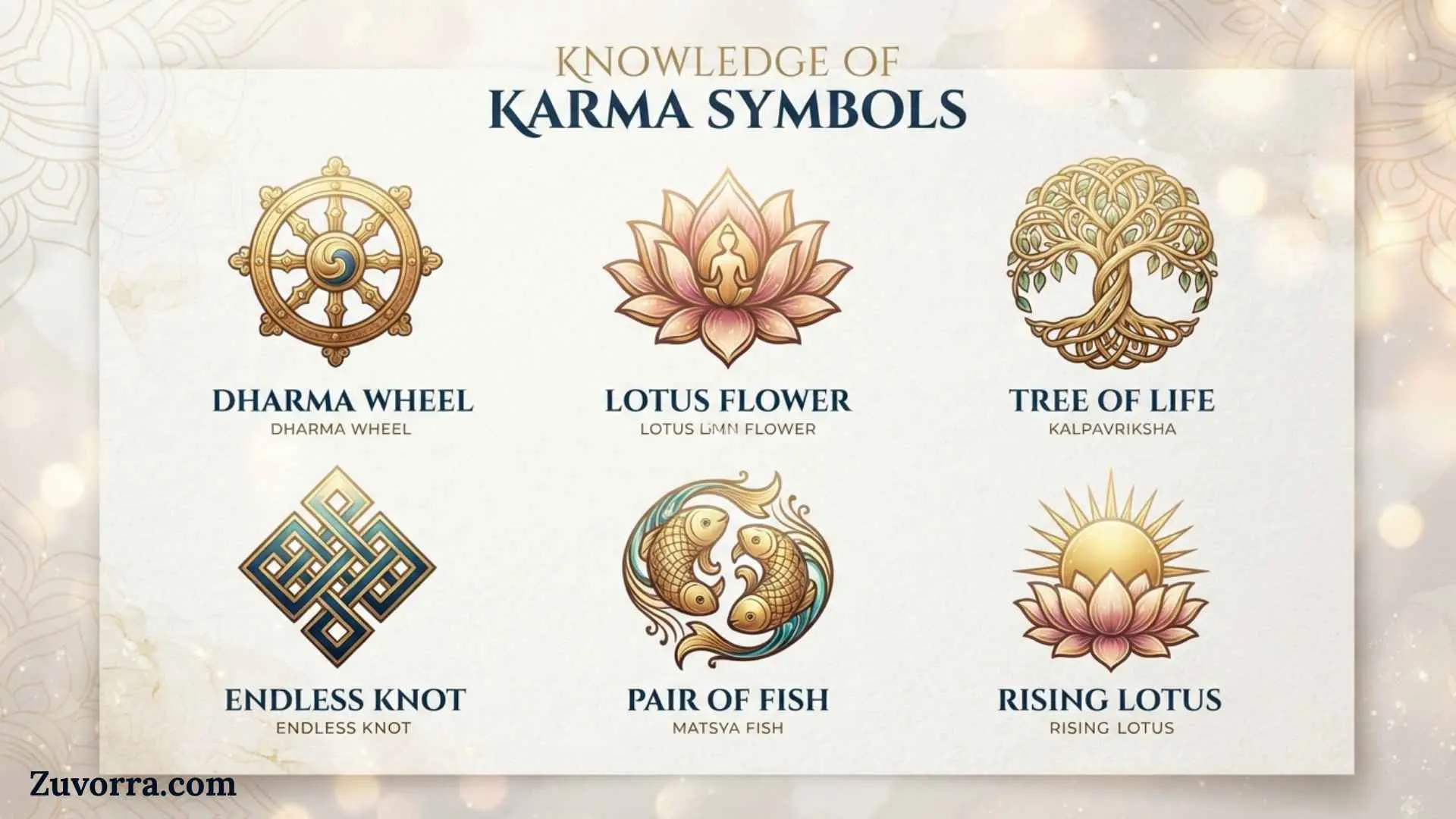
Karma symbols represent the belief that actions, intentions, and choices create consequences. However, there is no single ancient or universally accepted symbol for karma. Instead, the Dharma Wheel, endless knot, lotus flower, scales, circular arrows, and seed imagery are commonly used to express related ideas such as moral cause and effect, rebirth, responsibility, and spiritual growth.
You may encounter these symbols in Buddhist temples, Hindu artwork, meditation spaces, jewelry, tattoos, books, yoga studios, and digital designs. Understanding their origins matters because a modern “karma symbol” may carry a very different meaning from the traditional religious symbol on which it is based.
Quick Meaning
Karma symbols represent action and consequence, ethical responsibility, interconnectedness, rebirth, and the lasting effects of intention. The Dharma Wheel and endless knot are the closest traditional symbols, while circles, seeds, scales, and returning arrows are modern visual metaphors. None serves as an official symbol of karma across every religion or culture.
Karma Symbol Overview
| Field | Details |
| Symbol name | Karma symbol, often represented by the Dharma Wheel or endless knot |
| Primary meaning | Actions and intentions produce consequences |
| Category | Religious, spiritual, philosophical, and ethical symbolism |
| Linguistic origin | Sanskrit karma, meaning action, deed, or work |
| Cultural origin | Ancient India |
| Main traditions | Hinduism, Buddhism, Jainism, and Sikhism |
| Closest traditional symbols | Dharma Wheel, endless knot, lotus, bhavachakra |
| Modern representations | Circular arrows, scales, seeds, ripples, infinity-style designs |
| Common usage | Religious art, jewelry, tattoos, meditation decor, logos, illustrations |
| Unicode symbol | ☸, U+2638, Wheel of Dharma |
| Emoji equivalent | ☸️ |
| Related concepts | Dharma, samsara, rebirth, intention, consequence, liberation |
| Important distinction | Karma is a concept, not one fixed pictorial emblem |
What Do Karma Symbols Mean?
Karma symbols communicate a simple principle: what a person intentionally thinks, says, and does influences what follows. The exact meaning depends on the religious tradition and the symbol being used.
The Sanskrit word karma literally means “action.” In Indian philosophy, it developed into a technical term describing the relationship between actions and their results or “fruits.” The Stanford Encyclopedia of Philosophy explains that karma can include both moral consequences and psychological tendencies created through repeated actions.
A person who repeatedly acts with patience may strengthen patient habits. Someone who repeatedly acts from anger may make anger easier to repeat. Karma therefore concerns more than an external reward or punishment. It can also describe how choices shape character, relationships, circumstances, and future behavior.
Karma symbols usually express one or more of these meanings:
- Cause and effect: Every action enters a chain of consequences.
- Moral responsibility: Choices matter, even when results are delayed.
- Intention: The motive behind an action can affect its moral character.
- Interdependence: Actions influence other people and wider conditions.
- Rebirth: In several Indian traditions, karma affects future lives.
- Transformation: Harmful patterns can be changed through wiser conduct.
- Liberation: Spiritual practice aims to end bondage to karmic cycles.
The most accurate interpretation is not “everything that happens is deserved.” Karma is a complex religious and philosophical concept, not a simple slogan that blames people for suffering.
History and Origin of Karma Symbolism
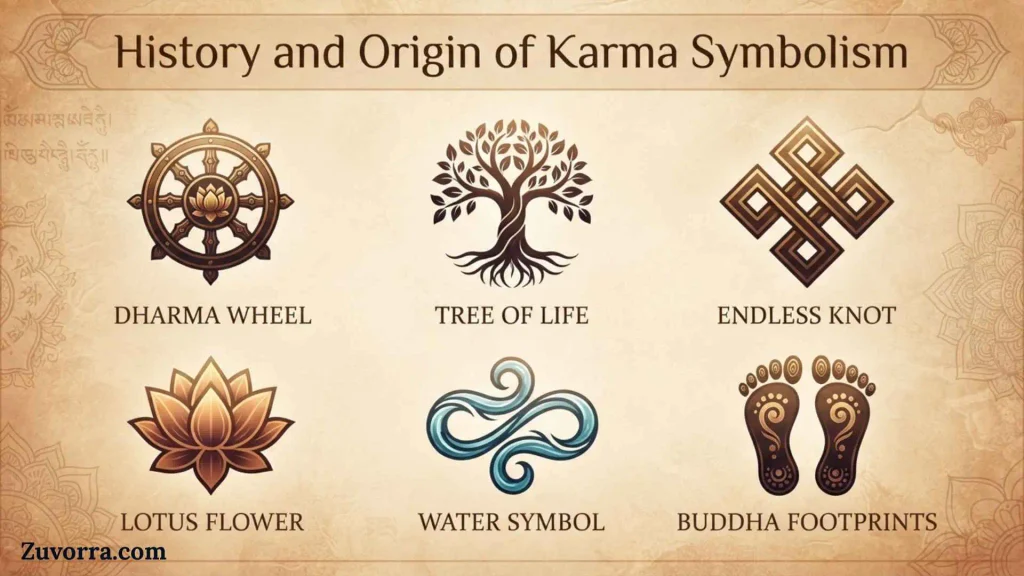
Karma originated as an Indian concept rather than as a single graphic sign. Its history developed through Vedic religion, Hindu philosophical schools, Buddhism, Jainism, and later Sikh thought.
Early uses of the Sanskrit term referred mainly to action, especially ritual action. Over time, Indian thinkers expanded the idea to include ethical conduct and the consequences of deeds. Karma became closely connected with samsara, the recurring cycle of birth, death, and rebirth.
Different traditions then developed distinct explanations:
Hindu Traditions
In Hindu thought, karma generally refers to actions and their consequences across present and future lives. It is often discussed alongside:
- Dharma: Right conduct, moral duty, or cosmic order
- Samsara: The cycle of rebirth
- Moksha: Liberation from samsara
- Yoga: Disciplines that transform action, knowledge, and consciousness
The Bhagavad Gita gives special importance to karma yoga, the path of disciplined action. It teaches that a person should fulfill appropriate duties without selfish attachment to the outcome. Karma is therefore not merely about receiving consequences. It is also about how and why one acts.
Buddhist Traditions
Buddhist teachings emphasize intention. In the Aṅguttara Nikāya, the Buddha is recorded as identifying intention with karma and explaining that intentional action occurs through body, speech, and mind.
This distinction is essential. An accidental act and a deliberate act may produce similar physical results, but they do not necessarily carry the same karmic significance.
Buddhist karma is not normally understood as a judgment delivered by a creator deity. It describes conditioned processes through which intentions and actions contribute to future experience. Buddhist ethics links harmful intentions with suffering and beneficial intentions with well-being.
Jain Traditions
Jainism gives karma a particularly detailed metaphysical meaning. Many Jain teachings describe karma as a subtle form of matter that binds itself to the soul through passions and actions.
Practices such as nonviolence, truthfulness, nonattachment, restraint, and ascetic discipline aim to prevent new karmic accumulation and remove existing karmic bondage. The Stanford Encyclopedia of Philosophy notes that Jain ethics focuses on disentangling the self from karmic matter through nonviolence, nonattachment, and related disciplines.
Sikh Tradition
Sikh teachings acknowledge karma and rebirth but do not present liberation as the mechanical result of good deeds alone. Divine grace, remembrance of God, truthful living, humility, and service are central.
This means that karma symbolism can change depending on context. A wheel in Buddhist art may suggest teaching and the spiritual path, while a similar circular design in modern art may simply mean “what goes around comes around.”
Symbolism and Interpretation
Traditional Meaning
Traditional karma symbolism centers on action, moral consequence, continuity, and liberation. It does not usually portray karma as a supernatural force seeking revenge.
Karma can be compared to planting seeds. The action is the seed, surrounding conditions influence its development, and the result appears when the necessary causes come together. Not every seed grows, and not every result appears immediately. This metaphor shows why karmic teachings are more nuanced than instant reward and punishment.
Modern Meaning
Modern popular culture often reduces karma to the phrase “what goes around comes around.” Circular arrows, boomerangs, and looping lines are therefore used as informal symbols.
These images communicate return and consequence clearly, but they are modern visual shorthand rather than ancient religious emblems.
Positive Symbolism
Positive interpretations include:
- Accountability
- Ethical living
- Compassion
- Personal development
- Hope for change
- Justice
- Mindful decision-making
- Freedom from harmful habits
A karma symbol may remind its wearer to pause before speaking, act honestly, or consider how a decision affects others.
Negative Symbolism
Karma imagery can also carry warnings:
- Harm may return to the person who causes it.
- Selfish actions create destructive patterns.
- Attachment can keep a person trapped in samsara.
- Repeated choices can harden into harmful habits.
- Unresolved causes may continue producing effects.
The negative meaning is not necessarily punishment. It often describes bondage, repetition, or the consequences of acting without awareness.
Psychological Interpretation
Karma also works as a psychological metaphor. Actions influence habits, habits shape character, and character affects future choices.
For example, telling one lie may make a second lie necessary. Repeated dishonesty may gradually change how a person views relationships and responsibility. In this sense, the consequence already begins inside the person before any external result appears.
Cultural Significance
India
India is the birthplace of karma as a major religious and philosophical concept. Hindu, Buddhist, Jain, and Sikh communities use the term differently, but all connect it in some way with action and consequence.
Indian visual culture does not assign karma one exclusive emblem. Wheels, lotuses, sacred diagrams, deities, narrative scenes, and images of rebirth may all communicate karmic themes.
Tibet and Himalayan Buddhism
The endless knot is one of the Eight Auspicious Symbols in Tibetan Buddhist traditions. Its interwoven line has no visible beginning or end, making it a strong image of continuity, interdependence, and the connected nature of causes and conditions.
It can be associated with karma because actions occur within an interconnected web. However, calling the endless knot “the official karma symbol” would be inaccurate. Its meanings also include the unity of wisdom and compassion and the interdependence of religious teaching and everyday life.
East and Southeast Asia
As Buddhism spread through Sri Lanka, China, Korea, Japan, Thailand, Myanmar, Cambodia, Vietnam, and other regions, local artistic styles reshaped Buddhist symbols.
The Dharma Wheel remained important, but its design, number of spokes, decorative details, and surrounding imagery varied. In some settings, karma is explained through painted scenes of rebirth, heavenly and hellish realms, moral stories, or the Wheel of Life rather than through an isolated emblem.
Western Popular Culture
In Western fashion, tattoos, wellness products, and social media, karma often means cosmic justice or returned energy. Designs commonly combine:
- Infinity signs
- Circular arrows
- Lotus flowers
- Scales
- Eyes
- Mandala patterns
- The words “karma” or “what goes around”
These designs can be personally meaningful, but they should not automatically be described as ancient or universally sacred.
Religious and Spiritual Meaning
Karma symbolism teaches that spiritual life involves responsibility rather than passive belief.
In Hindu traditions, karma can bind the self to rebirth, while selfless action, knowledge, devotion, and disciplined practice can support liberation.
In Buddhism, karma is closely tied to intentional conduct. The Noble Eightfold Path guides practitioners toward right view, intention, speech, action, livelihood, effort, mindfulness, and concentration. The Dharma Wheel is therefore connected to the ethical and spiritual framework through which harmful karmic patterns can be transformed.
In Jainism, karma binds the soul and obscures its natural qualities. Strict nonviolence and detachment help stop new karmic bondage.
Across these traditions, karma does not mean that human beings are permanently trapped by the past. Present choices matter. Spiritual practice exists partly because patterns can be understood, interrupted, and changed.
Is There a Scientific or Technical Meaning?
Karma is not a scientific law. It should not be presented as equivalent to Newtonian physics, biological evolution, or a measurable law of energy.
Science can study observable relationships between behavior and consequences. Psychology can examine habit formation, aggression, generosity, social trust, guilt, and decision-making. Sociology can study how behavior affects communities and institutions.
Those findings may resemble some practical lessons associated with karma, but they do not prove religious claims about rebirth or cosmic moral causation.
Digital Meaning
The Wheel of Dharma is encoded as ☸, U+2638 in the Unicode Standard. Unicode identifies it as “Wheel of Dharma,” not “karma.” It may also appear with emoji presentation as ☸️.
No official Unicode character is named “karma symbol.”
Where Karma Symbols Are Used
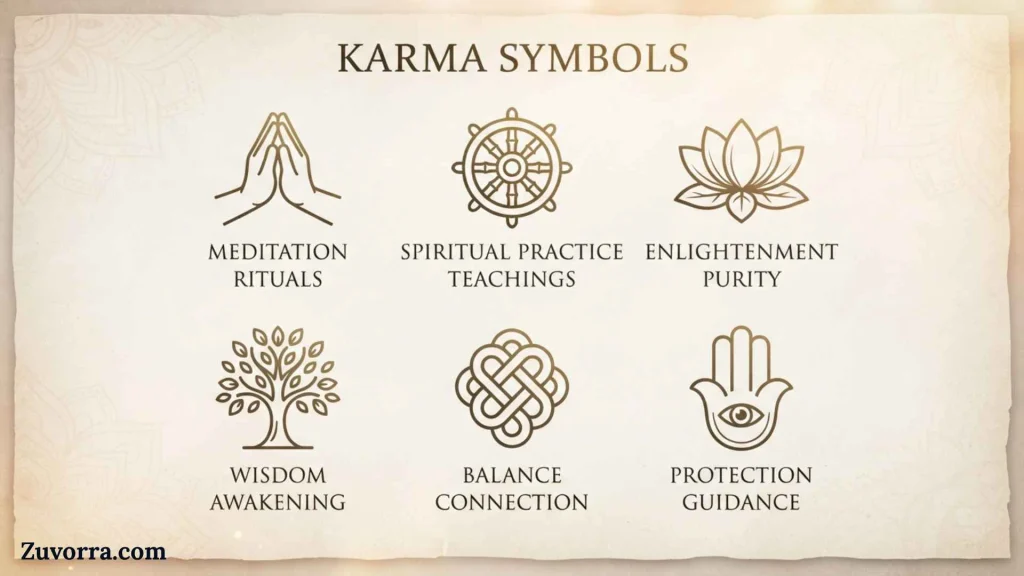
Religious Art and Temples
Dharma wheels, lotus flowers, endless knots, and Wheels of Life appear in monasteries, shrines, manuscripts, sculptures, murals, ritual objects, and teaching materials.
Jewelry
People wear karma necklaces, bracelets, rings, and pendants as reminders of compassion, responsibility, balance, or spiritual connection.
A jewelry listing may use the term “karma symbol” broadly, so buyers should examine the actual design rather than relying only on the product name.
Tattoos
Common karma tattoo designs include:
- Dharma Wheels
- Endless knots
- Lotus flowers
- Circular arrows
- Boomerangs
- Scales
- Seed-to-flower designs
- Ripples spreading across water
- The Sanskrit word कर्म, meaning karma
Before using a sacred symbol, it is wise to learn its traditional meaning and avoid combining it carelessly with unrelated imagery.
Books and Literature
Karma appears as a theme in religious texts, philosophical writing, novels, films, and moral stories. Authors often use repeated events, inherited conflict, returning consequences, or circular plots to represent karmic patterns.
Meditation and Wellness Spaces
Lotuses, mandalas, and endless knots are used in yoga studios and meditation rooms. Sometimes they reflect authentic religious traditions; in other cases, they function mainly as general signs of calm, balance, or spirituality.
Logos and Branding
Businesses use circular or interlocking forms to suggest sustainability, reciprocity, balance, and ethical responsibility. Such logos are usually modern adaptations rather than sacred symbols.
Common Variations
Dharma Wheel
The Dharma Wheel, or dharmachakra, is one of the symbols most often connected with karma.
Its wheel form can express teaching, moral order, movement, and the path beyond suffering. In Buddhism, an eight-spoked version is commonly linked with the Noble Eightfold Path. The wheel is a major Buddhist emblem, but its primary meaning is Dharma, not karma alone.
Endless Knot
The endless knot uses one continuous interwoven line. It represents interdependence, continuity, and connections among causes and conditions.
It makes a suitable karma symbol because actions do not occur in isolation. Every decision arises within a larger network of relationships and produces effects within that network.
Wheel of Life
The Buddhist bhavachakra, or Wheel of Life, illustrates samsara. Its detailed imagery may show realms of rebirth, mental poisons, dependent origination, death, and the possibility of liberation.
Unlike the simple Dharma Wheel, the Wheel of Life emphasizes bondage to recurring existence.
Lotus Flower
The lotus grows from muddy water yet rises above it. It often symbolizes spiritual purity, awakening, and transformation.
When used as a karma symbol, it suggests that difficult conditions and past actions do not prevent future growth.
Circular Arrows
Circular arrows are a modern symbol of return, repetition, and consequence. They offer a clear visual version of “what goes around comes around,” but they do not belong to one ancient tradition.
Scales
Scales represent justice, balance, and fair consequence. They are sometimes used in Western karma designs, although they are more directly connected with law, judgment, and moral balance.
Seed and Fruit
Seed imagery may be the most accurate visual metaphor for karma. A seed represents an action or intention; the fruit represents its result.
This design also shows that consequences depend on time and conditions rather than appearing instantly.
How to Choose the Right Karma Symbol
Use this simple guide:
Do you want a traditional Buddhist symbol?
↓
Choose the Dharma Wheel for teachings and the spiritual path, or the endless knot for interdependence and continuity.
Do you want to represent rebirth and samsara?
↓
Choose the Wheel of Life.
Do you want a personal reminder about growth?
↓
Choose a lotus or seed becoming a flower.
Do you want a simple modern cause-and-effect design?
↓
Choose circular arrows, ripples, or a boomerang motif.
Do you want to express moral balance or justice?
↓
Choose scales, while recognizing that this is a modern association.
Common Misconceptions
“There Is One Official Karma Symbol”
No single symbol represents karma across Hinduism, Buddhism, Jainism, Sikhism, and modern spirituality.
“The Dharma Wheel Means Only Karma”
The Dharma Wheel primarily represents Dharma, Buddhist teachings, moral order, and the path to awakening. Karma is related, but it is only part of the wheel’s wider meaning.
“Karma Means Revenge”
Karma is not a supernatural revenge system. It describes action and consequence within specific philosophical and religious frameworks.
“Every Misfortune Is Punishment for Bad Karma”
This claim oversimplifies complex traditions and can become cruel when used to blame people for illness, poverty, violence, or disaster. Religious teachings on karma contain debates about intention, past causes, present conditions, collective life, natural events, and freedom.
“Good Karma Guarantees Immediate Rewards”
Karmic results are not always described as instant or easily visible. Traditions may place consequences later in life or in future rebirths.
“Karma and Fate Are the Same”
Fate suggests that events are fixed in advance. Karma emphasizes the significance of action. Past conditions may influence the present, but present choices can create new directions.
“The Infinity Symbol Is an Ancient Karma Emblem”
The infinity sign can represent endlessness or cycles, but it is not the traditional universal emblem of karma.
Interesting Facts About Karma Symbols
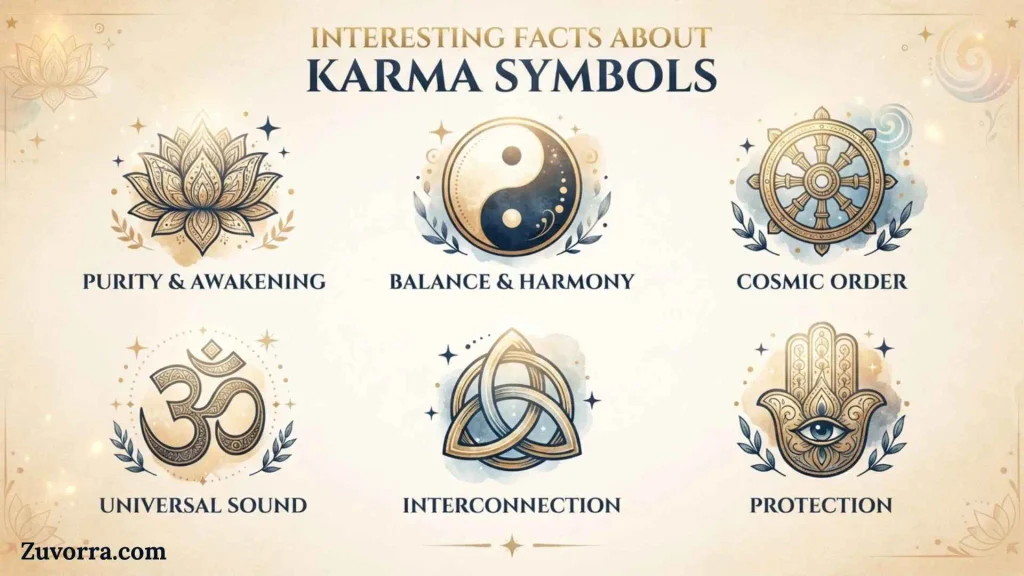
- Karma originally means action. Its earliest meaning is closer to “deed” or “work” than to punishment.
- The closest digital symbol is not named after karma. Unicode calls ☸ the Wheel of Dharma.
- Intention is especially important in Buddhism. Karma is not judged solely by visible outcomes.
- Jainism treats karma differently from most popular explanations. It describes karmic bondage in relation to subtle matter attached to the soul.
- The endless knot contains no obvious starting point. This makes it a useful image of interconnected causes rather than one simple chain.
- The lotus does not literally mean karma. Its connection comes through transformation, spiritual development, and liberation from difficult conditions.
- A wheel can express both bondage and freedom. The Wheel of Life shows samsara, while the Dharma Wheel points toward teachings that lead beyond suffering.
- Modern boomerang imagery is culturally different from Indian karma teachings. It translates the idea of return into a familiar contemporary visual metaphor.
- Karma is not identical in every Indian religion. Hindu, Buddhist, Jain, and Sikh traditions differ on the soul, intention, divine grace, karmic material, and liberation.
- Good actions can shape habits as well as circumstances. Some philosophical explanations include the psychological tendencies created by repeated behavior.
Related Symbols
| Symbol | Connection to Karma | Main Difference |
| Dharma Wheel | Ethical teaching, spiritual movement, and the path beyond suffering | Primarily symbolizes Dharma |
| Endless knot | Interdependence and continuous cause-and-effect relationships | Has several meanings beyond karma |
| Wheel of Life | Samsara, rebirth, and conditioned existence | Focuses on the cycle of suffering |
| Lotus | Growth, purity, and awakening | Represents transformation rather than consequence |
| Infinity sign | Endless cycles and continuity | Modern mathematical symbol, not a traditional karma emblem |
| Scales | Balance, justice, and moral accountability | More closely linked to judgment and law |
| Yin-yang | Balance and complementary forces | Comes from Chinese philosophy, not the Indian doctrine of karma |
| Ouroboros | Cycles, renewal, and self-continuity | Originates in ancient Mediterranean and Egyptian symbolism |
| Seed | Actions developing into future results | A metaphor rather than a standardized emblem |
| Ripples | One action spreading through a wider environment | Primarily a modern illustrative device |
Frequently Asked Questions
What is the main symbol for karma?
There is no universally recognized karma symbol. The Dharma Wheel is the most widely used traditional image associated with related teachings, especially in Buddhism. The endless knot also represents interdependence and continuing causes. Modern designs often use circular arrows, scales, infinity signs, or seeds to show action and consequence.
Is the Dharma Wheel a karma symbol?
The Dharma Wheel can represent karma indirectly, but it is mainly a symbol of Dharma, the Buddha’s teachings, moral order, and the path to awakening. Its circular form can also suggest cycles and consequences. Calling it only a karma symbol leaves out much of its traditional religious meaning.
What does the endless knot mean in relation to karma?
The endless knot represents interconnectedness, continuity, and the dependence of events on many causes and conditions. In relation to karma, it suggests that actions do not occur alone. Thoughts, words, choices, relationships, and circumstances weave together, producing effects that may continue far beyond one moment.
What is the Sanskrit symbol for karma?
The Sanskrit word karma can be written in Devanagari as कर्म. This is a written word, not a pictorial symbol. A tattoo using the script should preserve the correct spelling and letter order. The word may carry different philosophical meanings depending on the surrounding religious context.
Does the lotus symbolize karma?
The lotus is not specifically a symbol of karma, but it can express related ideas. Its growth from mud into a clean flower represents transformation, spiritual awakening, and the ability to rise beyond limiting conditions. It is often combined with wheels or knots in modern karmic designs.
Is karma the same as “what goes around comes around”?
The phrase captures the basic idea that actions have consequences, but it oversimplifies karma. Traditional teachings may include intention, rebirth, moral development, habit formation, spiritual bondage, and liberation. Karma is not merely an assurance that every rude person will soon experience an identical misfortune.
Can a karma symbol bring good luck?
A symbol cannot guarantee good luck. It may serve as a reminder to act thoughtfully, compassionately, and responsibly. In some cultural settings, the endless knot and other auspicious symbols are associated with favorable conditions, but their spiritual value comes from the teachings and practices they represent.
Is karma a form of divine punishment?
Not necessarily. Buddhist and Jain explanations generally do not require a creator deity who rewards and punishes actions. Hindu traditions vary widely and may discuss divine beings alongside karmic law. In most cases, karma is better understood as conditioned consequence than as anger or revenge from a god.
What is a respectful karma tattoo?
A respectful design begins with accurate research. The Dharma Wheel suits a commitment to ethical practice, the endless knot suits interconnectedness, and a lotus suits transformation. Avoid claiming that a symbol has one universal meaning. Correct script, thoughtful placement, and awareness of sacred context also matter.
Can karma be changed?
Many karma traditions teach that present actions matter. The past creates conditions, but it does not always remove all freedom. Ethical conduct, insight, compassion, restraint, devotion, meditation, repentance, and service may help transform harmful patterns and create conditions for spiritual growth or liberation.
Key Takeaways
- Karma means action and refers to the consequences connected with intentional conduct.
- There is no single official or universal karma symbol.
- The Dharma Wheel and endless knot are the closest widely recognized traditional symbols.
- The Wheel of Life represents samsara and karmically conditioned rebirth.
- Lotus flowers, seeds, ripples, scales, and circular arrows are related visual metaphors.
- Hinduism, Buddhism, Jainism, and Sikhism explain karma in different ways.
- Karma should not be confused with fate, instant revenge, or victim-blaming.
- The Unicode character ☸ is officially the Wheel of Dharma, not a dedicated karma sign.
- Context determines whether a design is sacred, cultural, philosophical, or purely decorative.
- A meaningful symbol should encourage responsible action rather than fear of punishment.
Conclusion
Karma symbols make an invisible principle easier to see: actions create patterns, choices affect others, and intentions help shape what follows. Yet no single image owns this meaning. The Dharma Wheel emphasizes teaching and the spiritual path, the endless knot reveals interdependence, the Wheel of Life portrays recurring existence, and the lotus shows the possibility of transformation.
The most meaningful interpretation of karma symbols is therefore not revenge or unavoidable destiny. It is responsibility joined with possibility. Past actions matter, but present awareness also matters. A well-chosen symbol can become a practical reminder to speak carefully, act compassionately, and recognize that even a small choice may continue far beyond the moment in which it was made.
References
- Stanford Encyclopedia of Philosophy. “Buddha.”
- Stanford Encyclopedia of Philosophy. “Ethics in Indian Buddhism.”
- Stanford Encyclopedia of Philosophy. “Jaina Philosophy.”
- Stanford Encyclopedia of Philosophy. “Personhood in Classical Indian Philosophy.”
- SuttaCentral. Aṅguttara Nikāya 6.63, teachings on intention and karma.
- Unicode Consortium. “Miscellaneous Symbols: U+2638 Wheel of Dharma.”
- Unicode Consortium. The Unicode Standard, South and Central Asian scripts and symbols.
- Encyclopaedia Britannica. “Karma.”
- Buddhist textual and art-historical traditions concerning the Dharma Wheel, samsara, and the Eight Auspicious Symbols.

I’m Felix Everard, a British writer passionate about the fascinating world of symbols and visual communication. I explore traditional, cultural, historical, and modern symbols, focusing on what they represent and why they matter. Through accessible explanations, I hope to help readers recognise the meanings hidden within familiar signs, shapes, and images.
Books:
- The Complete Guide to Symbolism
- Decoding Signs and Symbols