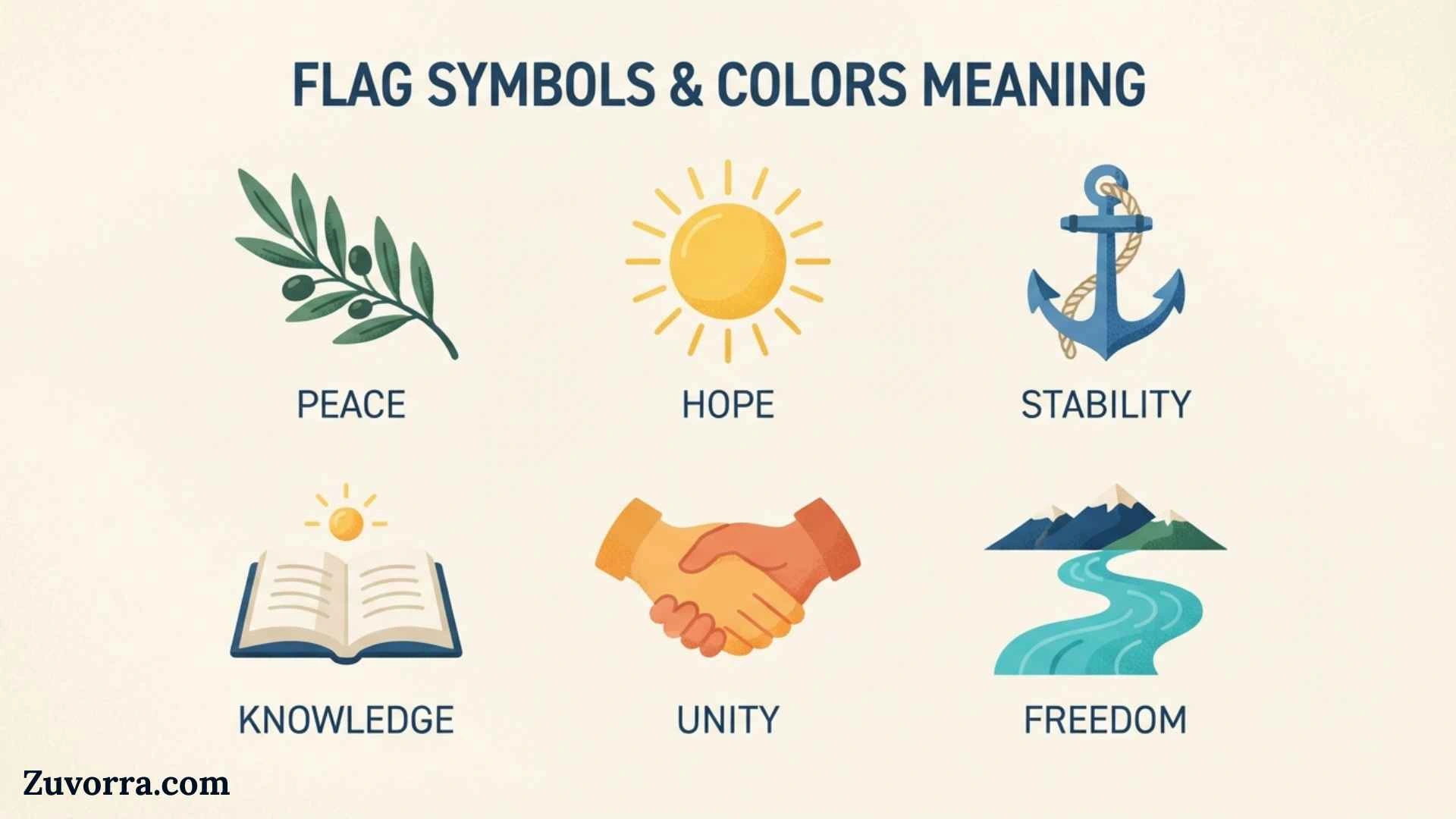
Flags communicate identity through color, shape, placement, and symbols. Red may honor sacrifice, green may represent land or faith, and a star may stand for unity, hope, states, or political ideals. However, flag symbols and colors meaning are never completely universal. Their true interpretation depends on the country, community, historical event, and official explanation behind the design.
You may encounter these visual messages on national flags, state banners, military standards, maritime signals, religious processions, political movements, sports emblems, and international organizations. Learning how to read them reveals how societies describe their history, values, geography, struggles, and hopes without using many words.
Quick Meaning
Flag colors and symbols represent the identity, history, values, geography, government, religion, or aspirations of a nation or group. Common elements include stars for unity, crosses for faith, stripes for regions, and colors such as red for courage or sacrifice. Meanings vary, so each flag should be interpreted within its own cultural and historical context.
Flag Symbolism Overview Table
| Field | Details |
| Symbol category | National, regional, civic, military, maritime, political, religious, or organizational emblem |
| Main purpose | Identification, representation, communication, unity, authority, remembrance, or signaling |
| Academic field | Vexillology, the study of flags |
| Historical roots | Ancient standards, military banners, religious emblems, royal insignia, and maritime signals |
| Common colors | Red, white, blue, green, yellow or gold, black, and orange |
| Common symbols | Stars, crosses, crescents, suns, moons, animals, plants, weapons, shields, and coats of arms |
| Common arrangements | Stripes, crosses, cantons, triangles, disks, borders, and diagonals |
| Modern uses | Government buildings, international events, protests, sports, digital icons, uniforms, and public ceremonies |
| Digital equivalent | National and regional flag emojis, where supported |
| Unicode category | Regional indicator sequences and selected subdivision flag sequences |
| Related fields | Heraldry, semiotics, history, political geography, art, and visual communication |
What Do Flag Symbols and Colors Mean?
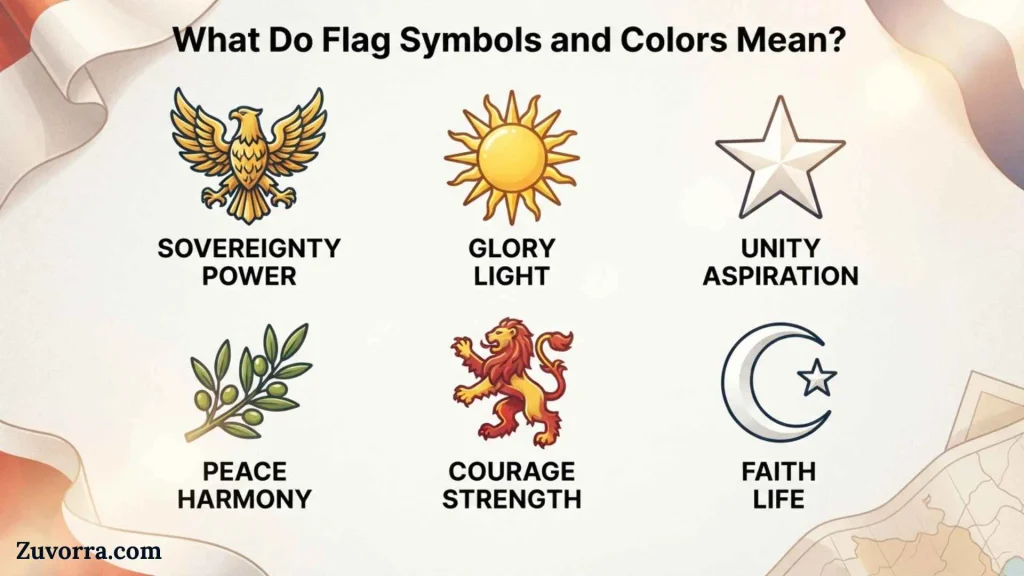
Flag symbols and colors express a shared identity in a form that can be recognized quickly. A flag may tell viewers who controls a place, which community is present, what values a movement supports, or what historical events a nation remembers.
The meaning comes from several connected elements:
- Color creates emotional and cultural associations.
- Symbols identify beliefs, places, rulers, peoples, or ideals.
- Placement can indicate rank, importance, union, or direction.
- Number may represent states, provinces, islands, peoples, or principles.
- Shape can distinguish a flag from surrounding designs.
- Proportion affects how the design appears when displayed.
A star, for example, does not have one fixed definition. It may represent a state on the United States flag, African freedom and unity on Ghana’s flag, or celestial guidance elsewhere. A crescent may have Islamic associations, but it can also reflect regional history, astronomy, or an older imperial tradition.
The most reliable interpretation therefore comes from the flag’s law, official history, designer’s explanation, or recognized historical record. General color charts can offer clues, but they cannot replace cultural context.
Common Flag Color Meanings
Red
Red commonly represents courage, sacrifice, revolution, strength, bloodshed, or the struggle for independence. Its high visibility also makes it useful for warnings, maritime communication, and military identification.
On the United States flag, the official explanation associates red with valor and bravery. In other flags, it may recall the blood of national heroes, revolutionary movements, royal traditions, or a dominant political ideology.
Red can carry both positive and negative associations:
- Positive: bravery, energy, love, determination, and resilience
- Negative: war, danger, violence, oppression, and political extremism
The correct meaning depends on the specific design. It should not automatically be interpreted as blood or conflict.
White
White often symbolizes peace, purity, innocence, honesty, unity, or a desire for harmony. It may also serve a practical design purpose by separating darker colors and improving visibility.
A white field can suggest peace, but a white stripe may represent a particular population, geographical region, or historical dynasty. In heraldic traditions, white commonly substitutes for silver.
White also has ceremonial associations. A plain white flag has long been recognized in warfare as a request for negotiation, truce, or surrender. That functional meaning differs from the symbolism of white within a national flag.
Blue
Blue frequently represents the sky, sea, rivers, justice, loyalty, freedom, vigilance, or perseverance. Countries with important coastlines or island geography often use it to depict surrounding waters.
The blue field of the United States flag is associated with vigilance, perseverance, and justice. Elsewhere, blue may represent a national liberation movement, a royal house, peace, or membership in a wider regional tradition.
Dark blue often feels formal and authoritative, while light blue may suggest open skies, peace, or clear water. These psychological impressions are useful, but they are not universal official definitions.
Green
Green commonly symbolizes agriculture, fertility, forests, natural wealth, hope, renewal, prosperity, or environmental values. It also has strong historical associations with Islam, although not every green flag or stripe is religious.
In many African flags, green refers to productive land, vegetation, or hope for the future. In environmental flags, it directly represents conservation and ecological responsibility.
Possible meanings include:
- Fertile land and farming
- Forests and natural resources
- Growth and national renewal
- Hope or independence
- Islamic heritage
- Political movements
A viewer should avoid assuming that green always has an Islamic meaning. Geography and agriculture are equally common explanations.
Yellow and Gold
Yellow or gold often represents sunlight, mineral wealth, prosperity, generosity, royalty, justice, or a bright future. In heraldry, yellow generally stands for gold.
Flags in resource-rich regions may use gold to represent minerals, crops, or economic potential. A golden sun can symbolize life, independence, enlightenment, or a new political era.
Yellow can also create a strong visual contrast with red, green, blue, or black. In some designs, its purpose is partly practical rather than purely symbolic.
Black
Black may represent the people, cultural heritage, determination, strength, mourning, resistance, fertile soil, or a painful period in history.
In several Pan-African designs, black represents African people or identity. In other settings, it can symbolize past oppression, remembrance, political resistance, or natural resources.
Black has especially varied interpretations:
- Constructive meanings: dignity, unity, strength, endurance, and heritage
- Somber meanings: mourning, death, suffering, and historical injustice
- Political meanings: anarchism, resistance, militancy, or revolution
Because black is culturally powerful, its meaning should always be verified within the flag’s own history.
Orange
Orange may stand for courage, sacrifice, energy, religious tradition, cultural identity, or natural resources. It appears less often than red, white, blue, green, and yellow, which can make it particularly distinctive.
On Ireland’s flag, orange is historically associated with the Protestant tradition, while green is associated with the Catholic and nationalist tradition. The white between them represents the hope for peace.
In India, the saffron band is officially connected with strength and courage. Saffron also carries deep religious and cultural importance across South Asia, but its meaning on a particular flag must be read through that flag’s official framework.
Purple
Purple is uncommon on national flags. Historically, purple dyes were expensive, so the color became associated with royalty, authority, wealth, spirituality, and distinction.
Its rarity is not evidence of a global prohibition. Purple simply developed less frequently in traditional flag-making systems, which relied on durable and widely available dyes.
When purple appears today, it may represent:
- Royal heritage
- Cultural uniqueness
- Spirituality
- Equality or social movements
- A specific local flower, animal, or historical emblem
History and Origin of Flags
Flags developed from earlier standards, banners, streamers, and emblems used to identify rulers, armies, ships, religious groups, and communities. Ancient societies carried objects or decorated poles into battle before lightweight cloth flags became widespread.
Military use strongly shaped early flag design. Soldiers needed to recognize their unit, commander, or rallying point from a distance. Large shapes, contrasting colors, animals, sacred emblems, and royal devices made this possible.
Maritime activity later encouraged more standardized designs. Ships needed to show nationality, authority, status, and intentions across open water. A clear flag could be understood before spoken communication was possible.
During the rise of modern nation-states, flags became public symbols of citizenship rather than only emblems of monarchs. Revolutions and independence movements introduced tricolors, republican symbols, stars, suns, and other devices associated with popular sovereignty.
The study of flags is called vexillology. Organized vexillology grew during the 20th century as researchers developed clearer methods for documenting flag history, terminology, design, and use. The International Federation of Vexillological Associations traces the formal growth of the field to the late 1950s and early 1960s.
Symbolism and Interpretation
Traditional Meanings
Traditional flag meanings often come from monarchy, warfare, heraldry, religion, and geography. Lions may represent courage or royal authority, eagles may suggest sovereignty, and crosses may reflect Christian history.
Heraldry influenced many European flags. Colors and emblems once displayed on shields, royal arms, and family banners were adapted into civic and national designs. However, flags and coats of arms are not identical. Flags must remain visible while moving, so complicated heraldic images are often simplified.
Modern Meanings
Modern flags frequently emphasize citizenship, equality, independence, unity, democracy, peace, or cultural recognition. Newly adopted flags may deliberately move away from colonial emblems or former political systems.
Regional and community flags also give visibility to identities that may not have official statehood. Indigenous peoples, linguistic communities, social movements, and international organizations use flags to create belonging across geographical boundaries.
Positive Symbolism
Flags can inspire:
- Unity during national celebrations
- Respect for shared history
- Pride in cultural heritage
- Hope after conflict or political change
- Solidarity during disasters or public movements
- Recognition in international settings
A successful flag turns complex history into an image people can identify quickly.
Negative Symbolism
Flags can also represent conquest, exclusion, extremism, colonialism, or oppression. The same banner may inspire pride in one community and pain in another.
This tension occurs because flags do not merely decorate spaces. They make claims about authority, history, and belonging. Disputes over flags often involve deeper disagreements about whose experiences should be remembered or honored.
Psychological Interpretation
Colors influence attention and emotional response, but psychology does not create a universal flag dictionary. Red is highly noticeable and may feel energetic or urgent. Blue often appears calm or formal. Green may suggest nature, while black can feel powerful or somber.
These impressions help explain why designers select certain colors. Nevertheless, an official historical meaning should take priority over a viewer’s personal emotional reaction. Research presented through international vexillological scholarship also shows that color interpretations vary across geographical and cultural settings.
Cultural Significance Across Regions
European Flags
Many European flags reflect royal houses, Christian crosses, medieval heraldry, revolutions, or later republican movements. The Nordic cross appears on the flags of Denmark, Sweden, Norway, Finland, and Iceland, linking regional identity with a Christian historical form.
Tricolor designs became especially influential after revolutionary and nationalist movements. Vertical or horizontal bands could represent political principles, historical regions, or relationships with neighboring countries.
African Flags
African flags often emphasize independence, land, natural wealth, unity, sacrifice, and Pan-African identity. Red, yellow, green, and black appear frequently, but their exact meanings vary by country.
The black star on Ghana’s flag became an important symbol of African freedom and anti-colonial aspiration. Other states adopted related color traditions while assigning meanings connected to their own geography and independence history.
Asian Flags
Asian flags draw on ancient philosophies, religious traditions, imperial history, revolutionary movements, and natural imagery. Suns, moons, stars, dragons, trigrams, and sacred colors appear in several designs.
South Korea’s flag combines a red-and-blue taegeuk with four black trigrams. The design reflects ideas of balance, complementary forces, and ordered relationships rather than a simple two-color opposition.
Middle Eastern and North African Flags
Red, white, black, and green appear prominently in many Arab national flags. These are often called the Pan-Arab colors and have links to major historical dynasties and modern Arab nationalism.
Crescents and stars appear on several Muslim-majority countries’ flags, but Islam has no single universal official flag. The crescent became closely associated with the Ottoman Empire and later appeared in various national designs.
The Americas
Flags across North, Central, and South America frequently reflect independence struggles, republicanism, federal systems, Indigenous heritage, geography, and natural resources.
Stars may count states or provinces. Suns can represent independence or a new era. Mountains, birds, plants, weapons, and coats of arms often identify local history and landscape.
Oceania
Pacific flags commonly use stars, waves, traditional patterns, and blue fields. These may represent island groups, ocean geography, navigation, cultural heritage, or relationships with former colonial powers.
The Southern Cross appears on several flags because the constellation is visible in the Southern Hemisphere and serves as a strong geographical marker.
Religious and Spiritual Meaning
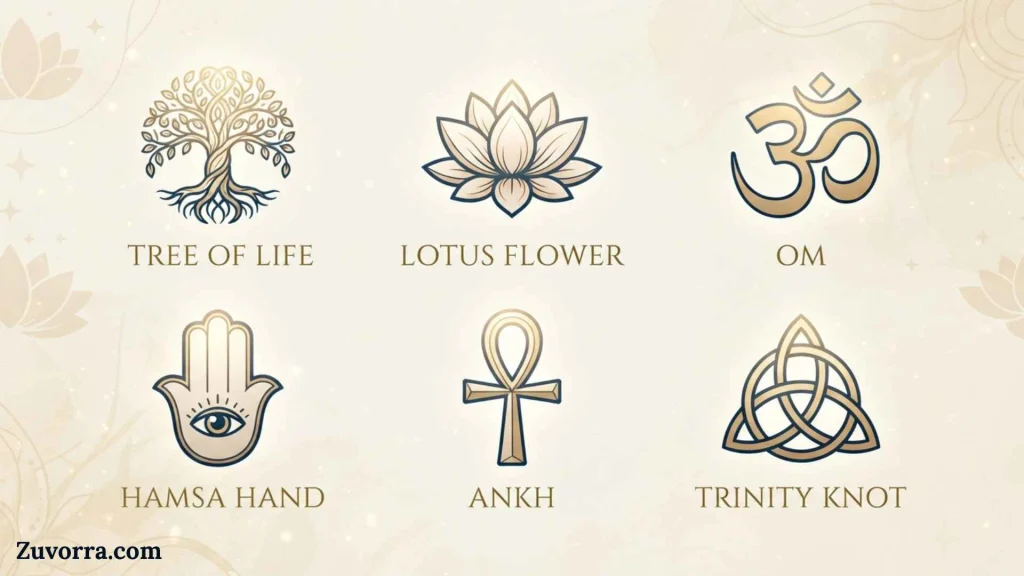
Religion has influenced many flag designs, although religious symbols can also develop national or historical meanings beyond worship.
The Cross
Crosses on flags commonly reflect Christian history. The Nordic cross marks a major Scandinavian design family, while the Union Jack combines crosses associated with the patron saints of England, Scotland, and Ireland.
A cross may also represent sacrifice, historical kingdoms, regional identity, or a state church tradition.
The Crescent
The crescent is widely associated with Islam today, especially through its historical use in Ottoman symbolism. However, crescent imagery existed long before Islam and appeared in ancient astronomical, political, and religious settings.
Its presence on a modern flag may refer to Islamic identity, national history, independence, or an older regional tradition.
The Sun
The sun can symbolize life, divine power, renewal, enlightenment, freedom, or the arrival of a new age. It appears in religious art and secular national imagery.
The number and shape of sun rays may carry additional meaning, such as provinces, ethnic groups, historical events, or geographical features.
Sacred Plants and Animals
Cedars, eagles, lions, dragons, and other living symbols may have spiritual as well as political meanings. Their interpretation often combines mythology, religion, ecology, and national history.
Scientific, Technical, and Digital Meanings
Flags also function as standardized communication tools.
Maritime Signal Flags
The International Code of Signals uses individual flags and combinations to communicate between ships. A flag’s meaning in this system is operational, not symbolic. It may indicate danger, a request for assistance, a vessel’s movement, or a letter of the alphabet.
Racing and Sports Flags
In motorsports, colored flags communicate conditions:
- Green usually starts or resumes racing.
- Yellow warns of danger.
- Red stops the event.
- Blue may warn a driver that a faster competitor is approaching.
- A black-and-white checkered flag marks the finish.
Exact rules vary by sport and governing body.
Beach Safety Flags
Beach flags warn swimmers about water conditions. Red often signals serious danger, while yellow may indicate moderate hazards. Purple can warn of dangerous marine life.
Because systems differ by region, beach visitors should read the posted local legend instead of relying only on general color knowledge.
Digital Flag Emojis
Most country flag emojis use pairs of Unicode regional indicator characters. Their appearance depends on the operating system, platform, and font support.
A country flag emoji represents a standardized regional code, not a separate colored picture stored in ordinary text. Some subdivision flags also exist, but support is less consistent.
Where Flag Symbols Are Used
Flag imagery appears far beyond flagpoles:
- Government buildings: to show jurisdiction and public authority
- Schools: during civic education, ceremonies, or pledges
- Military units: to preserve identity, honor, and battle tradition
- Ships and ports: for nationality, signaling, and maritime status
- Sports events: to identify teams, countries, officials, and conditions
- Maps: to label states, territories, or languages
- Passports and official documents: as marks of national identity
- Logos: to suggest origin, patriotism, or international activity
- Clothing and jewelry: to express pride, heritage, or solidarity
- Tattoos: as permanent statements of identity or remembrance
- Protests: to support, reject, or reinterpret political authority
- Memorials: to honor service members, public figures, or victims
- Digital profiles: to show nationality, language, residence, or support
Context matters. Displaying a flag at a diplomatic event carries a different meaning from wearing the same design on a shirt or altering it in a political artwork.
Common Flag Symbol Variations
Stars
Stars may have five, six, seven, or more points. A single star can represent unity or independence, while multiple stars may count political divisions, islands, peoples, or ideals.
Their arrangement may also matter. A circle can suggest equality, while a constellation can indicate geography.
Stripes
Stripes can be horizontal, vertical, diagonal, or wavy. They may represent regions, founding communities, rivers, political principles, or historical colors.
Three-band flags are often called tricolors, although all three bands do not always use different colors.
Crosses
Cross designs include Nordic crosses, centered crosses, saltire crosses, and combinations of several crosses. Their orientation and placement help distinguish related traditions.
Crescents and Moons
A crescent may face toward the hoist or fly and may appear with one or more stars. Direction alone does not provide a universal meaning.
Coats of Arms and Seals
Some flags place detailed official arms or seals on a plain field. These designs can communicate rich historical information, but small details may become difficult to recognize at a distance.
Unusual Shapes
Most flags are rectangular, but exceptions exist. Nepal’s national flag consists of two joined pennant shapes. Switzerland and Vatican City use square national flags.
Shape can make a flag highly distinctive, but it may also create practical challenges in manufacturing and display.
Common Misconceptions About Flag Meanings
Every Color Has One Universal Meaning
It does not. Red can mean bravery, blood, revolution, royalty, religion, or simply historical continuity. A color’s meaning must be confirmed through the flag’s own history.
Every Crescent Represents Islam
Crescents have ancient origins and are not exclusively Islamic. On modern flags, they may reflect Islamic identity, Ottoman influence, astronomy, or regional history.
Every Star Means Freedom
Stars can represent states, islands, unity, divine guidance, political ideology, or geographical position. Their number and arrangement often provide the most useful clues.
National Colors Always Have Official Explanations
Some governments provide detailed symbolism, while others do not. Popular stories can develop long after a flag’s adoption and may be mistaken for original intent.
Similar Flags Share the Same Meaning
Similar designs may result from common ancestry, political influence, coincidence, or limited combinations of simple colors and shapes. Their official meanings can still differ greatly.
A Flag’s Meaning Never Changes
Public interpretation can evolve. A former royal emblem may become a national symbol, while a historical flag may later acquire political or controversial associations.
A Simple Guide to Interpreting a Flag
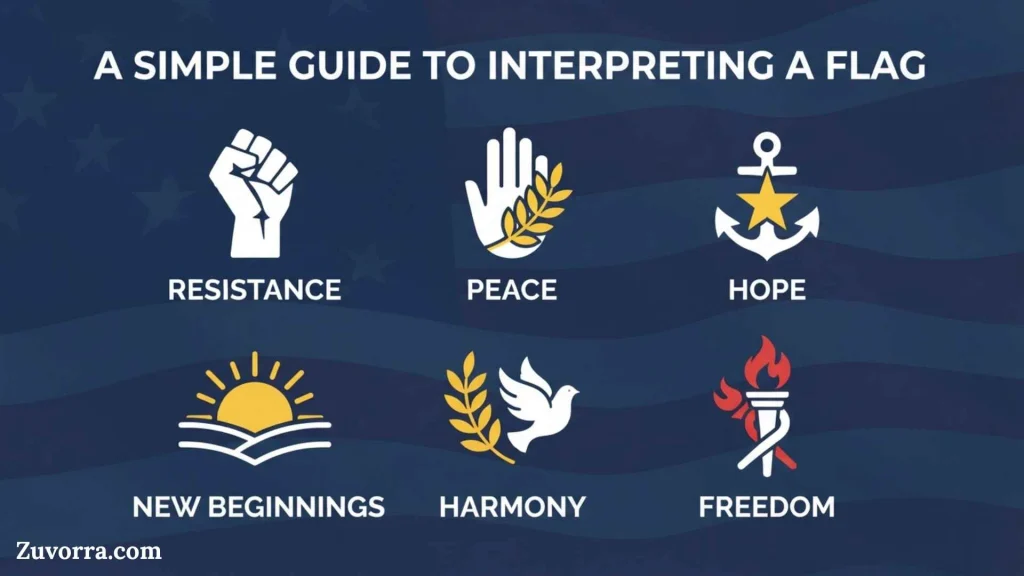
Use this decision path before assigning a meaning:
Is the flag officially recognized?
↓
Yes: Check the constitution, flag law, government website, or official historical account.
No: Identify the organization, movement, or community that uses it.
↓
Are the colors or symbols officially explained?
↓
Yes: Use that explanation as the primary meaning.
No: Study the design’s historical sources, related flags, geography, and cultural tradition.
↓
Is the meaning based only on a generic color chart?
↓
Treat it as a possible interpretation, not a confirmed fact.
Interesting Facts About Flag Symbols and Colors
- The study of flags has its own name. Vexillology examines flag history, design, symbolism, terminology, and social use rather than treating flags as simple decoration.
- Flag designs must work while moving. A flag is often seen from a distance, folded by wind, or partly hidden. This is why bold shapes and strong contrasts are valuable.
- The hoist is visually important. The area nearest the flagpole remains visible even when wind is weak, so stars, crosses, and other major devices often appear there.
- Purple is not forbidden on national flags. It was historically uncommon because reliable purple dyes were expensive and less practical than widely available colors.
- A symbol can have several meanings at once. A sun may describe climate, honor a deity, represent independence, and suggest a hopeful future within the same design.
- Official and popular meanings can differ. Citizens may attach emotional interpretations to colors even when those ideas were not recorded by the original designer.
- Changing one symbol can announce a new political era. Governments often remove crowns, colonial badges, or ideological emblems after revolutions, independence, or constitutional change.
- Flags can function as language. Maritime signal systems use standardized flag combinations to transmit precise messages without speech.
- Geography frequently shapes symbolism. Blue fields may represent oceans, stars may copy visible constellations, and mountains, rivers, or islands may appear directly in a design.
- Simple designs can contain complex history. A few stripes may preserve memories of dynasties, revolutions, ethnic communities, political unions, or independence movements.
- Not all flags are national. Cities, provinces, Indigenous nations, religions, universities, military units, companies, and social movements also create flag systems.
- Digital flags are code-based. Country flag emojis are generally produced from character sequences linked to regional codes, so their design can look different across platforms.
Related Flag Symbols
| Related symbol | Common association | How it differs |
| Star | Unity, states, guidance, independence | Meaning often depends on number, points, and arrangement |
| Sun | Life, freedom, renewal, geography | Usually emphasizes light, energy, or a new era |
| Crescent | Faith, history, astronomy | Not exclusively Islamic |
| Cross | Christianity, sacrifice, regional identity | Appears in several distinct geometric forms |
| Eagle | Sovereignty, strength, authority | Often comes from imperial or heraldic traditions |
| Lion | Courage, royalty, national heritage | Common in coats of arms and royal symbolism |
| Shield | Defense, government, protection | Usually forms part of a larger coat of arms |
| Crown | Monarchy, sovereignty, historical rule | May indicate present or former royal authority |
| Olive branch | Peace and reconciliation | Often used by international organizations |
| Laurel wreath | Victory, honor, achievement | Originates in ancient Mediterranean traditions |
| Mountain | Land, endurance, geography | Usually connects identity with a specific landscape |
| Tree | Life, ancestry, resilience, nature | The species may have a distinct local meaning |
Frequently Asked Questions
What do the colors of a flag usually mean?
Flag colors often represent ideals, geography, historical events, religion, political traditions, or groups of people. Red may suggest courage, green may represent land, and blue may symbolize water or justice. These are common patterns, not fixed rules. The official history of each flag provides the most dependable interpretation.
Why do so many flags use red, white, and blue?
Red, white, and blue became common through heraldic traditions, maritime visibility, influential national designs, revolutions, and historical relationships between states. The colors also contrast clearly at a distance. Countries that share them do not necessarily assign them the same meaning or share the same political values.
What does a star symbolize on a flag?
A star may represent unity, hope, divine guidance, independence, political divisions, islands, or membership in a federation. Its meaning often depends on how many stars appear and where they are placed. For example, the 50 stars on the United States flag represent the 50 states.
What does black mean on a flag?
Black may symbolize a people, ethnic identity, strength, fertile soil, mourning, resistance, natural resources, or a difficult historical period. It can also have specific political associations. Because its uses are highly varied, black should never be assigned a single meaning without checking the flag’s official or historical context.
Does green on a flag always represent Islam?
No. Green may represent Islam on some flags, but it frequently symbolizes agriculture, forests, hope, fertility, renewal, or natural wealth. Several countries use green primarily for geographical or economic reasons. The presence of green alone is not enough to identify a flag as religious.
Why do some flags include coats of arms?
Coats of arms provide detailed information about government, royal history, geography, religion, military tradition, or important national resources. Placing one on a flag connects the banner with an established state emblem. However, complex arms may be difficult to recognize when the flag is small or moving.
Do flag colors have psychological effects?
Colors can influence attention and emotional response. Red may feel urgent, blue calm, and black serious. Yet these reactions vary among people and cultures. Psychological associations can explain part of a design’s impact, but they should not be confused with the flag’s documented historical or official meaning.
What is the most common symbol on national flags?
Stars, crosses, crescents, suns, shields, eagles, and coats of arms are among the most widespread symbols. The answer can vary depending on whether repeated stars and heraldic details are counted separately. Simple geometric devices remain common because people can recognize them from far away.
Can the meaning of a flag change over time?
Yes. Governments may officially redesign a flag, while public interpretation can change without altering the design. Political conflicts, independence movements, social change, or new historical awareness may give an old flag different associations. The original meaning and present-day meaning may therefore need separate explanations.
How can I find the official meaning of a flag?
Begin with the country’s constitution, flag law, government portal, embassy, national archive, or official cultural institution. Then compare that information with reputable historical and vexillological research. Avoid relying solely on commercial flag stores, unsourced graphics, or generic lists of color meanings.
Key Takeaways
- Flag colors and symbols communicate identity, history, geography, beliefs, authority, and aspirations.
- No color or symbol has one universal meaning across every culture.
- Red often suggests courage or sacrifice, while blue may represent water, justice, or loyalty.
- Green can symbolize land, renewal, hope, or Islamic heritage.
- Stars, crosses, crescents, suns, animals, and plants gain meaning from their specific cultural setting.
- Official laws and historical records are more reliable than generic symbolism charts.
- The same flag may inspire pride in one community and controversy in another.
- Vexillology studies how flags are designed, interpreted, documented, and used.
- Modern flags operate as national emblems, political statements, safety signals, and digital identifiers.
- Understanding a flag requires examining its colors, symbols, arrangement, history, and users together.
Conclusion
Flags turn complex stories into designs that people can recognize in seconds. A stripe may preserve the memory of a revolution, a star may unite separate regions, and a color may honor land, faith, sacrifice, or hope. Yet these elements never exist in isolation.
The most important lesson about flag symbols and colors meaning is that context controls interpretation. General patterns can help you begin, but official records, cultural history, geography, and the experiences of the people represented by the flag reveal its fuller significance. Reading flags carefully allows us to understand not only what communities display, but also how they choose to describe themselves.
References
- International Federation of Vexillological Associations. “The Origins of Organized Vexillology.” Background on the development of flag studies as an organized field.
- International Federation of Vexillological Associations. “The Principles of Vexillology.” Scholarly discussion of evidence, objectivity, terminology, and research methods in flag studies.
- International Federation of Vexillological Associations. “Psychological Implication and Geographic Differences of Colours in National Flags.” Research concerning color interpretation and regional variation.
- International Federation of Vexillological Associations. “Twenty Principles for the National Flag Design.” Discussion of clarity, symbolism, proportion, distinctiveness, and practical flag design.
- USA.gov. “The American Flag and Other National Symbols.” Official information about the United States flag, including its stars, stripes, and color symbolism.

I’m Jasper Huxley, a British writer fascinated by the symbols that communicate ideas without words. I explore their meanings, origins, cultural connections, and everyday uses. From ancient markings to contemporary signs, I enjoy uncovering the stories behind visual language and presenting symbolism in a clear, engaging way for curious readers worldwide.
Books:
- The Hidden Language of Symbols
- Symbols, Signs and Their Meanings