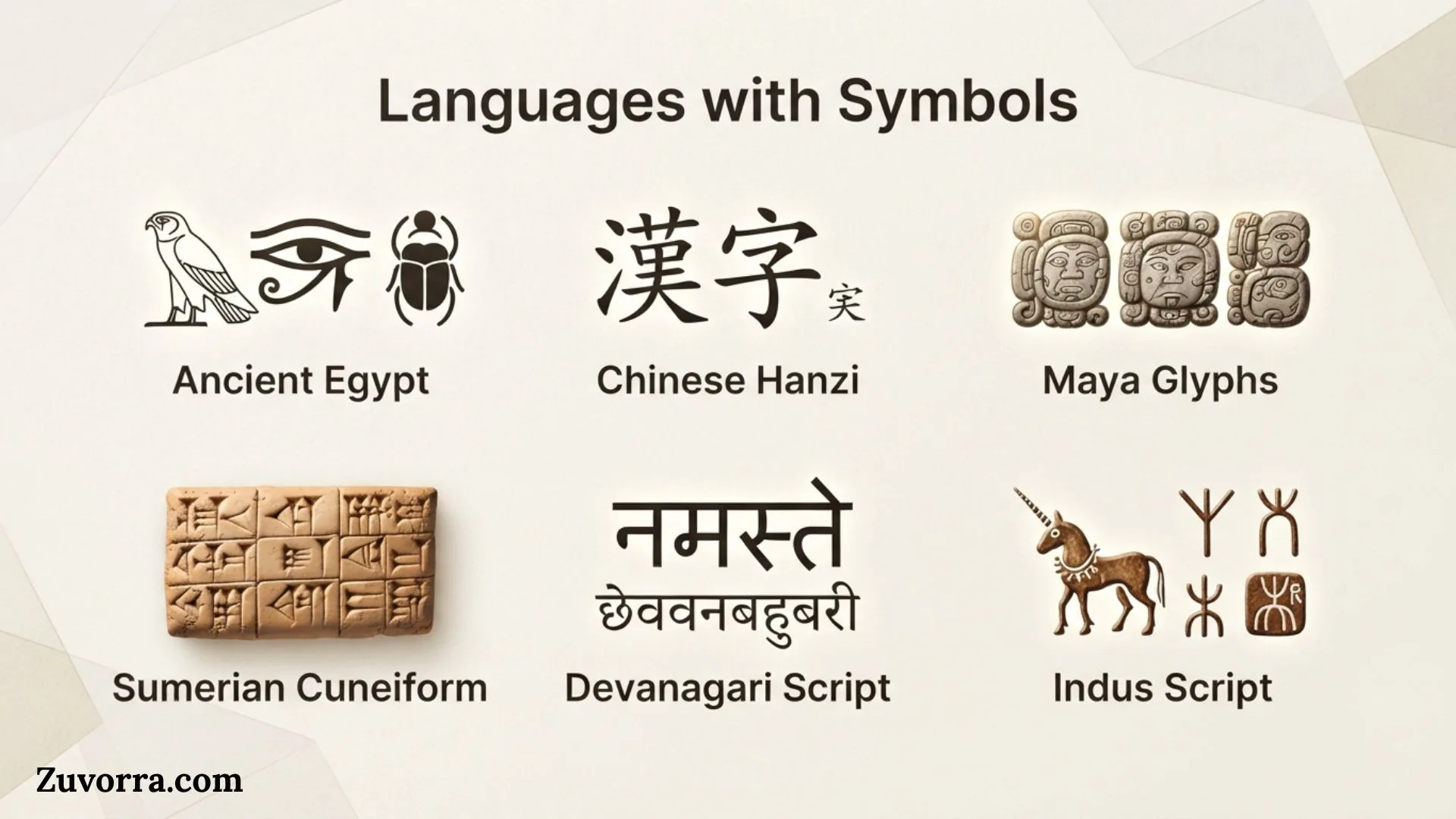
Languages with symbols use organized writing systems to represent sounds, syllables, words, meanings, or combinations of these elements. Chinese characters, Japanese kanji and kana, Egyptian hieroglyphs, Arabic letters, Devanagari signs, and Cherokee syllabary characters may all look symbolic, but they work according to different linguistic rules.
These writing systems appear in books, religious texts, monuments, maps, artwork, tattoos, keyboards, road signs, websites, and mobile devices. Understanding how they work reveals an important truth: a symbol is not automatically a picture, and a language is not the same thing as the script used to write it.
Quick Meaning
Languages with symbols are spoken or signed languages represented through visual characters. Some symbols indicate sounds, while others represent syllables, words, grammatical units, or both meaning and pronunciation. The accurate term is usually writing system or script, not “symbol language,” because the symbols follow rules for recording a language.
Writing Systems Overview
| Writing system | What its symbols mainly represent | Examples | Typical use |
| Alphabet | Consonants and vowels | Latin, Greek, Cyrillic | English, Greek, Russian |
| Abjad | Mainly consonants | Arabic, Hebrew | Arabic, Hebrew, Persian |
| Abugida | Consonants with built-in vowels | Devanagari, Ethiopic | Hindi, Amharic, Sanskrit |
| Syllabary | Syllables or morae | Cherokee, hiragana, katakana | Cherokee, Japanese |
| Logographic or morphosyllabic system | Meaning units plus sound information | Chinese characters, kanji | Chinese and Japanese |
| Featural system | Sound features reflected in letter shapes | Hangul | Korean |
| Hieroglyphic system | Sounds, words, and meaning classifiers | Egyptian hieroglyphs | Ancient Egyptian |
| Pictographic communication | Ideas or instructions through images | Road signs, icons | Public communication |
| Notational system | Specialized concepts rather than a full language | Mathematics, music, chemistry | Technical fields |
The Unicode Standard classifies and digitally encodes characters from modern and historical scripts so that computers can store, process, and display them consistently. Unicode 17.0 contains more than 150,000 characters, including alphabetic scripts, right-to-left scripts, Asian writing systems, historic scripts, punctuation, and technical symbols.
What Do Languages With Symbols Mean?
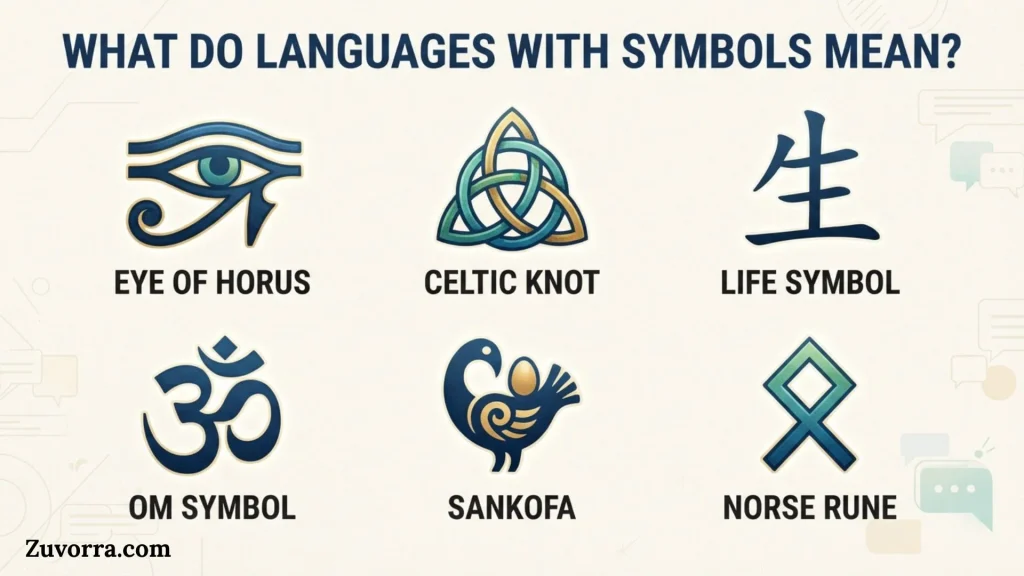
The phrase “languages with symbols” usually refers to languages whose written characters appear unfamiliar, decorative, picture-like, or complex to someone who uses the Latin alphabet. However, every written language uses symbols. The letters A, B, and C are symbols just as 中, अ, ع, and Ꭰ are.
What changes is the relationship between a written character and the language it records.
Symbols Can Represent Sounds
In an alphabet, individual letters usually represent consonants or vowels. English uses the Latin script, although English spelling does not always match pronunciation perfectly.
For example:
- c may sound different in cat and city.
- sh uses two letters to represent one sound.
- x may represent a sequence of sounds, as in box.
Greek, Cyrillic, Armenian, and Georgian are also alphabetic scripts, though their characters have different shapes and histories.
Symbols Can Represent Syllables
A syllabary gives each character a syllabic value. Japanese hiragana includes characters such as:
- か, pronounced ka
- き, pronounced ki
- く, pronounced ku
Cherokee also uses a syllabary. Its characters represent syllables rather than individual alphabetic letters. A syllabary may therefore require more basic signs than an alphabet because each consonant-vowel combination can have its own form.
Symbols Can Carry Meaning and Sound
Chinese characters are often called ideograms, but that description is incomplete. Many characters contain elements that suggest both meaning and pronunciation. Linguists therefore commonly describe Chinese writing as morphosyllabic or logosyllabic.
For example, a Chinese character typically corresponds to a spoken syllable and often to a morpheme, the smallest meaningful unit in a language. It is not simply a universal picture that every reader interprets without knowing Chinese.
Japanese uses Chinese-derived kanji alongside two syllabic systems, hiragana and katakana. This makes Japanese a clear example of a mixed writing system.
Symbols Can Mark Grammatical or Semantic Information
Some written signs do more than represent pronunciation. They may distinguish word classes, clarify meaning, mark vowels, indicate tone, or show how a character should be interpreted.
Ancient Egyptian hieroglyphic writing, for example, used phonetic signs as well as determinatives. A determinative was generally not pronounced. Instead, it helped identify the category or intended meaning of a word.
History and Origin of Symbol-Based Writing
Writing developed when human communities needed durable ways to record information. Before full writing systems appeared, people used marks, tokens, tallies, images, and seals to track goods, identify ownership, preserve rituals, and communicate ideas.
A drawing becomes part of a true writing system only when it operates within an organized structure capable of representing language. A picture of an animal may communicate “animal,” but a written script must do more. It must help record names, actions, relationships, grammar, and abstract ideas.
Mesopotamian Cuneiform
Cuneiform developed in ancient Mesopotamia from earlier administrative marks. Scribes pressed wedge-shaped signs into clay tablets. Over time, the signs became more abstract and gained phonetic as well as word-based functions.
Cuneiform was not one language. It was a script adapted to write several languages, including Sumerian and Akkadian. This distinction remains essential: language is the communication system, while script is the visual system used to record it.
Egyptian Hieroglyphs
Egyptian hieroglyphs included recognizable images of humans, animals, plants, objects, and body parts. Yet the system was not merely pictorial. Signs could function as:
- Whole-word signs
- Single-consonant signs
- Multi-consonant signs
- Determinatives that clarified meaning
Their visual beauty contributed to their religious and monumental use, but their linguistic structure allowed scribes to record names, titles, prayers, narratives, and administrative information.
Chinese Writing
The earliest securely identified Chinese writing appears on oracle bones from the late Shang period. These inscriptions recorded divination questions, royal concerns, offerings, warfare, weather, and other matters.
Character forms changed through bronze inscriptions, seal script, clerical script, and later standard styles. Although many modern characters no longer look like pictures, historical development remains visible in certain forms.
The Alphabetic Principle
Alphabetic writing emerged through a long process in which a smaller set of signs came to represent speech sounds. Phoenician writing strongly influenced Greek, and Greek influenced later systems, including the Latin and Cyrillic alphabets.
Alphabetic systems reduced the number of basic characters a learner needed, but they did not make writing entirely simple. Spelling rules, letter combinations, accents, punctuation, and historical changes can still create complexity.
Scripts Continue to Evolve
Writing systems are not frozen relics. Communities reform spellings, create new characters, revive traditional scripts, adapt handwriting to printing, and develop digital fonts and keyboards.
Unicode and international web standards now play a major role in whether a script works properly on phones, websites, electronic books, and software. The World Wide Web Consortium develops resources to support the layout needs of scripts such as Arabic, Chinese, Devanagari, Ethiopic, Hebrew, Japanese, Mongolian, Tamil, Thai, and Tibetan.
Symbolism and Interpretation
Written symbols serve practical linguistic functions, but societies also give them cultural, emotional, and artistic meanings.
Traditional Symbolism
A script can symbolize:
- Cultural identity
- Historical continuity
- Education and scholarship
- Political authority
- Religious tradition
- Community membership
- Resistance to cultural erasure
Calligraphy often increases this symbolic power. Beautifully written Arabic, Chinese, Japanese, Hebrew, Persian, Sanskrit, and Tibetan texts may be valued as both language and visual art.
Modern Symbolism
Today, scripts can communicate heritage in logos, fashion, tattoos, public art, and digital usernames. A heritage script may help a diaspora community maintain a connection with its ancestors.
At the same time, using an unfamiliar character only for its appearance can produce errors. A decorative tattoo may contain the wrong word, an unnatural translation, or a character chosen from an unreliable chart.
Positive Interpretations
Symbol-rich scripts may be associated with wisdom, tradition, beauty, sacred knowledge, refinement, or cultural pride. These interpretations usually come from social history rather than from the shapes alone.
Negative Interpretations
Unfamiliar writing can sometimes be treated as mysterious, threatening, alternative, or magical. Such assumptions often reveal the observer’s lack of knowledge rather than anything about the script.
No writing system is inherently more intelligent, spiritual, advanced, or artistic than another. Each developed to meet the needs of particular communities.
Psychological Interpretation
Humans naturally search for patterns in unfamiliar shapes. A reader may see a face, animal, or object in a character even when the resemblance has no linguistic importance.
This tendency explains why invented “ancient symbol meanings” spread easily online. Visual resemblance is not proof of historical origin. Reliable interpretation requires knowledge of the character’s language, pronunciation, use, date, and cultural setting.
Cultural Significance Across Regions
Different cultures connect writing with identity in distinct ways.
East Asia
Chinese characters are used in Chinese writing and also form the kanji component of Japanese. Historically, Chinese characters influenced writing elsewhere in East Asia.
The same written character may have different pronunciations across languages. This does not mean that Chinese and Japanese are the same language. It means that related character traditions can be adapted to different linguistic systems.
Japanese combines:
- Kanji for many lexical meanings
- Hiragana for grammatical endings and native words
- Katakana for many loanwords, emphasis, and specialized uses
- Latin letters in selected modern contexts
Korean is mainly written with Hangul, a script whose letter shapes systematically reflect features of speech production. Chinese characters, called hanja in Korean contexts, have also played a historical role.
South Asia
South Asia contains many scripts, including Devanagari, Bengali-Assamese, Gujarati, Gurmukhi, Kannada, Malayalam, Odia, Tamil, and Telugu.
Many belong to the Brahmic family. They often operate as abugidas: a consonant character carries an inherent vowel that can be modified or suppressed through additional signs.
Hindi and Sanskrit may both use Devanagari, but they remain different languages. Once again, a shared script does not create a shared language.
The Middle East and North Africa
The Arabic script writes Arabic and has been adapted for Persian, Urdu, Kurdish, Pashto, and other languages. These languages are not dialects of one another simply because their pages may look similar.
Arabic-script text normally runs from right to left, though numbers and embedded left-to-right material require special handling. Hebrew, Syriac, Thaana, and N’Ko are among other scripts associated with right-to-left writing.
Africa
Africa has ancient and modern script traditions, including Egyptian hieroglyphs, Ethiopic, Tifinagh, N’Ko, Vai, and Adlam.
Ethiopic, also known as Geʽez script, is used for languages such as Amharic and Tigrinya. Tifinagh is connected with Amazigh language and identity. N’Ko and Adlam demonstrate that new scripts can emerge from community needs rather than only from ancient civilizations.
Indigenous Scripts of the Americas
The Maya developed a complex writing system combining logographic and syllabic signs. Cherokee uses a syllabary created by Sequoyah in the early nineteenth century.
The visual appearance of Cherokee characters may remind readers of Latin or Greek letters, but their sound values are different. Similar shape does not guarantee shared pronunciation.
Religious and Spiritual Meaning
Writing often becomes sacred when a community connects it with revelation, ritual, prayer, or preserved teaching.
Sacred Texts and Scripts
Hebrew is central to Jewish scripture and liturgical tradition. Arabic has special importance in Islam because the Quran was revealed and preserved in Arabic. Devanagari and other Indic scripts appear in Hindu, Buddhist, and Jain texts, while Tibetan writing is prominent in Tibetan Buddhist literature.
Christians use many languages and scripts, including Greek, Latin, Cyrillic, Armenian, Georgian, Coptic, Arabic, Ethiopic, and others. No single visual system represents Christianity worldwide.
Calligraphy as Devotion
Religious calligraphy may transform writing into a devotional art. Sacred names, verses, and prayers can appear in manuscripts, architecture, textiles, amulets, and ceremonial objects.
The holiness belongs to the religious message and its cultural use, not automatically to every character in the script. A letter used in a sacred manuscript may also appear in an ordinary receipt or street sign.
Caution With “Spiritual Alphabets”
Online charts sometimes assign fixed spiritual meanings to every letter of an ancient alphabet. Some associations come from genuine mystical traditions, but others are modern inventions.
A responsible interpretation asks:
- Which historical community used the symbol?
- What language did it record?
- What is the earliest evidence?
- Was the spiritual meaning traditional or recently assigned?
- Does the source come from specialists or from anonymous image posts?
Scientific and Technical Meaning
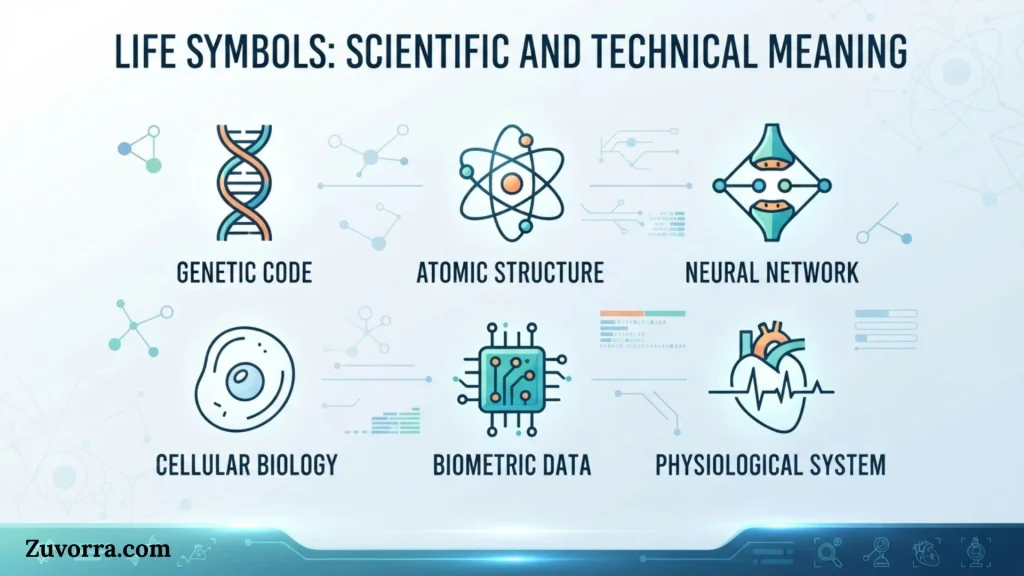
Written characters have become technical data as well as visual marks.
Unicode and Digital Text
Computers require consistent character identification. Unicode assigns code points to characters so that text can move between systems without depending on one language-specific encoding.
Unicode encodes characters, not one mandatory visual design. The exact appearance can vary by typeface, handwriting tradition, platform, or regional convention. Unicode’s own code-chart guidance notes that displayed character images are not prescriptive and that real fonts may vary.
Script Codes and Language Codes
Digital systems distinguish scripts from languages. ISO 15924 provides codes for script names, such as Latn for Latin and Arab for Arabic. A language may use more than one script, while one script may serve many languages.
For example:
- Serbian can be written in Cyrillic or Latin script.
- Urdu and Persian use adapted forms of the Arabic script.
- English, Vietnamese, Turkish, and Swahili use versions of the Latin script.
- Japanese routinely combines several scripts.
Writing Direction and Layout
Software must account for:
- Left-to-right and right-to-left direction
- Vertical writing
- Combining marks
- Character shaping
- Line breaking
- Word spacing
- Ruby annotations
- Punctuation placement
- Font selection
A text string may contain multiple directions at once, such as an Arabic sentence containing an English brand name and a telephone number.
Mathematical and Scientific Symbols
Mathematics, chemistry, music, and logic use symbols, but these are not full natural languages. The equation E = mc² communicates a scientific relationship, yet it lacks the broad vocabulary and grammar needed for ordinary human conversation.
Technical notation can cross language boundaries more easily than prose, but users still need training to understand its conventions.
Where Symbol-Based Writing Is Used
Languages written with distinctive characters appear throughout daily life:
- Books and newspapers: Stories, news, poetry, laws, and education
- Religious texts: Scripture, commentary, hymns, and prayers
- Maps: Place names, directions, and geographic labels
- Road signs: Warnings, destinations, and public instructions
- Technology: Keyboards, websites, applications, and messaging
- Architecture: Inscriptions, dedications, sacred passages, and decoration
- Currency: Names, numbers, mottos, and national emblems
- Art: Calligraphy, painting, sculpture, ceramics, and printmaking
- Jewelry and tattoos: Personal names, blessings, memorials, and identity
- Logos: Brand names adapted to regional languages
- National symbols: Seals, coats of arms, flags, and official documents
- Academic study: Linguistics, archaeology, history, and manuscript research
Common Variations
Simplified and Traditional Characters
Written Chinese includes simplified and traditional character standards. Simplification changed the written forms of selected characters, not the basic nature of the Chinese language.
Readers should not treat one form as merely a font for the other. Some characters correspond closely, while others require knowledge of formal conversion conventions and vocabulary context.
Printed and Handwritten Forms
A character may look different in handwriting, print, calligraphy, and digital fonts. English readers already accept this principle when recognizing different forms of lowercase a or g.
Regional Glyph Forms
The same encoded character may receive different conventional glyph forms in Chinese, Japanese, or Korean typography. These are often regional design differences rather than entirely separate characters.
Historic and Modern Styles
Scripts can pass through several stages. Egyptian hieratic and demotic developed alongside or from hieroglyphic traditions, while Chinese writing evolved through multiple historical styles.
Mixed-Script Writing
Modern writing frequently mixes systems. Japanese combines kanji, kana, Latin letters, Arabic numerals, and punctuation. Hindi advertisements may combine Devanagari and English. Online Arabic writing may include Latin letters or numerals for technical reasons.
Common Misconceptions
“Chinese Characters Are Just Pictures”
Some early characters had pictorial origins, but modern Chinese writing is not a collection of simple drawings. Characters function within a complex system involving sound, meaning, historical structure, and conventional usage.
“One Symbol Always Means One Word”
A character may have several meanings or pronunciations depending on language and context. It may represent a morpheme, syllable, grammatical element, or part of a larger compound.
“Japanese, Chinese, and Korean Use the Same Language”
These are distinct languages. Their writing traditions have influenced one another, but shared or historically related characters do not erase differences in pronunciation, grammar, vocabulary, and syntax.
“Arabic Script Means the Text Is Arabic”
Persian, Urdu, Pashto, Kurdish, and other languages also use adapted Arabic-derived writing. Identifying a script does not always identify the language.
“Hieroglyphs Are Secret Spiritual Codes”
Egyptian hieroglyphs recorded a real language. They could carry religious significance, but they also expressed names, titles, dates, possessions, actions, and ordinary administrative information.
“Emojis Are a Universal Language”
Emojis can support communication, but they do not form a complete universal language. Their meaning changes by platform, age group, culture, and context, and they usually depend on surrounding words.
“More Characters Mean a Less Advanced System”
The size of a character inventory does not measure intelligence or cultural development. Writing systems encode language in different ways, each with benefits, limitations, and historical reasons.
Interesting Facts About Languages With Symbols
- Every writing system is symbolic. Latin letters feel ordinary only because their users see them frequently.
- One script can serve many unrelated languages. The Latin script writes English, Indonesian, Turkish, Swahili, Vietnamese, and hundreds of others.
- One language can use several scripts. Serbian uses Cyrillic and Latin, while Japanese combines kanji, hiragana, and katakana.
- Character direction can change over history. Some ancient scripts appeared in more than one direction before a standard became common.
- Not all visible marks are independent characters. Accents and vowel marks may combine with base letters to create the final written form.
- A symbol’s shape does not reveal its pronunciation. Cherokee signs can resemble Latin letters while representing completely different syllables.
- Numbers are shared more widely than most scripts. The digits 0–9 appear in many writing environments, though languages may name and format numbers differently.
- Ancient scripts can remain undeciphered. Linear A, used on and around ancient Crete, has been encoded for scholarly use, but the language represented by surviving inscriptions remains undeciphered.
- Digital support affects language access. A community may possess a complete writing tradition yet struggle online if fonts, keyboards, line breaking, or rendering tools are inadequate.
- Fonts change appearance, not linguistic identity. Decorative, handwritten, bold, and regional glyphs can all represent the same underlying encoded character.
Related Symbols and Systems
| Related system | How it differs |
| Emoji | Adds emotion or visual context but does not fully encode ordinary language |
| Pictograms | Communicate through recognizable images, often without recording exact speech |
| Ideograms | Represent ideas conceptually, though the term is often overapplied to Chinese characters |
| Logograms | Represent words or meaningful units |
| Alphabets | Separate consonants and vowels into letter symbols |
| Abjads | Primarily represent consonants |
| Abugidas | Build written units from consonants with attached or inherent vowels |
| Syllabaries | Assign symbols to syllables or morae |
| Mathematical notation | Represents technical relationships rather than a complete natural language |
| Sign languages | Full visual-spatial languages expressed through the body, not ordinary written symbol systems |
Frequently Asked Questions
What languages use symbols instead of letters?
No clear boundary separates symbols from letters because letters are symbols. Chinese uses characters that often combine meaning and sound, while Japanese uses kanji and syllabic kana. Cherokee uses syllable signs, and Egyptian hieroglyphs combined phonetic and semantic functions. The systems differ in what each character represents.
Is Chinese a symbol language?
Chinese is a natural spoken language written with a character-based system. Its characters are not merely pictures or universal idea symbols. Most function within a morphosyllabic structure, connecting meaningful units with spoken syllables. Knowledge of Chinese pronunciation, vocabulary, and grammar is necessary to read them accurately.
Which language has the most symbols?
The answer depends on what counts as an active character, historic variant, specialist form, or dictionary entry. Chinese writing has a very large character inventory, although everyday literacy depends on a smaller working set. Comparing raw character totals across alphabets, syllabaries, and logographic systems can be misleading.
Are Egyptian hieroglyphs a language?
Hieroglyphs are a script, not a separate language. They were used to record ancient Egyptian. The system included signs for sounds, words, and semantic categories. Ancient Egyptian also changed over many centuries, so the language represented in one historical period was not identical to that of another.
Are emojis becoming a new language?
Emojis enrich digital messages but do not currently function as a complete natural language. They lack a stable, widely shared grammar capable of expressing every ordinary statement precisely. Most emoji messages depend on surrounding text, cultural knowledge, platform design, and context for interpretation.
Why do some languages write from right to left?
Writing direction develops through historical convention rather than a universal rule. Arabic, Hebrew, Syriac, and several other scripts normally run from right to left. Digital systems must handle these scripts carefully, especially when a sentence also contains left-to-right words, numbers, or web addresses.
Can the same symbol mean different things in different languages?
Yes. A shared or similar-looking character may have different pronunciations, uses, or associations across languages. Even within one language, context can change meaning. Visual resemblance alone cannot determine a character’s translation, so reliable interpretation requires the complete word, sentence, language, and regional setting.
Is sign language a language made of symbols?
Sign languages are complete natural languages expressed through handshape, movement, facial expression, location, and spatial grammar. They are not simply collections of universal gestures. Written notation systems for sign languages exist, but daily communication normally occurs through visual-spatial signing rather than a standard alphabet on a page.
How can I identify an unfamiliar script?
First examine writing direction, repeated shapes, punctuation, connected letters, vowel marks, and character complexity. Then compare the text with reliable script charts. Do not identify the language from appearance alone because one script may serve many languages. A full phrase provides better evidence than a single character.
How can I choose a symbol for a tattoo or logo?
Identify the exact language, hire a fluent speaker or qualified translator, and verify the complete phrase in context. Check regional character forms, grammar, cultural sensitivity, and font design. Avoid copying isolated symbols from decorative charts because they may be incorrect, incomplete, reversed, or culturally inappropriate.
Quick Decision Guide: What Kind of Writing System Is It?
Does each sign mainly represent an individual consonant or vowel?
↓
It is probably alphabetic.
Does the system mainly write consonants while readers infer or optionally mark vowels?
↓
It may be an abjad.
Does each consonant carry a default vowel that marks can change?
↓
It is likely an abugida.
Does each basic character represent a syllable?
↓
It is probably a syllabary.
Do many characters connect meaningful units with spoken syllables?
↓
It may be morphosyllabic or logosyllabic.
Does the image give a general instruction without recording exact speech?
↓
It is more likely a pictogram or public-information symbol than a full writing system.
Key Takeaways
- Every written language uses visual symbols, including familiar alphabets.
- Language and script are related but different concepts.
- Symbols may represent sounds, syllables, morphemes, words, or mixed information.
- Chinese characters are not simply pictures or universal ideograms.
- Japanese combines kanji, hiragana, katakana, and other characters.
- Arabic-derived writing is used for several languages besides Arabic.
- Hieroglyphs formed a real writing system for ancient Egyptian.
- Religious importance comes from cultural use and sacred content, not shape alone.
- Unicode enables scripts to function consistently across digital platforms.
- An unfamiliar symbol should be interpreted through language, history, and context.
Conclusion
Languages with symbols show how creatively human societies have turned speech, meaning, memory, and identity into visible form. An alphabetic letter, Chinese character, Cherokee syllable sign, Arabic consonant, Devanagari unit, and Egyptian hieroglyph may look different, but each belongs to an organized method of communication.
The most useful distinction is simple: a language is what people communicate, while a script is how they record it visually. Once that distinction is clear, unfamiliar characters stop looking like mysterious pictures and begin to reveal the history, sound patterns, cultural values, and technical rules behind the world’s writing systems.
References
- Unicode Consortium, The Unicode Standard: A Technical Introduction
- Unicode Consortium, Writing Systems and Punctuation
- Unicode Consortium, Supported Scripts
- Unicode Consortium, Unicode Character Code Charts
- Unicode Consortium, Unicode Standard Annex #24: Unicode Script Property
- Unicode Consortium, ISO 15924 Codes for the Representation of Names of Scripts
- World Wide Web Consortium, Language Enablement Index
- World Wide Web Consortium, Languages Using Right-to-Left Scripts
- World Wide Web Consortium, International Text Layout and Typography Index
- World Wide Web Consortium, Arabic and Persian Layout Requirements
I’m Rupert Ashbourne, a British author interested in how symbols have shaped human communication throughout history. I examine signs, emblems, markings, and visual representations, explaining their meanings and cultural significance. My aim is to make symbolism approachable while helping readers understand how simple shapes and images can carry surprisingly powerful messages.
Books:
- The Meaning of Symbols
- A History of Signs and Emblems