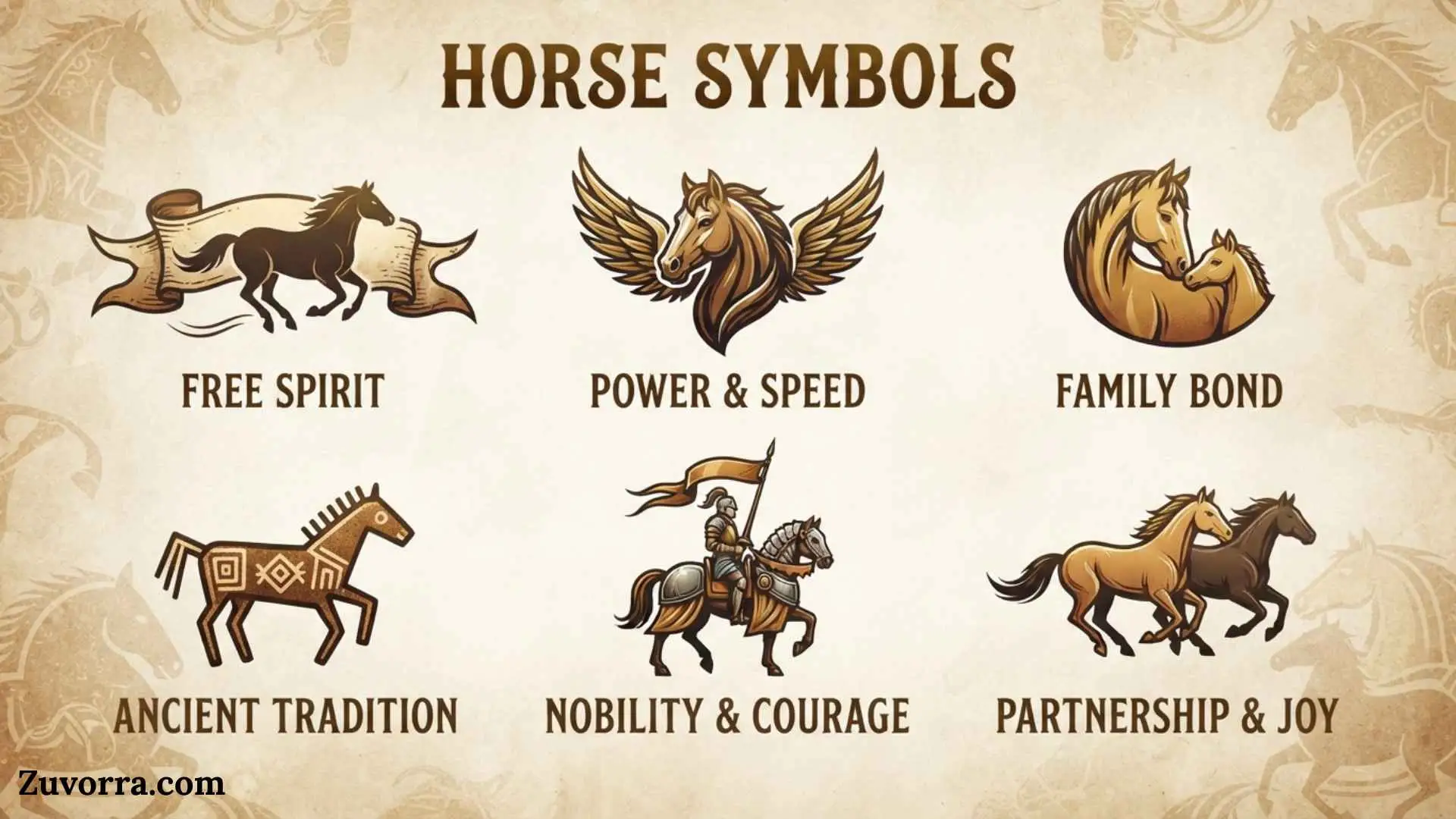
Horse symbols commonly represent freedom, strength, speed, courage, endurance, nobility, and the desire to move forward. Their meaning can change with the horse’s color, posture, cultural setting, and relationship with a rider. A running horse may express independence, while a bridled horse can suggest discipline, partnership, or controlled power.
People encounter horse symbolism in mythology, religious texts, paintings, jewelry, tattoos, national emblems, literature, dreams, sports logos, and memorial statues. The image carries such emotional force because horses have shaped transportation, farming, warfare, trade, ceremony, and human companionship for thousands of years.
Understanding horse symbols therefore requires more than assigning one simple definition. Their meanings developed from real human experiences with an animal capable of both tremendous power and sensitive cooperation.
Quick Meaning of Horse Symbols
Horse symbols primarily represent freedom, power, movement, courage, and endurance. They may also signify nobility, victory, loyalty, spiritual travel, fertility, wealth, or death. A horse’s color, direction, behavior, equipment, and cultural context determine whether the image expresses wild independence, controlled strength, heroic status, sacred power, or danger.
Horse Symbol Overview
| Field | Details |
| Symbol | Horse |
| Primary meanings | Freedom, power, speed, courage, endurance |
| Other meanings | Nobility, loyalty, victory, wealth, fertility, travel |
| Symbol category | Animal, mythological, spiritual, cultural |
| Historical basis | Transportation, warfare, farming, hunting, ceremony |
| Early symbolic use | Prehistoric and ancient art |
| Important cultures | Greek, Roman, Celtic, Norse, Chinese, Indian, Persian, Mongolian, Indigenous American |
| Common modern uses | Tattoos, jewelry, logos, flags, literature, film, sports branding |
| Positive interpretation | Progress, confidence, independence, determination |
| Negative interpretation | War, uncontrolled passion, pride, conquest, death |
| Emoji equivalent | horse, horse face |
| Unicode | U+1F40E and U+1F434 |
| Related symbols | Pegasus, unicorn, centaur, horseshoe, chariot, mounted warrior |
What Do Horse Symbols Mean?
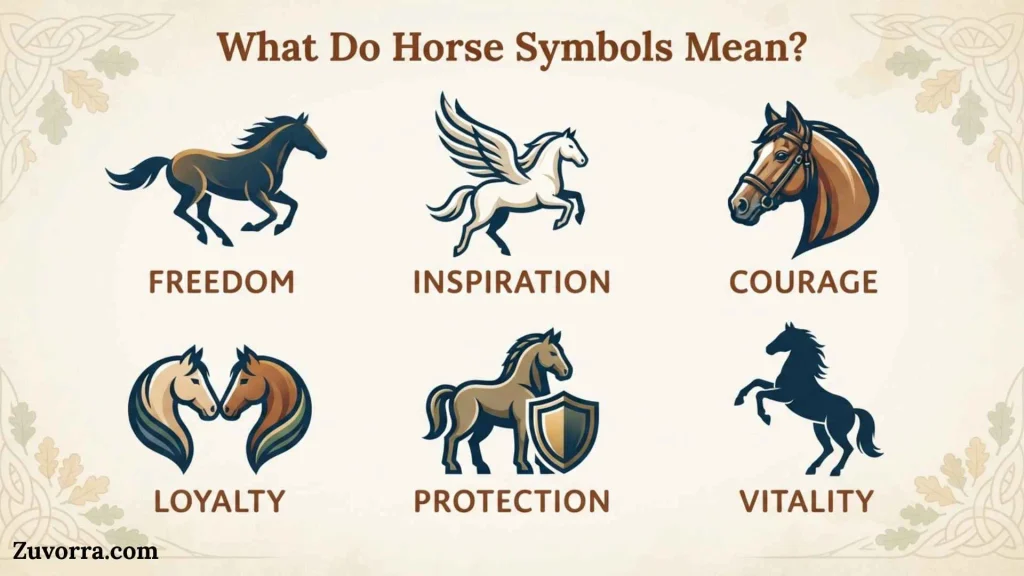
Horse symbols mean power in motion. Unlike animals associated mainly with physical strength, the horse combines strength with speed, responsiveness, balance, and direction. This makes it a natural image for energy that can either run freely or be guided toward a purpose.
Freedom and Independence
A horse running across an open landscape is one of the clearest symbols of freedom. It suggests the ability to escape limits, choose a direction, and move without restraint.
This interpretation is especially common in modern tattoos, photography, Western art, and advertising. Flowing manes, open fields, and raised hooves strengthen the idea of wildness and personal independence.
Strength and Vitality
The horse’s muscular body has long represented physical power, stamina, and life force. A standing stallion may symbolize confidence and readiness, while a charging horse communicates immediate force.
The Metropolitan Museum of Art describes the horse in the East Asian zodiac as a symbol of power, strength, vitality, and success.
Speed and Progress
Because horses transformed long-distance travel, communication, trade, and warfare, they became symbols of rapid movement and advancement. A forward-facing or galloping horse often conveys ambition, momentum, and progress toward a goal.
This meaning appears frequently in company logos, transportation brands, sports teams, and motivational artwork.
Courage and Heroism
Mounted warriors, messengers, explorers, and rulers gave the horse a close connection with bravery. In art, an upright rider on a strong horse can represent leadership, military achievement, or heroic control over danger.
However, the horse does not symbolize courage only because of warfare. It can also express emotional courage: the willingness to face uncertainty and continue moving.
Controlled Power
A bridled or saddled horse carries a different meaning from a wild one. It symbolizes disciplined energy, partnership, responsibility, and self-control.
The rider may represent reason, while the horse represents instinct, desire, or physical energy. When the two work together, the image suggests harmony between thought and action.
History and Origin of Horse Symbolism
Horse symbolism did not begin with a single civilization. It developed independently wherever people observed, hunted, managed, bred, rode, or honored horses.
Prehistoric Images
Horses appear in prehistoric cave and rock art, although scholars must be cautious about assigning exact meanings to such images. They may have reflected hunting, ritual, observation, storytelling, or social memory.
The oldest horse pictures do not prove that every prehistoric society viewed the animal in the same way. They do show that horses held enough importance to be repeatedly represented.
Domestication and Human Mobility
The history of horse symbolism changed dramatically when people began managing and domesticating horses. Archaeological and genetic research indicates that horse domestication was a complex, multistage process rather than one simple event.
Evidence links the Botai culture of northern Kazakhstan with early horse husbandry around 3500 BCE, but those horses were not the main ancestors of most modern domestic horses. Genetic research places the rapid spread of the dominant modern domestic lineage and horse-based mobility in the western Eurasian steppes during the late third millennium BCE.
As horses became essential for movement, their symbolism expanded. They came to represent:
- Distance and travel
- Military strength
- Communication
- Social rank
- Trade and cultural exchange
- Control over land
- Connection between distant communities
Horses, Chariots, and Political Power
Chariots made the horse a visible sign of authority. Kings, nobles, soldiers, and ceremonial leaders used horse-drawn vehicles to display wealth and military capacity.
British Museum research on Saharan rock art notes that chariots served as transportation, weapons, instruments of trade, and symbols of power.
Horses as Signs of Status
Owning and maintaining horses required land, food, training, equipment, and labor. In many societies, this made them symbols of wealth and rank.
During the European Renaissance, the horse served not only as transportation and a military asset but also as a sign of aristocratic status. Noble riders displayed skill through hunting, tournaments, processions, and formal equestrian portraits.
Horse Symbolism and Interpretation
Horse imagery can express both positive and negative ideas. The surrounding details determine which meaning is strongest.
Positive Horse Symbolism
The most common positive meanings include:
- Freedom: Life without unnecessary restrictions
- Strength: Physical or emotional resilience
- Endurance: The ability to continue through hardship
- Confidence: Trust in one’s abilities
- Success: Forward movement and achievement
- Loyalty: A dependable partnership
- Nobility: Dignity, honor, and elevated status
- Adventure: The courage to explore unfamiliar paths
- Transformation: Leaving one stage of life for another
Negative Horse Symbolism
Horse imagery can also represent destructive or uncontrolled energy.
Possible negative meanings include:
- Aggression
- War and conquest
- Recklessness
- Pride
- Untamed desire
- Loss of control
- Social domination
- Death or approaching disaster
A rearing horse, for example, may symbolize courage and resistance. In another context, it may suggest danger, anger, or instability.
Psychological Interpretation
Psychologically, the horse often represents instinctive energy. It may stand for bodily strength, desire, ambition, emotion, or the urge for independence.
The relationship between horse and rider can symbolize the relationship between instinct and conscious control:
- A calm rider and responsive horse suggest inner balance.
- A runaway horse may represent overpowering emotions.
- A rider falling from a horse may suggest lost control or damaged confidence.
- An unmounted horse may express independence or unused potential.
- A restrained horse may reflect discipline or emotional suppression.
These are interpretive frameworks, not scientific rules. Personal associations and cultural background remain important.
Cultural Significance of Horse Symbols
Different cultures developed distinctive horse traditions. It is therefore inaccurate to speak of one universal meaning.
Ancient Greek Culture
In Greek mythology, horses were linked with gods, heroes, the sea, warfare, athletic victory, and inspiration.
Poseidon was associated with horses as well as the sea. Pegasus, the winged horse, became one of the best-known mythological horse figures. Ancient stories connected Pegasus with the hero Bellerophon and with the Muses, giving the winged horse later associations with poetry, imagination, inspiration, and extraordinary achievement.
Horse races also had religious importance. Bronze horse and rider figures could be dedicated at Greek sanctuaries to commemorate victories at major athletic festivals.
Roman and Celtic Traditions
The Romans inherited and adapted many Greek equestrian associations. Horses appeared in military monuments, races, processions, religious art, and imperial imagery.
Epona, a Celtic and Gallo-Roman goddess, was closely associated with horses. Surviving images often show her seated beside or between horses. She was also connected with protection, land, and abundance.
Chinese Culture
In Chinese culture, the horse traditionally represents energy, endurance, talent, military strength, and success. It is one of the 12 animals of the Chinese zodiac.
By the Eastern Han period, the familiar zodiac order was well established. During the Tang dynasty, powerful horses also reflected the strength, wealth, and cosmopolitan reach of the empire.
Chinese horse paintings can carry political or personal meanings. The theme of the skilled judge who recognizes an exceptional horse became a metaphor for identifying talented people who deserve responsibility.
Indian and Hindu Traditions
Horses in Indian traditions may symbolize speed, royal authority, solar energy, warfare, sacrifice, and cosmic order.
Kalki, the future avatar of Vishnu in Hindu tradition, is commonly associated with a white horse. Museum collections often portray the horse as one of Kalki’s identifying symbols.
The ancient ashvamedha, or horse sacrifice, was a complex royal ritual connected with kingship, sovereignty, territory, and sacred authority. It should not be reduced to the modern idea that horses simply represented “good luck.”
Norse Tradition
The most famous horse in Norse mythology is Sleipnir, Odin’s eight-legged steed. Sleipnir’s unusual form emphasizes supernatural speed and the ability to travel between worlds.
This makes the horse a symbol of otherworldly movement, spiritual passage, and the crossing of boundaries between the human, divine, and dead.
Not every Norse horse image was positive. Scandinavian folklore also preserves ominous supernatural horses associated with illness or death, showing that horse symbolism could be protective, heroic, or threatening.
Indigenous Cultures of North America
Indigenous nations do not share one uniform horse symbolism. Meanings differ by nation, history, ceremony, geography, and individual community.
After horses returned to the Americas through European colonization, many Indigenous peoples developed new forms of travel, hunting, warfare, exchange, art, and ceremony around them. The National Museum of the alternative explains that horses became deeply connected with the social, economic, cultural, and spiritual foundations of many communities, especially on the Great Plains.
Depending on the nation and context, horses may be associated with bravery, generosity, wealth, kinship, mobility, spiritual power, or community survival. Broad claims such as “the horse means freedom in Native American culture” oversimplify many distinct traditions.
The American West
In modern Western imagery, the horse represents independence, open land, frontier life, ranch work, and personal toughness.
This symbolism is partly historical and partly romanticized. The popular heroic cowboy image often hides the difficult labor involved and the important roles of Spanish vaqueros, Black cowboys, Mexican riders, and Indigenous horse cultures.
Religious and Spiritual Meaning of Horses
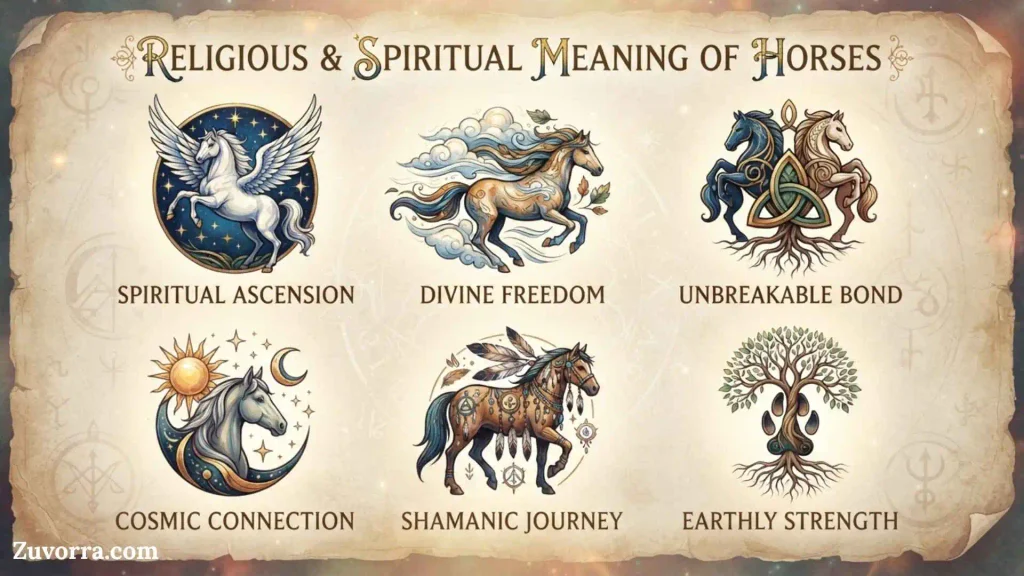
Spiritually, horses often represent movement between conditions, worlds, or stages of existence.
Sacred Travel
Because horses physically carried people over great distances, religious traditions often used them as symbols of spiritual travel. A divine horse might carry a god, hero, ruler, messenger, or soul beyond normal human limits.
Solar Symbolism
In several ancient traditions, horses pull the sun or a solar chariot across the sky. The image links horses with light, time, cosmic rhythm, royal authority, and the daily renewal of life.
Death and Judgment
Horses can also signal death, war, famine, or judgment. Pale, black, or spectral horses frequently appear in apocalyptic art and folklore.
The meaning depends on the specific source. A white horse may signify victory in one tradition and conquest in another. Color alone does not provide a complete interpretation.
Spiritual Freedom
In modern spiritual writing, an unrestrained horse often represents the soul’s desire for authenticity and release from limiting beliefs. This is a contemporary interpretation rather than a single ancient doctrine.
Scientific, Technical, and Digital Meanings
The horse is not a standard scientific symbol like a mathematical operator or chemical element. However, horse-related terms and images appear in technical fields.
Horsepower
Horsepower is a unit used to describe power, especially in engines and motors. James Watt popularized the term as a practical comparison between steam engines and the work associated with horses.
The unit is technical, but its name preserves the horse’s older symbolic connection with labor, strength, and mechanical force.
Chess Knight
The knight chess piece is commonly shaped like a horse’s head. It represents mounted cavalry and moves in an L-shaped pattern.
Symbolically, the knight may suggest strategy, unusual movement, calculated risk, protection, or the ability to bypass obstacles.
Digital Communication
The 🐎 and 🐴 emojis can refer literally to horses, riding, racing, farms, or equestrian events. Figuratively, users may employ them to suggest speed, freedom, strength, excitement, or playful “horse energy.”
Meaning depends heavily on the surrounding message.
Where Horse Symbols Are Used
Horse imagery appears wherever creators want to communicate movement, prestige, energy, tradition, or independence.
Art and Sculpture
Equestrian statues often honor military leaders, rulers, political figures, and national heroes. The horse enlarges the subject’s presence and suggests control, courage, or authority.
Tattoos
Popular horse tattoo meanings include:
- Freedom and independence
- Strength after hardship
- Love of riding
- Loyalty to family or heritage
- Adventure and travel
- Spiritual growth
- Connection with nature
Tattoo meaning should come from the full design, not the animal alone.
Jewelry
Horse necklaces, rings, bracelets, and brooches may celebrate equestrian identity, personal confidence, luck, elegance, or affection for a specific horse.
Logos and Branding
Companies use running or rearing horses to communicate speed, luxury, performance, heritage, and power. Automotive brands, sports clubs, ranches, fashion labels, and transportation businesses frequently use equine imagery.
Literature and Film
Writers use horses to explore freedom, class, war, childhood, wilderness, loyalty, and social change. A horse may function as a character, companion, status marker, victim of conflict, or reflection of a human character’s inner state.
Flags, Coats of Arms, and Emblems
Heraldic horses can express courage, readiness, nobility, military strength, or regional history. White horses are especially common in European landscape figures, civic emblems, and heraldry.
Common Horse Symbol Variations
Running Horse
A running horse symbolizes freedom, speed, progress, and escape from restraint.
Rearing Horse
A rearing horse suggests courage, resistance, energy, aggression, or readiness for action.
Horse and Rider
This image represents leadership, partnership, mastery, social rank, or the union of intellect and instinct.
Winged Horse
A winged horse, especially Pegasus, symbolizes imagination, inspiration, transcendence, fame, and rising above ordinary limits.
White Horse
A white horse may signify purity, sacred authority, victory, revelation, heroism, or death. Context determines the meaning.
Black Horse
A black horse can represent mystery, elegance, hidden power, danger, grief, rebellion, or the unknown.
Red Horse
Red horses are associated with passion, war, heat, aggression, courage, and intense life force.
Pale or Ghostly Horse
A pale horse often represents mortality, illness, judgment, or supernatural travel.
Horseshoe
The horseshoe is related to horse symbolism but has its own history. It usually represents luck, protection, and the guarding of a home or doorway.
Common Misconceptions About Horse Symbols
“All Horse Symbols Mean Freedom”
Freedom is common, but horses can also represent hierarchy, warfare, labor, wealth, discipline, or death.
“A White Horse Is Always Positive”
White horses may symbolize purity and victory, but some religious and literary settings connect them with conquest, supernatural danger, or death.
“Native American Horse Symbolism Is Universal”
There is no single Indigenous interpretation. North America contains many nations with different languages, histories, ceremonies, and relationships with horses.
“Ancient Horse Images Have One Proven Meaning”
Archaeologists can study context, placement, materials, and associated objects, but the exact meaning of many prehistoric images remains uncertain.
“A Horse and Rider Always Show Domination”
The pairing can suggest control, but it may also represent cooperation, trust, training, companionship, or shared purpose.
How to Interpret a Horse Symbol
Use this simple decision guide:
Is the horse running freely?
↓
It likely emphasizes freedom, natural energy, or independence.
Is it bridled, saddled, or ridden?
↓
Look for themes of partnership, discipline, leadership, or controlled power.
Is it rearing or charging?
↓
Consider courage, resistance, conflict, aggression, or intense momentum.
Does it have wings or supernatural features?
↓
It probably relates to imagination, divine travel, transformation, or transcendence.
Is the color important?
↓
Compare the color with the religious, artistic, or cultural context before deciding.
Interesting Facts About Horse Symbols
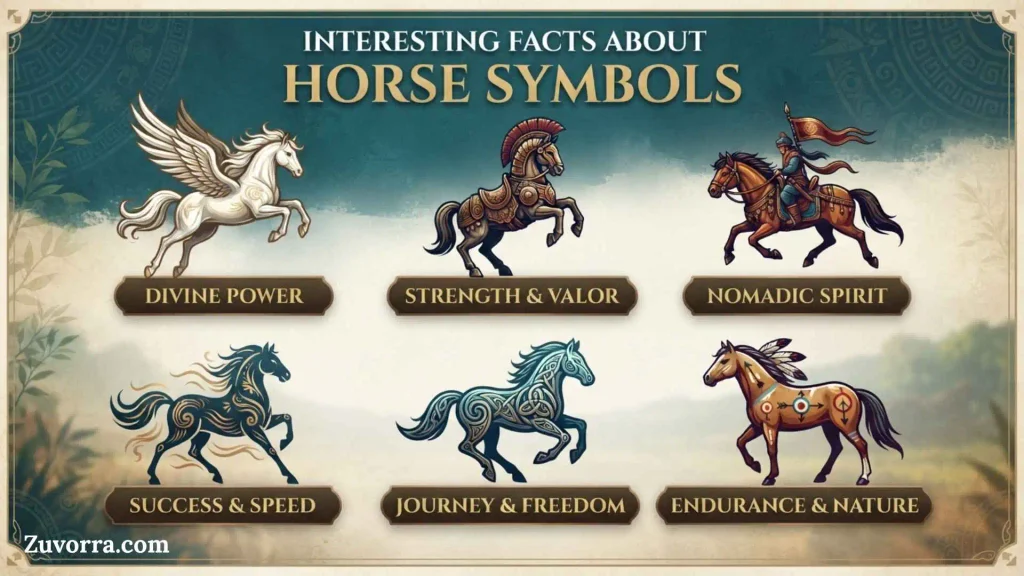
- Horse symbolism grew from practical experience. People associated horses with speed and power because the animals genuinely transformed transportation, communication, warfare, and labor.
- The modern domestic horse has a complicated origin story. Early horse management occurred at Botai, but most modern domestic horses descend from a different lineage that later spread across Eurasia.
- Chariots turned horses into political symbols. A ruler with horses and a chariot displayed resources, technology, military strength, and control over trained animals.
- Pegasus represents more than flight. Its later association with the Muses made it a lasting emblem of poetic inspiration and creative imagination.
- Horse art can contain coded social criticism. In Chinese painting, a valuable horse overlooked by poor judges could represent talented officials ignored by rulers.
- Equestrian portraits were carefully staged. The rider’s posture, clothing, horse, equipment, and setting communicated rank, discipline, and legitimacy.
- A riderless horse may honor the dead. In military and state ceremonies, a riderless horse can represent a fallen leader or soldier who will not return.
- Horse colors do not have fixed meanings. White, black, red, and pale horses take on different meanings across religion, folklore, literature, and popular culture.
- Horses can symbolize both freedom and control. A wild horse suggests independence, while a trained horse demonstrates power guided through trust and discipline.
- The horse is part of the Chinese zodiac. Zodiac traditions connect it with vigor, action, confidence, and success, but the full interpretation also depends on the associated element and calendar system.
- Horse symbolism remains tied to social identity. Riders, ranching communities, athletes, breeders, and Indigenous nations may use horse imagery to express heritage and belonging.
- The most accurate interpretation uses context. Posture, color, rider, equipment, location, artistic period, and cultural source matter more than any universal symbol dictionary.
Related Symbols
Pegasus
Pegasus is a winged horse associated with Greek mythology, imagination, poetic inspiration, and extraordinary achievement.
Unicorn
The unicorn usually symbolizes purity, rarity, innocence, healing, or magical power. Unlike the ordinary horse, it belongs mainly to myth and fantasy.
Centaur
A centaur combines a human upper body with a horse’s lower body. It often represents the tension or union between human reason and animal instinct.
Horseshoe
The horseshoe is linked with luck and protection rather than speed or freedom.
Chariot
A chariot symbolizes controlled movement, warfare, authority, victory, and the direction of competing forces.
Stag
Like the horse, the stag can symbolize nobility and vitality. It is more commonly associated with wilderness, renewal, and forest spirituality.
Eagle
The eagle shares themes of freedom and power but emphasizes height, vision, sovereignty, and the sky rather than earthly movement.
Frequently Asked Questions
What is the main meaning of a horse symbol?
The main meaning is powerful movement. Horses commonly symbolize freedom, strength, speed, courage, and endurance. The exact interpretation changes with the image. A running horse suggests independence, while a ridden horse may express partnership, training, authority, or disciplined energy.
What does a horse symbolize spiritually?
Spiritually, a horse may represent life force, personal freedom, transformation, sacred travel, or movement between different states of being. Some traditions connect horses with gods, solar journeys, death, or supernatural messengers. Spiritual meaning should always be linked to a specific tradition rather than treated as universal.
What does a running horse symbolize?
A running horse usually symbolizes freedom, momentum, confidence, and the urge to move beyond limitations. In motivational art, it may represent pursuing a goal. In a dream or story, it can also suggest escaping responsibility, releasing emotion, or following instinct.
What does a white horse symbolize?
A white horse can symbolize purity, victory, sacred authority, heroism, revelation, or spiritual power. It may also have darker associations with conquest, judgment, or death. The surrounding story, rider, and cultural tradition are necessary for an accurate interpretation.
What does a black horse symbolize?
A black horse often represents mystery, elegance, hidden strength, rebellion, danger, grief, or the unknown. In some designs, it expresses confidence and independence. In darker literature or folklore, it may signal an approaching threat or a supernatural presence.
What does a horse and rider symbolize?
A horse and rider commonly symbolize leadership, partnership, mastery, direction, and the relationship between reason and instinct. A calm pair suggests harmony and trust. A struggling rider may represent poor judgment, emotional conflict, or difficulty controlling powerful circumstances.
Are horses considered lucky symbols?
Horses may be linked with success, prosperity, and victory, but the horseshoe is the more direct luck symbol in many Western traditions. In Chinese zodiac imagery, the horse can suggest vigor and success. Luck associations still depend on regional beliefs and design details.
What does a horse tattoo mean?
A horse tattoo may express freedom, courage, strength, survival, adventure, or love of equestrian life. A winged horse suggests imagination, while a memorial horse may honor a person or animal. The wearer’s intention matters more than a standard symbolic definition.
What does dreaming about a horse mean?
A horse dream may reflect energy, confidence, freedom, sexuality, ambition, or emotional control. A healthy running horse can suggest opportunity, while an injured or frightened horse may represent exhaustion or vulnerability. Dream interpretations are personal and should not be treated as predictions.
Why are horses associated with nobility?
Historically, horses were expensive to own, feed, equip, and train. They also played major roles in cavalry, hunting, tournaments, travel, and royal ceremonies. Because rulers and elites frequently displayed them, horses became visual signs of wealth, rank, dignity, and political authority.
Key Takeaways
- Horse symbols most often represent freedom, strength, speed, courage, and endurance.
- A horse’s posture, color, rider, and equipment change its meaning.
- Wild horses emphasize independence, while bridled horses suggest disciplined power.
- Horses have represented wealth, warfare, travel, status, and sacred movement.
- Pegasus, Sleipnir, Epona, and Kalki’s white horse carry distinct cultural meanings.
- No single interpretation applies to every Indigenous, religious, or ancient tradition.
- White horses are not always positive, and black horses are not always negative.
- The best interpretation combines visual details with historical and cultural context.
Conclusion
Horse symbols remain powerful because they unite qualities that people often seek in themselves: strength without stillness, freedom with direction, and courage supported by endurance.
Across ancient sanctuaries, royal portraits, sacred stories, Indigenous art, modern tattoos, sports emblems, and digital communication, the horse continues to represent the force that carries life forward. Yet its meaning is never completely fixed. A horse may be wild or trained, protective or dangerous, heroic or haunting.
To understand horse symbols accurately, look beyond the animal alone. Consider how it moves, who rides it, what color it is, where the image appears, and which cultural tradition created it. Those details reveal whether the horse stands for freedom, authority, partnership, spiritual passage, conflict, or transformation.
References
- The Metropolitan Museum of Art. “Celebrating the Year of the Horse.”
- The Metropolitan Museum of Art. “Celestial Steeds: A Celebration of the Year of the Horse.”
- The Metropolitan Museum of Art. “The Armored Horse in Europe, 1480–1620.”
- The Metropolitan Museum of Art. “Bronze Statuette of a Horse.”
- British Museum. “The Domesticated Horse in Northern African Rock Art.”
- British Museum. “Chariots in the Sahara.”
- British Museum. “Gods and Goddesses of Roman Britain.”
- National Museum of the alternative. “A Song for the Horse Nation.”
- Librado, Pablo, et al. “The Origins and Spread of Domestic Horses from the Western Eurasian Steppes.” Nature, 2021.
- Taylor, William Timothy Treal, et al. “Rethinking the Evidence for Early Horse Domestication at Botai.” Scientific Reports, 2021.
I’m Rupert Ashbourne, a British author interested in how symbols have shaped human communication throughout history. I examine signs, emblems, markings, and visual representations, explaining their meanings and cultural significance. My aim is to make symbolism approachable while helping readers understand how simple shapes and images can carry surprisingly powerful messages.
Books:
- The Meaning of Symbols
- A History of Signs and Emblems